

Regenerative Meat Market Size Worth $5207.20 Million by 2034 | CAGR: 15.70%
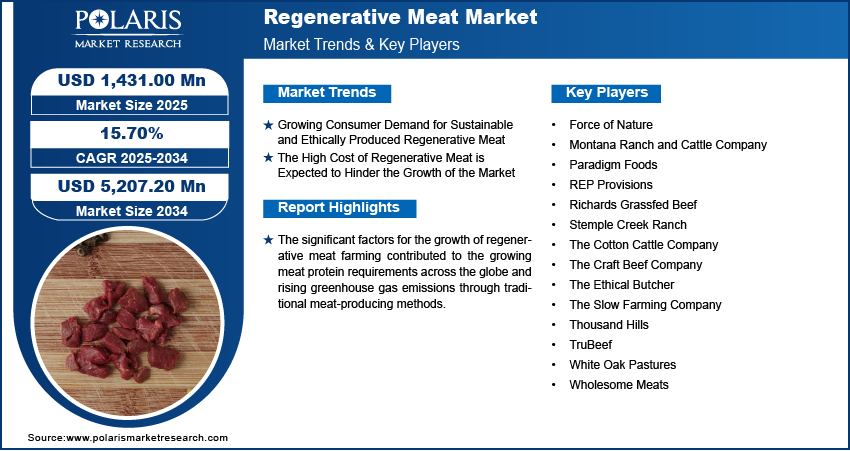
The global regenerative meat market is witnessing remarkable momentum as sustainability, ethical food production, and consumer health consciousness reshape the future of the Food & Beverages industry. According to the latest Regenerative Meat Market Share, Size, Trends & Industry Analysis Report, 2025–2034 by Polaris Market Research, the market is projected to grow from an estimated USD 1,431.00 million in 2025 to a commanding USD 5,207.20 million by 2034, expanding at a robust CAGR of 15.70% over the forecast period.
What Is Regenerative Meat and Why It Matters
Regenerative meat isn’t just another trend — it’s a paradigm shift in animal protein production. At its core, regenerative meat stems from regenerative agriculture, a holistic approach that prioritizes soil health, ecological balance, biodiversity, and animal welfare. Unlike conventional livestock practices that contribute significantly to greenhouse gas emissions, soil degradation, and water pollution, regenerative practices such as rotational grazing, cover cropping, and pasture-based rearing work to restore ecosystems while producing nutrient-dense meat.
This paradigm aligns perfectly with a global push toward sustainability and ethical consumption, making regenerative meat products increasingly attractive to environmentally conscious consumers and industry stakeholders alike.
Market Dynamics: Drivers Fueling Growth
Several key forces are propelling the regenerative meat market forward:
- Consumer Demand for Sustainable, Ethically Sourced Protein:
Modern consumers are more informed than ever about the environmental and ethical implications of their food. This awareness is fueling demand for meat products that not only taste great but also support animal welfare and environmental stewardship — a significant driver behind regenerative meat’s rising adoption. - Supportive Government Policies and Initiatives:
Governments across the world are recognizing the potential of regenerative agriculture to combat climate change, improve soil health, and protect biodiversity. As a result, policy incentives, research funding, and educational support are encouraging farmers and businesses to adopt regenerative practices. - Technological Advancements:
Innovations in precision agriculture — including the use of drones, sensors, and satellite imaging — are enabling producers to monitor soil and pasture health in real time. This results in optimized grazing patterns, improved herd welfare, and reduced operational waste, all of which contribute to scalable and sustainable regenerative meat production.
Product Segment Insights
The market is segmented by product into beef, venison, pork, and others, with beef commanding the largest share of demand. This is due in part to a strong consumer preference for grass-fed and pasture-raised beef products that offer superior nutrient profiles and improved environmental outcomes compared to traditionally raised counterparts.
Sales Channel Evolution
The online sales channel is emerging as the fastest-growing segment. E-commerce platforms have broadened accessibility and transparency, allowing consumers to order regenerative meat products directly from suppliers and farms. Detailed product sourcing information has fostered trust and enabled consumers to make more informed, values-driven purchases.
Meanwhile, traditional offline channels continue to play a crucial role, particularly in regions where localized, farm-to-table movements are strong.
View More Information @ https://www.polarismarketresearch.com/industry-analysis/regenerative-meat-market/request-for-sample
Regional Market Perspectives
North America currently leads the global regenerative meat market, accounting for more than 38% of total market share. This dominance reflects strong consumer awareness of sustainability issues, established supply chains, and significant investment in regenerative practices by both private and public sectors.
The Asia Pacific region, however, is poised for the fastest CAGR during the forecast period as awareness of health, environmental concerns, and ethical food consumption grows among emerging economies. Consumer inclination toward grass-fed and pasture-raised meat, supported by evolving market infrastructures and regulatory encouragement, underscores the immense growth potential in APAC markets.
Challenges and Market Restraints
Despite its promising trajectory, the regenerative meat market faces certain challenges. Notably, higher production costs compared to conventional meat can result in premium pricing for end consumers — potentially limiting broader adoption among price-sensitive segments. These costs stem from labor-intensive practices, infrastructural investments, and regenerative-specific inputs such as organic feed and pasture management.
To overcome these hurdles, stakeholders are exploring innovative distribution strategies, enhanced subsidies, and efficiency gains through technology integration — steps that could drive more competitive pricing and expand market reach.
Competitive Landscape and Future Outlook
The regenerative meat sector is rapidly evolving, with both established players and innovative startups contributing to market growth. Some of the prominent participants include Force of Nature, REP Provisions, Wholesome Meats, Montana Ranch and Cattle Company, Richards Grassfed Beef, The Slow Farming Company, Thousand Hills, The Craft Beef Company, TruBeef, The Cotton Cattle Company, White Oak Pastures, and Stemple Creek Ranch.
Looking ahead, the regenerative meat market is well-positioned to redefine how protein is produced and consumed. As consumer values evolve toward sustainability and ethical sourcing, regenerative practices are likely to gain further traction — offering benefits that extend beyond the plate to positively impact ecosystems, rural economies, and global climate goals.
Conclusion: A Milestone for Sustainable Food Innovation
The regenerative meat market represents a transformative force within the Food & Beverages industry, offering a powerful combination of sustainability, health benefits, and ethical production principles. With an anticipated expansion to over USD 5.2 billion by 2034, this market is poised for rapid growth as industry stakeholders, governments, and consumers alike embrace the imperative for responsible food production.
Read More @ https://www.polarismarketresearch.com