



A Modular Low-Pressure Pneumatic System for Elevation and Periodic Repositioning of the Recumbent Bovine: Design Rationale and Anticipated Welfare Benefits
Sanchit Pal Singh
PhD 2nd year, AGB, IVRI
Abstract
Downer cow syndrome, prolonged recumbency in cattle, most frequently a sequel to periparturient hypocalcaemia, parturition-associated trauma, or toxaemic disease, carries a high case-fatality rate that is driven less by the primary insult than by secondary, pressure-induced injury to the dependent musculature and peripheral nerves. Conventional assistive devices (hip clamps, slings, mechanical hoists) concentrate load over small anatomical regions and are themselves a recognised source of iatrogenic injury, whereas buoyancy (flotation) therapy, although effective, is resource-intensive and largely confined to referral facilities. This article presents the design rationale for a modular, low-pressure pneumatic support system intended to both elevate and periodically reposition the recumbent bovine while distributing load over a wide area of the body wall.
Keywords: bovine recumbency; downer cow syndrome; pressure myopathy; animal welfare; assistive lifting device; pneumatic support; repositioning.
- Introduction
Bovine recumbency that persists despite correction of the inciting metabolic or traumatic cause is termed the “downer cow syndrome” and is most commonly observed in the periparturient dairy cow. Although the primary precipitants, hypocalcaemia, calving trauma, obturator or sciatic neuropathy, and toxaemic mastitis or metritis, are frequently amenable to treatment, prognosis deteriorates rapidly with the duration of recumbency, and a large proportion of animals remaining non-ambulatory beyond 24 h fail to survive. This disproportion between a treatable primary disease and a poor outcome reflects the central pathophysiological feature of the syndrome: recumbency itself precipitates a self-perpetuating secondary injury [1].
The clinical corollary is that survival depends chiefly on two interventions, early relief of dependent-tissue loading and frequent postural change, both of which are constrained by the assistive equipment currently available. The present article describes a device conceived to address both requirements simultaneously. It first summarises the relevant pathophysiology and the shortcomings of existing lifting modalities, then details the proposed system, its method of atraumatic deployment, and its two operating modes, before considering anticipated benefits and the validation still required.
- Pathophysiology of prolonged recumbency
Sustained lateral or sternal recumbency subjects the dependent limb musculature, principally the caudal thigh and gluteal groups, to compressive loading by the animal’s own substantial body mass. The resulting intramuscular pressure exceeds capillary perfusion pressure, producing regional ischaemia analogous to a compartment syndrome and culminating in ischaemic pressure myonecrosis; experimental and clinical observations indicate that such damage may commence within approximately 6 h of continuous recumbency. Concurrent compression of the sciatic and peroneal nerves contributes a neuropathic component, so that hind-limb function may be lost even after resolution of the primary disorder.
Secondary sequelae compound the picture and include rhabdomyolysis with attendant myoglobinaemia and renal compromise, decubital ulceration over bony prominences, ruminal tympany, urinary retention, and environmental mastitis arising from prolonged contact with contaminated bedding. Because these processes are time-dependent, the therapeutic window is narrow: the interval that most influences outcome begins not at diagnosis of the primary disease but at the moment the animal becomes unable to reposition herself. Repositioning at 2-4 h intervals and provision of deep, dry bedding are accordingly regarded as cornerstones of supportive management.
- Limitations of current lifting modalities
3.1 Hip clamps
Ilial (hip) clamps engage the coxal tuberosities and transfer hindquarter load via mechanical hoist. The device concentrates the entire dependent weight onto a small osseous and muscular contact area. Excessive compression can induce gluteal contusion and compromise regional perfusion, thereby reproducing the ischaemic injury the intervention is intended to relieve. Prolonged or repeated application increases this risk.
3.2 Slings and belly bands
Full-body slings distribute load more favourably than clamps but are difficult to position beneath a heavy, uncooperative animal, may impede thoracic excursion and respiration when incorrectly applied, and can produce cutaneous abrasion during extended suspension.
3.3 Manual assistance
Terminal manual assistance, coordinated pushing, rolling, and tail-base elevation to bring the animal to a standing position, is a recognised occasion for iatrogenic injury, including muscle rupture, coxofemoral luxation, and pelvic fracture, and additionally poses a substantial occupational-safety hazard to attending personnel.
3.4 Flotation therapy
Buoyancy support in a water-filled flotation tank distributes load uniformly and is the modality most reliably associated with avoidance of secondary compressive injury. The reported survival-to-discharge in referral populations is of the order of 47-55%. However, the apparatus is heavy, requires several hundred litres of warmed water and appreciable filling time, and is generally restricted to referral institutions rather than the on-farm environment in which the prognostically critical early hours elapse.
Collectively, existing options leave an unmet need for a device that distributes load over a wide body-wall area, can be deployed without forceful manipulation, is independent of fixed installations, and is sufficiently portable to be applied within the therapeutic window, while also enabling the frequent repositioning that clamps, slings, and hoists cannot provide.
- Device description
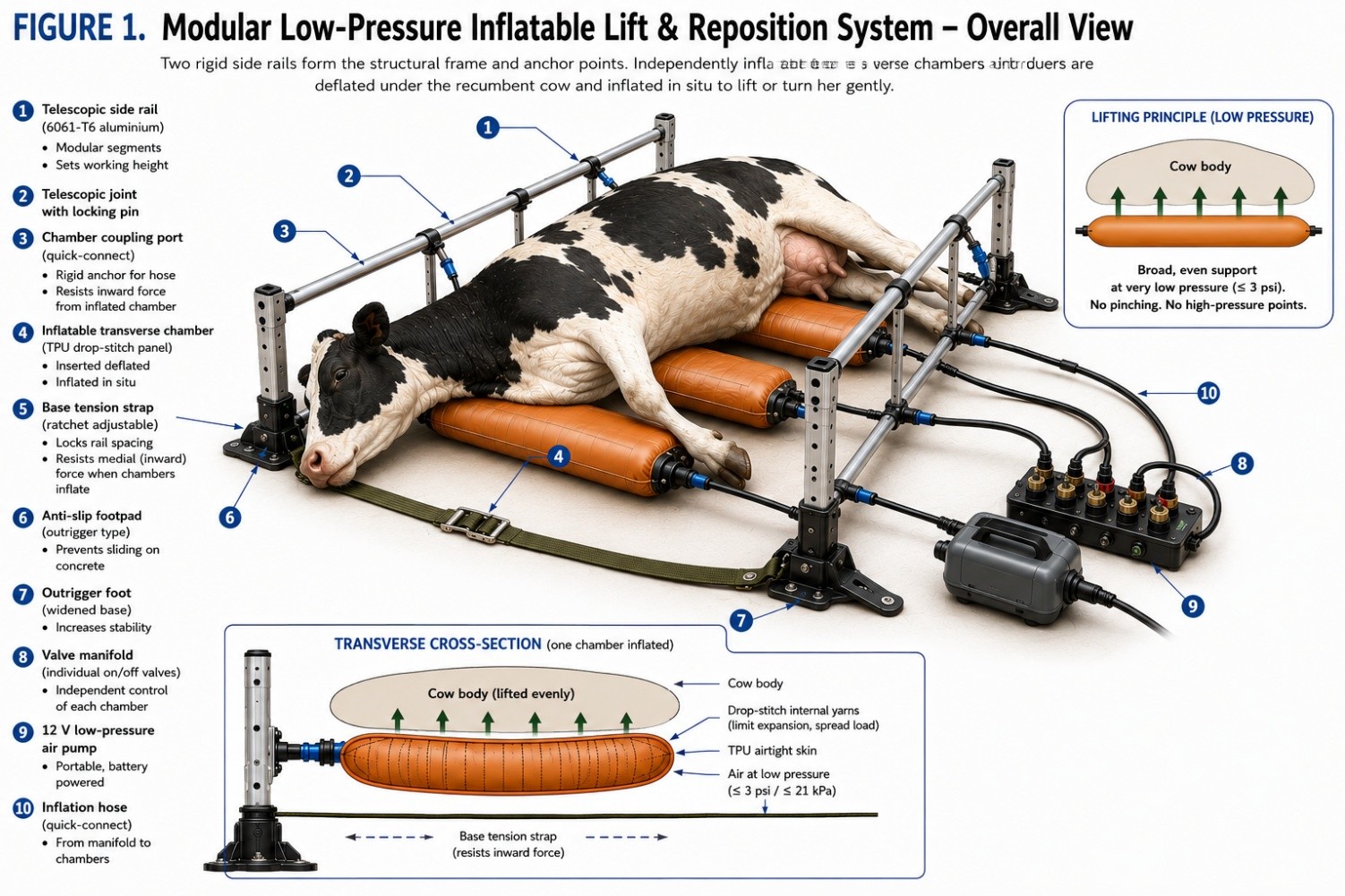
The proposed system substitutes distributed low-pressure pneumatic support for concentrated mechanical force and is configured so that a single apparatus can perform either elevation or in-situ repositioning (Figure 1). It comprises four principal subassemblies.
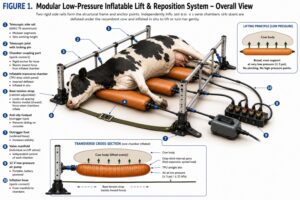
Figure 1: Pictorial representation of the proposed system
4.1 Rigid lateral rails
Paired rigid rails are positioned parasagittally on either side of the recumbent animal and constitute the load-reacting structure to which all pneumatic elements attach. The rails are of sectional (modular) construction to permit compact transport and field assembly.
4.2 Base tension member and anti-migration footpads
A tensioned base member connects the rail feet and establishes a defined inter-rail spacing (adjustable to accommodate animal size and to modulate the lift-versus-cradle geometry). This member reacts the medially directed force generated during chamber inflation, thereby preventing inward collapse of the rails, while high-friction footpads resist lateral migration on smooth substrates such as concrete standing. As no ground penetration is required, the system is substrate-independent.
4.3 Independently actuated transverse chambers
Multiple transverse inflatable chambers, typically three, sited beneath the thorax (heart-girth), mid-abdomen, and pelvis, span the inter-rail distance beneath the animal and attach to the rails at fixed-height coupling ports. Each chamber is independently pressurised, a feature that underlies both operating modes described in Section 6.
4.4 Pump and valve manifold
A low-pressure, high-volume blower supplies the chambers through a manifold providing individual per-chamber valving. Low working pressure is intentional as it distributes reaction force across a broad contact area, analogous to a fluidised support surface, and minimises focal loading. Operation from a vehicle or tractor battery obviates any requirement for mains power at the point of care.
- Atraumatic deployment
The principal practical obstacle common to all assistive devices, introduction of a supportive element beneath a fully recumbent animal presenting minimal ground clearance, is addressed by exploiting the collapsibility of the pneumatic chamber (Figure 2). In the deflated state each chamber presents a thin, flexible, cord-like profile that is advanced beneath the animal through the natural para-anatomical hollows (caudal to the olecranon and cranial to the stifle) conventionally used for passage of ropes and straps; a semi-rigid leading tip facilitates transit. Inflation is performed only after correct positioning, whereupon the low-profile element expands into a broad, load-distributing cradle. This collapsed-insertion / expanded-support principle obviates the forceful lifting or rolling otherwise required to place a bulky device and constitutes the core design novelty relative to existing single-cushion pneumatic aids.
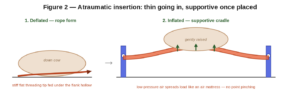
Figure 2. Atraumatic deployment. Each chamber is advanced beneath the animal in a deflated, low-profile state (left) and subsequently inflated in situ to form a broad, load-distributing support (right).
- Operating modes
Independent pressurisation of the transverse chambers permits two functionally distinct operations to be performed with identical hardware.
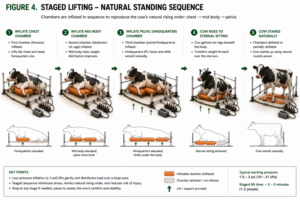
Figure 3: Staged elevation of the cattle
6.1 Staged cranio-caudal elevation
Sequential inflation, thoracic chamber first, followed by the caudal chambers, elevates the forequarter in advance of the hindquarter, reproducing the physiological sequence by which an unaffected cow rises and permitting the animal to contribute to the effort as proprioceptive and motor function return. At every stage, load is distributed across a wide body-wall belt by the low-pressure medium, avoiding the focal compression characteristic of clamp-based systems.
6.2 Lateral in-situ repositioning
Preferential inflation of the chambers on one side with concurrent deflation of the contralateral chambers rolls the animal from one flank to the other without net elevation. This provides the frequent postural change (recommended at 2-4 h intervals) that constitutes the principal prophylaxis against pressure myonecrosis and decubital ulceration, and which is otherwise achievable only through labour-intensive manual turning. The capacity for repeated, low-effort repositioning may represent the system’s most clinically significant attribute, being preventive rather than solely rescue-oriented.
6.3 Individualised chamber placement
Because chambers are introduced and controlled independently, support may be applied selectively, omitting an injured coxofemoral region or an established decubital lesion, incrementally increasing support as tolerance improves, or withdrawing a chamber associated with discomfort, without disturbing the remaining elements. Support is thereby adapted to the individual animal rather than the animal to the apparatus.
- Practical and biosecurity considerations
Clinical utility requires that the device be deployable by farm personnel and veterinary practitioners under field conditions. The modular rails, collapsible chambers, and battery-driven blower render the assembled system portable, enabling application within the therapeutic window rather than necessitating transport of the animal to a fixed installation. All animal-contact surfaces are specified to permit washing and chemical disinfection between patients and between premises, a prerequisite for biosecurity given inter-animal reuse. Substrate independence permits use on concrete standings, cubicle passages, and pasture alike, and the derivation of lifting force from distributed low-pressure air, rather than concentrated mechanical contact, is intended to minimise device-induced injury.
- Limitations and required validation
The present account is a design rationale and is not accompanied by empirical performance data. Several parameters require systematic evaluation prior to clinical use: the structural adequacy and anti-migration performance of the rail-strap assembly under physiological loading; achievable and safe contact pressures across chamber geometries; the practicability of deflated-chamber passage in animals of varying condition and disposition; and, ultimately, controlled clinical assessment of elevation success, complication rates, and survival relative to established modalities. Such evaluation should proceed under appropriate animal-ethics governance, with preliminary mechanical testing conducted on suitably weighted inanimate models before any use in living animals. The quantitative clinical figures cited herein are drawn from the published literature and should be independently reappraised in the context of any formal study.
- Conclusion
Secondary compressive injury, rather than the primary precipitant, is the principal determinant of outcome in bovine recumbency, and its mitigation depends on early, evenly distributed support and frequent repositioning, objectives inadequately served by existing clamp, sling, and flotation modalities. A modular, low-pressure pneumatic system employing independently actuated transverse chambers, collapsed-insertion deployment, and a substrate-independent rail assembly offers a mechanism to deliver both distributed elevation and in-situ repositioning at the point of care. Subject to the mechanical and clinical validation outlined above, the approach warrants development as a welfare-oriented alternative to force-based assistive lifting.