
Reimagining India’s Goat Economy: From Traditional Livelihood to Organised Rural Enterprise
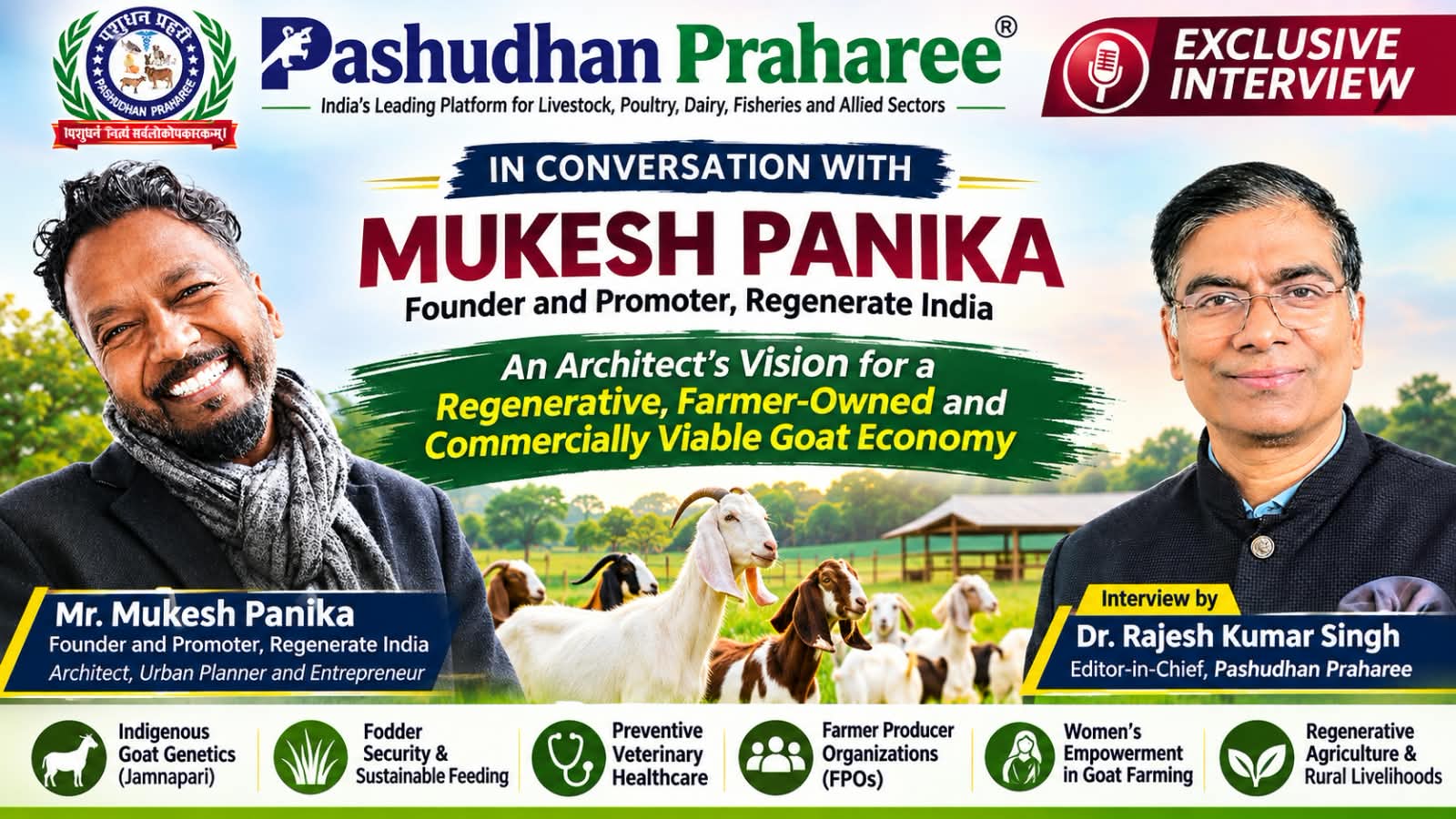
IN CONVERSATION WITH MUKESH PANIKA
Founder and Promoter, Regenerate India
An Architect’s Vision for a Regenerative, Farmer-Owned and Commercially Viable Goat Economy
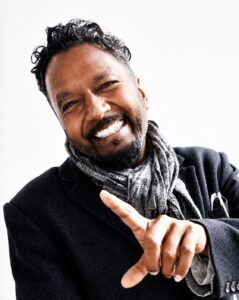 MR. MUKESH PANIKA |
INTERVIEWEE PROFILE
Mr. Mukesh Panika Founder and Promoter, Regenerate India Architect, Urban Planner and Entrepreneur Sonbhadra, Uttar Pradesh, India Following the COVID-19 pandemic, he returned to his hometown to lead regenerative agriculture and rural enterprise initiatives. Through Regenerate India, he is developing an integrated Goat Enterprise, Fodder Estate and Farmer Producer Organization (FPO), with a vision of promoting sustainable livelihoods and holistic rural transformation. |
Reimagining India’s Goat Economy: From Traditional Livelihood to Organised Rural Enterprise
Goat farming has long been an integral part of India’s rural economy, providing supplementary income, livelihood security and economic support to millions of farming households. However, despite India’s substantial goat population and rich indigenous genetic resources, the sector continues to face challenges related to breeding, fodder availability, animal healthcare, market access and fragmented production systems.
The need of the hour is to transform traditional goat rearing into a scientifically managed, commercially viable and farmer-centric enterprise.
In this insightful conversation with Pashudhan Praharee, Mr. Mukesh Panika, Founder and Promoter of Regenerate India, shares his vision of building an integrated and regenerative goat economy. Drawing upon his background in architecture and urban planning, he explains how rural households, farmer-owned institutions and professional enterprises can work together to create a sustainable livestock ecosystem.
From indigenous Jamnapari genetics and fodder security to preventive veterinary healthcare, traceability, Farmer Producer Organizations and women’s economic empowerment, this interview explores the possibilities of a new approach to goat-based rural development.
His perspective offers valuable insights for veterinary professionals, goat farmers, policymakers, entrepreneurs, FPO leaders and all stakeholders committed to strengthening India’s livestock economy.
INTERVIEWER Dr. Rajesh Kumar Singh
Editor-in-Chief, Pashudhan Praharee
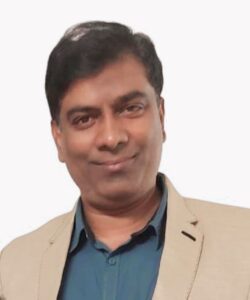
THE INTERVIEW
Interviewer: Dr. Rajesh Kumar Singh, Editor-in-Chief, Pashudhan Praharee
Q1. Could you take us through your entrepreneurial journey and what inspired you to identify goat farming as an opportunity for building a commercially viable rural enterprise?
Mr. Mukesh Panika:I was trained as an architect and planner, so my instinct has always been to understand systems rather than address problems in isolation.
Working with farming communities in Sonbhadra, I found that rural families were not short of assets or ability. They had land, livestock skills, traditional knowledge and a tremendous capacity for hard work. What was missing was an ecosystem capable of converting these strengths into predictable and dignified livelihoods.
That led us to view the household as the basic unit of rural regeneration, connecting Land • Livelihood • Life.
Goats became important within this framework because they are already part of rural life, can be managed by smallholders and women, and are well suited to fragmented landholdings and climate-vulnerable regions. But the opportunity is not simply to add more animals. It is to connect indigenous genetics, fodder security, preventive healthcare, traceability, farmer institutions and markets.
Our work in Kuldomari is exploring how households, a farmer-owned FPO and professional enterprise can function together. Families retain ownership of their land and animals while gaining access to systems that would be difficult to build individually.
Goat farming, in this sense, is not an isolated activity. It is an entry point into a more resilient, farmer-owned rural economy.
Q2. Goat farming has traditionally been viewed as a supplementary livelihood. What gaps did you identify, and what made you believe it could evolve into an organised, scalable industry?
Mr. Mukesh Panika:Goat farming remains supplementary because most rearers participate in only the first and weakest part of the value chain. They raise a few animals and often sell them when they urgently need money, without reliable information on weight, quality or prevailing prices.
The principal gaps are connected: inconsistent breeding, little performance recording, seasonal fodder shortages, reactive healthcare, fragmented markets and limited animal-level traceability.
Better genetics cannot perform without good nutrition. Improved production means little if animals are lost to preventable disease. Higher productivity does not necessarily improve household income if farmers must continue selling under distress.
India does not have a shortage of goats. It has an organisation problem.
The sector will become commercially scalable when breeding, feed, healthcare, data, aggregation and markets function as one system. In practical terms, the household produces, the FPO aggregates and protects farmer participation, and professional enterprise provides specialist services and market connections.
This allows distributed ownership to coexist with commercial scale. The future need not be one enormous goat farm. It can be thousands of scientifically supported and market-connected household enterprises participating in one organised rural economy.
| “India does not have a shortage of goats. It has an organisation problem.” |
Q3. Your vision extends beyond goat rearing to building an integrated goat economy. What does this ecosystem look like?
Mr. Mukesh Panika:A goat economy is not simply a larger goat farm. It is an ecosystem that creates value throughout the animal’s lifecycle.
The household is the foundation. Each family manages its livestock, cultivates fodder and integrates animals with farming and agroforestry. The household is treated as a productive enterprise rather than as a passive beneficiary.
The farmer-owned FPO provides the institutional backbone. It can coordinate services, maintain records, aggregate animals and produce, facilitate weighing and procurement, organise payments and represent members in the market.
Scientific and commercial partners provide the specialist capabilities that households and FPOs cannot efficiently build alone. These may include genetics, veterinary systems, traceability, processing, logistics, certification and market development.
Our emerging model combines conservation-led Jamnapari genetics, planned breeding, climate-resilient fodder, silage, productive agroforestry, preventive healthcare, insurance and animal identification. It also creates pathways for transparent livestock trading, milk aggregation and value addition where these are commercially viable.
The proposed Kuldomari cluster is intended to organise this architecture progressively across 30 villages. Its expansion will depend on demonstrated biological, institutional and financial performance.
The purpose is not simply to increase production. It is to ensure that farming families participate in, and retain a fairer share of, the value created across the system.
Q4. What are the biggest challenges facing India’s goat-farming sector, and how can these be addressed?
Mr. Mukesh Panika:The principal challenge is not the absence of goats or traditional knowledge. It is the absence of coordinated rural infrastructure.
In breeding, we must move from appearance-based selection to performance-based selection. This requires animal identification, breeding records, planned mating, health screening and responsible rotation of breeding males. Indigenous-breed conservation must also create economic value for the farmers maintaining those breeds.
Feed and fodder should be treated as production infrastructure. Village-level fodder systems, silage, productive agroforestry, improved crop-residue use and drought-resilient feed resources can reduce seasonal scarcity.
Healthcare must shift from crisis treatment to prevention through vaccination, appropriate deworming, biosecurity, disease surveillance and accessible veterinary support. Trained community workers, including Pashu Sakhis, can strengthen last-mile delivery under professional supervision.
Markets require transparent weighing, quality-based grading, collective aggregation and recorded payments. Traceability should connect each animal’s identity with its ownership, health, breeding and transaction history.
These systems become more viable when developed within defined clusters. Expansion should also be stage-gated: scale should follow verified biological, institutional and commercial performance, not precede it.
Q5. How can organised goat farming create sustainable livelihoods for small rearers, women and rural youth?
Mr. Mukesh Panika:The transformation begins when a family stops seeing a goat only as an emergency asset and begins managing livestock as part of a planned household enterprise.
Rural households already contribute productive capital through their land, labour, animals, knowledge and daily care. An organised system adds what they cannot efficiently create alone: improved genetics, fodder security, preventive healthcare, insurance, aggregation and dependable markets.
Livestock can complement crops, agroforestry, fodder cultivation, manure and other rural enterprises. This creates a more diversified household economy rather than dependence on one crop or the occasional sale of an animal.
Women are central because they already carry much of the responsibility for livestock management. Ownership, training, FPO membership, decision-making authority and direct payments should follow the responsibility they already bear.
For rural youth, an organised goat economy can create skilled local roles in animal health, breeding support, fodder and silage production, digital records, procurement, logistics, processing and market services.
The FPO can convert these separate household activities into collective economic strength. Farmers should therefore not be viewed merely as beneficiaries. They are productive partners, asset owners and co-creators of value.
| “Women are central because they already carry much of the responsibility for livestock management.” |
Q6. What is your long-term vision for India’s goat economy?
Mr. Mukesh Panika:India’s 20th Livestock Census recorded 148.88 million goats in 2019. This demonstrates the scale of the opportunity, but animal numbers alone do not create an organised or globally competitive industry. My vision is for India to build a distributed, traceable and farmer-owned goat economy in which indigenous genetics, ecological regeneration and commercial value chains reinforce one another.
This will require breed-specific conservation and multiplication systems, dependable fodder infrastructure, preventive animal healthcare and practical animal-level traceability. It will also require professionally governed FPOs with appropriate working capital, transparent systems and direct market relationships.
India must modernise livestock trading, grading, logistics and processing while recognising that every region need not pursue the same product. Cluster strategies should respond to local breeds, ecological conditions, household capabilities and market demand.
The real opportunity is not to build the largest centralised goat farms. It is to enable thousands of families to participate in organised livestock economies while retaining ownership of their land, animals and livelihoods.
India does not need to choose between farmer prosperity, indigenous-breed conservation and commercial scale. With the right architecture, all three can reinforce one another.
The future of Indian livestock will not be defined by the biggest farms. It will be defined by the strongest ecosystems.
| “The future of Indian livestock will not be defined by the biggest farms. It will be defined by the strongest ecosystems.” |
| “India does not have a shortage of goats. It has an organisation problem.” |
| “The household produces, the FPO aggregates and protects farmer participation, and professional enterprise provides specialist services and market connections.” |
| “Women are central because they already carry much of the responsibility for livestock management.” |
| “The future of Indian livestock will not be defined by the biggest farms. It will be defined by the strongest ecosystems.” |
Dr. Rajesh Kumar Singh
Editor-in-Chief, Pashudhan Praharee
India’s livestock sector has enormous potential to contribute to rural prosperity, employment generation and sustainable agricultural development. However, achieving this potential requires us to move beyond conventional production-oriented approaches towards integrated, scientifically supported and market-linked livestock enterprises.
The insights shared by Mr. Mukesh Panika offer an interesting perspective on how goat farming can become a catalyst for rural transformation. His emphasis on indigenous genetic resources, fodder development, preventive animal healthcare, farmer-owned institutions and women’s participation highlights the importance of an ecosystem-based approach.
I believe that veterinary professionals, livestock entrepreneurs, policymakers and farmer organisations have an important role to play in translating such visions into practical and scalable models.
Pashudhan Praharee remains committed to bringing forward innovative ideas, successful initiatives and thought leadership that can contribute to the advancement of India’s livestock and allied sectors.