
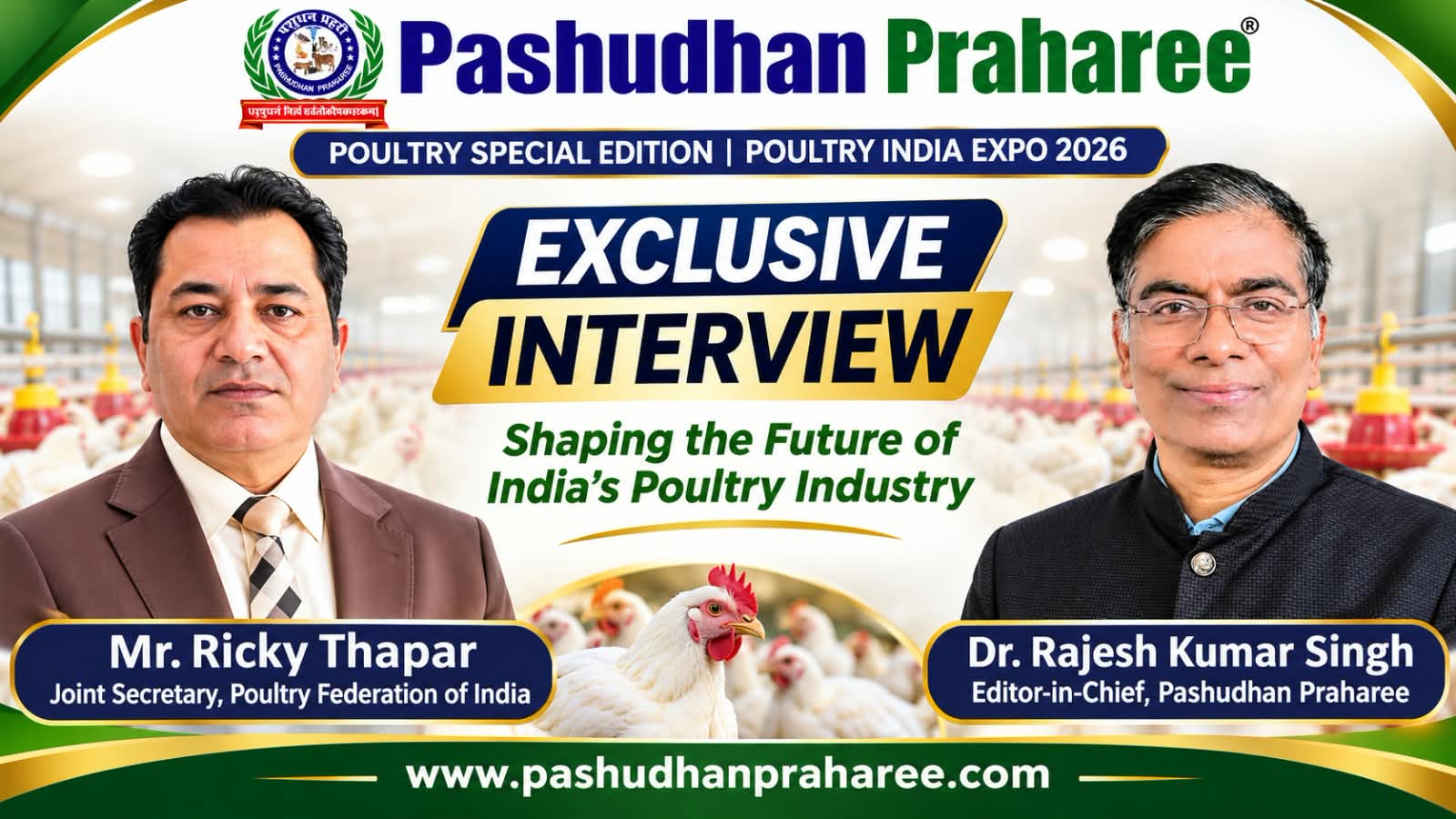
FEED SECURITY IS NATIONAL FOOD SECURITY : An Exclusive Interview with Mr. Ricky Thaper
SPECIAL EDITORIAL INTERVIEW
Poultry Industry Expert | Global Industry Contributor | Regional Advisory Council Member, Soy Excellence Center (SEC), India
POULTRY INDIA EXPO 2026 SPECIAL EDITION
| “Food, Feed and Fuel should grow together, not compete with each other.” |
INTRODUCTION
With nearly four decades of experience in the poultry sector, Mr. Ricky Thaper has established himself as an active contributor to the global poultry industry through his participation in international conferences, exhibitions, technical programmes and industry discussions. His professional journey encompasses international exposure to poultry feed preparation, extrusion technology and soybean processing, alongside his contributions to industry publications and global knowledge-sharing platforms.
He serves on the editorial boards of several poultry journals and regularly interacts with prominent international poultry personalities through his popular Global Talk Series. He also provides inputs to the Reserve Bank of India’s Inflation Analysis Team on poultry meat and feed price trends and is a Regional Advisory Council (RAC) Member of the Soy Excellence Center (SEC), India.
In this exclusive interaction with Pashudhan Praharee, Mr. Thaper discusses India’s poultry feed security, the rising cost of maize and soybean meal, the demand for imports of GM feed ingredients, market regulations and the future prospects of the Indian poultry industry.
THE INTERVIEW
Q1. With nearly 40 years of experience in the poultry sector and participation in numerous international conferences and exhibitions, could you briefly take us through your professional journey and key milestones?
Mr. Ricky Thaper: Throughout my professional journey, I have actively engaged with global poultry communities, contributing to industry advancement and sharing knowledge through lectures and presentations on various international platforms. My commitment to animal care and passion for the poultry sector have earned me several national and international awards over the past four decades.
I serve on the editorial boards of several poultry journals and have contributed numerous articles on the poultry sector to national and international publications. My Global Talk Series has also become a popular platform through which I interact with prominent personalities from the global poultry industry.
An important milestone in my professional development was my participation in the prestigious Cochran Fellowship Program, through which I attended a short course on poultry feed preparation at Texas A&M University, USA, in 2000.
I subsequently completed a course on extrusion processes at the Food Protein Research and Development Centre, Texas Engineering Experiment Station, Texas A&M University, in 2005. In 2008, I attended a specialised course on soybean processing at the National Soybean Research Centre, University of Illinois Urbana-Champaign, USA.
Over the years, I have participated in several prestigious international industry events, including:
- International Poultry Exposition, Atlanta, USA
- International Exposition for Food Processors, San Francisco, USA
- World’s Poultry Congress, Canada
- VIV Turkey, Istanbul, Turkey
- SPACE Poultry and Livestock Exhibition, Rennes, France
- VIV EUROPE, Utrecht, The Netherlands
- ILDEX, Vietnam
- EuroTier Exhibition, Hanover, Germany
In addition to my international engagements, I regularly provide inputs to the Reserve Bank of India’s (RBI) Inflation Analysis Team regarding future price movements and the food price outlook for poultry meat and feed.
I am also a member of the Regional Advisory Council (RAC) of the Soy Excellence Center (SEC), India.
Q2. What is the availability of poultry feed like during the current Kharif harvest season, particularly given the concerns over soybean and maize production due to the impact of El Niño?
Mr. Ricky Thaper: The Indian poultry industry is valued at approximately US$30 billion and provides direct and indirect employment to more than six million people. India is the world’s fourth-largest producer of chicken in the broiler segment and the second-largest producer of eggs in the layer segment.
The poultry industry is growing at an average annual rate of 7–8%, whereas agricultural growth is only around 1–2% per annum. This disparity raises serious concerns about our ability to meet the rapidly increasing demand for maize and soybean meal, the two major ingredients in poultry feed.
Feed accounts for approximately 65–70% of the total cost of producing eggs and chicken. Whenever the prices of major feed ingredients, particularly soybean meal and maize, rise significantly above their Minimum Support Price (MSP) levels, poultry farmers face severe financial challenges.
At present, maize prices are approximately ₹30,000–₹31,000 per metric tonne, considerably higher than the government’s announced MSP of ₹24,100 per tonne for the Kharif harvest. During the corresponding period last year, maize was priced at approximately ₹25,000 per metric tonne.
India’s total feed demand is estimated at nearly 57 million metric tonnes (MMT) in 2026 and is projected to reach 61 MMT or more in 2027.
The estimated sector-wise feed demand is as follows:
• Poultry feed: 35–36 MMT
• Dairy feed: 19–20 MMT
• Aquaculture feed: 2.9–3.5 MMT
Overall feed demand is growing at a Compound Annual Growth Rate (CAGR) of approximately 7.5%.
Maize demand from the poultry feed sector alone is estimated at 21.26 MMT in 2026 and is expected to exceed 22 MMT in 2027.
Other major users of maize include:
• The starch sector, which consumes approximately 6.5 MMT.
• The dairy feed sector, which uses approximately 5–6 MMT.
• The ethanol sector, which is expected to consume 12 MMT in 2026, potentially increasing to 16.7 MMT in 2027.
In addition, the food and beverage alcohol industries require substantial quantities of maize. Consequently, India’s total maize demand is estimated at 49–50 MMT in 2026 and is projected to increase to 55.70 MMT in 2027.
The poultry industry has requested the Ministry of Animal Husbandry and the Ministry of Commerce and Industry to grant permission for the import of five million metric tonnes of genetically modified (GM) maize for the ethanol industry.
This would help meet the raw material requirements of the ethanol industry while ensuring adequate availability of domestically produced maize for the poultry, livestock and aquaculture feed sectors.
Food, Feed and Fuel should grow together and not compete with each other.
Regarding soybean, the current year’s MSP is ₹57,080 per tonne, compared with ₹53,280 per tonne last year. However, the prevailing market price of soybean is approximately ₹69,000–₹70,000 per tonne.
Consequently, the price of high-protein (HIPRO) soybean meal containing 50% protein has reached approximately ₹65,000 per tonne, plus GST and freight.
The new soybean crop has just started arriving in the market, but prices remain exceptionally high. This has created considerable uncertainty within the industry regarding price movements over the next three to five months.
Q3. Various associations have demanded the import of three million tonnes of GM soybean de-oiled cake (DOC). As someone closely associated with the poultry industry, what are your views on this demand?
Mr. Ricky Thaper: All major national and state-level poultry associations have been requesting the Government of India to permit the import of three million tonnes of genetically modified (GM) soybean meal at concessional import duties.
We have a precedent for such intervention. In 2021, when soybean meal prices increased to approximately ₹85,000 per tonne, the government permitted the import of 1.2 million tonnes of GM soybean meal for a period of three months.
This decision provided significant relief to the poultry, dairy and aquaculture sectors at that time.
We are seeking similar support from the government under the present circumstances.
Another major concern is the hoarding of soybean stocks by stockists. The poultry industry has requested the government to consider imposing stockholding limits under the Essential Commodities Act, 1995, to prevent hoarding and the creation of artificial shortages in the market.
Q4. Has the current high cost of soybean meal become a crisis for the poultry and animal husbandry sectors?
Mr. Ricky Thaper: Feed security must be treated as national food security.
Affordable milk, eggs, chicken and fish are among the cheapest and most accessible sources of high-quality protein for Indian households. Ensuring a stable and affordable supply of animal feed is therefore essential to India’s nutritional security.
At present, broiler feed is costing approximately ₹50,000 per metric tonne, while layer feed is priced at around ₹34,000 per metric tonne.
During the last month alone, feed prices have increased by approximately 20–25%, and they may rise further if the government does not take immediate corrective measures.
Poultry farmers are already operating under severe financial pressure and facing losses.
If stockholding restrictions are introduced and imports are permitted, the poultry, dairy and aquaculture sectors can receive much-needed relief. Otherwise, the continued increase in feed costs will inevitably push up the prices of milk, eggs, chicken, fish and mutton, contributing to higher food inflation.
The Confederation of Indian Industry (CII), in its Vision Document for the Poultry Sector in 2047, has also highlighted that the current growth rate of maize and soybean production in India will be insufficient to meet the future requirements of the poultry industry.
CII has urged the government to allow imports of genetically modified maize and soybean in view of the unprecedented increase in feed prices.
Several South Asian countries, including Pakistan, Bangladesh, Nepal and Sri Lanka, have already permitted imports of GM maize and GM soybean or soybean meal.
In my view, imports of GM soybean meal and maize should be permitted under fixed quotas. Such a mechanism would help address the feed shortage without adversely affecting the price realisation of Indian agricultural farmers.
Q5. There has also been a demand for zero import duty on non-GM soybean. Would this effectively increase supply, or would concerns regarding import costs and quality persist?
Mr. Ricky Thaper: Import duties on commodities originating from Least Developed Countries (LDCs), such as Niger, are already zero. However, these countries do not have sufficient stocks of non-GMO soybeans to meet India’s supply requirements.
Therefore, if the government extends zero customs duty to non-GMO soybean imports from other countries as well, the overall availability of stocks in India would improve.
This would provide an additional sourcing opportunity and could help ease the current supply constraints.
Q6. There is a demand to continue the ban on futures trading in soybean and oilseeds beyond March 31, 2027. Will this prohibition help stabilise prices, or could it weaken the market’s hedging mechanism?
Poultry, livestock and aquaculture industry associations have requested the government to continue restrictions on futures trading in soybean and oilseeds beyond March 2027.
The continuation of these restrictions would help discourage excessive speculation, artificial price escalation and market volatility.
Another important factor is the uncertainty surrounding soybean meal imports. If the government announces permission for the import of GM soybean meal under a fixed quota for the next few months, stockists may stop hoarding and release their existing stocks into the market.
This would significantly improve the availability of soybean meal and provide considerable relief to the poultry, dairy and aquaculture sectors.
Q7. Looking ahead to 2035, where do you see the Indian poultry industry, and what do you think will be the defining headline of that transformation? Is the demand for eggs and chicken in India expected to rise further in the coming years?
Mr. Ricky Thaper: India’s population is currently around 1.4 billion and is projected to reach approximately 1.53 billion by 2047.
This population growth will directly translate into higher food demand, including increased consumption of eggs and chicken.
The Indian poultry industry therefore has considerable growth potential. However, ensuring sustainable feed supplies in the coming years will remain one of the sector’s biggest challenges.
By ensuring a cost-effective supply of animal feed ingredients, the government can directly address the challenge of feed inflation.
This will not only stabilise production costs for poultry, dairy and aquaculture farmers but also ensure that high-quality protein remains affordable for consumers.
Feed security must be treated as national food security.
Affordable eggs and chicken are among the cheapest and most accessible sources of high-quality protein for Indian households. Ensuring a stable feed supply is therefore essential to safeguarding India’s long-term nutritional security.
KEY TAKEAWAY
FEED SECURITY IS NATIONAL FOOD SECURITY
The future growth and sustainability of India’s poultry, dairy and aquaculture industries will depend significantly on the availability of affordable feed ingredients. A balanced policy approach that ensures adequate domestic production, rational imports, market stability and protection of farmers’ interests will be essential to maintaining affordable animal protein for India’s growing population.
ABOUT THE INTERVIEWEE
Mr. Ricky Thaper
- Nearly 40 years of experience in the poultry industry.
- International exposure to poultry feed preparation, extrusion technology and soybean processing.
- Member of the editorial boards of several poultry journals.
- Presenter and host of the Global Talk Series.
- Regular contributor to the RBI Inflation Analysis Team on poultry meat and feed price outlook.
- Regional Advisory Council (RAC) Member, Soy Excellence Center (SEC), India.
Contact Details
Mobile: +91 9810016293 | +91 9910016293
Email: ricky.thaper0712@gmail.com
| PASHUDHAN PRAHAREE
An Open-Access Monthly Magazine on Animal Husbandry, Veterinary Science, Livestock and Allied Sectors www.pashudhanpraharee.com | SPECIAL EDITION • POULTRY INDIA EXPO 2026 |