

After Pashmina Goat, SKUAST Scientists Engineer Gene-Edited Sheep in Kashmir
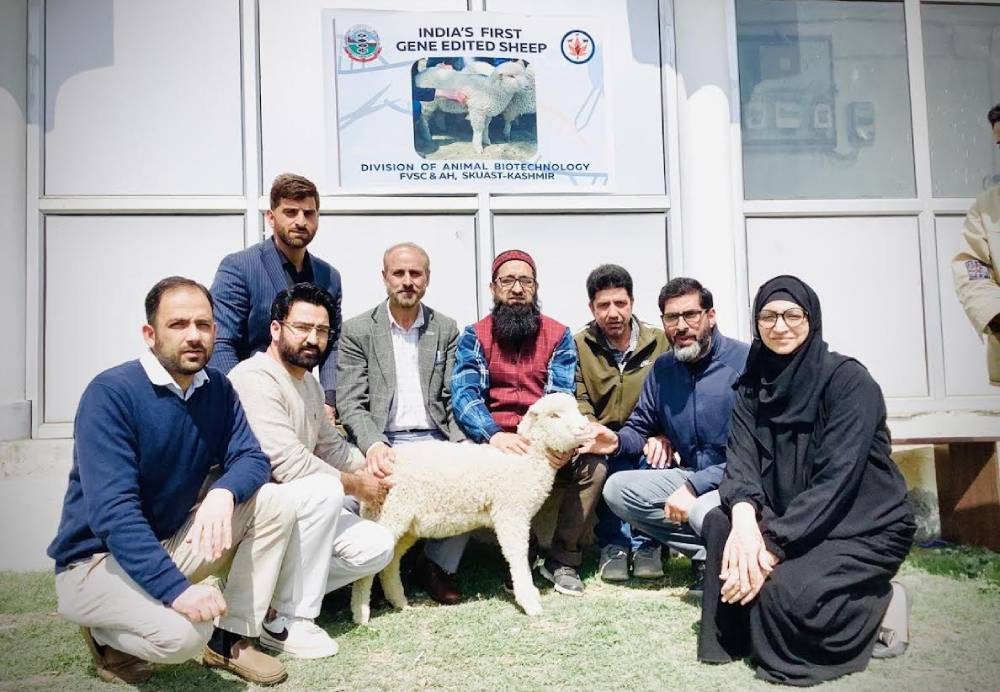
In a landmark scientific breakthrough, researchers at the Sher-e-Kashmir University of Agricultural Sciences and Technology (SKUAST), Kashmir, have successfully produced India’s first gene-edited sheep, without introducing any foreign DNA, positioning the institution at the vanguard of reproductive biotechnology and genetic innovation in the country.
The announcement marks a historic milestone in animal biotechnology and comes more than a decade after the same team, led by Dr Riaz Ahmad Shah, successfully cloned the world’s first Pashmina goat, Noori, in 2012. The Pashmina goat died in March 2023. Now, the gene-edited lamb, developed after four years of painstaking research, may transform India’s approach to livestock breeding. Dr Shah is the pioneer of cloning technology in India.
“This is not just the birth of a lamb, but the birth of a new era in livestock genetics in India,” said SKUAST-K Vice-Chancellor Dr Nazir Ahmad Ganai. “With gene editing, we can bring precise, beneficial changes without inserting foreign DNA. This makes the process safer, efficient and, more importantly, potentially acceptable to both regulators and consumers under India’s evolving biotech policy framework.”
Unlike transgenic organisms that involve the insertion of foreign genetic material, the edited lamb’s DNA remains entirely indigenous. The gene editing was carried out using the globally acclaimed CRISPR-Cas9 technology—winner of the 2020 Nobel Prize in Chemistry—and strictly followed international biosafety protocols.
“This mutation is not imported. It has been edited within the genome itself,” explained Prof Riaz Ahmad Shah, Dean of SKUAST’s Faculty of Veterinary Sciences and the principal investigator. “We’ve modified the ‘myostatin’ gene, responsible for regulating muscle growth, which is naturally inactive in certain European breeds like Texel. The result is a 30 per cent increase in muscle mass.”
He added that this trait, previously absent in Indian sheep breeds, could significantly enhance meat production and economic viability in India’s livestock sector. “Through this intervention, we are not only boosting productivity but also laying the foundation for disease resistance and twin-birth capabilities in future gene-editing projects,” he said.
The edited lamb, now over three months old, shows visibly greater muscle development compared to its non-edited sibling. The DNA samples have been sent to international research laboratories for verification and documentation.
“This achievement opens new frontiers,” Shah said. “We can use the same technique to edit out genes responsible for diseases or increase reproductive efficiency. It’s like applying Artificial Intelligence to biology; the kind of leap this represents is huge.”
Gene editing, or genome editing, refers to the precise alteration, addition, or deletion of DNA at specific sites. While earlier methods relied on selective breeding over generations, technologies like CRISPR enable scientists to introduce beneficial traits with accuracy and speed previously unimaginable.
The success of the SKUAST team comes on the heels of India’s first gene-edited rice variety being officially endorsed by the Union Agriculture Ministry. This dual advancement, one in plant genetics, the other in livestock, has placed India on a rapidly rising trajectory in genomic science.
“The introduction of this mutation through editing rather than traditional breeding is a technological leap akin to the revolution AI is driving globally,” Shah said. “It firmly places SKUAST-K on the global biotechnology map.”
The Indian Council of Agricultural Research (ICAR) sponsored the project, which is part of SKUAST’s broader vision to build India’s most advanced reproductive biotechnology facility. “This success reflects our commitment to cutting-edge science and its direct benefits for agriculture, food security, and sustainable rural development,” said Vice-Chancellor Ganai.
Because the lamb contains no foreign DNA, it may fall under a less stringent regulatory category. India is currently drafting comprehensive guidelines for gene-edited organisms that differentiate them from genetically modified organisms (GMOs), often a subject of public and policy concern.
“The distinction is critical,” Shah explained. “This lamb is not a GMO. It is gene-edited, and that makes all the difference for future deployment at the farmer level.”
Once approved, the innovation could have widespread applications across India’s sheep-rearing regions, enhancing meat yields, animal health, and farm incomes.
This achievement is yet another feather in the cap of Prof Shah, one of India’s foremost reproductive biotechnologists. Apart from cloning Noori, the world’s first Pashmina goat, Shah was also part of the National Dairy Research Institute (NDRI) team that produced the world’s first cloned buffalo.
“Noori survived for 11 years and gave birth to seven kids,” Shah recalled. “We proved that cloning and high-level genetic interventions are not just possible in India—they can thrive here with the right support.”
The researchers stress that the current breakthrough is confined to laboratory and research settings for now. However, with regulatory green signals and wider institutional support, gene-edited livestock could soon reach India’s farms.
As Vice-Chancellor Ganai said, “We are not just pushing the frontier of science. We are ensuring that this science delivers for the people—farmers, herders, and all those who rely on livestock for their livelihood. This is innovation with a purpose.”
What is Gene-Editing?
DNA (deoxyribonucleic acid) is a molecule that carries an organism’s genetic information, which is necessary for its development and functioning.
It is mainly located in the nucleus of the cells of the organism.
The genetic information is transmitted from one generation to another by the parents to their offspring.
- Gene -editing refers to the changes made in the DNA of an organism deliberately by the scientist to obtain desired change in the animal.
- In gene editing, scientists cut the DNA of the organism at a specific spot where they want to change or modify it.
- The scientist then removes, adds, or replaces the DNA to achieve the desired change in the organism, such as changing its colour, strengthening a muscle, or reducing a specific disease risk.
- Scientists use various techniques for gene editing. The CRISPR technique, invented in 2009, is increasingly being used worldwide.
About the Gene-edited Sheep
Dr Shah and his team edited the gene of a female sheep using the CRISPR-Cas9 technique for gene editing.
- No foreign gene was inserted into the body of the sheep.
- The aim of the project was to get a naturally born sheep with enhanced muscle growth as compared to a normal sheep.
- The team targeted the myostatin gene, which regulates muscle growth in the sheep..
- The female sheep gave birth to a gene-edited female lamb four months ago.
- Dr Shah and his team are monitoring the sheep to see whether the desired muscle growth in the newly born gene-edited sheep is taking place or not.
- The team is expected to announce the name of the gene-edited sheep shortly.