


All India Article Writing Competition & Nomination for Rudolf Virchow Excellence Award 2025 for “One World -One Health” opens to celebrate World Zoonoses Day & to be Presented on 15th August 2025
Nomination for the 2025 Rudolf Virchow Excellence Award for One World -One Health opens
The AgroVet Research & Development Foundation (ARDF) www.agrovetfoundation.com , CM Singh Trust , LITD (www.litd.in) & Pashudhan Praharee are pleased to announce nominations for the 2025, Rudolf Virchow Excellence Award for One World -One Health can be submitted through 26th of June , 2025. The award honors outstanding lifetime achievements that have significantly contributed to improving global health, One World –One Health Concept and uphold the attainment of the Sustainable Development Goals (SDGs) of the United Nations 2030 Agenda.
“The ARDF along with its subsidiary partner,Pashudhan Praharee, is dedicated to recognizing those who work tirelessly to alleviate suffering and promote health equity around the Country. The Rudolf Virchow Excellence Award for One World -One Health serves as a beacon of inspiration, highlighting the incredible contributions of individuals and organizations working toward a stronger, more equitable world and ‘Health for All’,
Eligible nominators are invited to submit their nominations for the 2025 Rudolf Virchow Excellence Award for One World -One Health by sending their complete Profile to pashudhanpraharee@gmail.com.
Laureates of the prestigious Award will be awarded annually.
ALL INDIA ARTICLE WRITING COMPETITION FOR ” Rudolf Virchow Excellence Award for One World -One Health” ON WORLD ZOONOSES DAY-6TH July 2025 , TO BE GIVEN 15 AUGUST 2025
” Rudolf Virchow Excellence Award for One World -One Health “
All India Popular Article Writing Competition for Rudolf Virchow Excellence Award for One World -One Health on the ocassion of World Zoonoses Day ie on 6th July 2025 to be Presented on Indian Independence Day 15th August 2025.
The ARDF, Pashudhan Praharee & LITD (Livestock Institute of Training & Development) are going to conduct an all India popular article /essay writing competition on the Theme- : “One World, One Health: Prevent Zoonoses, Stop the Spread”.
WHO CAN PARTICIPATE-
Field veterinarians & veterinary Scholars/ University Academia /KVK Scientists or Human Health Professionals.
Following are the criteria and details about the competition.
Term and Condition:
Languages: English and Hindi (Mangal Hindi Unicode Fonts)
Topic:
Topics for Popular Article / Essay Writing Competition:
- “Bridging the Gap: One Health Approach to Combat Zoonotic Threats in India”
- “Preventing the Next Pandemic: Strengthening Veterinary Public Health Systems”
- “Role of Veterinarians in the One Health Paradigm: Challenges and Opportunities”
- “Zoonoses and Climate Change: A Double Threat to Global Health”
- “Community Surveillance and Early Warning Systems: A Zoonoses Control Strategy”
- “Integrating AYUSH & Ethno-Veterinary Knowledge in One Health for Rural India”
- “Livestock-Wildlife-Human Interface: Understanding and Managing Spillover Events”
- “From Rabies to COVID-19: Lessons from Zoonotic Diseases for a Healthier Tomorrow”
- “One Health Education & Awareness: A Roadmap for India’s AgriVet Sector”
- “Empowering Grassroots Workers (A-HELP, Paravets) in Zoonotic Disease Control”
Last date for receiving entries: 1oth August, 2025
COMPETITORS:
- The Competition is open to Indian Veterinarians /Vet Scholars only or Heath Professionals.
- Vet Must be registered with either Veterinary Council of India (VCI) or any Indian State Veterinary Council.Or student of a VCI recognize veterinary college
- Heath professionals Must be registered with either Medical Council of India (MCI) or any Indian State Medical Council.Or student of a NMC recognize Medical college
- No Competitor may win more than one prize.
- All participants ( Vets participating in All India Article Writing Competition & Individuals or Companies participating through self nomination) must register for the competition by paying Rs 500/– (Five Hundred only) on the following Ac:
PASHUDHAN PRAHAREE
IDBI BANK
A/C NO-1131102000001779
IFC CODE-IBKL0001311
Google Pay/Paytm/Phone pay on mobile no 8092877290
NB- Please acknowledge us the payment confirmation through screenshot or online payment Details.
- ADJUDICATION AND PRIZED:
- The winners will be decided on the basis of merits by a team of distinguished jury
- The result of the best Articles will be published on 15th August 2025.
3.Date of Commencement of Article writing competition & Nomination Process:
The entries are accepted from 16th June 2025 to 10th August 2025
Evaluation Criteria
- Relevance to the theme (30%)
- Depth of research and originality (25%)
- Clarity, coherence, and structure (20%)
- Scientific and practical applicability (15%)
- Grammar, language, and presentation (10%)
ALL THE PARTICIPANTS IN THE ESSAY WRITING COMPETITION WHOSE ESSAY WILL NOT SELECTED FOR AWARDS, WILL BE GIVEN PARTICIPATION CERTIFICATE.
All the submitted entries selected for competition will be published in our Pashudhan Praharee website.
- A list of prize-winners will be uploaded on the website
- The sellected Received articles would be compiled & will be published in a book form bearing ISBN No.(Proposed)
ENTRY:
The following procedure be followed for sending the entries:
- Article can be sent through e-mail at pashudhanpraharee@gmail.com
- Article must be typed in MS Word with Times New Roman fonts in English and Unicode Mangal Hindi Unicode fonts in Hindi. Photos related to the article, if any, be sent in jpg image.
- Each entry must be either an article written in English or Hindi by the competitor.
- Competitors may submit maximum of 05 (five) articles.
- In case of submission of translated version of copyrighted article in English or Hindi before submitting the article, the author should have obtained permission from the original author for the use of their work for the Competition. Scanned copy/copies of the permission/s should be sent along with the entry/entries by e-mail.
- Each article and photographs must be the unaided work of the author or translator and it must not have been previously published or broadcast.
- In case of any copyrighted photograph, before submitting the photograph, the author should have obtained permission from the original author for the use of their work for the Competition. Scanned copy/copies of the permission/s should be sent along with the entry/entries by e-mail.
- The submitted article/essay should be plagiarism free.If it has been found that the competitor has copied in full or part an article of another author and submitted as an entry to the Pashudhan praharee, the competitor will be responsible for any legal action arising thereof.
- Entries will be judged by its merit as decided by our jury.
- Name and Designation of the contributor can be added to the text of the article.
- Receipt of an entry will be acknowledged by e-mail after the receipt.
- The worldwide copyright of each article submitted will remain with the author, but Pashudhan Praharee shall have the unrestricted right to publish the article with photographs to website, or to use it.
- The right to cancel the competition in case of less than 50 entries in each category received will be with us.
All competitors shall be deemed to have read and accepted all the conditions of entry for the “All India Popular Article Writing Competition 2025”at the time of submission. - Article written by single author will only be entertained.In case of article with more than one author ,the name of the first author will be considered as competitor .
ALL INDIA ARTICLE WRITING COMPETITION FOR “Rudolf Virchow Excellence Award for One World -One Health 2025”
Declaration:
………………………………………………………………………………….…….
I/We have read and I/We accept all the conditions of the competition and wish to enter the following Article for the ALL INDIA ARTICLE WRITING COMPETITION FOR “Rudolf Virchow Excellence Award for One World -One Health 2025”
I declare that the article and photographs entered for the competition is/are unaided works of my own and I am eligible to enter this competition.
Signed ……………………………………………….. Date ………………………….
NB-For any queries, write to us pashudhanpraharee@gmail.com
Pashudhan Praharee is a media platform dedicated to animal husbandry sector in India.
For more details, please contact us on
9431309542.
The Pashudhan Praharee recognizes outstanding contributions to public health through its annual awards program. The Awards aims to acknowledge and honor individuals and organizations that have made significant achievements in promoting health, preventing diseases and injuries, and ensuring safe and healthy conditions for people and animals around the world.
This year, the Pashudhan Praharee Presents 2 types of Awards on the occasion of world Zoonoses Day , on 06 th July , 2025 to be given to selected participants through All India Article Writing Competition or Nomination.
Rudolf Virchow Excellence Award for One World -One Health is to presented to via nominations to renowned public health professionals who has made extraordinary contributions in improving global health, including Health of Animals.
Rudolf Virchow Excellence Award for One World -One Health is to be presented to winning candidates to be selected through the All India Article Writing Competition .
World Zoonoses Day is observed annually every July 6. This day aims to shed light on diseases that originate in animals that can be transmitted to humans. In a study by the C.D.C., 60% of all existing infectious diseases are zoonotic and at least 70% of emerging infectious diseases originate in animals.
HISTORY OF WORLD ZOONOSES DAY
On July 6, 1885, French biologist Louis Pasteur successfully administered the first rabies vaccine to a little boy bitten by a rabid dog. The vaccine not only prevented the child from getting rabies; it saved his life.
Rabies is just one example of many zoonotic diseases. Avian influenza, Ebola, and the West Nile Virus are some other examples that have been discovered over the years. Zoonotic pathogens can be viral, bacterial, or parasitic and can spread to humans through direct contact or indirectly through food, water, or the environment. It may even spread through an intermediary species. It does not just originate from wild animals like bats or monkeys. It can also come from pets and farm animals. The use of antibiotics in animals raised for food increases the potential for drug-resistant strains of zoonotic pathogens. That’s why animals have an important role in zoonotic infections.
As there are many types of Zoonotic diseases, there are also many types of treatments such as antibiotics. Some practices can help prevent the spread of foodborne zoonotic diseases like safe guidelines for animal care in the agriculture industry. Having access to clean drinking water and proper waste removal are effective ways to reduce the spread of diseases. Vaccinating household pets and maintaining proper hygiene like washing your hands after close contact with animals can also help.
Protecting and managing the health of animals that live alongside humans is vital. When we prevent diseases in animals, we safeguard the health of people.
About the Rudolf Virchow
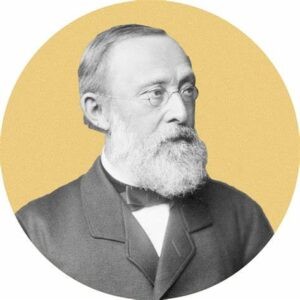
Lived 1821 – 1902.
Rudolf Virchow was an eminent pathologist and politician, widely regarded as one of the greatest and most influential physicians in history. A founding father of both pathology and social medicine, Virchow analyzed the effects of disease in various organs and tissues of the human body. He identified that diseases are caused by malfunctioning cells.
A man of boundless energy, he simultaneously had four careers: medical scientist, editor of several medical journals, politician, and anthropologist. Although he played a tremendous part in ridding medicine of unscientific practices, he also made some rather large scientific errors.
Beginnings
Rudolf Ludwig Carl Virchow was born on October 13, 1821 in the town of Schivelbein, in the German kingdom of Prussia. Today the town is called Świdwin and lies in Poland.
His father was Carl Christian Siegfried Virchow, a farmer, and town treasurer of Schivelbein; his mother was Johanna Maria Hesse. The couple were not especially well-off financially and Rudolf was their only child. His parents loved the natural world and passed this love on to their son, taking him on bird watching trips.
Rudolf attended elementary school in Schivelbein. From his earliest days at school, he seems to have been exceptionally gifted intellectually, so much so that his parents paid for extra lessons to push him forward. From elementary school he progressed to the Gymnasium (a high school for academically strong students) in Köslin, about 40 miles from his hometown.
Rudolf’s high school curriculum was classical, with heavy emphasis on Greek and Latin. This was not a problem for Rudolf, who had a passion and remarkable ability for learning languages. In addition to Greek and Latin, he also learned Dutch, English, French and Hebrew. In his spare time between high school and medical school he taught himself Italian.
He graduated from high school in 1839, aged 17.
Abandoning his original idea of becoming a pastor – he didn’t think his voice was strong enough to be an effective preacher – he won a scholarship to study medicine at the Friedrich-Wilhelms University in Berlin, Prussia’s capital city. Completing his course in 1843, he spent short spells in a number of different medical jobs.
His passion was pathology – the study of diseases.
Politics in Brief
A man with incredible energy levels, Virchow enjoyed an important political career in addition to his scientific career. Here we’ll be concerned mainly with the science. Suffice to say that Virchow’s politics were liberal. He promoted better education, better living conditions, and better health for the poor. These political beliefs coincided with his ideas for social medicine.
Virchow was elected to the German Parliament in 1880 to represent the party he helped found, the German Progress Party. He had a sharp tongue, and his political opponents became wary of his sarcasm. Virchow was ardently anti-Catholic, believing the Catholic Church’s influence led to bad outcomes for society and the poor.
Rudolf Virchow’s Contributions to Science and Pathology
Autopsies and Leukemia
Virchow carried out the first systematic autopsies involving microscopic examination of tissue. One such autopsy in 1845 led to his first published contribution to science.
Virchow identified and named the disease leukemia and offered the best description of it available. He named the disease by combining the Greek words leukos (white) and aima (blood). Even in his earliest work he focused heavily on cells.

A microscope view of a bone marrow smear in a leukemia case. Virchow recommended systematic microscopic examinations of tissues from autopsies to diagnose causes of death.
Outflanking the journals that blocked publication of his work
In 1847 Virchow started a new job, teaching pathological anatomy at the University of Berlin. Although he had once believed his voice too weak to preach, he became a supremely self-assured teacher and researcher.
He was also ambitious, and had grown increasingly frustrated by the editors of German medical journals. They refused to publish some of his research papers: in Virchow’s opinion they were hamstrung by out-of-date ideas about medicine.
In his new teaching job he met Benno Reinhardt, another young physician who shared his dim view of the medical journals. Virchow and Reinhardt decided to bypass the journals’ stuffy editors entirely.
They launched their own journal, Archive for Pathological Anatomy and Physiology and Clinical Medicine. This new journal insisted all medical contributions should be based on robust, well-researched science. Virchow utterly rejected medical practices that had persisted for millennia which he believed had no scientific basis, such as Galen’s use of the ‘humours.’
Virchow and Reinhardt’s journal has been remarkably resilient. Today it is still one of the leading medical journals, now called Virchows Archiv. Sadly its founding co-editor Benno Reinhardt died young in 1852. Virchow, who had a prodigious appetite for hard work, became the journal’s sole editor until his own death in 1902.
Epidemics and Public Health
Early in 1848 the Prussian Government sent Virchow to Upper Silesia to investigate a typhus epidemic that had begun the previous year and was claiming thousands of lives.
After studying the situation, Virchow characterized the peasants of Upper Silesia as lazy and unhygienic. He was shocked at the extreme poverty they lived in and their extremely poor diets. He blamed their plight on the combined effects of the Catholic Church sapping their ambition and local landowners removing any wealth generated in Upper Silesia to be spent elsewhere.
“Wealth, education and liberty depend on one another and thus, conversely, do hunger, ignorance and servitude.”
Rudolf Virchow
Report on the Typhus Epidemic in Upper Silesia, 1848
The medical consensus at the time, accepted by Virchow, was that diseases like typhus were caused by ‘miasma’ – bad air caused by rotting matter. Virchow believed malaria was caused by rotting vegetable miasma, while typhus was caused by rotting animal miasma. So, although he rejected some doctrines of medicine taught in ancient times by Galen, he did not question the truth of miasmas.
Virchow did not recognize that epidemics are spread by microorganisms.
He formed the view that the main cause of the epidemic in Upper Silesia was the terrible conditions most of the people were living in. He decided that if living conditions could be improved, there would be no more epidemics.
Epidemics, he said, were best treated politically rather than medically. This is not entirely correct. However, he was correct to say that improving people’s living conditions, hygiene, and diets would be highly beneficial to their general health and well-being. And, although he did not know it, better hygiene slows the spread of the microorganisms that cause epidemics such as typhus, and more recently Ebola, bird flu, and SARS.
The Beginning of Social Medicine
Never slow to act on his beliefs, in July 1848 Virchow founded the weekly magazine Medical Reform to promote his new concept of social medicine and his idea that:
“physicians are the natural advocates of the poor”.
The magazine ran for about a year before folding, but in that time it was highly influential in promoting improved public health for everyone in Germany, including the poorest.
How do Cells Form?
In 1849 Virchow moved to University of Würzburg and began a program of serious research into the roles cells play in the body and in disease.
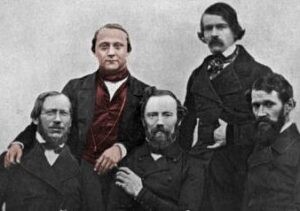
Rudolf Virchow, clean shaven, poses with other professors at the University of Würzburg in 1850.
The great Theodor Schwann had pushed biological science forward dramatically in 1837, when he established that all animal tissues are made of cells. However, he made a major error when he said new cells are created from a fluid called blastema. Although incorrect, this was the accepted explanation for cell reproduction in the early 1850s.
Scientists believed imbalances in the body created blastema in which disease cells start to grow. This belief began changing in 1855 when Virchow, aged 34, published an essay in which famously he declared:
“Every cell arises from another cell.”
Although he was not the first person to suggest this, people only began to take serious notice after Virchow said it. It was a turning point in biology.
Cellular Pathology
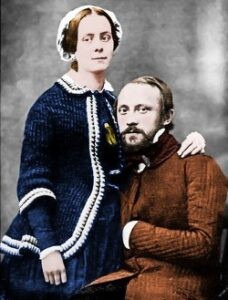
Rudolf Virchow and his wife Rosa in the late 1850s. They were married in 1850.
In 1856 Virchow returned to Berlin to the Chair of Pathological Anatomy at the Friedrich-Wilhelms University.
In 1858 he published Cellular Pathology, a groundbreaking book of 20 lectures he had given at the university, which laid the foundations of modern pathology and indeed of modern medical theory.
Simply put, Virchow established that all diseases can be traced to cells. Diseases attack normal cells and cause them to malfunction. A whole organism does not get sick; each disease affects a particular set or sets of an organism’s cells, not all of its cells. Different diseases affect different types of cell.
Virchow told doctors and pathologists seeking to diagnose diseases or to understand their effects that they could do this best by studying the affected cells.
“Virchow, the chief founder of modern scientific medicine … will rank for all mankind and for all time to come as one of the greatest figures in science … the establishment by Virchow of the principles of cellular pathology marked the greatest advance which scientific medicine had made since its beginning.”