



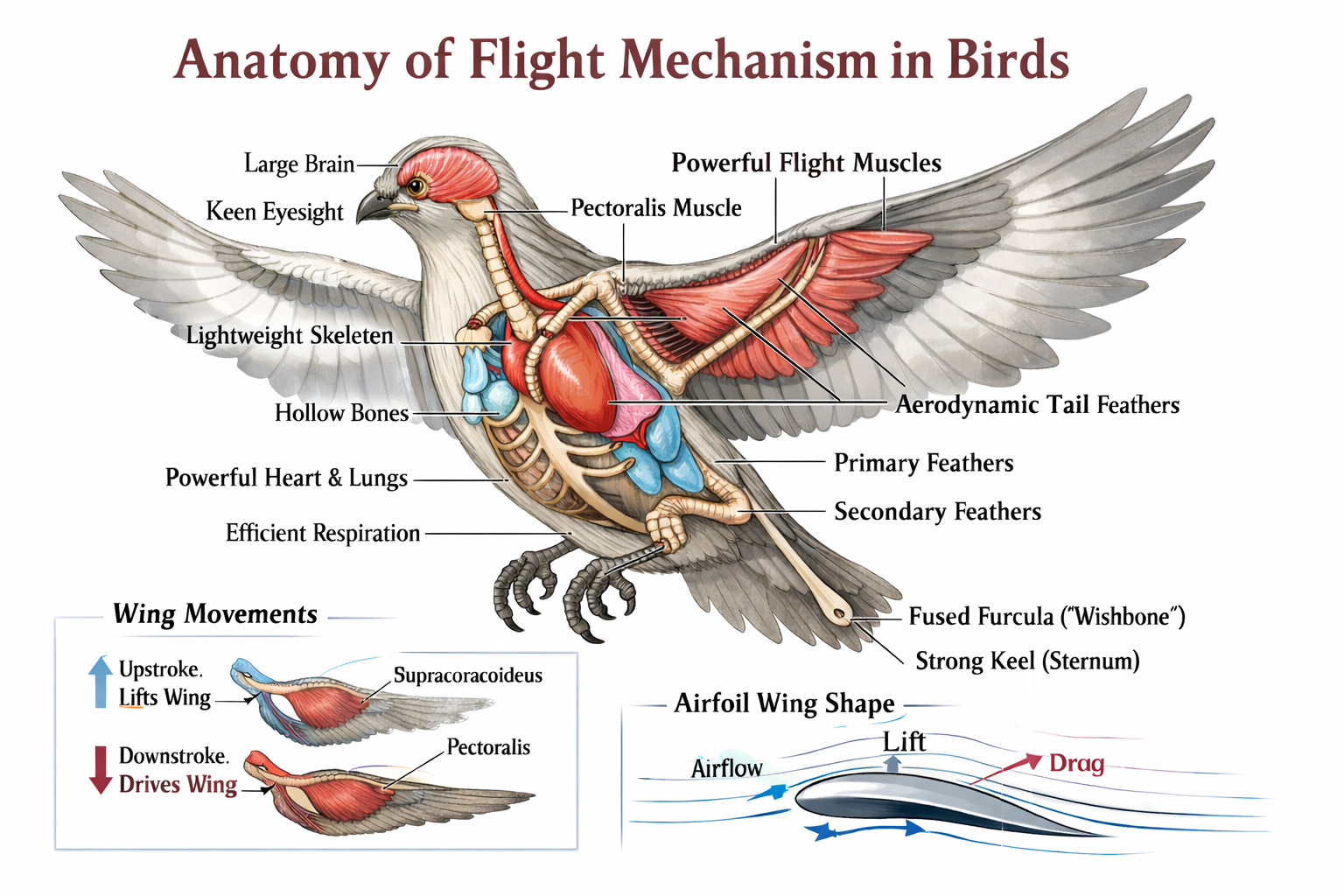
Anatomy of Flight Mechanism in Birds
Anil Kumar Safi1 and Sudhanshu Kumar2
1Assistant Professor, Department of Veterinary Anatomy
2Assistant Professor, Department of Veterinary Medicine
Mahala Veterinary College, Reengus, RAJUVAS
Corresponding author: anilkumarsafi1501@gmail.com
Introduction
Flight mechanism in bird is one of the most complex forms of locomotion in the animal kingdom. It includes taking off, hovering and landing which involves many complex movements. As different bird species have adapted to specific environments and other basic needs, they have developed different forms of wings and various forms of flight.
Adaptations for flight
Adaptation is the process by which living organisms evolve charcteristics of behaviors that enable them to thrive and survive in their specific environment. For the flight mechanism in birds, the body has been well adapted morphologically and anatomically.
Morphological adaptations
- Streamlined body
The body of the bird is narrower in the front and back, while broader in the middle that makes a streamlined body which minimizes air resistance during flight.
- Body configuration
Position of most of the light organs like lungs, air sacs is dorsal to the central axis of body, while the heavier organs (digestive organ), bones (sternum), muscles (pectoral muscle) are placed ventral to the central axis. Birds typically have their center of gravity located slightly ahead of the pelvic region.
- Forelimbs modified into wings
Forelimbs of birds is modified into unique and powerful propelling organs called wings which propel the body high up in the air. Feathers of wings increase the surface area for striking the air and serves as a blanket enveloping the air around the body and adds buoyancy. At the leading edge of a bird’s wing is a structure called the propatagium, which contains a muscle connecting the shoulder and wrist, that helps the wing in flapping and makes the flight possible.
- Perching
Perching is the act of bird landing and gripping onto a branch over the elevated surface with its feet, and for this muscles are strongly developed and modified.
- Short tail
As the number of coccygeal vertebrae is less the birds are adapted to short tail, which serve as a rudder during flight and helps in steering, lifting during flight it serve as rudder. This adaptaion helps in steering and counterbalancing of the body.
- Shape of the beak
Bird’s beak are adapted for various feeding strategies, and in some cases, streamlined to reduce air resistance during flight as the shape of beak is mostly curved in flight birds.
- Leg positioning
Legs are positioned towards the rear of the body, reducing drag and facilitating a more aerodynamic shape in flight.
- Bipedal locomotion
The hind limbs are used to support the body weight and acts as locomotory organs on the ground.
Anatomical modifications
- Endoskeleton
Due to bone fusion, the skeleton is compact, concentrated, and moderately stiff.
Most bones of the birds are pneumatic type that are filled with air spaces which are light weighted and have large surface area for its muscular attachment. Reduction in the number of digits and fusion of certain bones into a carpometacarpus. Modification of the extremities of the limb for the attachment of feathers and flight muscle.
- Keel
A prominent keel on the breastbone provides a large surface area for muscle attachment, essential for powerful flight. This keel is absent in flightless birds.
- Wings modification
The structure of a bird’s wing is critical for generating lift. The anatomy of the birds wing, consist of humerus, radius & ulna, and carpomtacarpus. The radius and ulna are attached only at their ends, it provides large surface area that assist in flight. Modified wings of birds increases speed over a curved, larger wing area creating a longer path of air. This indicates that the air is flowing faster across the upper surface of the wing, lowering air pressure and producing lift.
- Feathers
The feathers are attached to the ulna, that directly transmits force from the flight muscles to these feathers and it is therefore relatively heavier than the radius. The body of a bird is covered with smooth, backward-directed, and closely fitting feathers that streamline the body and reduce friction during flight. They provide a large surface area for air contact,
feathers contribute to body buoyancy and tends to make them airborne. This allows birds to endure low temperatures at high altitudes.
- Tail Feathers
Most of the tail feathers provide an interlocking microstructure. Typically, birds have six pairs of feathers on tail. The tail feathers provide stability and steering during flight aiding in precise maneuvers.
Major flight muscles
- Pectoral muscle
These muscles are present around the breast bone. It is well-developed flight muscles which provides the strength needed for flapping the wings during flight.
- Supracoracoideus muscle
This is the major muscles for flight mechanism in birds. Other muscle includes Pectoralis major and pectoralis minor.
Organ system
- Digestive organs
Digestive system is efficient with a reduced length of intestinal tract. Therefore, food digests rapidly. In birds the undigested food is never stored, thus there is no extra burden of faeces.
- Respiratory System
The respiratory systems of birds have several peculiar properties that are adaptations for flight. Birds have nine air sacs that makes their body light weighted and also gives continuous flow of oxygen, as they have more oxygen demand during the flight. In addition to gas exchange, the respiratory system also makes streamline of the body which alters its mass distribution.
- Circulatory System
Birds have evolved a tightly controlled cardiovascular system that meets the rigorous energy demand for flight. Birds also have a unique circulatory adaptation called the Crossed Circulation which allows for a more efficient exchange of oxygen and carbon dioxide. Birds are efficient to keep the pure and impure blood completely separate.
Basic mechanism of flight
- Lift
Bird flying is fundamentally comparable to airplane flight. Lift force is generated by the action of airflow on the wing, which is an airfoil. The lift force occurs because the air pressure is lower immediately above the wing and greater below.
- Soaring
During gliding, the wings travel through the air at an angle, deflecting the air downwards and causing an opposing response, lift. However, the bird’s body has drag (air resistance), therefore it must lean forward and dive to maintain forward speed. When gliding, the wings are kept outside of the body and do not flap. A bird does not have to do any labor when gliding.
3. Flapping
When a bird flaps, its wings continue to generate lift, but the lift is turned forward to give propulsion, counteracting the drag and increasing speed.
Flapping has two stages: the down-stroke, which generates most of the push, and the up-stroke, which produces less thrust than the down-stroke.
4. Drag
A bird in flight is resisting three drag forces in addition to its own weight.
Friction between air and body surfaces creates drag. The drag is caused by the bird’s frontal region. It is often referred to as pressure drag. Lift-induced drag is caused by the wingtip.
Act of flight
During flight, the wings expand, extend, and rise vertically upward. These then go downward and forward (down stroke), and then upward and backward (up stroke). The motion of pectoralis minor lowers the wing. The pectoralis minor, as well as other muscles, contract to elevate the wings. During the downstroke, the wing is pushed downward like an oar. It glides forward and vertically upwards with little air resistance, preparing for the following forceful downward stroke. The body travels forward in an upward stroke.