



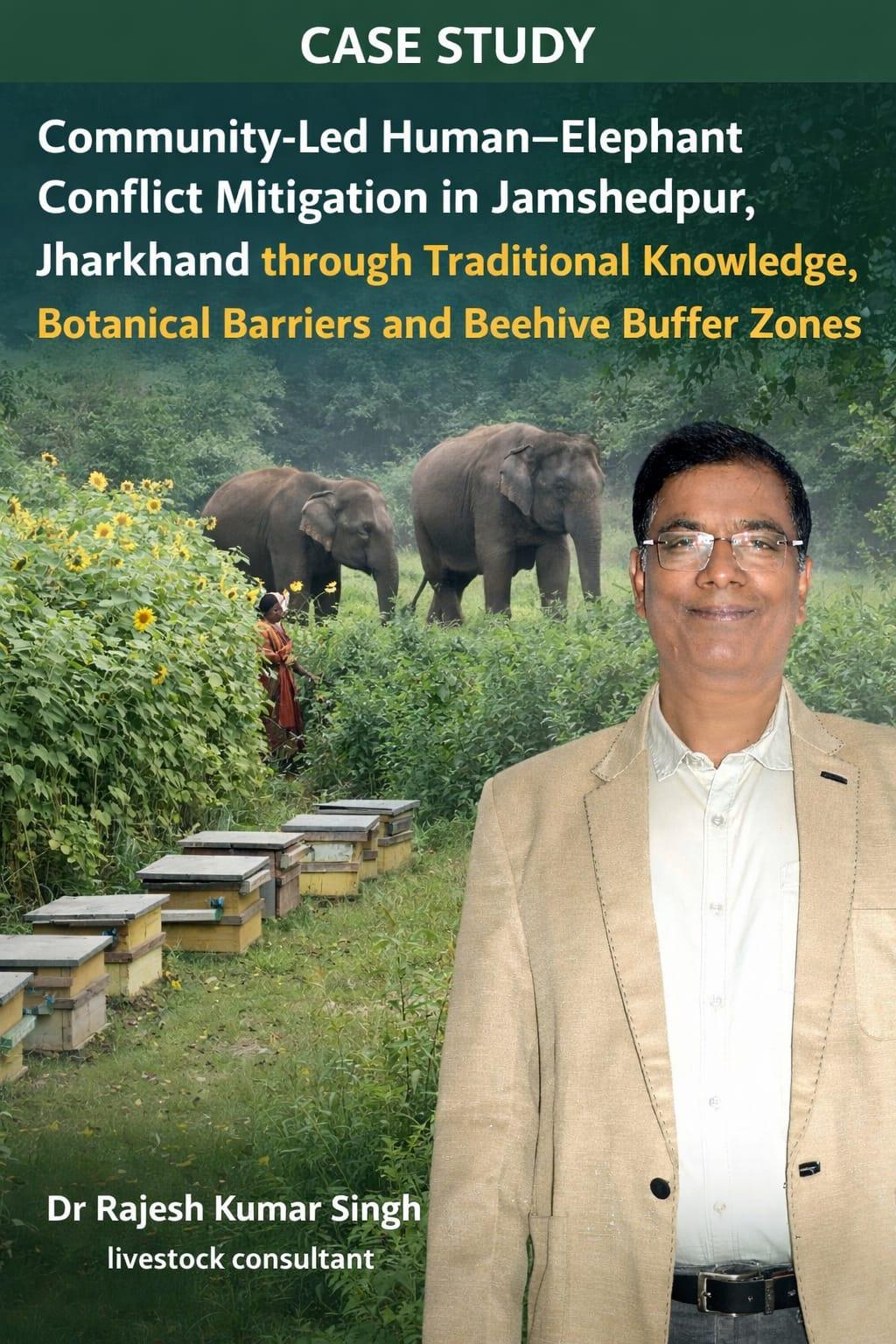
Case Study: Community-Led Human–Elephant Conflict Mitigation in Jamshedpur, Jharkhand through Traditional Knowledge, Botanical Barriers and Beehive Buffer Zones
- Background
Jamshedpur, located in the East Singhbhum district of Jharkhand, lies adjacent to the Dalma Wildlife Sanctuary, a well-known elephant habitat in Eastern India. The region represents a classic forest–industrial–agrarian interface, where rapid urbanization, mining activity, and expansion of agricultural land intersect with traditional elephant migratory corridors. Seasonal elephant movement from Dalma hills toward adjoining forest belts of Odisha and West Bengal frequently results in crop damage, property loss, and occasional human casualties.
Recognizing the limitations of purely technological or force-based interventions, local communities, forest officials, and civil society groups in the Jamshedpur periphery have increasingly relied on community-driven, nature-based, and traditional mitigation practices.
- Study Area Characteristics
Geography: Undulating plateau terrain with sal (Shorea robusta) forests, bamboo patches, and river valleys.
Climate: Tropical monsoon with pronounced agricultural cycles influencing elephant foraging patterns.
Population Profile: Predominantly tribal communities such as Santhal, Ho, Munda, and Oraon, with livelihoods linked to agriculture, forest produce, and livestock.
Conflict Period: Peak incidents typically occur during paddy harvest seasons and summer water scarcity months.
- Problem Statement
Villages located along the Dalma–Patamda–Baharagora belt experienced recurrent elephant intrusion leading to:
Crop raiding (paddy, banana, sugarcane)
Damage to houses and grain storage
Human injuries and fatalities
Economic distress and retaliatory hostility toward wildlife
Conventional electric fencing alone proved insufficient due to maintenance challenges and corridor disruptions. Hence, an integrated community-based strategy was explored.
- Community Practices Adopted
4.1 Traditional Vigilance Systems
Construction of Machans (watch towers) using bamboo and timber.
Formation of night patrol groups equipped with torches, drums, and whistles.
Use of conch shells and metal plates to create acoustic deterrence.
4.2 Smoke and Olfactory Repellents
Preparation of chilli–cow dung smoke cakes burned at village peripheries.
Use of neem leaves and mustard husk smoke during peak elephant movement nights.
- Botanical Bio-Fencing Interventions
Communities initiated multi-layered green barriers around agricultural fields and village edges.
Deterrent Plant Species Used
Plant Type Local/Scientific Name Observed Effect
Citrus Hedges Lemon (Citrus limon) Strong odor discourages entry
Thorny Shrubs Karonda (Carissa carandas) Physical barrier
Succulent Barrier Agave (Agave americana) Sharp spines, low palatability
Medicinal Tree Neem (Azadirachta indica) Bitter smell
Aromatic Herb Tulsi (Ocimum sanctum) Strong fragrance
Root Grass Vetiver (Chrysopogon zizanioides) Dense root clumps
These plantations also provided supplementary income and soil conservation benefits.
- Identification and Management of Attractants
Communities mapped crops and vegetation that unintentionally attracted elephants:
Paddy fields near forest edges
Banana and sugarcane clusters
Bamboo and Napier grass plantations
Water ponds near settlements
Buffer planning encouraged shifting high-attractant crops slightly inward and strengthening outer bio-fences.
- Introduction of Beehive Buffer Zones
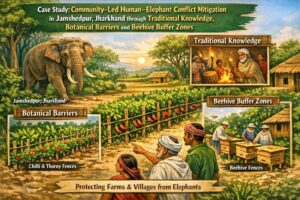
Rationale
Elephants exhibit natural avoidance behavior toward bees due to painful stings inside the trunk and ears. This ecological trait formed the basis for introducing beehive fencing.
Implementation in Jamshedpur Fringe Villages
Installation of Apis cerana indica wooden hives at 10–12 meter intervals.
Placement along corridor edges and paddy field perimeters.
Training of tribal youth and women self-help groups in apiculture management.
Integration with citrus and agave hedges to form dual biological barriers.
Outcomes Observed
Noticeable diversion of elephant paths in pilot clusters.
Additional household income from honey and beeswax sales.
Improved crop pollination and biodiversity.
Increased community ownership of conservation initiatives.
- Institutional and Technological Support
Forest Department Collaboration: Corridor mapping and rapid response teams.
Solar Street Lighting: Reduced surprise encounters at night.
Mobile Alert Groups: Informal WhatsApp/SMS networks for elephant sighting alerts.
NGO Involvement: Training in apiculture and plant nursery development.
- Results and Impact
Indicator Observed Change (Qualitative)
Crop Damage Frequency Moderate reduction in pilot villages
Community Participation High, especially among youth and SHGs
Income Diversification Increased via honey and plant nurseries
Human Casualties Declining trend in monitored clusters
Wildlife Retaliation Reduced hostility and improved tolerance
While not eliminating conflict entirely, the integrated approach shifted the paradigm from confrontation to coexistence.
- Challenges
Maintenance of beehives during extreme weather.
Occasional hive abandonment by bee colonies.
Need for continuous training and funding.
Corridor encroachment pressures from infrastructure development.
- Lessons Learned
- Nature-based solutions gain faster community acceptance than purely mechanical barriers.
- Economic incentives (honey, citrus fruit, nursery plants) significantly improve sustainability.
- Layered defense systems—botanical, acoustic, and biological—are more effective than single interventions.
- Traditional tribal knowledge, when combined with scientific guidance, yields practical and culturally respectful outcomes.
- Conclusion
The Jamshedpur–Dalma landscape demonstrates that community-centered ecological strategies, particularly botanical bio-fencing and beehive buffer zones, can substantially mitigate human–elephant conflict while enhancing rural livelihoods. This case study underscores the importance of integrating indigenous practices, biodiversity conservation, and participatory governance. The model offers a scalable framework for other elephant-range districts in Eastern and Central India seeking sustainable coexistence between humans and wildlife.
NB- This case study is jointly documented by Dr. Rajesh Kumar Singh, TVO, Baharagora, Jamshedpur, and Shri Raja Ghosh, Forest Guard, Dalma Range, based on ground experience of human–elephant interactions in the Dalma landscape. It focuses specifically on human–elephant conflicts in the Dalma range and the community-led measures adopted in fringe villages around Jamshedpur, Baharagora and adjoining forest corridors.
Dalma Wildlife Sanctuary and its surrounding villages form a critical elephant range where traditional migratory routes intersect with expanding agriculture, roads, industry and mining, leading to frequent human–elephant encounters, crop loss and tragic casualties. In this sensitive context, local tribal communities, the Forest Department and veterinary services have experimented with nature-based, low-cost and culturally rooted solutions—including traditional vigilance systems, chilli–smoke deterrents, multi-layered botanical bio-fencing and innovative beehive buffer zones—to reduce confrontations and move towards coexistence.
The case study highlights how botanical barriers (lemon, karonda, agave, neem, tulsi, vetiver) combined with beehive fences not only help deflect elephant movement away from standing crops, but also generate side benefits such as honey income, pollination services, soil conservation and stronger community ownership of conservation. Supported by corridor mapping, early-warning networks and selective use of solar lighting and other tools, the Dalma experience demonstrates that layered, community-centered strategies can significantly soften human–elephant conflict, and offers a replicable model for other conflict hotspots in Jharkhand and eastern India.
13 . References / Suggested Readings
- Project Elephant – Ministry of Environment, Forest and Climate Change (MoEFCC), Government of India.
Guidelines and reports on human–elephant conflict mitigation, elephant corridors, and community participation.
- Wildlife Institute of India (WII).
Right of Passage: Elephant Corridors of India. Dehradun, India.
A landmark document mapping elephant corridors and landscape-level conservation strategies.
- Asian Elephant Specialist Group (IUCN SSC).
Technical briefs and conservation action plans on Asian elephant management and coexistence models.
- WWF–India (World Wide Fund for Nature – India).
Publications on community-based human–elephant conflict mitigation, bio-fencing, and early warning systems in eastern and northeastern India.
- Forest Survey of India (FSI).
India State of Forest Report (various editions).
Provides data on forest cover, habitat fragmentation, and landscape change influencing elephant movement.
- Sukumar, R. (2003).
The Living Elephants: Evolutionary Ecology, Behavior, and Conservation. Oxford University Press.
Foundational scientific text on elephant ecology, behavior, and human interactions.
- Fernando, P., et al. (2011–2015).
Research articles on human–elephant conflict and coexistence strategies in South and Southeast Asia. Published in conservation and ecology journals.
- FAO (Food and Agriculture Organization of the United Nations).
Community forestry and human–wildlife conflict mitigation manuals, including nature-based solutions.
- King, L. E., Douglas-Hamilton, I., & Vollrath, F. (2007–2011).
Studies on Beehive Fences as elephant deterrents in Africa, widely cited as the scientific basis for bee-buffer strategies adopted globally.
- Down To Earth Magazine (Centre for Science and Environment, India).
Field reports and analytical articles on human–elephant conflict trends in eastern and northeastern India.
- Mongabay-India (Environmental Journalism Platform).
Case studies on lemon fencing, chili deterrents, and community conservation models across Indian states.
- State Forest Department Reports – Jharkhand, Odisha, Chhattisgarh, and West Bengal.
Annual wildlife management plans, elephant census reports, and mitigation guidelines relevant to regional practices.
- National Biodiversity Authority (NBA), India.
Documents on traditional ecological knowledge, indigenous plant usage, and community biodiversity registers.
- Apiculture and Pollination Studies – ICAR (Indian Council of Agricultural Research).
Manuals and research papers on beekeeping practices (Apis cerana indica, Apis dorsata) and their ecological benefits.
Dr. Rajesh Kumar Singh, TVO, Bahragora, Jamshedpur
Raja Ghosh , Forest Guard , Dalma