
Effective treatment and prevention of Lumpy Skin Disease in cattle with alternative medicine: A field report
Karthick kumar N , Project Manager,Graze Valley,Cattle Valley Limited, Athikaripatti, Madurai District-625527,Tamil Nadu.
Abstract
Lumpy skin disease (LSD) causes huge economic losses in the livestock industry. It is caused by a virus (LSDV) in the family Poxviridae, genus Capri pox virus. It is characterized by high fever, enlarged superficial lymph nodes, round nodules, edema of the limbs, edema in the brisket region, and ulcers. Homeopathic medicine and ethno-veterinary medicine provide low-cost alternatives to allopathic drugs. Hence, a study was conducted to evaluate the clinical effectiveness of the homeopathic remedies and herbal paste in cattle affected by lumpy skin disease. The study was conducted on 24 affected animals and 10 unaffected animals. The affected animals were randomly categorized into 3 groups depending upon the severity of disease. Category 1: 8 animals, category 2: 8 animals, category 3: 3 animals. The unaffected animals were allotted to category 4: 10 animals. In affected animals, a recovery rate of 95.8% with a mean recovery period of 16 days was attained following the oral administration of homeopathic remedies such as Variolinum 200C, Rhus tox 200C, Dulcamara 200C, Thuja 200C, Apis mellifica 200C, Ocimum sanctum 30C, and Calendula off 30C and the external application of neem oil and turmeric powder paste. In unaffected animals, a prevention rate of 100% was attained with the oral administration of the homeopathic remedy Variolinum 200C. In this study it was observed that the homeopathic remedies and ethno-veterinary medicine were effective for the treatment and prevention of lumpy skin disease and were documented.
Keywords: cattle, lumpy skin disease with homeopathic remedies and herbal paste.
Introduction
Lumpy skin disease is an infectious disease. It is caused by a virus (LSDV) in the family Poxviridae, genus Capripoxvirus. Lumpy skin disease is a disease of cattle and water buffalo. It is a vector-borne disease transmitted by different biting blood-feeding arthropods. Lumpy skin disease causes considerable economic losses due to emaciation, damage to hides, infertility, mastitis, loss of milk production, and mortality of animals up to 20%. Until 1989, lumpy skin disease was limited to the African continent (Tuppurinen and Oura, 2011). However, the disease has moved outside Africa to Madagascar and the Middle East and causes serious economic loss to the livestock industry. In India, lumpy skin disease was reported in 2019 in Odisha state and spread to all other states of India, posing a significant threat to the livestock sector. ( Sudhakar S.B.et al.(2020). According to official data from the government of India, as of September 2022, the disease has impacted 251 districts in 15 states, affecting over 2 million animals, with 100,000 deaths reported. In these states, milk production has decreased by more than 26 %. ( Shagun 2022).
In recent years, interest in complementary and alternative therapies for the management of disease has increased. In this homeopathy medicine and ethno-veterinary medicine play an important role in alternative Medicine. Homeopathy is emerging as an alternative therapy in veterinary medicine (Day 1999). Ethno veterinary medicine is one of the indigenous systems of medicine to prevent and treat different disease conditions in animals since antiquity. (Swarup et.al 2010). Under this situation, an effort was made to treat the use of herbal medicine and homeopathic medicines for the treatment of cattle with lumpy skin illnesses.
Materials and Methods.
Study area: This study was carried out in door step veterinary health services in Melur Taluk, Madurai District, and Tamil Nadu. This area is densely populated with animals of different species, especially cattle. This study was conducted from the year 2020 to 2021.
Study Population: This study was carried out on twenty-four affected cattle and 10 unaffected cattle of the same herd belonging to different owners, suffering from lumpy skin disease. Animals were from both sexes (male and female), different breeds (local and cross), and different age groups (young and adults).
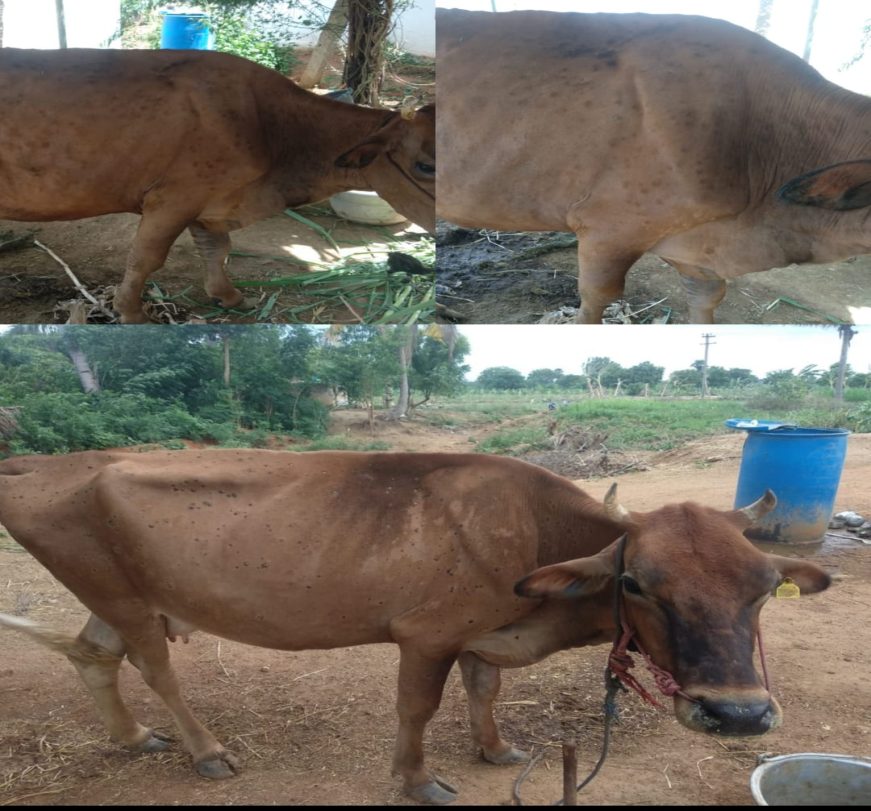
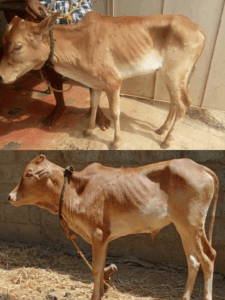
Clinical examination of animals: Affected cattle were presented to doorstep veterinary health services with the history of nodular growth on different body parts along with reduced feed intake and being depressed, lethargic, and emaciated. During clinical examination rectal body temperature was recorded as 104°F to 105°F, while other physiological parameters are within normal range. There was a flare-up of small- to large-sized circumscribed nodules on different areas of the body. In some animals edematous and inflammatory swelling was also noticed in the brisket region. The cases were tentatively diagnosed as Lumpy Skin Disease (LSD) based on the owner history and typical clinical findings.
Study design
In the present study 24 infected animals and 10 unaffected animals were classified in 4 categories.
Category 1: High fever and enlarged superficial lymph nodes, such as subscapular and prefemoral nodes, become swollen and easily felt.
Category 2: Characteristic firm, round, slightly raised nodules, 10-25 mm in diameter, appear on the skin, particularly on the head, neck, limbs, and genitalia. Edema of the limbs and brisket region.
Category 3: Nodules can rupture, forming ulcers.
Category 4: unaffected animals in the same herd.
Table 1: base line treatment of infected animals
| categories | no. of animals | Homeopathy remedies | Administration |
| Category 1 | 13 | Variolinum 200C | All remedies are mixed in equal proportion and mixed with 40mm sugar pills was given orally B.I.D for continuous 10 days |
| Rhus Tox 200 C | |||
| Dulcamara 200 C | |||
| Ocimum Sanctum 30 C | |||
| Thuja 200 C | |||
| Category 2 | 8 | Variolinum 200C | All remedies are mixed in equal proportion and mixed with 40mm sugar pills was given orally B.I.D for continuous 10 days |
| Apis mellifica 200C | |||
| Dulcamara 200 C | |||
| Ocimum Sanctum 30 C | |||
| Thuja 200 C | |||
| Category 3 | 3 | Variolinum 200C | All remedies are mixed in equal proportion and mixed with 40mm sugar pills was given orally B.I.D for continuous 10 days |
| Calerndula off 30 C | |||
| Dulcamara 200 C | |||
| Ocimum Sanctum 30 C | |||
| Thuja 200 C | |||
| Acidum Nitricum 200 C | |||
| Category 4 | 10 | Variolinum 200C | Remedy mixed with 40mm sugar pills was given orally S.I.D for continuous 5 days |
Dilution preparation:
One drop of mother tincture is diluted with Ninety –nine drops of alcohol to give a potency of 1C (One in hundred). When one drop of potency 1C is diluted again with Ninety – nine parts of alcohol it gives 2C potency (One in thousands). With such serial dilution, potency 12C, 30C, 200C, 1 M etc. can be prepared. At each stage, the dilution is thoroughly shaken. (Madrewar., 1996).
Clinical indication of homeopathic remedies:
Dulcamara
It is useful in the treatment of ringworm and large fleshy wart (Madrewar B.P., 2016)
Calendula officinalis
This remedy is found to be one of the most reliable healing agents. It will rapidly bring about resolution of tissue promoting healthy granulation and healing by first intention. (Madrewar B.P., 2016)
Variolinum
It is used for “internal vaccination” seems to be efficacious in protecting against from viral diseases in animals and it also cure them. (Madrewar B.P., 2016)
Thuja occidentalis
This remedy is great importance in the treatment of skin conditions. It is indicated in polyps, tubercles, epithelioma, carbuncles and ulcers. (Madrewar B.P., 2016)
Acid nitricum
This remedy is indicated when warts are large and sharp edged which may tend to bleed easily. (Madrewar B.P., 2016)
Ocium sancutum
It has anti- inflammatory and antioxidant property and builds immunity, supports immune health and skin diseases. (Madrewar B.P., 2016)
Apis mellifica
This remedy is useful to treat the lymphangitis, oedema,urticarial swelling, allergic reactions, and acute joint pain with swelling ,pain and heat (Madrewar B.P., 2016)
Rhus toxicondendron
This remedy useful in lameness, arthritis, fever, sprains, strains, back and neck pain,urticaria, lymphangitis, and septicemia (Madrewar B.P., 2016)
Herbal paste preparation:
100 ml of Neem oil was mixed with 100 grams of turmeric powder and applied to affected parts of the body.
Table 2: Properties of herbal paste
| Herbals | Properties | Uses | Reference |
| Neem oil | Analgesic, Antipyretic, antiviral, antibacterial, anthelminitic and skin diseases | Boils, Maggot wounds and Pox | Thyagarajan D et.al.,(2010) |
| Tumeric powder | Anti-inflammatory and anti-oxidant | Reduce inflammation, promote wound healing and various type of skin diseases | Amrita kumari et al., (2022) |


Result and discussion
The World Organization for Animal Health (OIE) categorizes the disease as a notifiable disease because of its severe economic losses. The economic importance of the disease was mainly due to having high morbidity rather than mortality (Tuppurainen and Oura 2011).
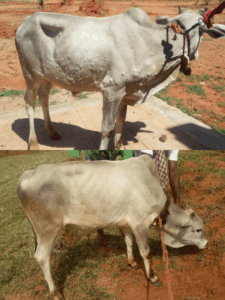
In the current study LSD-affected animals were categorized into three groups depending upon the severity of disease as follows: category 1: 13 (54%), category 2: 8 (33%), and category 3: 3:3 (12.5%). Feed intake and normal rectal temperature were noticed in all infected animals within 2 days. In the present study, overall complete recovery was achieved in 23 animals (95.8%) with a mean recovery period of 16 days. Among twenty-four animals, one animal was not completely recovered till 25 days. Similarly, 100% of animals have been prevented from LSD in the same infected animal herd.
Previously, Abdi Fufa Feyisa (2018) reported complete recovery from lumpy skin disease in a bull by using an injection of 10% oxytetracycline at 10 mg/kg B.wt./day and an injection of dexamethasone at 0.2 mg/kg/day. Similarly, Bithika Halder et al. (2022) reported complete recovery from lumpy skin disease in a calf by using an injection of gentamicin 5 mg/kg/day, an injection of meloxicam 0.2 mg/kg B.wt/day, an antihistamine injection, and a multivitamin injection.
Through this article, it is worthy to note that homeopathic medicine and ethno-veterinary medicine are very effective in simultaneously treating infected animals and preventing unaffected animals from LSD. Although complete treatment for LSD is provided by allopathic medicine, the cost of treatment is higher than that of homeopathic and ethno-veterinary medicine.
This holistic approach helps to reduce the socio-economic losses to livestock industries due to Lumpy Skin Disease.
References
- Abdi fufa Feyisa (2018):A case report on clinical management of LSD in Bull. Journal of Veterinary Science and Technology, 9:3.
- Amrita kumara, Neha Raina, Abhishek Wahi, Khang Wen Goh, Pratibha Sharma, Riya Nagpal, Atul Jain, Long Chiau Ming, Madhu Gupta (2022).Wound-healing effects of curcumin and its Nano formulations, A comprehensive review: Phamaceutics 2022 oct 25;14(11):2288.
- Bithika Halder and Basarat seikh (2022).Successful management of LSD in calf: A case study; Journal of Fishers and Livestock production. 2022; 10:2.
- Day, C (1999)Veterinary homeopathy: Principal and Practices in : Schoen AM, Wyne SG editors. Complementary and alternative Veterinary Medicine. St.Luis: Mushy, P.485-513.
- Madrewar B.P (1996)Therapeutics of Veterinary Homeopathy. Jain Publishers (P) Ltd. India.
- Madrewar B.P.(2016)Materia Medica, Nosodes and Repertory of Veterinary Homeopathy . B.Jain Publishers (P) Ltd. India.
- Swarup D and Dey S (2010)Prospect and Perspective of ethnoveterinnary practices in treatment of animal diseases. International conference on Ethnoveterinary Practices, January 2010.Thanjavur, India.
- Shashi B Sudhakar, Nirajan Mishra, Semmannan Kalaiyarasu, Sandeep K Jhade, Divakar Hemadri, Richa Sood, Gopal C Bal, Mishir K Nayak, Sunil K pradhan an Vijendra P Singh (2020):Lumpy skin disease (LSD) out breaks in cattle in Osisha state, India in August 2019: Epidemilogical features and molecular studies: Emerg.Dis. 67(6), 2408-2422.
- Shagun (2022)Lumpy skin disease has created a livelihood crisis for India small dairy farmers. Down to Earth, September 30.
- Thyagarajan D, Omprakash A.V, Kanagaraju P, Chitramhigai K.(2010). Role of ethnoveterinary medicine in poultry health: International conference on ethnoveterinary practices, Thanjavur, India,January 2010.
- Tuppurainen ESM, Oura CAL (2011). Review: Lumpy Skin Disease: An Emerging Threat to Europe, the Middle East and Asia, Institute for Animal Health, Pirbright, Surrey,UK.