

Good Manufacturing Practices of CNG Gas from Cow Dung: Transforming India into Viksit Bharat @2047
In the journey towards a sustainable and energy-secure Viksit Bharat @2047, one of the most promising innovations lies in the utilization of indigenous and eco-friendly resources. Among these, cow dung, an age-old agricultural by-product in Indian villages, is now emerging as a valuable resource for producing Compressed Natural Gas (CNG). This transformation of cow dung into bio-CNG (CBG – Compressed Bio-Gas) is not just an energy revolution but also a symbol of rural empowerment, waste-to-wealth creation, and environmental sustainability.
With the growing demand for sustainable fuel in India, there’s never been a better time for farmers, startups, and small-scale entrepreneurs to venture into this rapidly expanding market. Add to it the robust support from government schemes, and what you end up with is a significant business opportunity that’s as good for the planet as it is for your pocket. Agriculture plays a crucial role in providing the raw material for these renewable energy projects, and government support is often linked to strengthening agricultural infrastructure.
If you’ve been considering a venture in renewable energy, this article is your one-stop guide. From understanding Bio-CNG plants to exploring the Startup India initiative, PM-KUSUM Yojana, GOBARdhan Scheme, and other subsidies, we’ll walk you through every step to turn this green dream into reality.
Advantages of Cow Dung Biogas Production
- Renewable Energy Source:
Cow dung biogas is a renewable source of energy, which means that as long as there is livestock, cow dung will continue to be produced. It provides a continuous supply of energy that is sustainable and reduces dependency on fossil fuels such as coal, oil, and natural gas.
- Waste Management:
Instead of allowing cow dung to accumulate and potentially release methane into the atmosphere, anaerobic digestion captures the methane for energy use. This helps mitigate the environmental impact of livestock farming by reducing greenhouse gas emissions and preventing groundwater contamination.
- Economic Benefits for Farmers:
Rural farmers who utilize cow dung for biogas production can save money by using the biogas for their own cooking and heating needs instead of purchasing expensive fossil fuels. Additionally, excess biogas can be sold to local communities, providing an additional source of income.
- Reduction in Deforestation:
In many rural areas, wood is the primary fuel for cooking and heating. The use of cow dung biogas helps reduce the demand for firewood, thereby decreasing deforestation rates and preserving forests.
- Fertilizer Production:
The byproduct of anaerobic digestion, known as digestate, is a nutrient-rich organic fertilizer that can be applied to crops. This not only reduces the need for chemical fertilizers but also helps improve soil fertility and crop yields.
- Health Benefits:
Using biogas from cow dung for cooking and heating significantly reduces indoor air pollution, a major health issue in households that rely on traditional biomass such as wood or coal. Cleaner air reduces respiratory problems and improves overall health, particularly for women and children who spend more time indoors.
From Gobar to Green Energy
Cow dung, often discarded or used in rudimentary forms, contains immense potential as a raw material for biogas generation. When processed scientifically, biogas can be upgraded to bio-CNG, which serves as an alternative to conventional fossil fuels. This green energy can be used in households, transportation, and even industries.
This aligns perfectly with the Government of India’s vision of:
- Doubling farmers’ income
- Reducing dependence on fossil fuels
- Promoting circular economy
- Achieving Net-Zero Emissions by 2070
2. What is Bio-CNG?
Bio-CNG or Compressed Bio-Gas is purified biogas containing over 95% methane content. It is almost identical to natural gas and can be used as a fuel for vehicles or for domestic and commercial energy needs. It is obtained through the anaerobic digestion of organic waste such as cow dung, agricultural waste, or food waste.
What Is a Bio-CNG Plant, and Why Is It Game-Changing?
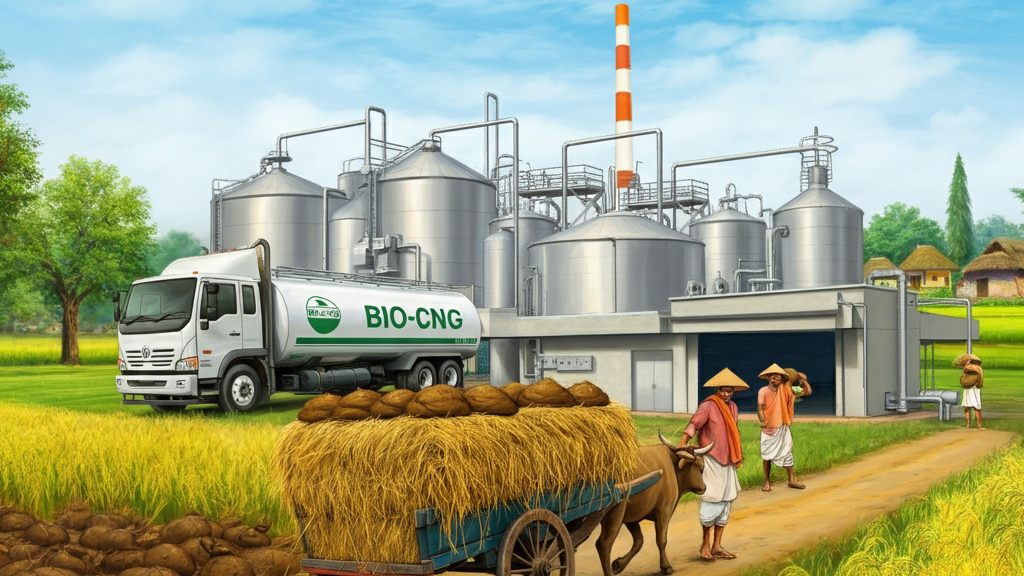
A Bio-CNG plant converts organic waste into biogas, which is further refined into high-purity compressed natural gas (CNG). But that’s not all. It also generates slurry, an organic by-product that serves as a nutrient-rich manure for farming.
Here’s how it works:
- Step 1: Organic waste (like cow dung, paddy straw, or sugarcane leftovers) is fed into the plant.
- Step 2: These materials decompose in an anaerobic digester, producing raw biogas.
- Step 3: The biogas is purified and compressed to create Bio-CNG.
This process not only combats waste management issues but also capitalises on untapped agro-resources.
3. Good Manufacturing Practices (GMP) for Bio-CNG from Cow Dung
A. Raw Material Collection
- Collection of fresh cow dung from gaushalas, dairy farms, and individual livestock owners.
- Quality control to avoid contamination with plastic, chemicals, or antibiotics.
- Ensuring adequate moisture content (~80%).
B. Pre-Treatment
- Mixing with water or slurry to maintain an appropriate C:N ratio.
- Addition of slurry from existing digesters as inoculum to enhance microbial activity.
C. Anaerobic Digestion
- Utilization of digesters (KVIC, fixed dome, floating drum, or Deenbandhu type).
- Ideal temperature: 35–40°C (mesophilic range).
- Retention time: 25–30 days.
- Output: Raw biogas (methane 55–60%, CO₂, hydrogen sulfide).
D. Purification & Upgradation
- Scrubbing of CO₂, moisture, and H₂S using water scrubbing, PSA (Pressure Swing Adsorption), or membrane technology.
- Final methane concentration >95%.
E. Compression and Bottling
- Compressed to 200–250 bar pressure using CNG compressors.
- Stored in high-pressure gas cylinders for distribution.
F. Quality Control
- Testing methane percentage, calorific value, and absence of contaminants.
- Adhering to BIS standards for fuel-grade bio-CNG.
G. By-product Utilization
- The digested slurry is rich in nutrients and used as organic manure or CFOM (Crop-Specific Fermented Organic Manure).
- Helps in improving soil health and reducing chemical fertilizer dependency.
4. Economic Viability
Cost Analysis
- Small plant (for 100 cattle): ₹20–25 lakh investment.
- Medium-scale plant (1000 kg dung/day): ₹50–70 lakh.
- Large-scale commercial plant: ₹1 crore and above.
Return on Investment
- Daily CBG production: 25–100 kg per 1000 kg of dung.
- Selling price of CBG: ₹60–₹75/kg.
- Sale of organic manure: ₹2–5/kg.
Break-even Period: 3–5 years
Livelihood Opportunities
- CBG Plant operators
- Organic manure packaging & distribution
- Cattle dung procurement agents
- Transport & maintenance services
5. Government Support and Schemes
A. SATAT Scheme (Sustainable Alternative Towards Affordable Transportation)
Launched by the Ministry of Petroleum & Natural Gas in 2018.
- Promotes setting up of 5000 CBG plants by 2025.
- Oil Marketing Companies (OMCs) like IOCL, BPCL, and HPCL will procure CBG.
B. New National Bio-Energy Programme (MNRE)
- Central Financial Assistance (CFA) for setting up biogas and CBG plants.
- ₹10,000 to ₹40 lakh based on plant size and location.
C. GOBARdhan Scheme
- Implemented by the Department of Drinking Water and Sanitation.
- Promotes management and reuse of livestock waste.
- Supports village-level infrastructure and market linkages.
D. NABARD & Rural Livelihood Missions
- Financial support to SHGs and FPOs.
- Subsidized loans under Agri Infrastructure Fund.
6. Role in Viksit Bharat @2047
The production of bio-CNG from cow dung contributes to several pillars of the Viksit Bharat @2047 initiative:
A. Energy Independence
- Reduces import dependency on fossil fuels.
- Saves foreign exchange.
B. Rural Development
- Decentralized energy solutions for rural India.
- Generates local employment and entrepreneurship.
C. Waste Management
- Scientific use of animal waste.
- Reduces open defecation by animals and methane emissions.
D. Climate Action
- Reduces GHG emissions.
- Supports India’s Net-Zero commitment.
E. Sustainable Agriculture
- Enhances soil fertility through organic manure.
- Promotes natural farming.
7. Challenges and Way Forward
Challenges
- High initial investment and technical knowledge.
- Limited awareness among dairy farmers.
- Complex regulatory procedures and permits.
- Gas distribution infrastructure gaps.
Recommendations
- Simplify clearances and incentives.
- Foster public-private partnerships.
- Train youth under Skill India for CBG plant operations.
- Launch awareness campaigns via Krishi Vigyan Kendras (KVKs) and Panchayats.
Common Feedstocks:
- Paddy straw, a common residue from rice fields that often goes to waste.
- Cow dung, generated in abundance by dairy farms and gaushalas.
- Other agro-residues like sugarcane bagasse or fruit peels.
Sugarcane press mud is also a suitable feedstock for biogas production, further expanding the options for agricultural residues.
The Output:
- Bio-CNG – A clean fuel alternative for industries and vehicles.
- Slurry – A by-product transformed into high-quality organic compost.
Compressed biogas (CBG) is produced and can be injected into city gas distribution networks, supporting urban renewable energy infrastructure.
It’s a smart way to close the agri-waste loop while giving you multiple revenue streams.
Should You Start a Bio-CNG Plant?
This type of business works best for those with steady access to organic waste. Here’s who should consider it:
- Farmers:
Have large amounts of crop residue every season? Why burn it when you can convert it into energy and profits?
- Gaushalas or Dairy Farms:
With constant dung output, these establishments are perfectly positioned to use Bio-CNG technology.
- Startups Focused on Sustainability:
Clean energy is a hot sector. Bio-CNG can add an eco-friendly feather to your cap while opening doors to potential carbon credit revenue.
- Cooperatives and Agri-Tech Entrepreneurs:
Working at scale? A Bio-CNG plant can fuel income diversification while promoting rural sustainability.
This opportunity is not just business; it’s a way to give back to the environment while securing your financial future.
Building Your Bio-CNG Business Model (Step-by-Step)
- Choose the Right Land
- Small Scale: Requires about 0.5–1 acre.
- Medium Scale: Up to 3 acres. Ensure easy access to raw materials and transportation routes.
- Secure Your Feedstock
Estimates suggest 10 tonnes of waste daily for small-scale operations. Teaming up with neighbouring farmers could ensure a consistent supply.
- Get the Right Machinery
Key equipment includes:
- Anaerobic digesters.
- Scrubbers to purify biogas.
- Compressors to convert biogas into Bio-CNG.
Procurement of machinery and equipment is a critical step, and government schemes often facilitate procurement by providing financial assistance or streamlined processes.
Opt for brands that have MNRE certification to qualify for capital subsidies under government programmes.
- Plan for Labour & Utilities
- Small-scale plants need 5–10 workers.
- Availability of water and electricity is a must.
- Crunch the Numbers
- Small-scale Investment: ₹50–80 lakhs.
- Medium-scale Investment: ₹3–5 crores. Consider government subsidies and access to low-interest MSME/business loans.
- Tap Multiple Revenue Streams
- Bio-CNG sales to oil marketing companies or commercial buyers.
- Sell slurry to farmers as organic manure.
- Carbon Credits, potentially sold to green-conscious industries.
By-products like pellets and briquettes are created through a densification process, adding further value to your output.
It’s a business where one ton of raw agro-waste can generate around 18–20 kg of Bio-CNG and 50 kg of high-value fertiliser. That’s impact and income hand-in-hand!
The construction phase is crucial, as financial assistance is often tied to the successful construction and commissioning of the plant.
Is It Profitable? Breaking Down ROI
Bio-CNG is a highly profitable venture once you’re past the break-even point. Here’s why:
- Cost of producing 1 kg of Bio-CNG is around ₹15, while the market sale price ranges between ₹45–₹60 per kg.
- A small-scale plant generating 5,000 kg/day of Bio-CNG can rake in ₹2.25–₹3 crores annually.
Typically, you can expect to recover your investment within 5–6 years, making this a long-term, lucrative business idea. Government schemes or contracts often have a validity period, so be sure to check the duration of support and plan your project timeline accordingly.
Unlock the Benefits of Government Schemes
India’s central and state governments actively promote renewable energy projects, especially in rural and agricultural settings. Here’s how you can take advantage:
Relevant departments such as the Ministry of Petroleum and Natural Gas and the Department of Agriculture are involved in scheme approvals and funding for CBG projects.
- Startup India
- Process: Register your business with the DPIIT portal.
- Benefits: Tax exemptions for three years, funding access, and self-certification privileges.
- PM-KUSUM Scheme
Specifically under Component B and C, you can avail subsidies for power/energy generation through biomass. Tie up with DISCOMs to sell surplus energy.
- GOBARdhan Scheme
- Provides financial aid to gaushalas or farms setting up Bio-CNG plants near villages.
- Submit your proposal via local bodies or panchayats.
- MNRE Subsidies
Avail capital subsidies for machinery or plant setup under the National Bio-Energy Mission. Applications can be submitted via the MNRE website.
Financial support is provided as a subsidy and is often facilitated by government authorities to make project implementation easier.
- State-Specific Support
States like Punjab, Haryana, and Maharashtra lead the way with extra incentives. These could include additional grants, free/subsidised land, or tax benefits.
When applying for these schemes, the process often involves submitting forms or proposals online, and many departments provide an online form for ease of application.
These schemes take a considerable bite out of the initial cost and make the venture financially feasible.
Galvanizing Organic Bio-Agro Resources Dhan (GOBARdhan) is a vital umbrella initiative of Government of India, based on the whole of Government approach and aims to convert waste to wealth towards promoting circular economy. Government of India intends to build a robust ecosystem for setting up Biogas/Compressed Biogas (CBG)/ Bio-Compressed Natural Gas (CNG) plants to drive sustainable economic growth and promote a circular economy. As the nodal department for GOBARdhan, Department of Drinking Water and Sanitation (DDWS), Ministry of Jal Shakti has developed a portal.
This initiative encompasses a wide range of schemes, programs, and policies designed to facilitate the conversion of organic waste such as cattle dung and agricultural residues into biogas, CBG, and Bio-CNG. It includes schemes and programs from various ministries and departments, such as the Waste to Energy Scheme by the Ministry of New and Renewable Energy, the SATAT (Sustainable Alternative Towards Affordable Transportation) scheme by the Ministry of Petroleum and Natural Gas, the SBM(G) Phase II program by the DDWS, the Agri Infrastructure Fund (AIF) by the Department of Agriculture Cooperation & Farmers Welfare, and the Animal Husbandry Infrastructure Development Fund (AHIDF) by the Department of Animal Husbandry & Dairy. GOBARdhan is being implemented in collaboration with state governments and the private sector, including entrepreneurs and societies. Any plant or project that produces CBG/biogas (with a daily output exceeding 10 cubic meters) and bio slurry as primary outputs is eligible to be a part of GOBARdhan.
The GOBARdhan initiative has been conceived to make a substantial contribution to India’s climate action objectives, particularly the goal of achieving net-zero emissions by 2070. With the world’s largest livestock population, India generates significant quantities of animal waste. The CBG/biogas sector can play a pivotal role in India’s transition to clean energy, ensuring energy security and affordability, fostering entrepreneurship, creating rural employment opportunities, and stimulating local economies. The shift towards CBG/biogas has the potential to generate jobs for semi-skilled and skilled labor across various areas, including waste collection, operations, and construction. It will benefit rural communities in general and women in particular, providing them with access to clean fuel, improved hygiene in villages, and subsequently, better health outcomes by reducing the incidence of vector-borne and respiratory diseases. Moreover, this initiative aligns with the nation’s endeavors to achieve the Sustainable Development Goals (SDGs), including SDG 3 (Good Health and Wellbeing), SDG 6 (Clean Water & Sanitation), SDG 7 (Affordable & Clean Energy), SDG 13 (Climate Action), and others. Furthermore, it significantly contributes to the circular economy and the Government of India’s Mission LiFE.
Objectives of GOBARdhan
- To support villages, safely manage their cattle and agricultural waste,and make the villages clean.
- To support communities in converting cattle and organic waste into wealth using treatment systems.
- To convert organic waste, especially cattle waste, to biogas and organic manure for use in rural areas.
- To promote environmental sanitation and curb vector-borne diseases through effective disposal of waste in rural areas.
- To promote rural employment and income generation opportunities by involving entrepreneurs, SHGs and youth groups insetting up, operation and managing GOBARdhan units.
Guiding Principles of GOBARdhan Implementation
- Implement GOBARdhan
- Popularize the compelling business case for safe management of cattle dung and other organic waste among rural population by state, district and block adminstration
- Promote the business case and community collective action on GOBARdhan through intensive IEC at the local level
- Initially prioritize villages with high cattle population
- Enable usage of the financial provision of Rs.50 lakhs by several villages in a district
- Create infrastructure that would enable it to be owned, operated and managed by the community themselves
Eligibility
- For Individual Household Model: Individual Households identified by the Gram Panchayats.
- For Cluster Model: Cluster of Households identified by the Gram Panchayats, in association with Cooperatives, Milk Unions, Farmer Producer Organizations (FPOs), SHGs, CBOs developed under DAY-NRLM, Private entrepreneurs, etc. These households should have a minimum of 3 to 4 cattle.
- For Community Model: Households identified by the Gram Panchayats.
- For Commercial Model: Entrepreneurs/Cooperatives/Gaushalas/Dairies, etc. are eligible to setup large biogas/Compressed Bio-gas (CBG) plants
- Villages with a high population of cattle should be taken on priority.
PRADHAN MANTRI KISAN URJA SURAKSHA EVAM UTTHAAN MAHABHIYAN (PM-KUSUM)
Pradhan Mantri Kisan Urja Suraksha evam Utthan Mahabhiyan (PM-KUSUM) Scheme for de-dieselisation of farm sector and enhancing the income of farmers. Under the Scheme, central government subsidy upto 30% or 50% of the total cost is given for the installation of standalone solar pumps and also for the solarization of existing grid-connected agricultural pumps. Further, farmers can also install grid-connected solar power plants up to 2MW under the Scheme on their barren/fallow land and sell electricity to local DISCOM at a tariff determined by state regulator. This scheme is being implemented by the designated departments of the State Government.
- The PM-KUSUM Scheme allows inter-se transfer of quantities between Component-B and Component-C. All three components of the scheme aim to add Solar capacity of about 34,800 MW by March 2026 with the total Central Financial support of ₹ 34,422 crore.
The PM KUSUM Scheme has the following components:- Component A:
Setting up of 10,000 MW of Decentralized Ground/ Stilt Mounted Grid Connected Solar or other Renewable Energy based Power Plants by the farmers on their land.
-
- Component B:
Installation of 14 Lakh Stand-alone Solar Agriculture Pumps.
-
- Component C:
Solarisation of 35 Lakh Grid Connected Agriculture Pumps including Feeder Level Solarization.
- Scheme Available Till 31.03.2026
What Licenses Do You Need?
Before you start operations, ensure compliance with India’s regulatory landscape. Here’s a checklist:
- NOC from the State Pollution Control Board.
- Factory License and MSME registration on Udyam portal.
- PPA (Power Purchase Agreement) with stakeholders like DISCOM or oil marketing companies.
- FSSAI Certification to sell slurry as compost.
Demonstrating your commitment to meeting all legal and contractual obligations is essential for smooth approvals and long-term success.
Having the right licenses will keep your operations smooth and legitimate.
Tackling Challenges
Starting a Bio-CNG plant isn’t without its hurdles. But most challenges can be mitigated:
- Feedstock Supply: Build partnerships with farmers or agriculturists.
- Initial Costs: Use government schemes and MSME loans.
- Regulatory Delays: Work with a consultant to fast-track license applications.
A strong firm structure is important, and if your business needs to be reconstituted, the process is straightforward but must be formally approved.
Adaptability and a solid business strategy will help you overcome these obstacles.
Success in Real Life
- A medium-scale plant in Punjab, owned by a farmer cooperative, earns ₹1.5 crores annually from selling Bio-CNG and organic compost.
- A startup in Maharashtra has partnered with FMCG companies to provide clean fuel, carving a profitable niche.
Punjab is a leading state in the sector, with benchmark projects that set an example for others.
CBG or biogas produced at these plants is transported to end-users or retail outlets, ensuring efficient supply chain management.
These stories underline that with planning, the Bio-CNG business is both impactful and financially rewarding.
Taking the Next Step
An agro-waste Bio-CNG plant is your chance to combine environmental responsibility with entrepreneurial success. With abundant resources, government support, and multiple revenue streams, now is the perfect time to seize this green revolution.
The installation process for a Bio-CNG plant is straightforward, and you can also apply to install CBG stations as part of your business opportunity.
Want to explore how schemes like Startup India, PM-KUSUM, or GOBARdhan can help you get started? Consult with a financial expert or project report consultant today to chart your next steps.
The future of clean energy in India is bright. Will you be part of it?
The Promise of Agro-Waste to Bio-CNG in India
India’s agricultural heartland produces an immense volume of organic waste every year—ranging from crop residues and municipal solid waste to cattle dung. Traditionally, much of this waste has posed a disposal challenge, but today, it represents a golden opportunity. By harnessing advanced technologies, this organic waste can be transformed into Compressed Bio Gas (CBG), also known as Bio-CNG, through a process called anaerobic digestion.
CBG plants are at the forefront of India’s renewable energy revolution. They convert agricultural residue and other organic waste into clean energy, helping to reduce the country’s dependence on fossil fuels. This sustainable alternative not only addresses waste management issues but also supports rural employment and economic development. The government’s proactive approach, through initiatives like the SATAT scheme, is accelerating the adoption of CBG plants across the country, making clean energy accessible and profitable for farmers, entrepreneurs, and communities alike.
By turning waste into energy, India is paving the way for a greener, more sustainable future—where every bit of organic waste contributes to the nation’s energy production and environmental well-being.
- Government Support: Startup India, PM-KUSUM & GOBARdhan Schemes
The Indian government is playing a pivotal role in driving the growth of the Bio-CNG sector by offering robust support through various schemes. The Startup India initiative is designed to foster innovation and entrepreneurship in renewable energy, making it easier for new businesses to enter the CBG plant market. Entrepreneurs benefit from streamlined registration, tax exemptions, and access to funding, which lowers the barriers to starting a Bio-CNG venture.
The PM-KUSUM scheme empowers farmers by promoting the integration of solar and biogas technologies, enabling them to generate additional income from their agricultural activities. By supporting the installation of biogas and CBG plants, PM-KUSUM helps farmers turn organic waste, especially cattle dung, into valuable energy resources.
Meanwhile, the GOBARdhan scheme focuses on the efficient management of cattle dung and other organic waste, encouraging its conversion into biogas and organic manure. This not only supports clean energy production but also enhances soil fertility and farm productivity.
Through financial assistance, subsidies, and technical guidance, these government schemes are making it easier for entrepreneurs and farmers to set up CBG plants, overcome initial investment hurdles, and contribute to the country’s renewable energy growth.
- CBG Plants and Technology: Turning Waste into Wealth
At the core of every successful CBG plant is a sophisticated process that transforms organic waste into valuable resources. Using anaerobic digestion, CBG plants break down materials like agricultural residue, municipal solid waste, and cattle dung in oxygen-free conditions. This process generates biogas, which is then purified to remove impurities such as carbon dioxide, resulting in high-quality Compressed Bio Gas (CBG).
The properties of CBG closely match those of conventional Compressed Natural Gas (CNG), making it an ideal, eco-friendly replacement for use in vehicles, industries, and commercial applications. In addition to clean energy, the process yields fermented organic manure—a nutrient-rich by-product that can be used to improve soil health and boost agricultural productivity.
By maximizing methane production and minimizing waste, CBG plants not only provide a sustainable solution for energy needs but also support circular economy principles, turning what was once a disposal problem into a profitable business opportunity.
- Setting Up Your Bio-CNG Plant: From Vision to Reality
Transforming your vision of a Bio-CNG plant into a thriving business involves careful planning and execution. The journey begins with assessing the availability of organic waste in your area and designing a plant that matches your feedstock and market needs. Access to financial assistance, especially Central Financial Assistance (CFA) from the government, can significantly ease the burden of initial investment and setup costs.
The process includes securing necessary permits, constructing the plant, and installing the required technology for efficient CBG production. Quality management is essential—not only to meet regulatory standards but also to ensure the consistent output of high-grade CBG and by-products.
Once operational, your Bio-CNG plant will contribute to renewable energy production, create local jobs, and support rural economic growth. With the right approach and government backing, entrepreneurs can turn this green business model into a sustainable and profitable enterprise.
- Location and Site Selection: Laying the Foundation for Success
Choosing the right location is a critical step in ensuring the success of your CBG plant. The ideal site should offer reliable access to organic waste sources, such as agricultural residue, municipal solid waste, or cattle dung, to maintain a steady supply for biogas generation. Proximity to CNG stations, industrial hubs, or other potential buyers of CBG can help reduce transportation costs and streamline distribution.
It’s also important to consider the local infrastructure—availability of electricity, water, and skilled labor—as well as the presence of supportive government policies and financial incentives. A thorough evaluation of these factors will help you select a site that maximizes operational efficiency and profitability, setting your Bio-CNG plant on a path to long-term success in India’s renewable energy sector.
The journey from cow dung to clean fuel is a shining example of innovation rooted in tradition. With the right policies, community participation, and industry involvement, India can become a global leader in sustainable energy from livestock. Cow dung, once seen as mere waste, is now powering the engines of growth, cleanliness, and sustainability.
This initiative is not just about energy — it’s about dignity, self-reliance, and transformation. As we march towards Viksit Bharat @2047, Bio-CNG from cow dung represents the “Gaon ka Vikas, Desh ka Vikas” in its truest form.