


Improving Buffalo Welfare Through Rubber Mat Use Under SCSP: A Field Initiative in Village Gujjar Herri
Author: Dr ASHISH BHALADHARE1, Dr M H JAN1 , Dr A S HABBU1 , Dr F C TUTEJA2
1 ICAR-Central Institute for Reseach on Buffaloes, Sub Campus Nabha, Punjab, 147201
2 ICAR-Central Institute for Research on Buffaloes, Hisar, Haryana, 125001
Animal welfare remains one of the most overlooked aspects of livestock management in rural India. Traditionally, animals were housed on kachha floors or partially bricked surfaces, and they spent long hours grazing in open fields. These older systems, although rudimentary, provided a certain level of comfort due to softer ground and more natural movement.
However, with shrinking grazing lands, increasing stall-feeding, and the shift to permanent tin or cement sheds, livestock now spend most of their time standing or resting on hard concrete floors. This shift has made welfare problems such as hoof injuries, joint stress, hock lesions, and udder infections more common, though still largely unnoticed by livestock keepers. Recognizing the importance of livestock comfort and health, ICAR–CIRB, Sub Campus Nabha selected Village Gujjar Herri—located in the Nabha block of Patiala district—as a Model Village under the Scheduled Caste Sub Plan (SCSP) during FY 2024–25. The village has over 90% Scheduled Caste households, and livestock is a critical component of their livelihood.
Baseline Survey and Welfare Need Assessment
The intervention began with a comprehensive baseline and livelihood survey covering 132 households, of which 117 belonged to the SC community. Nearly 50 households depended directly on livestock, primarily buffaloes, cattle, and goats, for income, home consumption, and financial security during emergencies.
The village has more than 150 cattle and buffaloes (including calves) and 50–60 goats. Observations during field visits revealed:
- Most animals were kept under tin sheds or open structures.
- Flooring was mostly cemented, broken, uneven, or hard-packed soil.
- Floors were difficult to clean, often wet or slippery.
- Animals showed signs of leg strain, hoof wear, and discomfort while lying down.
- Udder hygiene was compromised due to hard, cold, or rough flooring.
These conditions significantly affect animal comfort, immunity, productivity, and long-term health.
Identifying the Problem: Hard Flooring and Animal Discomfort
During discussions with the villagers, it became clear that most families were marginal landholders or landless, and purchasing high-quality rubber mats was financially beyond their reach. Even if aware, villagers could not afford to spend thousands of rupees on welfare equipment for their sheds.
The scientific team from ICAR–CIRB highlighted how hard flooring causes multiple long-term problems, including:
- Joint and hock injuries
- Hoof abrasions and slipping
- Udder contamination and increased mastitis risk
- Heat and cold stress due to direct contact with cement floors
- Loss of body energy in maintaining temperature balance rather than milk production
- Reduced lying time and chronic fatigue
Extreme heat or cold from the cement flooring forces animals to expend significant energy on coping with the environment, leading to reduced milk yield, slowed recovery from illness, and higher veterinary expenses.
Introducing Rubber Mats as a Welfare Intervention

Fig. 1. Rubber mats and mineral mixture distributed to farmers of Gujar Heri by CIRB Nabha team.
To address these issues and support the welfare needs of the community, the SCSP committee provided good-quality rubber mats for large ruminants in selected beneficiary households. Demonstrations were held to show how rubber mats:
- Provide soft, cushioned flooring
- Reduce injuries to joints, hooves, and hocks
- Protect the udder from cold floors and contamination
- Improve resting comfort, thereby enhancing milk production
- Reduce stress during extreme weather conditions
- Lower the risk of cold shock, heat stress, and related metabolic disorders
Farmers were trained to install the mats properly, maintain regular cleaning, and observe behavioural changes in animals kept on cushioned flooring.
Visible Improvements and Farmer Response

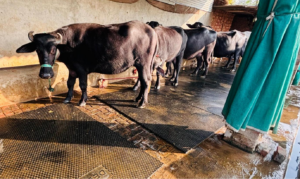
Fig. 2 & 3. Rubber mats placed in livestock houses for improved animal comfort.
Within weeks of use, farmers reported:
- Improved standing stability
- More comfortable resting behaviour
- Reduced hock abrasions
- Cleaner udders and flanks
- Better overall condition of animals
The intervention helped villagers understand that animal welfare is directly linked to productivity and profit, not just comfort. Seeing the changes firsthand increased their interest in adopting welfare-friendly practices in the long term. The initiative has created a strong foundation for promoting science-based, practical welfare practices among livestock keepers in the Model Village. The use of rubber mats is now being discussed widely within the community, encouraging farmers to share experiences and motivate others.
Conclusion
The rubber mat intervention under SCSP in Village Gujjar Herri demonstrates that even small, low-investment welfare practices can create significant improvements in livestock health, comfort, and productivity. By improving animal welfare through simple innovations, rural households can secure better economic returns, healthier herds, and sustainable dairy practices for the future.