




Optimizing Water Management in Poultry: Understanding the Role of pH
Dr. S.Navaneetha Krishnan,
Animal Nutritionist, Dindigul dist, Tamilnadu.
Introduction:
Water management for poultry operations is a subject of much conversation between growers, veterinarians and live production personnel. Water is a crucial nutrient for poultry, as it accounts for 70% of their body weight and is essential for many physiological functions, such as digestion, temperature regulation and waste excretion. However, the quality of the water can have a significant impact on the health and productivity of the birds. One critical aspect of water quality is pH, which can affect the availability and absorption of nutrients, as well as the growth and survival of microorganisms in the bird’s digestive tract.
- Water is the most essential nutrient for poultry.
- Water is a medium for transporting nutrients along the gastrointestinal tract.
- Water plays an important role in regulating body temperature and is a component of many basic chemical reactions.
- Good quality water is very important for good digestion and to create a healthy gut flora, which will help the bird to absorb all the essential nutrients.
- Constant monitoring of drinking water pH & coliform count is essential.
- It is important for water to remain hygienic all the way until it reaches the birds.
- Water lines should be thoroughly cleaned and sanitized at regular intervals.
The usage of water acidification as a preventive or treatment tool for disease management or to improve bird performance is probably one of the most poorly understood areas of poultry husbandry. This stems partly from the fact that until recently, no controlled research had been done investigating the preferred pH for poultry water consumption. Water acidification protocols for the prevention or management of certain bacterial diseases had been developed, but in many instances required a drinking water pH at bird level of 4.0 or below to be effective. Due to the lack of solid information on what type of water turkeys and chickens preferred, many within the industry were reluctant to acidify the drinking water to those biologically effective low levels. A high-pH crop environment (pH greater than 7.0) favors microflora that can hurt poultry performance. Poultry water treatment through acidification of the drinking water acidifies the crop, thereby encouraging the growth of favorable microflora while discouraging microflora that can harm intestinal integrity and function. Water acidification is most critical during the establishment of intestinal microflora and at each feed change when nutrient shifts can create instability in the normal intestinal microflora ecology. Using an animal feed grade mineral acid such as sodium bisulfate (PWT® water acidifier, Jones-Hamilton Co.) to reduce the pH of drinking water to 4.0 during the critical periods of intestinal development helps the birds maintain the stability of intestinal microflora throughout the growing period. The establishment and maintenance of healthy intestinal microflora improves live production performance and cost.
How Crop Acidification Works?
The reduction of Salmonella, Staph and Clostridium at the farm level focuses on creating a hostile environment to reduce horizontal spread from bird to bird and to reinforce the bird’s natural protection mechanisms. This is most critical when the birds are first placed into the house, when they are moved into the whole house or to the growout barn, and when they are withdrawn from feed.
Acidifying drinking water for poultry with sodium bisulfate for the first seven days of life provides a second layer of protection to the lactic acid producing bacteria (LAPBs) that are part of the crop’s normal ecology. This helps the newly hatched poult to maintain a low crop pH until it has established its own population of stable LAPBs. A low crop pH reduces the number of Salmonella or Clostridium that pass farther along the digestive tract and enables the bird to colonize with normal gut flora first. Once the crop’s LAPB population has been established, the bird will be able to maintain a low crop pH on its own as long as feed is available. When feed is withdrawn or turkeys are not eating for any reason, the normal population of LAPBs dies off and Salmonella will multiply in the crop. Acidifying the drinking water to a pH of 3.5 or below during times when feed is not available will prevent the crop pH from becoming too high.
Advantages of Using Water Acidifiers:
- Improvement of Nutrient digestibility. (Protein, Ca & P in early ages).
- Significantly increases the villus width, height in the duodenum, jejunum, and ileum of chicks.
- Improves digestive enzyme activity and Litter quality.
- Improves H.H eggs by decreasing soft shelled eggs plus broken eggs% (Less porosity).
- Decreased mortality% and good uniformity in Chicks & growers.
- Improves external egg qualities like egg weight, egg colour and egg diameter.
- Reduces number of soiled eggs in daily production.
- To have an efficient disinfection with chlorine, decrease the PH.
- It increases the quality of litter.
By reducing the pH of water, Acidic pH creates an environment that promotes optimal digestion and microbial balance in the gastrointestinal tract. This leads to improved feed utilization, resulting in optimal weight gain and an enhanced feed conversion ratio.
Acidification is a vital component of our health program, designed to maintain microbial balance, reduce antibiotic usage, and enhance animal performance. Acidic pH is your ultimate solution for effective litter management.
Effective litter management is crucial for optimal animal nutrition. Proper litter management practices ensure a clean and healthy environment for animals, reducing the risk of contamination and disease. By maintaining clean and dry litter, for better hygiene, minimize bacterial growth, and enhance feed safety.
Relationship of pH and Sanitisation (Chlorination):
- Chlorination becomes even more effective when combined with a proper approach to water pH.
- pH is an important factor in making sure the chlorine is an effective disinfectant.
- The relationship between pH and the balance of the forms of chlorine is shown below in the graph and table.
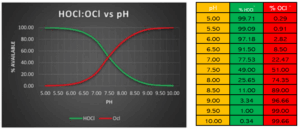
Relationship between pH and the balance of the forms of chlorine
Chlorination becomes even more effective when combined with a proper approach to acidification. Chlorine reaction (HOCl ↔ OCl- + H+) is pH dependent. At a pH 5 to 6, the chlorine species is nearly 100% hypochlorous acid (HOCl) and highly effective at killing bacteria. Above pH 6, it starts to convert to the hypochlorite ion (OCl-) and acts mainly as an oxidizer. Water with a pH ≥ 7 may need to be lowered for chlorine to achieve optimal bacteria-killing efficacy.
Necessary Characteristics to Acidify Water without Affecting Consumption :
A target pH of 3.5-4.0 is critical for bacterial control programs to work. Therefore, it is important to choose a mineral acid that birds will drink readily at that low pH. If the birds refuse to drink the water at the proper pH for crop acidification, the program will not work.
PWT® water acidifier is the first FDA approved feed grade mineral acid water treatment available to the poultry industry. Due to the unique chemistry of PWT®, the consumption of treated water is not decreased at higher concentrations as has been reported for organic acids. This advantage gives producers the flexibility for administration in a wide range of applications in all livestock and poultry species. All of the acids currently marketed to the poultry industry are weak organic acids, i.e. citric, acetic, lactic, that have poor taste profiles and limited pH reducing capabilities. Because PWT® has a low pKa, it has a cleaner taste profile and profound acidification properties that should overcome all of the issues of using the weak organic acids. An organic acid is an acid that has carbon in it such as lactic, acetic (vinegar) or proprionic acids. Organic acids are often characterized as being sour due to their pKa being above the solution pH (a lazy acid). Some suggest that organic acids will work anyway at a high pH but research on bacterial killing ability shows that final pH is the determining factor and not organic acid concentration. Field experience seems to support this as the final pH at bird level seems to be the determining factor of efficacy rather than organic acid concentration.
The ability to significantly reduce water pH without impacting water consumption is also of great advantage in cleaning water lines during the flock. The periodic cleaning of water lines with birds in the house is very desirable especially in areas with high levels of iron in the water. The use of organic acids to clean the water lines with birds in the house results in decreased water consumption during the cleaning period. With PWT® water acidifier, the lines can be cleaned frequently without negatively impacting bird health or performance. In most houses a shift in pH is sufficient to clean the lines. In houses with iron water, the pH of the water at bird level should be a 4.0 or less during cleaning in order to reduce the negative impact of the iron content.
Conclusion :
Finally, it is critical to use an animal feed grade or human food grade acid in the drinking water. Industrial grade liquid acids are not approved by FDA for animal consumption. PWT® water acidifier contains Sodium Bisulfate Animal Feed Grade and is produced under the guidelines for “Manufacturing, Packaging and Distribution of Animal Feeds and Feed Ingredients.” It is produced in a manner that assures the quality required for consumption by food-producing animals and meets requirements that are necessary to minimize the potential for contamination. PWT® is approved by the FDA for use in animal feed and water.















