

Preventing the next Pandemic: Strengthening Veterinary Public Health Systems
P.V. Patil* and M. K.Patil
College of Veterinary and Animal Sciences, Udgir Dist. Latur, Maharashtra-413517
*Corresponding author: drpv9ann@gmail.com
Abstract
Given the interdependence of environmental, animal, and human health, strengthening veterinary public health systems is essential to averting future pandemics. This entails improving communication, risk reduction, capacity building, research, and surveillance within a One Health framework. The deadly Coronavirus Disease 2019 (COVID-19) pandemic has shown how important it is to diagnose candidates with pandemic potential early. However, the enormous and quickly changing number and species of microorganisms make it impractical to perform complete metagenomic sequencing of the entire microbiome. According to an analysis of past pandemics, the main causes of pandemic emergence include increased human-animal interactions, shifting animal and arthropod distributions brought on by climate change and deforestation, ongoing RNA virus mutations and interspecies jumping, and frequent travel. Key strategies include enhanced surveillance for early disease detection, research on zoonotic diseases, capacity building for professionals in the One Health approach, risk reduction to minimize pathogen spillover, and effective communication to raise public awareness. These measures foster collaboration across sectors, significantly enhancing our ability to respond to potential outbreaks and safeguard both human and animal health. In conclusion, strengthening veterinary public health systems through enhanced surveillance, research, and intersectoral collaboration is crucial for preventing future pandemics, as evidenced by the COVID-19 crisis. By adopting a One Health approach, we can effectively address the interconnected challenges of environmental, animal, and human health, ultimately safeguarding our societies against emerging infectious threats.
Keywords: Human-animal interaction, One health, Pandemics, Strengthening, Veterinary Public health
Introduction
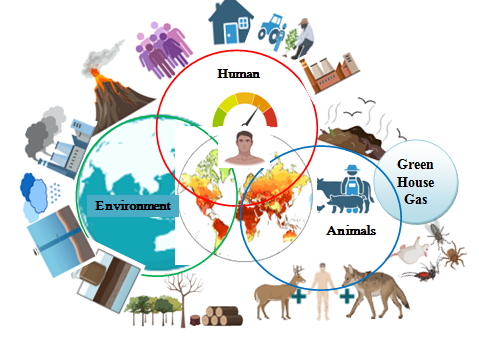
The advent and worldwide spread of avian flu, COVID-19, and other zoonotic illnesses have brought attention to the interdependence of environmental, animal, and human health. This idea, called One Health, emphasizes how important it is for all sectors to work together in order to stop pandemics in the future. Conventional public health approaches frequently concentrate on human health separately, ignoring the intricate interactions between environmental variables, animal health, and the genesis of zoonotic illnesses (diseases that can spread from animals to people). A more comprehensive and proactive approach to pandemic prevention is provided by the One Health concept.
Pathogens can cross the species barrier as a result of human activities like deforestation, intensive livestock farming, and the wildlife trade. These diseases have the potential to cause outbreaks with disastrous outcomes when they come into contact with vulnerable human populations. For example, the Nipah virus most likely started in fruit bats and spread to people via tainted date palm sap. In a similar vein, it is believed that the Hendra virus first infected fruit bats before spreading to horses and finally humans.
These examples demonstrate the inadequacies of a fragmented approach to public health. Early warnings of zoonotic dangers are missed by fragmented surveillance systems that only concentrate on human diseases. The veterinary and public health sectors are unable to coordinate their responses due to a lack of communication. Furthermore, we are insufficiently prepared for new infections because to a lack of funding for One Health research and development.
Through the preservation and development of animal resources, veterinary services enhance rural livelihoods and contribute to global food security, ultimately lowering poverty and hunger. By tackling “risk at source” for new pandemic threats, antibiotic resistance, and food safety emergencies, they also have an extra positive impact on global health security. For these strong reasons, bolstering the livestock industry with investments in national animal health systems founded on international norms and “good governance” principles encourages and protects commerce while also fostering the growth and well-being of all communities, both local and global.
Some recent instances of zoonotic infections that can be lethal are swine flu, SARs, MERs, and Ebola. The threat to human health is not limited to pandemic outbreaks. Brucellosis, bovine tuberculosis, and rabies are just a few of the diseases that people contract on a daily basis and, regrettably, many of them result in death.
75% of newly discovered illnesses have already been spread from animals, and 61% of all human infections already originate from animals. It is hard to imagine what it will cost of the next pandemic that we will cause if we do not invest in animal health systems.
Animals play a significant role in the lives of millions of people in the global south. Livestock and companion animals share their homesteads and diseases with humans. We often overlook this intimate connection until something goes wrong, like the COVID-19 pandemic.
The One Health program, which unites interdisciplinary teams in environmental, animal, and human health, currently has animal health systems as its weakest link.
The potential of people, communities, and entire nations is hampered by zoonotic diseases and epidemics like COVID-19, which are the result of poor and middle-income countries’ lack of investment in veterinary services and veterinary public health.
The World Organization for Animal Health states that “livestock and veterinary services are chronically under-resourced against all comparative measures.” Uncontrolled diseases and significant livestock losses are caused by underfunded veterinary services that are also poorly staffed and organized.
In light of this, there are a number of methods we can stop pandemics and other international health emergencies in the future. We can strengthen the Animal Healt systems to prevent future pandemics by following ways.
Integrated Monitoring of Diseases:
- It is crucial to create and put into place reliable surveillance systems that keep an eye on both human and animal populations.
- Monitoring the development and dissemination of zoonotic illnesses in diverse animal populations (livestock, wildlife, and companion animals) is part of this.
- Better data gathering and analysis can aid in the early detection of disease outbreaks, allowing for prompt response.
- To improve our capacity to anticipate and take preventative action against zoonotic disease outbreaks, a strong scientific foundation is necessary. Such a framework ought to involve the methodical collection and thorough comprehension of data pertaining to the complexities of disease genesis and transmission. This offers comprehensive insights into the ecological, sociological, demographic, and genetic factors that contribute to the spread of zoonotic infections to human hosts. These scientific methods are essential for creating a comprehensive plan for early outbreak identification and containment, which improves readiness to foresee, stop, and address potential zoonotic disease risks in the future.
Development and Research:
- It is crucial to fund research on zoonotic illnesses, including their causes, modes of transmission, and potential for outbreaks in humans.
- Creating efficient vaccines, tests, and therapies for various illnesses is part of this.
- Understanding the ecological and environmental elements that influence the origin and spread of zoonotic infections should also be a major area of research.
Developing Capacity: To create a workforce capable of handling zoonotic illnesses, education and training are essential. This includes educating veterinarians, environmental scientists, and human health professionals about the concepts of One Health. Enhancing capabilities in disease surveillance, laboratory diagnoses, and epidemic response is also crucial.
Risk Mitigation and Reduction: It is crucial to put policies in place that lower the risk of disease onset, spread, and spillover. This entails encouraging ethical animal husbandry methods, minimizing human-animal contact in high-risk regions, and controlling wildlife populations to prevent the spread of disease. It’s also critical to fortify biosecurity protocols at farms and other animal facilities.
It is also important that we must train more veterinarians and veterinary paravets to meet the OIE competency frameworks’ standards. These professionals offer communities with basic animal health care and advice when trained veterinarians are not available. This essential workforce is in short supply worldwide. By preventing, diagnosing, treating, and monitoring zoonotic diseases, these experts are on the front lines of the battle. Through our animal health mentorship framework, Brooke has trained more than 4,000 animal health professionals throughout the years, which is a noteworthy accomplishment. However, programs such as these must be expanded as other organizations implement the framework.
A list of necessary veterinary medications that are comparable to those used for human health care must be established. To guarantee that animal health experts can treat and vaccinate animals to maintain high standards of health, it is necessary to monitor access to and the quality of these vital veterinary medications. Inappropriate use and poor quality antibiotics are the main causes of antimicrobial resistance.
The surveillance activities of veterinary public health organizations and laboratories must be supported. Reagents, facilities, and training are necessary in laboratories. We can develop models to anticipate and prevent the spread of human diseases by better monitoring animal illnesses. Governments and other public bodies could use this information to take preventative measures, such tighter regulations on cattle transportation or higher hygienic standards. To protect investigators’ health and avoid unintentional exposure, biosafety procedures must be given top priority. Strong biosecurity procedures also guarantee the safe handling and containment of harmful microorganisms, lowering the possibility of misuse or purposeful harm. Standardized laboratory protocols promote smooth staff collaboration and guarantee uniformity and dependability in diagnostic procedures. These protocols should be flexible enough to adjust to changing research requirements by guaranteeing thorough and quick diagnostic procedures.
Nanotechnology is one of the newest and most promising approaches to help fight antimicrobial resistance in animals. It can offer a solution that is more effective than traditional antibiotics when it comes to the development of new antimicrobial drugs, targeted drug delivery systems, and alternative treatments for antibiotic resistance. Many metal nanoparticles, including copper, zinc oxide, gold, and silver, are highly effective at combating infections. Furthermore, they can produce reactive oxygen species, destroy pathogen cell walls, and block important metabolic pathways to produce effective antibacterial actions.Because nanoparticles have several characteristics that traditional antibiotics do not, they can efficiently combat a variety of drug-resistant bacteria and get around drug resistance. Additionally, antibiotics may be delivered to the infection site in a targeted manner via nanodrug delivery systems including nanocapsules, nanoliposomes, and nanomicelles, which would lower the dosage that the patient must take and the likelihood of drug side effects.
There is obviously more to be done, but at the moment, we risk failing if we disregard animal health systems. We can guarantee that qualified veterinarians and paravets can reach communities with necessary medications and a degree of competence to prevent and treat animal infections if governments, international organizations, training institutions, non-governmental organizations, and other stakeholders work together. In this manner, we can safeguard everyone from dangerous infections like COVID-19 while simultaneously enhancing the health and welfare of animals and lessening the effects of endemic zoonotic disease.
Conclusion
In conclusion, the One Health approach underscores the critical need for integrated efforts across environmental, animal, and human health sectors to effectively combat zoonotic diseases and prevent future pandemics. By investing in robust animal health systems and fostering interdisciplinary collaboration, we can enhance global health security, safeguard communities, and mitigate the risks posed by emerging infectious diseases.
References
Chiu, K. H., Sridhar, S., and Yuen, K. Y. (2023). Preparation for the next pandemic: challenges in strengthening surveillance. Emerging microbes & infections, 12(2), 2240441. https://doi.org/10.1080/22221751.2023.2240441.
Carroll, D., Morzaria, S., Briand, S., Johnson, C. K., Morens, D., Sumption, K., Tomori, O. and
Wacharphaueasadee, S. (2021). Preventing the next pandemic: the power of a global viral surveillance network. BMJ 372 :n485 doi:10.1136/bmj.n485.
Gostin, L.O., (2021). 9 Steps to End COVID-19 and Prevent the Next Pandemic: Essential Outcomes From the World Health Assembly. JAMA Health Forum, 2(6):e211852. doi:10.1001/jamahealthforum.2021.1852
Klara Saville (2020). Opinion: Support animal health systems to prevent the next pandemic. https://www.devex.com/news/opinion-support-animal-health-systems-to-prevent-the-next-pandemic-96798.
Morse, S. S., Mazet, J. A., Woolhouse, M., Parrish, C. R., Carroll, D., Karesh, W. B., Zambrana-Torrelio, C., Lipkin, W. I., and Daszak, P. (2012). Prediction and prevention of the next pandemic zoonosis. Lancet (London, England), 380(9857), 1956–1965. https://doi.org/10.1016/S0140-6736(12)61684-5
Sadr, S., Santucciu, C., Chisu, V., Lotfalizadeh, N., Nazemian, S., Esfandiari, N., Hajjafari, A., Sepahvand, H., Rahdar, A., Pandey, S. and Borji, H. (2025), Pandemic Prevention Paradigms: Understanding Global Health Governance. Public Health Chall., 4: e70051. https://doi.org/10.1002/puh2.70051
Sharan, M., Vijay, D., Yadav, J. P., Bedi, J. S., and Dhaka, P. (2022). Surveillance and response strategies for zoonotic diseases: A comprehensive review. Science in One Health, 2, 100050. https://doi.org/10.1016/j.soh.2023.100050.
Tajudeen, Y. A., Oladipo, H. J., Oladunjoye, I. O., Mustapha, M. O., Mustapha, S. T., Abdullahi, A. A., Yusuf, R. O., Abimbola, S. O., Adebayo, A. O., Ikebuaso, J. G., Adesuyi, D. S., Okereke, B., Omotosho, A. O., Ahmed, A. F., & El-Sherbini, M. S. (2022). Preventing the Next Pandemic through a Planetary Health Approach: A Focus on Key Drivers of Zoonosis. Challenges, 13(2), 50. https://doi.org/10.3390/challe13020050.