

Doubling Farmers’ Income through Integrated Dairy Farming Systems
Dr.A.V.Joseph Ayyadurai, M.V.Sc., MBA., PGDRD., PGCVH.
Abstract:
The goal of doubling farmers’ income in India can be realistically achieved through Integrated Dairy Farming Systems (IDFS)—a holistic, sustainable model that combines dairy farming with allied activities such as fodder cultivation, biogas production, manure management, and value-added dairy processing. This approach not only reduces input costs but also diversifies income sources. A crucial, cost-effective element within this system is the use of Veterinary Homoeopathy for the treatment, prevention, and breeding of dairy animals. Homoeopathic medicines, being natural, affordable, and free from residues, offer significant advantages over conventional allopathic treatments, including reduced veterinary expenses, no milk withdrawal period, and improved reproductive health. Real-life success stories from Tamil Nadu demonstrate the practical benefits of integrating homoeopathy into dairy farming, such as improved animal performance and enhanced profitability. With proper training, institutional support, and policy incentives, IDFS combined with Veterinary Homoeopathy can empower small and marginal farmers, making the vision of income doubling both achievable and sustainable.
Keywords:Integrated Dairy Farming Systems (IDFS), Veterinary Homoeopathy, Doubling Farmers’ Income, Cost Reduction, Reproductive Efficiency, Value Addition, Biogas Production, Fodder Cultivation, Eco-friendly Farming.
Introduction
Agriculture remains the backbone of India’s economy, and dairy farming is a crucial component that supplements the income of millions of farmers. Despite its importance, farmers often face fluctuating prices, high input costs, and poor access to veterinary services, which adversely affect their income. To address this, the Government of India envisioned doubling farmers’ income through sustainable and integrated approaches. One such strategy is Integrated Dairy Farming Systems (IDFS)—a holistic model that integrates multiple components of farming to ensure economic stability. This essay elaborates on how IDFS, when combined with the use of Homoeopathic veterinary medicines for treatment, prevention, and breeding, can significantly reduce costs and boost farmers’ incomes.
Understanding Integrated Dairy Farming Systems (IDFS)
Integrated Dairy Farming Systems refer to a scientifically designed, multi-dimensional approach where dairy farming is not treated as an isolated activity but as a part of a broader agricultural ecosystem. The integration includes:
Livestock management (especially dairy cattle)
Fodder cultivation
Organic manure and biogas production
Value-added dairy product processing
Crop-livestock integration
Veterinary healthcare and breeding programs
These interconnected components create a circular economy, improving efficiency, reducing wastage, and increasing profitability for farmers.
The Economic Rationale for Integration
Traditional dairy farming often depends heavily on external inputs like synthetic medicines, commercial feed, and chemical fertilizers. These lead to higher operating costs. Integrated systems, on the other hand:
Recycle farm waste
Reduce dependency on expensive inputs
Improve milk yield and animal health
Provide additional income sources (e.g., manure, biogas, value-added products)
As a result, costs go down while income streams diversify, creating a sustainable path to doubling farmers’ income.
Role of Veterinary Healthcare in Farmer’s Income:
One of the major drains on a dairy farmer’s income is the cost of animal health management.
Traditional allopathic treatments can be:
Expensive
Often overused, especially antibiotics
Ineffective in chronic conditions
Associated with milk withdrawal periods leading to losses.
Poor animal health reduces milk yield, reproductive performance, and the working
lifespan of the animal.
Veterinary Homoeopathy: A Sustainable and Cost-Effective Alternative
Veterinary Homoeopathy, based on the principles of natural healing and holistic treatment, is emerging as an effective tool in animal health care. It focuses on strengthening the animal’s immunity, addressing root causes, and is non-toxic and residue-free.
Veterinary Homoeopathy: A Game-Changer in Doubling Farmers’ Income
Veterinary homoeopathy plays a crucial role in supporting the “Doubling Farmers’ Income” concept by offering an affordable, sustainable, and effective alternative to conventional animal healthcare. Here’s how:
Benefits of Homoeopathy in Dairy Farming:
1. Cost-Effective Treatment: Low Cost of Medicines: Homoeopathic medicines are significantly cheaper than allopathic drugs, reducing treatment expenses for farmers.
No Withdrawal Period: Unlike antibiotics, Homoeopathic remedies don’t require a withdrawal period, allowing uninterrupted sale of milk, eggs, or meat.
2. Prevention of Diseases
Improved Herd Health: Regular preventive Homoeopathic care boosts immunity, reducing the frequency and severity of diseases.
Disease Resistance: Animals treated with homoeopathy develop better natural resistance, especially against seasonal diseases.
3. Enhanced Productivity
Better Milk Yield: Homoeopathic remedies help treat conditions like mastitis, infertility, and metabolic disorders effectively, leading to better milk production.
Improved Reproductive Efficiency: Fertility-enhancing remedies reduce calving intervals and increase conception rates.
- Eco-Friendly and Safe
No Side Effects: Homoeopathy is gentle and safe for animals, farmers, and the environment.
Chemical-Free Animal Products: Leads to higher market value and consumer preference for organic milk and meat.
- Minimizing Losses
Reduction in Mortality and Morbidity: Timely Homoeopathic intervention can save animals from fatal conditions.
Faster Recovery: Animals recover quickly and resume normal productivity, reducing economic losses.
- Easy to Administer
No Need for Injections: Most remedies are given orally, making it easier for farmers to treat animals themselves with minimal veterinary supervision.
Can Be Stored Easily: Long shelf life and no need for refrigeration make it ideal for rural use.
- Supporting Organic and Integrated Farming
Complements Organic Dairy Farming: Homoeopathy fits well with organic practices, attracting premium markets.
Integrated Approach: Used alongside nutrition, hygiene, and good management, it maximizes animal health and farmer income.
- Reduces Dependence on Antibiotics and Hormones
Sustainable Livestock Health: Reduces the need for costly and harmful antibiotics and hormone injections.
Practical Application of Homeopathy in Integrated Systems
- Preventive Healthcare: Preventive homoeopathy can be used forMastitis prevention: Administering Phytolacca, Silicea, or Belladonna during the peripartum period, Foot-and-Mouth Disease: Variolinum and Thuja as prophylactics,
Tick-borne diseases: Regular use of Ledum Pal, Sulphur, and Arsenicum Album.
This proactive approach reduces the incidence and severity of diseases, minimizing treatment costs and production losses.
- Therapeutic Use
Mastitis treatment: Bryonia, Conium, and Silicea.
Diarrhea in calves: Aconite, Arsenicum Alb, and China.
Fever and infections: Baptisia, Pyrogenium, Gelsemium.
Chronic infertility: Pulsatilla, Calcarea Carb, Sepia.
These remedies are non-invasive, promote natural healing, and can be integrated into routine health management plans.
- Breeding and Reproductive Health
Homoeopathy supports:
Timely estrus
Improved conception rates
Healthy calving
Post-partum recovery
Using Homoeopathy in breeding management avoids costly hormonal treatments, improves conception rates, and ensures better reproductive efficiency—a key driver of productivity in dairy systems.
Integrated Components of Dairy Farming That Support Income Doubling
- Fodder Cultivation and Management
Growing high-yielding green fodder like CO-4, CO-5 reduces the need for costly commercial feed.
Integrating legumes improves soil health and animal nutrition.
Using organic manure from cow dung enhances crop yields.
- Biogas and Manure Utilization
Cow dung is used for biogas production, providing clean cooking fuel and electricity.
Slurry from biogas is a potent organic fertilizer. Vermi composting adds a revenue stream.
- Value Addition in Milk Products
Processing milk into paneer, ghee, curd, and sweets increases profit margins.
Direct marketing through self-help groups or farmer producer companies enhances earnings.
- Diversification and Risk Reduction
Integration with poultry, fishery, or goat farming provides additional income and insures against market or climatic shocks.
Case Studies: Real-Life Successes with Homeopathy in IDFS
This picture shows a pregnant Kangayam breed cow in its final stages of gestation. A few days before it was due to calve, the cow lay down and has been unable to stand up since. Despite continuous conventional (English medicine) treatment for seven days, costing over ₹5000, the cow could not stand. Subsequently, homeopathic medicine was administered. The very next day after starting homeopathic treatment, the cow attempted to stand. On the second day, it stood up with support. By the third day, it began walking on its own without any assistance. The total cost for this treatment was less than ₹500. The cow was cured in a very short time and at a low cost through homeopathic medicine.
A 3rd calved HF crossbred cow was affected by mastitis. Despite receiving allopathic treatment with antibiotic injections continuously for 10 days, there was no improvement. Instead, the condition worsened day by day, and the milk turned bloody. The allopathic treatment cost over ₹8,000. The person who provided the treatment eventually gave up and said that he could not treat the cow any further.
In this situation, the cow’s owner decided to try homeopathic treatment. On the third day of homeopathic treatment, the bloody milk slightly changed color. By the fifth day, it turned yellowish. On the seventh day, it became thick yellow. By the ninth day, the milk returned to its natural color. The entire 10-day homeopathic treatment cost only ₹500.
The cow, which was in a life-threatening condition due to septic mastitis, was not only saved through homeopathic medicine but was also completely cured. It started giving milk normally again. This helped safeguard the farmer’s economic well-being.
A 3 year old Jersey crossbred pregnant heifer had wart-like growths with a rough appearance around its left eyebrow. One month of allopathic treatment yielded no results. The owner then decided to try homeopathic treatment, and homeopathic medicines were administered continuously for 20 days. From the 15th day of treatment, the warts around the eye began to fall off one by one. Within a month, all the warts around the eye had fallen off completely. The heifer’s coat also became shiny and healthy in appearance. As a result, the value of the heifer increased.
When cows are affected by Lumpy Skin Disease (LSD), the cost of treatment using allopathic medicine is very high. Even if the disease is cured, the wounds and scars left on the skin can significantly reduce the animal’s value, leading to major financial loss. However, when treated with homeopathic medicines, the disease can be cured at a very low cost. Moreover, it also helps prevent the formation of wounds and scars.
In the case of the animal shown in the picture, homeopathic medicines were administered immediately after the onset of Lumpy Skin Disease. Within 48 hours of treatment, all the swellings on the skin had completely dried up. The animal quickly returned to its normal condition. The total cost of the homeopathic treatment was less than ₹100. As a result, the farmer was saved from a major financial loss.
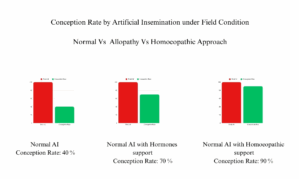
In the present times, the conception rate in dairy cows is steadily declining. Under normal field conditions, the conception rate through artificial insemination in cows is around 40%.
In allopathic treatment, when hormones are used to induce estrus or ovulation, the conception rate can reach up to 70%. However, the use of hormones can lead to many side effects, and the cost of medication is high.
In contrast, when homeopathic medicines are used, the conception rate can go up to 90%. Without any side effects and with very low expenses, homeopathic treatment does not impose a financial burden on livestock farmers. Moreover, the use of homeopathic medicines does not harm the environment.
Challenges and Recommendations
Challenges:
* Lack of awareness and trust in Homoeopathy
* Inadequate training of field veterinarians in integrated systems
* Poor market linkages for value-added products
Recommendations:
- Capacity Building: Training farmers and paravets in integrated systems and Homoeopathy.
- Research Support:Scientific validation of Homoeopathic protocols for various diseases.
- Policy Incentives:Subsidies for biogas units, value addition equipment, and Homoeopathic kits.
- Institutional Linkages:Strengthening FPOs (Farmer Producer Organizations) to market products directly.
Conclusion
Doubling farmers’ income is not an abstract goal, it is achievable through smart, integrated, and sustainable practices. Integrated Dairy Farming Systems, when implemented correctly, can transform small farms into profitable rural enterprises. Among the most promising tools within this system is the use of Homoeopathy for veterinary care—a low-cost, natural, and highly effective approach that can drastically reduce medical expenses, enhance reproductive and productive performance, and improve overall animal well-being.
By treating, preventing, and managing dairy animals with Homoeopathic medicines, farmers not only reduce their dependence on costly chemical drugs but also align with eco-friendly and consumer-safe farming practices. This synergy between tradition and science, when embedded into integrated dairy systems, holds the key to a prosperous and sustainable future for India’s farmers.
References
- Kurien, V. (2007).I Too Had a Dream. Roli Books.(Autobiography of Verghese Kurien, founder of India’s White Revolution, discussing dairy-based income models.)
- Planning Commission of India (2012).Report of the Working Group on Animal Husbandry & Dairying for the Twelfth Five Year https://niti.gov.in/planningcommission.gov.in/docs/ aboutus/committee/wrkgrp12/agri/AHD\_REPORT\_Final\_rev.pdf](https://niti.gov.in/ planningcommission.gov.in/docs/aboutus/committee/wrkgrp12/agri/ AHD_REPORT_Final_rev.pdf)
- Patil, S. L., & Nadagouda, B. T. (2013). “Impact of Integrated Farming System on Sustainability and Farmers’ Income.” Indian Journal of Agronomy, 58(3), 411–418.
- Banerjee, G.C. (2015).A Textbook of Animal Husbandry (8th Ed.). Oxford & IBH Publishing Co.(Covers principles of dairy farming, health management, and feeding.)
- Food and Agriculture Organization (FAO) of the United Nations. (2018).The future of livestock in India: Opportunities and challenges for smallholder dairy systems. [https://www.fao.org/in-action](https://www.fao.org/in-action)
- Government of India. (2018). Doubling Farmers’ Income by 2022: Strategy Document – Volume I–XII. Committee on Doubling Farmers’ Income, Ministry of Agriculture and Farmers Welfare.
[https://agricoop.nic.in/](https://agricoop.nic.in/)
- Sharma, R. et al. (2019). Role of Homeopathy in Dairy Animal Health Management.Journal of Dairy and Veterinary Sciences, 10(2), 555782.
[https://juniperpublishers.com/jdvs/](https://juniperpublishers.com/jdvs/)
- ICAR – Indian Council of Agricultural Research. (2020). Integrated Farming Systems: Models and Success Stories. [https://icar.org.in/](https://icar.org.in/)
- Kumar, R., & Parashar, A. (2021). Veterinary Homeopathy: Scope and Applications in India. International Journal of Homeopathy & Natural Medicines, 7(1), 1–7. [https://doi.org/10.11648/ j.ijhnm](https://doi.org/10.11648/j.ijhnm)
- National Dairy Development Board (NDDB).Dairy Development Vision 2030.
[https://www.nddb.coop/](https://www.nddb.coop/)