

Principles and Practices of Biosecurity in Commercial Poultry Farms
Dr Sarvadnya Ghongde , MVSc, PhD
Senior Veterinary Officer Bhalki, Dist Bidar
Abstract
The poultry industry is one of the fastest-growing sectors of animal agriculture and plays a vital role in food security, nutrition, employment generation, and rural development. However, increasing intensification of poultry production has heightened the risk of infectious diseases such as Avian Influenza (AI), Newcastle Disease (ND), Infectious Bursal Disease (IBD), Salmonellosis, Mycoplasmosis, and other economically significant infections. Biosecurity has emerged as the most effective preventive strategy for minimizing disease risks and ensuring sustainable poultry production. Biosecurity encompasses all management, operational, and physical measures designed to reduce the introduction, establishment, and spread of infectious agents within and between poultry farms. Effective biosecurity safeguards flock health, enhances productivity, supports food safety, protects public health, and strengthens the economic viability of the poultry sector.
Introduction
India is among the world’s leading producers of eggs and poultry meat, with the poultry sector contributing significantly to the national economy and nutritional security. The rapid expansion of commercial poultry farming has improved production efficiency but has also increased vulnerability to infectious disease outbreaks. Diseases can result in substantial economic losses through mortality, reduced growth and egg production, increased treatment costs, trade restrictions, and disruptions in market access.
The World Organisation for Animal Health (WOAH) identifies biosecurity as a fundamental component of disease prevention and control in poultry production systems. Preventing disease introduction is considerably more economical and effective than managing outbreaks after they occur. Consequently, biosecurity has become an indispensable element of modern poultry management and a critical tool for maintaining flock health and productivity (WOAH, 2023).
Concept of Biosecurity
Biosecurity refers to the implementation of management and physical measures designed to reduce the risk of introduction, establishment, and spread of animal diseases, infections, or infestations to, from, and within animal populations (WOAH, 2023).
The concept of biosecurity is based on three fundamental principles:
- Isolation– Preventing contact between poultry and potential sources of infection.
- Traffic Control– Regulating the movement of people, birds, vehicles, equipment, and materials.
- Sanitation– Cleaning and disinfection procedures aimed at reducing pathogen load.
Together, these principles establish multiple barriers that prevent disease-causing organisms from reaching susceptible birds.
Principles of Biosecurity in Commercial Poultry Farms
- Farm Location and Design
Farm location is a critical determinant of biosecurity effectiveness. Poultry farms should be situated away from other poultry operations, live bird markets, slaughter facilities, and areas frequented by migratory birds. Adequate separation distances reduce the likelihood of airborne transmission and indirect disease spread.
An ideal farm design should include:
- Secure perimeter fencing.
- Controlled entry and exit points.
- Clearly defined clean and dirty zones.
- Designated parking areas outside production zones.
- Efficient drainage and waste management systems.
Proper farm planning significantly contributes to disease prevention and operational efficiency.
- Controlled Access to Farms
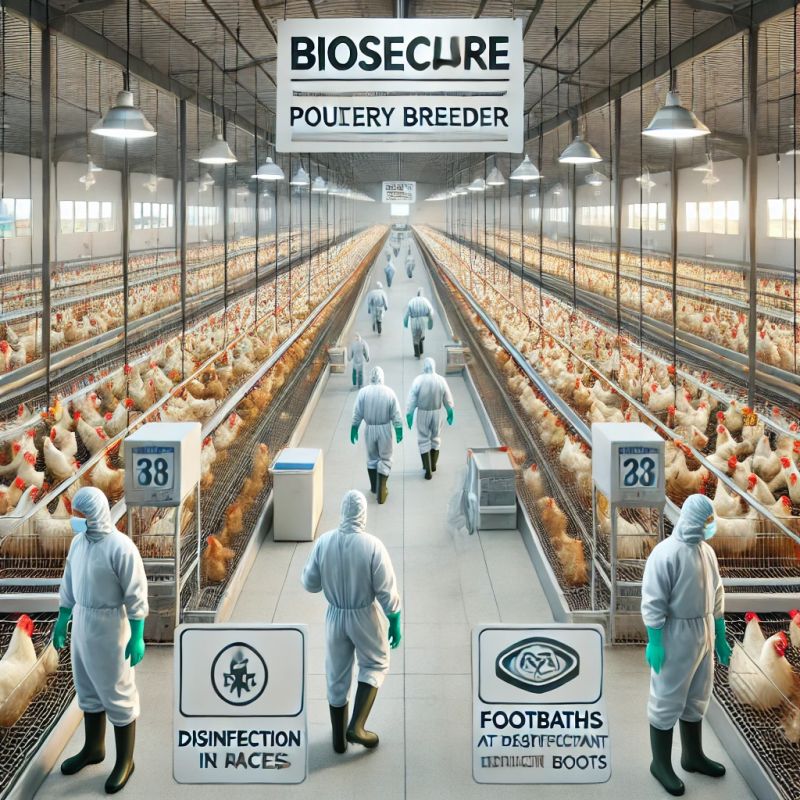
Human activity is a major pathway for pathogen transmission. Strict control of personnel and visitor movement is therefore essential.
Recommended measures include:
- Restricting unnecessary visitors.
- Maintaining visitor records.
- Providing farm-specific clothing and footwear.
- Installing disinfectant footbaths at entry points.
- Ensuring handwashing and sanitation facilities.
Personnel who have recently visited other poultry farms should observe an appropriate downtime period before entering poultry premises (FAO, 2008).
- All-In All-Out Production System
The all-in all-out system involves placing birds of the same age group together and removing them simultaneously at the end of the production cycle.
Benefits include:
- Interruption of disease transmission cycles.
- Thorough cleaning and disinfection between flocks.
- Reduced pathogen persistence.
- Improved flock uniformity and performance.
This system is widely recommended by WOAH and poultry health experts as a key biosecurity practice.
- Quarantine and Flock Segregation
The introduction of replacement birds represents a significant biosecurity risk. Newly acquired birds should be quarantined for a minimum of 2–3 weeks and monitored for signs of disease before integration into existing flocks.
Segregation should be maintained between:
- Different age groups.
- Breeder and commercial flocks.
- Healthy and diseased birds.
Effective quarantine procedures reduce the likelihood of introducing infectious agents into the farm.
- Cleaning and Disinfection
Cleaning and disinfection are essential components of disease prevention.
An effective sanitation program should include:
- Removal of litter and organic debris.
- Washing with appropriate detergents.
- Application of approved disinfectants.
- Routine cleaning of feeders, drinkers, and equipment.
- Disinfection of vehicles entering the farm.
Organic matter can significantly reduce disinfectant efficacy; therefore, thorough cleaning must precede disinfection (USDA APHIS, 2020).
- Feed and Water Biosecurity
Contaminated feed and water can serve as important sources of infection.
Recommended practices include:
- Purchasing feed from reputable suppliers.
- Protecting feed storage facilities from rodents and wild birds.
- Providing potable water.
- Conducting regular water quality assessments.
- Periodically sanitizing water distribution systems.
Maintaining feed and water hygiene is essential for optimal bird health and performance.
- Control of Wild Birds, Rodents, and Insects
Wild birds, rodents, insects, and other pests can act as reservoirs and vectors of numerous poultry pathogens.
Control measures include:
- Bird-proof poultry houses.
- Comprehensive rodent control programs.
- Elimination of stagnant water sources.
- Proper vegetation management around poultry houses.
- Installation of screens and bird nets.
Preventing contact between poultry and wild birds is particularly important for reducing the risk of Avian Influenza transmission (FAO, 2008).
- Mortality Disposal
Improper carcass disposal can facilitate disease spread and environmental contamination.
Recommended disposal methods include:
- Deep burial following regulatory guidelines.
- Rendering where facilities are available.
Prompt daily collection and safe disposal of dead birds are essential biosecurity practices.
- Vaccination and Health Monitoring
Vaccination programs should complement, not replace, biosecurity measures.
An effective flock health program should include:
- Farm-specific vaccination schedules.
- Routine health inspections.
- Monitoring feed and water intake.
- Recording mortality and morbidity.
- Laboratory confirmation of suspected diseases.
Early detection and rapid response are critical for minimizing disease-related losses.
- Record Keeping and Traceability
Accurate record keeping supports disease surveillance, outbreak investigations, and management decision-making.
Essential records include:
- Bird placement and source information.
- Vaccination schedules.
- Mortality and morbidity records.
- Medication and treatment history.
- Feed consumption data.
- Production performance records.
- Visitor and vehicle movement logs.
Traceability systems are increasingly important for disease control, food safety, and market access.
Emerging Biosecurity Challenges
The poultry industry faces several evolving biosecurity threats, including:
- Highly Pathogenic Avian Influenza (HPAI).
- Antimicrobial resistance (AMR).
- Climate change-associated disease emergence.
- Increased movement of poultry and poultry products.
- Expansion of live bird marketing systems.
Addressing these challenges requires continuous improvement of farm-level biosecurity practices and national disease surveillance systems.
Role of Veterinarians in Poultry Biosecurity
Veterinarians play a central role in the development, implementation, and evaluation of biosecurity programs.
Their responsibilities include:
- Disease surveillance and diagnosis.
- Development of farm biosecurity protocols.
- Farmer education and capacity building.
- Vaccination planning and monitoring.
- Outbreak investigation and emergency response.
- Promotion of prudent antimicrobial use.
- Implementation of One Health approaches.
Veterinarians serve as critical links between animal health, public health, and food safety systems.
Economic Benefits of Biosecurity
Investment in biosecurity generates substantial economic returns through:
- Reduced disease incidence.
- Lower mortality rates.
- Improved feed conversion efficiency.
- Enhanced egg and meat production.
- Reduced expenditure on medications and treatments.
- Improved market access and trade opportunities.
- Increased consumer confidence in poultry products.
Biosecurity should therefore be regarded as a strategic investment rather than an operational expense.
Conclusion
Biosecurity is the cornerstone of successful commercial poultry production. In the face of emerging infectious diseases, antimicrobial resistance, and expanding global trade, robust biosecurity measures are essential for protecting poultry health, public health, and farm profitability. Effective implementation requires the active participation of poultry producers, farm workers, veterinarians, industry stakeholders, and policymakers. The long-term sustainability and competitiveness of the poultry sector depend on the consistent adoption of science-based biosecurity practices. Strengthening biosecurity today will ensure a healthier, safer, and more resilient poultry industry in the future.
References
- World Organisation for Animal Health (WOAH). (2023). Terrestrial Animal Health Code: Biosecurity Procedures in Poultry Production. Paris, France. Available at: https://www.woah.org
- Food and Agriculture Organization of the United Nations (FAO). (2008). Biosecurity for Highly Pathogenic Avian Influenza: Issues and Options. FAO Animal Production and Health Paper No. 165. Rome, Italy.
- Food and Agriculture Organization of the United Nations (FAO). (2020). Good Practices for Biosecurity in the Poultry Sector. Rome, Italy.
- United States Department of Agriculture (USDA), Animal and Plant Health Inspection Service (APHIS). (2020). Biosecurity Principles for Poultry Farms. Washington, D.C., USA.
- Swayne, D. E. (Ed.). (2020). Diseases of Poultry(14th Edition). Wiley-Blackwell, Ames, Iowa, USA.
- Saif, Y. M., Fadly, A. M., Glisson, J. R., McDougald, L. R., Nolan, L. K., & Swayne, D. E. (Eds.). (2013). Diseases of Poultry(13th Edition). Wiley-Blackwell.
- McMullin, P. (2022). A Pocket Guide to Poultry Health and Disease(7th Edition). 5M Publishing Ltd., United Kingdom.
- Food and Agriculture Organization of the United Nations (FAO) & World Organisation for Animal Health (WOAH). (2023). Practical Biosecurity Measures for Poultry Production Systems. Rome and Paris.
- Ministry of Fisheries, Animal Husbandry and Dairying, Government of India. (2023). National Action Plan for Prevention, Control and Containment of Avian Influenza. New Delhi, India.
- Sharma, B., Singh, V. P., & Kumar, M. (2021). Biosecurity practices and disease prevention in commercial poultry farms: A review. Indian Journal of Poultry Science, 56(3), 201–210.