

Zoonoses and Climate Change: A Double Threat to Global Health
Dr.Shubham Sharma
Ph.D. Scholar, Livestock Production & Management
Post Graduate Institute of Veterinary Education and Research
Abstract
Zoonotic diseases and climate change pose unprecedented challenges to global health. With over 75% of emerging infectious diseases (EIDs) originating from animals and rising global temperatures due to climate change, the synergy between these phenomena threatens not only human health but also food security and biodiversity. This paper reviews the mechanisms through which climate change exacerbates zoonotic disease risks, with a focus on India, and emphasizes the critical role of the One Health approach in mitigating these compounded threats.
Introduction
The World Health Organization (WHO, 2022) estimates that over 61% of known human infectious diseases are zoonotic, and nearly 75% of emerging infectious diseases originate from animals. Concurrently, anthropogenic climate change has led to a global average temperature rise of 1.1°C above pre-industrial levels (IPCC, 2023). The convergence of zoonotic disease emergence and climatic shifts forms a potent threat multiplier, destabilizing public health, ecosystems, and agricultural systems.
Zoonoses
Zoonoses are infectious diseases transmitted between vertebrate animals and humans. These diseases may be:
- Viral (e.g., Nipah virus, avian influenza)
- Bacterial (e.g., brucellosis, tuberculosis)
- Parasitic (e.g., toxoplasmosis)
- Fungal (e.g., histoplasmosis)
Key Statistics:
- FAO-OIE-WHO Tripartite Report (2021): Over 70% of recent epidemics are zoonotic in origin.
- ICMR (2023): Brucellosis seroprevalence among dairy workers rose from 3.2% in 2015 to 6.1% in 2022.
- Leptospirosis incidence in South India exceeds 1000 cases per million annually during monsoons.
Climate Change as a Catalyst for Zoonotic Outbreaks
Climate change influences zoonotic disease dynamics through multiple ecological pathways:
Expansion of Vector-Borne Diseases
- WHO reports dengue is now endemic in 129 countries.
- IPCC (2022): Mosquito vectors have expanded into new altitudes and latitudes.
Shifts in Wildlife Migration
- WOAH data shows a 25% global increase in avian influenza outbreaks (2020–2024).
- India reported outbreaks in 15 states in 2021, primarily linked to migratory birds.
Waterborne Diseases and Flooding
- Increased flooding events promote diseases like leptospirosis, cholera, and cryptosporidiosis.
- Post-2020 Assam floods, over 1000 cases of leptospirosis were reported (NVBDCP, 2020).
Wildlife Displacement and Nipah Virus
- Nipah virus outbreaks in Kerala (2018, 2021) were associated with fruit bat migration triggered by unseasonal weather and flowering patterns
India: A Zoonotic and Climatic Hotspot
India’s tropical climate, dense population, and agrarian economy create a high-risk environment for zoonotic outbreaks:
- Over 50% of the population depends on agriculture and livestock (NITI Aayog, 2023).
- Rising incidence of Japanese encephalitis, scrub typhus, brucellosis, and leptospirosis (ICMR, 2023).
- ICAR-NIVEDI (2022) disease risk maps identify Uttar Pradesh, Bihar, Odisha, and Kerala as high-risk zones.
One Health: An Integrated Response
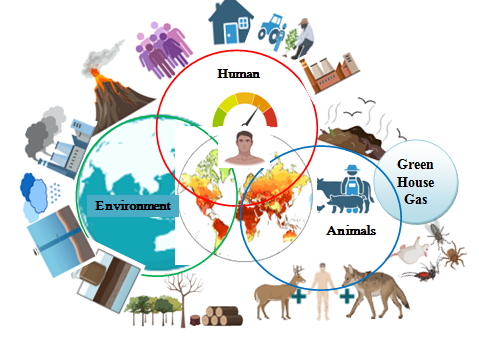
The One Health approach integrates human, animal, and environmental health to manage zoonotic and climate-related threats.
Recommended Strategies:
- Develop integrated disease surveillance systems incorporating meteorological data.
- Establish climate
Conclusion
- Zoonoses and climate change are interconnected global crises. The rise in zoonotic outbreaks, driven by ecological disruptions, is further amplified by climate change. Addressing this challenge requires early warning systems, strengthened veterinary services, inter-disciplinary collaboration, and public health education.
A unified, science-based and policy-backed “One Health” approach is not just desirable—it is essential to prevent the next pandemic.
References
- WHO. 2022. “Zoonoses: Key Facts.”
- IPCC. 2023. Sixth Assessment Report – Climate Change 2023.
- FAO-OIE-WHO. 2021. Tripartite Zoonoses Guide.
- ICMR. 2023. Bulletin on Emerging Zoonotic Diseases in India.
- ICAR-NIVEDI. 2022. Livestock Disease Forecast Reports.
- National Vector Borne Disease Control Programme (NVBDCP), India.
- NITI Aayog. 2023. Status of Indian Livestock Sector.
- World Organisation for Animal Health (WOAH, formerly OIE), 2023.