



Precision Dairy Farming in the Indian Context
Martha Pasar1*, Tusoing Alphonse Houmai H2, Akanksha3
1*PhD scholar, LPM, ICAR-National Dairy Research Institute, Karnal, Haryana, 132001
2PhD scholar, DESM, ICAR-National Dairy Research Institute, Karnal, Haryana, 132001
3Subject Matter Specialist (Animal Science). ICAR-KVK, East Sikkim, Sikkim, 737102
*Corresponding author: pasarnakut@gmail.com
Abstract
In India, dairy farming is an integral part of agriculture and is the backbone of rural farmers. India stands as the global leader in milk production and total livestock population. Economic pressures, technological innovations, and consumer demands have contributed to the evolution of the global dairy industry over recent years. Dairy farming is a decision-intensive enterprise that must rely on a holistic approach to maintain a profitable system that does not compromise with consumers’ well-being, environmental impacts, and product quality. In India, the dairy industry is continuously rising and faces a shortage of skilled manpower. At present, about 20-25% milk is handled by the organized sector, and 75-80% milk is handled by the unorganized sector, so there is a need to adopt advanced technologies like precision dairy technologies for quality milk production. Precision dairy farming (PDF) aims to improve individual animal performance, well-being, and the socioeconomic status of dairy farmers. Through the “per animal approach” of PDF, a farmer can deliver better results in terms of quantity and quality for more sustainable dairy farming. The status of PDF in India is still in a juvenile stage, but there are tremendous opportunities for the betterment of the Indian dairy sector because of the rich genetic potential of the indigenous milch breeds. Certain organized farms in India’s private sector have implemented RFID-based animal identification and farm automation management systems, demonstrating that such innovations can substantially enhance farm profitability. Progressive Indian farmers will implement it on a limited scale with assistance from both governmental and commercial sectors if there is good coordination between the sectors, which will benefit the farmer as well as the economy of the Indian dairy industry.
Keywords: Dairy farmers, Indian dairy Sector, Per animal approach, Precision dairy farming.
Introduction
India is an agrarian economy, and raising of livestock, especially dairy cattle, has been an integral part of its agricultural ecosystem. India’s milk production outstands the global milk production. It contributes about 25% to the global milk production and is home to the largest dairy herd in the world. In spite of the potential and opportunities India harbors with respect to milk production, the production per unit is less. The average milk production of indigenous buffalo and cattle was 4.01 kg/day and 3.44 kg/day, respectively (BAHS, 2024). To improve the profit margin of the farmers in the dairy sector, intervention to improve production per unit is necessary. Hence, precision dairy farming, where the approach is the improvement of the lot through individual animal management, can be used to exploit the maximum production capacity of the animal. Precision livestock Farming can be defined as the collection of data from animals and their environment, by innovative, simple, and low-cost techniques, followed by evaluation of data by using knowledge-based computer models (Berckmans, 2017). “Precision Dairy Farming is defined as the use of technologies for the assessment of fine-scale animal and physical resource variability aimed at improved management strategies for optimizing economic, social, and environmental farm performance” (Eastwood et al., 2004).
Precision Dairy Farming can be the next Dairy Marvel
There has been tremendous evolution of the Global Dairy industry over the recent decades due to economic pressure, innovation in the IT sector, and the diversity in the preferences of consumers’ demands. The rate of population growth is 0.87% which is about 71 million heads per year (UN Report, 2023) and to meet the growing demand of the escalating population it has been estimated that farmers need to increase the production of animal products by 70% to meet the demand of the growing population over the next two decades (Rojas-Downing et al., 2017). The milk consumption in the country has been reported to be about 78% in rural and 85% in urban populations, respectively (CES, 2011-12). It is also reported that the total household consumption of milk and milk products was 16.1 crore tonnes during 2020, and this is expected to grow up to 26.7 crore tonnes by 2030 (IMARC, 2021). As per the annual report 2024, the market for liquid milk is projected to grow by 16% during the next 5-6 years (Annual report 2023-2024). Hence, considering the above points and taking into account the asymmetric distribution of dairy animals in the country, we can conclude that adopting and accepting the intervention of Precision dairy farming in the horizon of dairy sector will boost its productivity appreciably and hence Precision dairy farming can be the next dairy marvel.
Objectives
Precision dairy farming aims to improve the production efficiency of each animal through precise management. It helps in timely decision-making which improves the productivity and profitability of the farm. Precision dairy farming aims in production of ecologically and economically sustainable milk with respect to quality as well as in consideration to high degree of the health and wellbeing of animal and human.
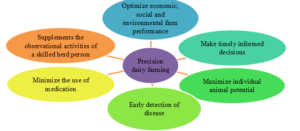
Fig 1: Objectives of Precision dairy farming
Elements of PDF
Precision dairy farming technology consists of a sensor, an algorithm, a data integration unit and a decision-making unit. Sensor records and measures the biological and physical data. Algorithm does the work of Integration of sensor data from time to time and identifies changes and variation in the data from the previous data. Integration of Data from Different sources is done by the data integration unit, and the decision-making unit helps in making the decision by the farmer.
Challenges for the adoption of PDF in India
India is an agrarian economy, with agriculture and its allied sector contributing approximately 18.2 percent to India’s Gross Domestic Product (GDP) at current prices. As per the Basic Animal Husbandry Statistics (BAHS, 2024), the proportion of small and marginal farmers in India accounts for about 85 percent. As a result of this, a huge proportion of livestock, approximately 75 percent, is found scattered across wide geographical areas (USDA, 2024). This distribution pattern makes the traceability of animals difficult, and it also becomes an obstacle to the implementation of precision livestock technologies in the country. Small and marginal farmers generally follow the system of low input and low output. In the case of precision technologies, the investment in technologies is high and has been thought to be not beneficial for small herd size because the cost of production per unit per animal will be much higher than the production cost in larger farms. In India, the adoption of precision livestock farming is still in its exploratory phase. Hence, there is less availability of information technology (IT) tools and skilled personnel. In spite of all obstacles, a few commercial farms like Lakshya dairy farm, Haryana, Sangamner milk union, Maharashtra, Chitale dairy farm, Pune, are the few farms where precision technologies have been implemented and have shown tremendous improvement in production and quality of the products. NDDB has developed an information network for animal Productivity and health (INAPH), which is an IT application that facilitates the capturing of real-time, reliable data on breeding, nutrition, and health services delivered at farmers’ doorsteps. A wireless ad hoc sensor network was developed at NDRI to monitor the behavioural changes in animals, which in turn help in the detection of heat and early diagnosis of disease (Ruhil et al., 2013).
Opportunities and risks of PDF
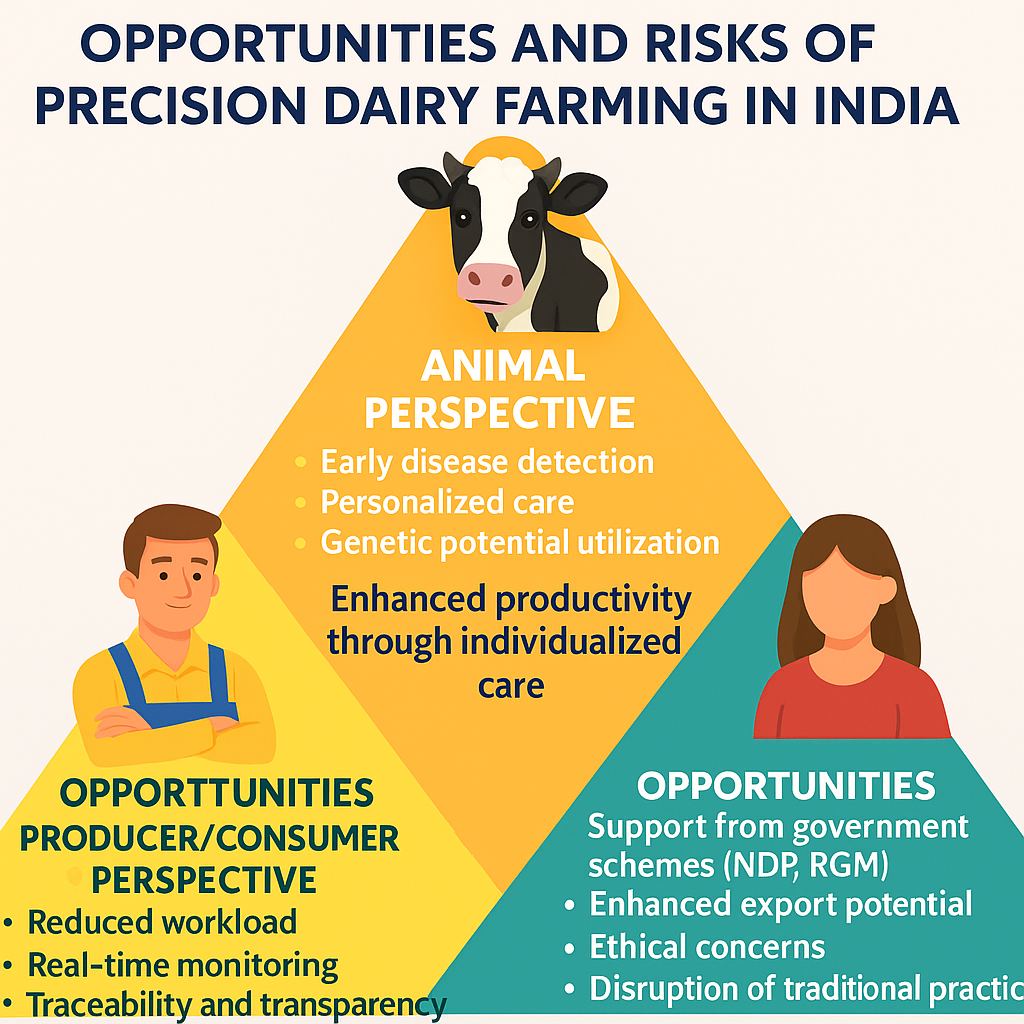
The opportunities of Precision dairy farming are vast in India because of the huge population of dairy animals, presence of animals of superior genetics in terms of milk production and disease resistance, government support and policies like National Dairy Plan (NDP), Rastriya Gokul Mission (RGM), etc, high domestic demands, and export opportunities. The risks associated with precision dairy farming are of equal importance as the opportunities. The opportunities and risks that are associated with precision dairy farming can be categorized into three types based on the perspective of the animal, consumer, and public. Precision dairy farming aims to work on individual animals as per the needs and requirements of the animal, which further brings improvement in the productivity of the herd by improving the animal husbandry practices. By assessing the changes that occur in the animal, Precision dairy farming can help in early detection and prediction of disease. However, due to the intervention of IT tools, there will be less contact between the animal and humans, as a result of which the human-animal relationship can deteriorate. There is a high chance of misinterpretation of the data due to the operator’s lack of knowledge and also due to technical errors. From the producer’s perspective, precision dairy farming will reduce the workload and provide more opportunities for analysis and benchmarking of the behaviour of animals. There will be transparency in the information about production and products to the consumer, and the traceability of the product will be improved. The intervention of precision dairy technologies can give rise to conflicts with regard to traditional norms of animal farming. There can be serious case of cyber-attacks to the farm’s confidential data and the data stored can be manipulated.
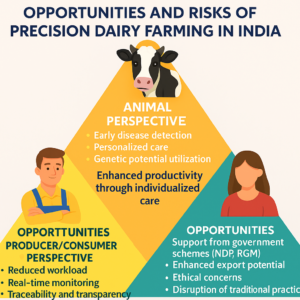
Fig 2: A Tri-Perspective Approach to Precision Dairy Farming
Strategies and Way Forward
Precision dairy farming is a multidisciplinary aspect where the expertise in one field is not enough to achieve a fruitful result. Therefore, a team of experts from different disciplines, including veterinarians, engineers, manufacturers, extension workers, and scientists, needs to come together for the purpose. Self-help groups and cooperatives can play a major role in providing the necessary tools and devices to the resource-poor farmers. Hands-on practice and demonstration of the tools and their results practically by conducting pilot studies should be executed at the farmer’s level to show the results of PDF technologies, which will encourage them to accept and adopt Precision dairy farming.
Conclusion
India has tremendous opportunities to evolve its dairy sector by adopting precision dairy technologies. The farmers and milk producers have to be exposed to the innovations in the field of the Dairy sector and their impact on the profitability margin of milk production and marketing. In an economy like India, the adoption of precision dairy farming technologies will improve the livelihood of people. There should be proper coordination between the farmers, private, and public sectors for the implementation of precision dairy farming technologies to yield the best results. Precision dairy farming is in itself a solution to many of the present-day issues with respect to animal health, milk quality, milk quantity, and animal welfare. It will improve the quality of milk as well as the management of dairy animals.
Reference
Berckmans, D. (2017). General introduction to precision livestock farming. Animal Frontiers. 7(1): 6-11.
Rathod, P. K., and Dixit, S. (2020). Precision dairy farming: Opportunities and challenges for India. The Indian journal of animal sciences. 90(8): 1083-1094.
Ruhil, A. P., Mohanty, T. K., Rao, S. V. N., Lathwal, S. S., and Subramanian, V. V. (2013). Radio-frequency identification: A cost-effective tool to improve the livestock sector. Indian Journal of Animal Sciences. 83(9): 871-879.
Rojas-Downing, M. M., Nejadhashemi, A. P., Harrigan, T., and Woznicki, S. A. (2017). Climate change and livestock: Impacts, adaptation, and mitigation. Climate risk management. 16: 145-163.
Agrawal, S., Ghosh, S., Kaushal, S., Roy, B., Nigwal, A., Lakhani, G. P., and Udde, V. (2023). Precision dairy farming: A boon for dairy farm management. Int. J. Innov. Sci. Res. Technol. 8(3): 509-518.
Singh, S. P. (2014). Precision dairy farming: the next dairy marvel. Journal of Veterinary Science and Technology. 5(02).
BAHS (2024). Retrieved from https://dahd.gov.in/sites/default/files/2024-11/BAHS-2024.pdf
UN population report (2024). Retrieved from https://population.un.org/wpp/
Annual report (2023). Retrieved from https://dahd.gov.in/sites/default/files/2024-10/AnnualReport202324.pdf















