

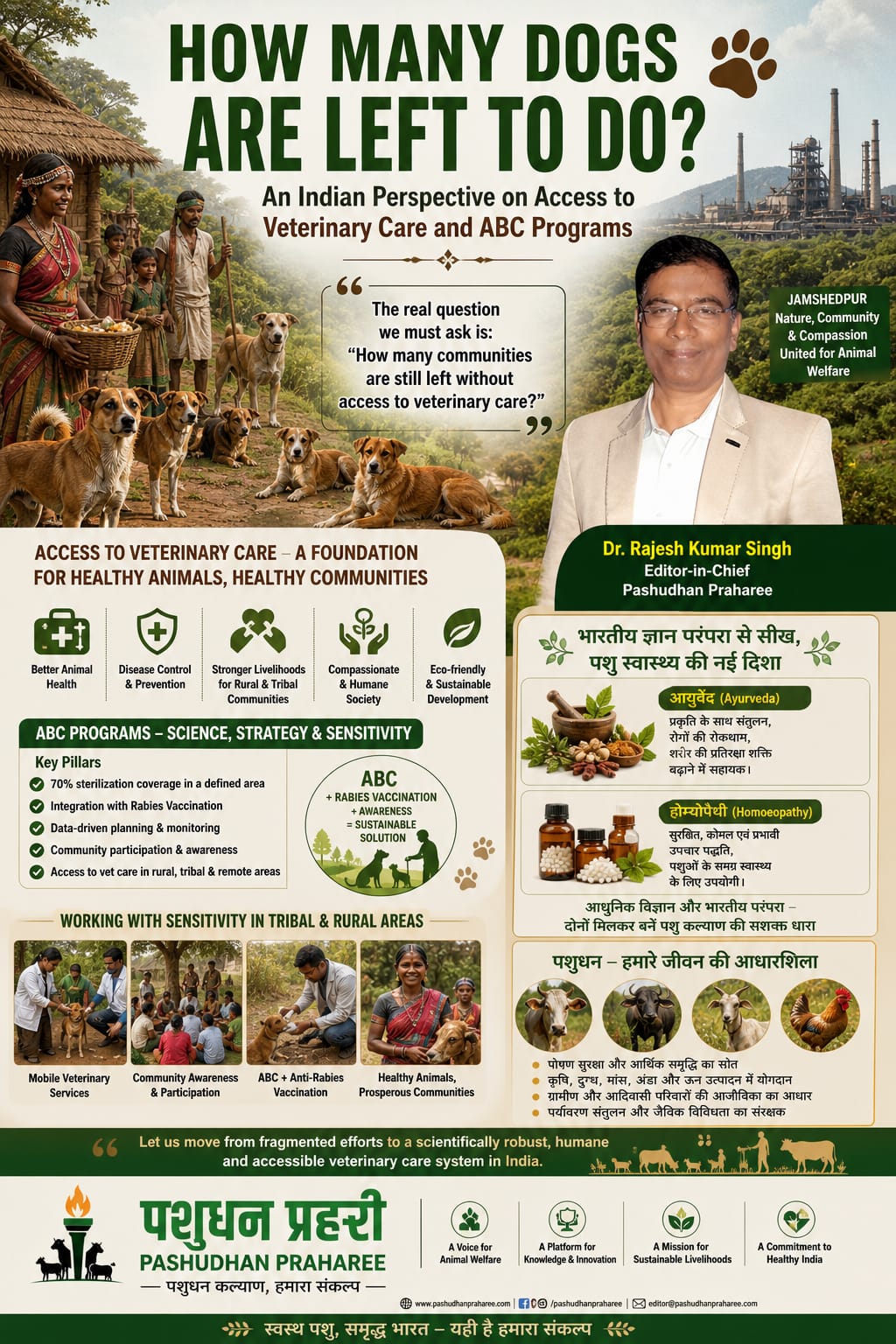
How Many Dogs Are Left to Do? – An Indian Perspective on Access to Veterinary Care and ABC Programs
The recently published article, “How many dogs are left to do?” by Dr. Ilona Otter on the Access to Vet Care platform, raises a deeply relevant and thought-provoking question for the global veterinary and animal welfare community.
🔗 https://accesstovetcare.in/how-many-dogs-are-left-to-do/
At the outset, I extend my sincere appreciation to Dr. Ilona Otter for articulating such a critical issue with clarity and scientific depth. The Access to Vet Care initiative itself deserves commendation for consistently bringing forward evidence-based discussions on one of the most neglected yet impactful aspects of animal welfare—equitable access to veterinary services.
Beyond Numbers: The Indian Reality
In the Indian context, the question “How many dogs are left to do?” goes far beyond numbers. With an estimated 70 million free-roaming dogs, India represents one of the largest and most complex ecosystems for implementing Animal Birth Control (ABC) programs.
However, the real challenge lies not in counting dogs, but in confronting a systemic gap:
👉 Limited access to veterinary care across rural and peri-urban India
👉 Inadequate infrastructure and workforce constraints
👉 Fragmented implementation of ABC programs
This makes it evident that population control strategies cannot operate in isolation.
Scientific Lens: Where Are We Falling Short?
From an epidemiological standpoint, ABC programs are effective only when at least 70% of the dog population is sterilized within a defined geographic area in a limited time span.
But in India, we must ask:
Do we have accurate baseline population data?
Are we ensuring uniform coverage across regions?
Is there integration with rabies vaccination and public health systems?
Without reliable data and integrated execution, even well-intentioned programs risk becoming numerically impressive but biologically ineffective.
The Core Issue: Access to Veterinary Care
Dr. Otter’s article rightly shifts focus to the foundational problem—access to veterinary care.
In India, this challenge manifests across five critical dimensions:
Availability – Shortage of veterinarians and surgical facilities
Accessibility – Remote and tribal areas remain underserved
Affordability – Financial limitations restrict program scalability
Acceptability – Cultural perceptions influence community participation
Accommodation – Service delivery models are often rigid and urban-centric
Unless these dimensions are addressed holistically, ABC programs will continue to face coverage gaps and sustainability issues.
A Critical Insight: ABC is Not Just Surgery
One of the most important takeaways from the article is the need to rethink ABC as a public health intervention, not merely a surgical exercise.
In the Indian field scenario, we often observe:
Underestimation of population turnover and migration
Inconsistent post-operative care and follow-up
Weak rabies vaccination linkage
Minimal community engagement and ownership
This leads to rebound population dynamics, where gains are temporary and ecosystems quickly return to baseline conditions.
The Way Forward: A Science-Based Indian Model
To make ABC programs truly effective in India, we must adopt a multi-dimensional, One Health approach:
- Data-Driven Planning
Use GIS mapping, AI-based surveys, and local enumeration for accurate population estimation.
- Strengthening Veterinary Infrastructure
Deploy mobile veterinary units, telemedicine platforms, and decentralized surgical centers—especially in tribal and remote areas.
- Integrated Implementation
Combine ABC + Rabies Vaccination + Community Awareness as a single unified strategy.
- Monitoring & Evaluation
Shift focus from “number of surgeries” to impact indicators like population stabilization and rabies reduction.
- Policy & Institutional Support
Encourage sustainable funding models and stronger coordination between municipalities, NGOs, and veterinary institutions.
Role of Platforms like “Access to Vet Care”
The Access to Vet Care platform plays a crucial role in bridging the gap between science, policy, and field realities. By highlighting global challenges and contextualizing them across regions, it enables professionals to rethink strategies and adopt evidence-based practices.
Such platforms are essential for:
Knowledge dissemination
Policy advocacy
Professional dialogue
Global collaboration
A Question That Demands Action
Dr. Ilona Otter’s article is not just a question—it is a call for systemic introspection.
As veterinary professionals in India, we must acknowledge:
👉 The success of ABC programs is not measured by surgical numbers,
👉 But by reduction in suffering, disease burden, and uncontrolled population growth.
Therefore, the real question we must ask is:
“How many communities are still left without access to veterinary care?”
Let this discussion not remain confined to academic or professional circles. I strongly urge all members of the veterinary fraternity, policymakers, NGOs, and ABC implementers to read, reflect, and share this perspective widely.
The time has come to move from fragmented efforts to a scientifically robust, humane, and accessible veterinary care system in India.
By -Dr. Rajesh Kumar Singh
Editor-in-Chief, Pashudhan Praharee