


A Historic Judgment Balancing Humanity, Public Safety, and Animal Welfare : The Hon’ble Supreme Court Upholds Constitutional Balance Between Human Life and Compassion for Animals
India’s judicial system has always stood not only as a guardian of law but also as a protector of compassion, social harmony, and constitutional values. The recent judgment delivered by the Hon’ble Supreme Court concerning stray dogs and public safety is a remarkable example of a balanced, humane, and constitutionally sensitive approach toward one of the most complex public issues of modern urban India.
This case was never merely about “humans versus animals.” Rather, it concerned a far deeper constitutional and ethical question — how to harmonize compassion for animals with the fundamental right of citizens to live safely, freely, and with dignity under Article 21 of the Constitution of India.
After extensive deliberations and careful consideration of arguments from all stakeholders, the Hon’ble Supreme Court adopted a thoughtful and balanced position. The Court acknowledged that while India’s civilizational ethos strongly supports kindness and humane treatment toward animals, the protection of human life, health, and public safety remains a paramount constitutional obligation.
The judgment recognized that the issue of stray dog management is not merely an animal welfare concern, but also one involving public health, urban governance, environmental balance, institutional safety, and constitutional rights.
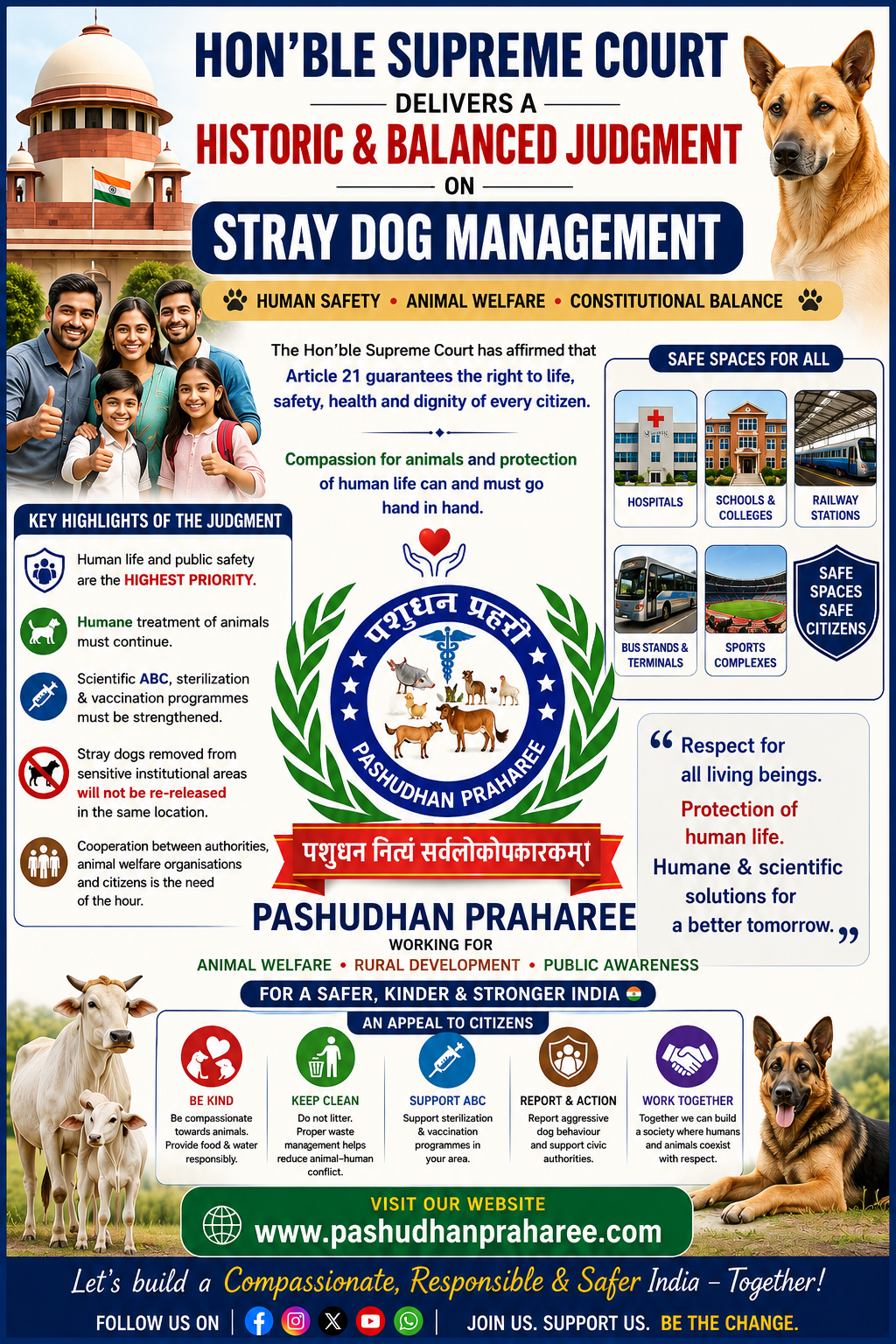
In particular, the Court made important observations regarding sensitive public spaces such as hospitals, schools, colleges, sports complexes, railway stations, bus terminals, and other institutional premises that are accessed daily by millions of citizens, including children, patients, elderly individuals, and vulnerable sections of society. The Court rightly emphasized that such spaces are expected to remain secure, hygienic, and free from avoidable risks.
The Hon’ble Supreme Court further clarified that the Animal Birth Control Rules, 2023 cannot be interpreted as granting an unrestricted or perpetual right to stray dogs to remain within every category of institutional or restricted-access premises. The Court held that the purpose of the statutory framework is humane and scientific population management — not the unrestricted occupation of sensitive public spaces.
Importantly, the Court also gave full consideration to the concerns raised by animal welfare organizations, animal lovers, and veterinary experts. Their arguments regarding the Capture-Sterilise-Vaccinate-Release (CSVR) model, rabies control, ecological balance, and humane coexistence were carefully recorded and examined in detail.
This is precisely what makes the judgment historic and commendable — it does not reflect hostility toward animals, nor does it dismiss the sentiments of animal lovers. Instead, it reflects judicial maturity and constitutional wisdom by recognizing that public safety and humane animal management must coexist in harmony.
The Court rightly observed that Article 21 guarantees citizens not merely survival, but the right to live with dignity, safety, unhindered mobility, and access to secure public spaces. The concerns of children, elderly persons, patients, differently-abled citizens, and economically vulnerable groups were appropriately given significant constitutional importance.
Today, India faces a growing challenge of dog-bite incidents, rabies exposure, and increasing human-animal conflict in both urban and rural areas. Thousands of people, especially children, suffer dog attacks annually, while livestock losses due to stray dog predation have also become a matter of concern in several regions. In this context, the judgment serves not only as a legal determination but also as a wake-up call for authorities to adopt scientific, humane, and administratively practical solutions.
At the same time, the judgment strongly reinforces that no solution can be based on cruelty, violence, or inhumane treatment of animals. India’s cultural and ethical traditions are deeply rooted in compassion, non-violence, and respect for all living beings. Therefore, the true spirit of this judgment lies in balancing compassion for animals with the constitutional necessity of protecting human life and public order.
Significantly, the Hon’ble Supreme Court nowhere endorsed cruelty against animals. On the contrary, the Court specifically emphasized that all measures adopted by authorities must remain “humane, lawful and effectively implemented.”
This judgment should therefore be viewed as an opportunity — not a conflict. It calls upon municipal authorities, policymakers, veterinary professionals, public health experts, animal welfare organizations, and citizens to work collectively toward sustainable solutions, including:
Strengthening scientific Animal Birth Control (ABC) programmes
Expanding rabies vaccination coverage
Improving urban sanitation and waste management
Ensuring safe public spaces for citizens
Preventing cruelty toward animals
Promoting responsible and humane coexistence between humans and animals
The need of the hour is not confrontation, but cooperation. The concerns of animal lovers and the safety of ordinary citizens are not mutually exclusive. Both are essential components of a civilized, compassionate, and constitutionally governed society.
The Hon’ble Supreme Court’s judgment may well become a landmark foundation for future policy reforms concerning public safety, animal welfare, urban governance, and humane stray animal management in India. It reminds us that true compassion must always be accompanied by responsibility, practicality, and a broader commitment to public welfare.
Once again, India’s judiciary has demonstrated that justice is not merely the interpretation of statutes, but the careful balancing of competing rights, responsibilities, and humanitarian values for the greater good of society.
The Hon’ble Supreme Court’s judgment

The Hon’ble Supreme Court’s judgment on stray dogs and stray Animals