

Diversified Poultry Farming: The Next Frontier for Food security, Rural Prosperity and sustainability
Dr. Abhijeet Champati1, Dr. Venus Das2, Dr. Vanlalhmangaihsanga2, Dr. Nanda K. Roy2 and Dr. V. Keerthi2
1Assistant Professor, Department of Livestock Farm Complex, IVSAH, SOADU, Bhubaneswar-751003, Odisha, India
2Assistant Professor, Department of Livestock Production Management, IVSAH, SOADU, Bhubaneswar-751003, Odisha, India
*Corresponding author: Dr. Abhijeet Champati (abhijeetchampati@soa.ac.in)
Abstract
The poultry sector has become one of the most technologically advanced and fastest-growing livestock businesses with a substantial contribution to food security, employment and economic development in India. The poultry industry is dominated by commercial chicken production, supplying most poultry meat and eggs. But commercial production is generally a high volume, low profit business and creates problems for small, marginal and landless farmers. Diversification into alternative poultry species including quail, turkey, guinea fowl, ostrich and waterfowl is a promising route for sustainable livelihood creation and rural development. These species are well adapted to the local agroclimatic conditions, requiring comparatively less inputs and can be successfully integrated into backyard and small-scale agricultural systems. Information on the production, management and economic prospects of these species is sparse, despite increasing potential. This essay underlines the significance of poultry diversification, reviews the existing status and future potential of alternate poultry species in India and explores the problems and future chances of developing a more resilient and inclusive poultry sector.
Keywords: Backyard farming, Diversified poultry,Duck. Emu, Guinea fowl,Quail,Turkey
Introduction
Rising incomes, more urbanization, a larger population, and a general fondness for poultry products have all contributed to the phenomenal success of India’s poultry industry. The egg output and broiler production have been increasing at a rate of 6-8% and 8-10% per annum respectively due to improvements in genetics, nutrition, health care and management methods which has converted the industry from a typical backyard pastime to a dynamic agribusiness (BAHS, 2024). Poultry accounts for about 11% of the agricultural GDP and more than 1% of the national GDP. There were 851.81 million chickens, 3.94 million ducks, and 1.22% of other poultry species in India’s flock, as reported in the 20th Livestock Census (2019).
But the sector still relies primarily on commercial chicken production, which makes it vulnerable to disease outbreaks and market volatility. Poultry diversification reduces reliance on a single species or production system, improves market and disease resistance, and optimizes community resources and generate extra income opportunities for farmers. Therefore, poultry diversification can improve the sustainability and resilience of the poultry sector and contribute to rural development and the growth of the national economy (Bist et al., 2024) which is in line with the vision of New India and Atmanirbhar Bharat.
Poultry Diversification
Indian commercial poultry farming is a well-organized, technology-driven business that depends on intensive management, huge capital investment and strict biosecurity precautions to attain high output. However, the dominance of this large-scale production model often restricts the participation of small and marginal farmers. Hence, poultry diversification is an important strategy to promote inclusive and sustainable growth (Prabakaran et al., 2020; Aruna and Anand, 2023).
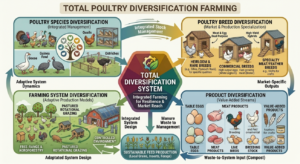
Figure 1: Poultry diversification
Poultry diversification can be achieved through:
- species diversification, involving alternative poultry species such as ducks, quails, turkeys, guinea fowl, geese, pigeons, emus, and ostriches
- breed diversification, through the promotion of indigenous and improved breeds suited to local conditions
- system diversification, including backyard, semi-intensive, free-range, organic, and integrated farming systems
- product diversification, encompassing value-added products such as meat, eggs, manure, feathers, and specialty poultry products supported by efficient market linkages (Bhadauria et al., 2015).
Diversified poultry systems based on locally available resources and adaptable to varying agro-climatic conditions offer new revenue options, decrease production risks and improve livelihood security for rural communities.
Benefits of Poultry Diversification
- Food security: Poultry diversification enhances access to high quality animal protein and key micronutrients. Indigenous breeds like Kadaknath and Aseel, quails and ducks give nutritionally better meat and eggs, thereby supporting dietary diversity and nutritional security (Ansari as al., 2024).
- Disease resilience: Poultry diversity improves biological and economic resilience by adding species and indigenous breeds that are more adaptable, tolerant to disease and better able to survive than commercial chicken, therefore decreasing production risks and minimizing economic losses during disease outbreaks (Bhadauria et al., 2015; Naik et al., 2022).
- Cultural and regional relevance: Across India, different poultry species cater to regional food demands and specialty markets. Ducks are preferred mainly in eastern and southern India but quails and turkeys have acquired popularity in some of the regional marketplaces. Indigenous chicken breeds still fetch a premium price for their unique taste and cultural importance. Promotion of indigenous and alternative poultry species would assist conserve traditional food cultures, while catering to diversified consumer wants (Naik et al., 2022).
- Export potential: Poultry diversification provides an opportunity to increase India’s presence in the global market. The growing demand for halal-certified chicken products, processed meats, ready-to-cook and ready-to-eat goods, frozen poultry and egg-based products such as egg powder and liquid eggs, provides significant export opportunity. Value added chicken products can enhance profitability, minimize post harvest losses and make India more competitive in the global poultry trade.
- Rural livelihoods: Smallholders, landless farmers and rural women can access low-cost income-generating options through alternative poultry species. Backyard production systems based on indigenous and low-input technology (LIT) breeds like Vanaraja, CARI Nirbhik, give regular revenue, household nutrition and employment prospects (Banerjee and Ghosh, 2021). Diversifying revenue streams, building economic resilience and encouraging women’s involvement in rural entrepreneurship are facilitated by the incorporation of ducks, quails, turkeys and other alternative poultry species.
- Climate resilience for sustainability: Indigenous breeds, alternative poultry species are frequently better suited to local areas, require fewer inputs and perform well under tough climatic conditions. Wetland habitats are the best for ducks, and quails need less area and feed supplies and have quick growth rates. Guinea fowl and turkeys are well adapted to free-range and organic production systems, boosting biodiversity and lowering pressure on intense commercial poultry production. Their integration encourages sustainable and climate-resilient chicken production systems (Aruna and Anand, 2023).
Potential of Diverse poultry species
Turkey (Meleagris gallopavo)
Turkey farming in India is still in nascent stage, accounting for barely 0.05% of the poultry population (4.48 lakh birds) according to the 20th Livestock Census (2019). Turkey populations are highest in Assam, Uttar Pradesh, and West Bengal. Turkeys can generate income, nutritional security, and rural livelihoods due to their adaptability to semi-intensive and free-range systems, efficient foraging, and suitability to diverse agro-climatic conditions. The Beltsville Small White (BSW), Broad Breasted White (BBW), Broad Breasted Bronze (BBB), and Black Turkey strains do well in India. These birds weigh 5–7 kg with an FCR of 2.5–3.0 by 20–24 weeks, reach sexual maturity at 30–32 weeks, and lay 90–100 eggs each year. However, natural mating and artificial insemination issues limit reproductive efficiency, resulting in 75–80% hatchability. ICAR-CARI, Izzatnagar, CPDO (SR), Hessarghatta, and TANUVAS encourage turkey farming as a low-input backyard business for rural households (Ilavarasan et al., 2020; Champati in 2024).
Duck (Anas platyrynchos)
Ducks rank as the second most significant poultry species following chickens in terms of meat and egg production. India’s duck population stands at around 3.35 crore birds, which constitutes 3.93% of the overall poultry population. Notably, indigenous ducks make up nearly 88% of this total, according to the 20th Livestock Census conducted in 2019. Common exotic breeds raised in India include Khaki Campbell, White Pekin, and Indian Runner. India is home to nine indigenous duck breeds—Pati, Maithili, Andamani, Tripureshwari, Kodo, Kudu, Kuttanad, Manipuri, and Nagi (ICAR Report, 2025), which are distributed across various regions of the country. Local ducks may not be the most productive, but they are a great genetic resource due to their adaptability, disease tolerance, and compatibility with low-input production methods. Duck farming shows a notable concentration in regions such as Assam, West Bengal, Odisha, Kerala, and the Northeastern states (Aruna and Anand, 2023; Padhi and Giri, 2024). Duck eggs and meat fetch high market prices owing to their distinctive flavor and nutritional benefits. Integrated systems like rice–duck and fish–duck farming significantly enhance farm profitability by lowering feed expenses and optimizing resource use (Padhi and Giri, 2024). Enhanced duck breeds yield between 160 and 223 eggs each year, in contrast to local ducks that generally produce fewer eggs in backyard settings. This underscores the necessity for genetic enhancement and selective breeding initiatives (BAHS, 2024). Their disease resistance, good foraging ability, huge egg size and adaptability to wetlands and coastal settings make them a valuable choice for livelihood of small and marginal farmers.
Guinea fowl (Numida meleagris)
Guinea fowl, native to Africa, is gaining attention for its flavourful game-like meat, nutrient-rich eggs, and adaptability to low-input production systems. In Africa and Europe and North America, it is raised free-range, whereas in India, it is mostly grown in backyards (Houndonougbo et al., 2017). In India, the common colour variants include Pearl, White and Lavender. Other improved varieties include Guncari (Kadambari, Swetambari and Chitambari) and Nandanam Guinea Fowl-1 (Prabakaran et al., 2020; Aruna and Anand, 2023). Guinea fowls are tough birds, have good foraging abilities, endurance to severe environment and resistance to various illnesses and mycotoxins. In India guinea fowls acquire a body weight of 1.2-1.4 kg around 16-18 weeks of age and start laying at 16 weeks of age, laying roughly 100 eggs in a year. Meat is low in cholesterol, abundant in vital fatty acids and has a larger carcass proportion than chicken. Their eggs are characterized by thick shells that reduce breaking losses and contain high levels of protein, iron, zinc, selenium, vitamins A, B12, and D, as well as healthy omega-3 fatty acids (Rambabu, 2025). Their resilience to varied climatic conditions, minimal management requirements and high value products make them an attractive species for poultry diversification, rural income creation and sustainable backyard poultry development.
Japanese Quail (Coturnix coturnix japonica)
Japanese quail is a significant alternative poultry species called as ‘Bater’ in India due to its fast growth, early maturity and excellent output. Tropical and subtropical nations, including India, produce nearly 80% of the world’s 1.4 billion quails (Mnisi et al., 2025). In India, organized quail breeding and research has developed improved strains such CARI-Uttam, Pearl, Suneheri, Nandanam quail kinds. Quails are well adapted for small scale and home farming because of early sexual maturity (5-6 weeks), high egg production (up to 300 eggs per annum), short generation interval, low feed consumption (20-25 g/day) and comparatively lower disease susceptibility (Jatoi et al., 2013). Broiler quails can reach a body weight of about 210 g in five weeks, which results in a dressing percentage of 74-66% (Gecgel, 2015). Their small size allows for high stocking density. Quail meat and eggs are high-quality sources of protein, iron, phosphorus, selenium, B-vitamins, and other nutrients. Quails have great potential for diversification of poultry, nutritional security and revenue creation in rural areas of India due to low space demand, little immunization needs and high reproductive efficiency.
Ostrich (Struthio camelus) and Emu (Dromaius novaehollandiae)
Ostriches and emus are flightless ratites, valuable for their meat, leather, feathers and other items. Ostrich farming is a global industry driven by demand for high-quality leather and lean, low-cholesterol red meat, especially in South Africa, Europe, the United States, and portions of Asia (Mnisi et al., 2025). Ostrich farming is still in its infancy in India, with the first pilot farm was set up in 2000 in Tamilnadu. But the high manufacturing costs and limited marketing channels of byproducts impede the expansion (Selvan et al., 2012).
Emu farming has been popular in states like Andhra Pradesh, Tamil Nadu, Maharashtra and Kerala. Emus produce lean red meat, premium leather, feathers, and 5–6 litres of oil each bird, which is utilized in cosmetics and pharmaceuticals (Warale, 2014). Economic value is further added by its ornamental byproducts and enormous emerald-green eggs. High feed costs, late hide and oil harvesting, and poor processing and marketing facilities hinder commercial ratite cultivation. To tap on the potential of ostrich and emu farming as specialized enterprises for poultry diversification in India, it is crucial to strengthen value-added services and market connections.
Geese (Anser anser)
Traditionally, geese are raised for their meat, eggs, and down feathers; Asia, primarily China, produces around 96% of the world’s geese (Biswas et al., 2015). Kashmir Anz and Rajdigheli are recognized indigenous breeds in India and are known for their quality meat and generally are maintained under free range systems. Geese are ideally adapted to low-input and sustainable agricultural systems due to their effective use of grasslands, aquatic vegetation and crop leftovers. Native goose populations are attractive for both small-scale and large-scale production systems due to their rapid growth, high disease resistance, and abundant carcass yields (Hamadani et al., 2020). Despite being relatively underutilized, goose farming holds considerable potential in India because of the country’s extensive wetlands, water bodies, and paddy-growing regions. Goose are a viable choice for poultry diversification, rural income generation, and sustainable farming systems due to their minimal food and housing needs, adaptability, and long productive lifespan.
Key constraints and challenges with diversification of poultry farming in India
The diversified poultry sector in India faces several challenges hindering its widespread adoption and growth
- Localized demand: Uneven market demand is a consequence of regional preferences for alternate poultry products.
- Disjointed production and marketing systems: Fragmented supply chains lead to inefficiencies and expenses in distribution.
- Reproductive limitations: Limitations in large-scale production are caused by the fact that some alternative species have lower hatchability and fertility rates.
- Training inadequacy: Inadequate capacity-building initiatives limit the adoption of improved management techniques, which in turn limits training possibilities.
- Insufficient veterinary support: Lack of species-specific health and technical services reduces production and disease control.
- Lower productivity: Many alternative poultry species are slower growing and lay fewer eggs than commercial hens.
- Policy and subsidy constraints: The expansion of diverse poultry firms is hampered by the lack of government assistance and incentives.
To tackle these challenges, it is essential for government agencies, agricultural institutions, and industry stakeholders to collaborate effectively in order to foster a more conducive environment for diversified poultry farming in India.
Future Prospects for poultry diversified farming in India
A comprehensive approach is needed to boost India’s varied poultry sector’s competitiveness versus commercial chicken. This strategy should include farmer capacity building, product marketing, and strong support systems.
- Farmer capacity-building:It is essential to provide farmers with the skills and knowledge they need to upgrade their capabilities. Training programs on scientific poultry management, disease prevention and sustainable farming techniques have been launched by institutions like ICAR-CARI, ICAR-DPR and KVKs.
- 2. Product brand and commercialization: A consistent branding scheme is needed to promote various poultry products. A approach similar to the label Rouge initiative in France could be helpful. Label Rouge ensures regional poultry products meet high animal welfare and environmental sustainability criteria, which can be implemented in India, through the formation of regional producer alliances, quality control and marketing of products under a single label.
- Institutional cooperation and policy assistance: There should be collaboration between government departments and institutions to provide complete support. Programs such as RKVY, NLM, SHGs and NGOs can play a crucial role in pushing policies, providing subsidies and market access. Besides, ICAR-CARI, ICAR-DPR and state agricultural agencies should work jointly in developing and popularizing improved poultry breeds such as Vanaraja and Giriraja suitable for rural and backyard farming
- R&D (Research and Development): Research investment must be made for the development of new breeds of poultry with faster growth, higher feed efficiency and better adaptability. This includes developing breakthrough reproductive methods, such artificial insemination, to enhance fertility rates. Farmer-researcher collaboration can help produce poultry breeds for varied farming systems.
- Value added products and developing markets: We need to provide more market opportunities for varied poultry products. This can be achieved through the development of value added items like smoked duck, quail egg pickles, tandoori quail etc. Targeting marketing channels and promoting these products can raise awareness and demand from consumers.
Conclusion
India’s poultry market is growing due to rising protein demand and changing customer tastes. The commercial broiler and layer industries have steadied, but the diverse poultry species are also gaining popularity. Diversification promotes rural development, nutrition, and income. Developing India’s diverse poultry sector requires capacity training, branding, policy support, research, and market growth. These strategies can help the sector grow sustainably and improve rural livelihoods and food security. Through “Vision 2050,” central government organizations that oversee the Indian poultry industry, seek to radically transform the diverse poultry industry to ensure nutritional security and generate additional revenue as an alternative to the commercial poultry industry. Market surveys should identify demand for certain products, and economic feasibility studies should show that a species can be produced in the existing agroclimatic conditions for viable production. It is also important to characterize local breeds and variations of distinct poultry species in order to preserve significant material. Thus, food security will depend on the industry’s creativity and green production.
References
20th Livestock Census. 2019. Department of Animal Husbandry and Dairying, Govt of India
Ansari, S., Dehru, S., Rajpurohit, V., Dabas, R., Geetanjali, Farooq, W. and Patel, A. 2024. Quail farming and its usefulness in india: an overview. Greenaria 2(11): pp.168-170.
Aruna, T. S. and Anand, T. S. 2023. The Current Scope of Diversified Poultry Production in India. Food and Scientific Reports 4(7): pp.46-52.
Banerjee, S. and Ghosh, B. 2021. The strategic management of backyard poultry farming: The scenario in rural India. Indian Journal of Animal Health 60(2): pp.127-141.
Basic Animal Husbandry Statistics (BAHS) 2024. DAHD, Govt of India.
Bhadauria, P., Kataria, J.M., Majumdar, S., Bhanja, S.K., Divya and Jadoun, Y.S. 2015. Management Practices for Diversiied Poultry Production in India. Bilingual International Conference on Information Technology: Yesterday, Today, and Tomorrow, 19-21 February 2015, pp.108-114.
Bist, R.B., Bist, K., Poudel, S., Subedi, D., Yang, X., Paneru, B., Mani, S., Wang, D. and Chai, L. 2024. Sustainable poultry farming practices: a critical review of current strategies and future prospects. Poultry Science 103(12): pp.104295.
Biswas, A.K., Jairath, G., Mandal, A. and Khanna, S. 2015. Non-traditional small poultry species: An approach to food sustainability. Agricultural Reviews 36(2): pp.147-152.
Champati, A., Bhanja, S.K., Rokade, J.J., Yadav, A.S., Nayak, N., Saha, S.K., Sonale, N.S., Chakma, J., Mishra, J. and Wadajkar, P., 2024. Dietary concoction of formic acid and thymol and its effects on zoo-technical performance, immunity, jejunal architecture and gut health in Turkey. Research in Veterinary Science 179: pp.105394.
Gecgel, U., Yilmaz, I., Gurcan, E.K., Karasu, S. and Dulger, G.C. 2015. Comparison of fatty acid composition between female and male Japanese quail meats. Journal of Chemistry 2015(1): pp.569746.
Hamadani, H., Khan, A., and Banday, M. 2020. Kashmir Anz geese breed. Worlds Poultry Science Journal 76(1): pp.144–153.
Houndonougbo, P.V., Chrysostome, C.A., Mota, R.R., Hammami, H. and Bindelle, J. 2017. Phenotypic, socio-economic and growth features of Guinea fowls raised under different village systems in West Africa. African Journal of Agricultural Research 12(26): pp.2232-2241.
ICAR Report. 2025. Indian Council of Agricultural Research.
Ilavarasan, S., Jaishankar, S., Lurthu Reetha, T., Sheeba, A. and Priya, J., 2020. A Study on Growth Performance of Nandanam II Turkey under Intensive System. International Journal of Current Microbiology and Applied Sciences 9(12): pp.3520-3523.
Jatoi, A.S., Sahota, A.W., Akram, M., Javed, K., Hussain, J., Mehmood, S. and Jaspal, M.H. 2013. Response of different body weights on blood serum chemistry values in four close-bred flocks of adult Japanese quails (Coturnix coturnix japonica). Journal of Animal and Plant Sciences 23(1): pp.35-39.
Mnisi, C.M., Njeri, F.M., Maina, A.N., Waliaula, P.K., Cheng, V., Kumalo, I., Egbu, C.F. and Kiarie, E.G. 2025. A review on the potential use of eubiotics in non-chicken poultry species. Tropical Animal Health and Production 57(4): pp.213.
Naik, P.K., Swain, B.K. and Beura, C.K. 2022. Duck production in India-A review. The Indian Journal of Animal Sciences 92(8): pp.917-926.
Padhi, M.K. and Giri, S.C. 2024. Status of duck breeding in India. The Indian Journal of Animal Sciences, 94(1): pp.3-10.
Prabakaran, R., Ezhill Valavan, S. and Thiruvenkadan, A.K. 2020. Diversified poultry production: An overview. Journal of Entomology and Zoology Studies 8(2): pp.211-217.
Rambabu D. 2025. Overview and scientific management of guinea fowl. Pashudhan Praharee Pet Care Blog. pp.1-6.
Selvan, S. T., Kumarasamy, P., and Thyagarajan, D. 2012. Growth performance of ostriches (Struthio camelus) in India. Indian Journal of Animal Research 46(2): pp.176-179.
Warale, R. H., Chauhan, H., Parmar, D., Kulkarni, R. C., Srivastava, A. K., and Makwana, R. B. 2014. Emu farming: an alternative to Indian poultry. Trends in Veterinary and Animal Science 1: pp.9-14.