
The White Revolution Redefined: Women-Led Sustainable Dairy Enterprises and SHG Models in India
Drs. Vanshika1, Saurav Singla2
1 Department of Veterinary Pathology, Guru Angad Dev Veterinary & Animal Sciences University, Ludhiana, 141004
2 Department of Veterinary Surgery and Radiology, Guru Angad Dev Veterinary & Animal Sciences University, Ludhiana, 141004
Abstract
India’s rural economy is undergoing a profound structural shift driven by the intersection of the dairy sector, the Self-Help Group (SHG) movement, and sustainable development frameworks. As the world’s largest milk producer, India relies heavily on its livestock sector, which contributes roughly 3.9% to the national Gross Dependent Product (GDP) (Yadav & Sagar, 2016). Crucially, rural women dominate approximately 76% of these agriculture-allied activities (Kabiraj, 2023). Under the National Rural Livelihood Mission (NRLM), which has mobilized over 100 million women into more than 9 million SHGs (Survase, 2026), these grassroots collectives are shifting women from invisible backyard laborers to institutional micro-entrepreneurs.
This article analyzes the structural mechanics of dairy-SHG linkages and evaluates their socioeconomic impacts. While regional models like JEEViKA in Bihar, Mulukanoor in Telangana, and KMF initiatives in Karnataka demonstrate immense transformative potential, the ecosystem faces persistent bottlenecks, including climate-induced fodder scarcity and structural credit barriers. To address these vulnerabilities, this paper proposes an actionable, decentralized circular economy blueprint. Ultimately, we argue that integrating Decentralized Renewable Energy (DRE) and precision livestock management into the dairy-SHG framework is essential to securing long-term climate resilience, gender equity, and rural economic growth.
- Introduction: The Intersection of Gender, Dairying, and Development
The rural landscape of India faces a triple challenge: economic vulnerability, accelerating climate risks, and entrenched gender disparities. Women represent a vital engine of the rural agrarian economy, yet their contributions have historically remained unrecognized and undervalued, placing them at the bottom of the socioeconomic hierarchy. This marginalization is particularly evident in traditional agriculture, where structural barriers like limited land ownership restrict women’s access to direct institutional financing and independent market entry.
In this context, dairy farming serves as a strategic economic lever. Unlike crop cultivation, which is highly seasonal and heavily dependent on land inheritance, dairying provides a consistent, daily cash flow and relies on livestock assets that are easier for women to manage and own. Recognizing this dynamic, India’s development strategy has pivoted toward leveraging women-led Self-Help Groups (SHGs) and Women Dairy Cooperatives (WDCs) to formalize this informal labor pool.
By embedding livestock management within democratic, women-led collectives, programs like the National Rural Livelihood Mission (NRLM) have scaled financial inclusion across rural communities. This article examines how the synthesis of the SHG model with sustainable dairy enterprises creates a scalable pathway for women’s empowerment, rural economic resilience, and ecological preservation.
- Institutional Framework: The Architecture of Dairy-SHG Cooperatives
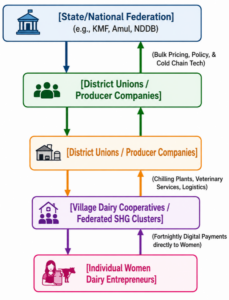
The success of women-led dairy models relies on a structured, multi-tiered institutional architecture that connects isolated smallholder farmers to competitive regional and national markets. This framework typically manifests in two primary organizational forms: Integrated SHG-Microenterprises and formalized Women Dairy Cooperative Societies (WDCs).
2.1. The Three-Tier Cooperative Mechanism
As seen in highly successful states like Gujarat, Karnataka, Bihar, and Maharashtra, the traditional dairy cooperative framework operates on a robust three-tier structure:
- Primary Village Dairy Cooperative Societies:Local collection centers where individual women pour milk daily.
- District Cooperative Milk Producers’ Unions:Entities managing processing plants, cold chain logistics, and veterinary extension services.
- State Cooperative Milk Federations:High-level bodies managing marketing, brand equity, and macro-level distribution.
2.2. The Layered SHG Infrastructure
The SHG model infuses a vital democratic and financial layer into this system. Typically comprising 10 to 20 women from similar socioeconomic backgrounds, SHGs utilize micro-financing, thrift savings, and internal lending to bypass rigid commercial banking requirements (Mondal et al., 2025; Rathinam, 2014).
When layered with dairy operations, the SHG acts as an incubator. It provides the initial capital to purchase high-yielding milch breeds, while the cooperative infrastructure guarantees market buy-back.
A prominent example of this model is the Mulukanoor Women’s Mutually Aided Milk Producers Cooperative Society in Telangana. Mulukanoor altered historical paradigms by directly linking women’s SHG savings to a dedicated dairy union (Farnworth et al., 2023). The enterprise established strict institutional rules designed to bypass patriarchal interference:
- Milk payments are made directly into the individual bank accounts of the women members on a fortnightly basis.
- Board governance is entirely populated by elected women farmers across diverse caste lines.
- Annual dairy bonuses are distributed directly to the producers based on milk volume, reinforcing the economic reality of their labor.
- Socioeconomic Impact Analysis: Empirical Evidence of Empowerment
Quantifying the impact of dairy-based SHGs reveals substantial improvements across economic, social, and nutritional domains.
3.1. Income Generation and Asset Accumulation
Empirical evaluations demonstrate that when rural women transition into formal dairy SHGs, their household asset base and independent annual incomes scale significantly. Longitudinal data indicates that the economic contribution of dairying to total household income rises from an average of 20% to over 30% within a short period of group maturity, with post-SHG situations yielding an average increase of 68% in production assets and 77% in individual annual incomes for participating women (Rathinam, 2014).
Crucially, this relative economic advantage is most pronounced among highly vulnerable demographics, such as widows and landless laborers. For these marginalized groups, dairying generates up to 36% of total household income, compared to 29% for economically better-off households (Rathinam, 2014).
3.2. Structural Empowerment Dimensions
The Women’s Empowerment in Livestock Index (WELI) highlights that formal WDC structures significantly improve social participation, access to technical training, and institutional group activity compared to private, unorganized milk supply chains (Geetha & Srikantha Murthy, 2022). This collective organization fosters several distinct forms of agency:
- Internal Agency (“Power Within”):Overcoming long-standing social limitations, superstitions, and historic exclusion from financial decision-making (Farnworth et al., 2023; Rathinam, 2014).
- Actionable Agency (“Power to Act”):Mobilizing credit, independently managing animal health, and managing household financial allocations (Farnworth et al., 2023).
- Dismantling Intersectional Barriers (“Power Over”):Disrupting deeply entrenched gender and caste hierarchies. In models like Mulukanoor, the mandatory practice of pooling milk from marginalized and non-marginalized castes into the same collection silos serves as a powerful practical tool for social integration and community cohesion (Farnworth et al., 2023).
3.3. Health and Nutritional Outcomes
Beyond financial metrics, layering health and nutritional interventions onto established women’s collectives yields measurable community health improvements. Large-scale programs, such as Bihar’s JEEViKA initiative, demonstrate that using mature SHG networks to deliver targeted health and nutrition education effectively drives positive behavioral modifications, improves maternal and newborn health care utilization, and directly enhances dietary diversity within impoverished rural households (Mondal et al., 2025).
- Key Bottlenecks and Structural Constraints
Despite the clear successes of the dairy-SHG framework, several systemic bottlenecks threaten its long-term operational sustainability and scalability.
4.1. Feed and Resource Deficits
The most pervasive operational constraint cited by rural dairy producers is the chronic shortage of green fodder throughout the year, coupled with the high cost of veterinary treatments and high-quality livestock feed (Yadav & Sagar, 2016). Due to shifting rainfall patterns and escalating climate risks, smallholder women farmers increasingly struggle to secure stable forage, leaving them dependent on volatile commercial concentrate markets that erode net profit margins.
4.2. Cold Chain and Infrastructure Deficits
Inadequate storage infrastructure at the village level presents a major barrier to market access. Up to 67.7% of dairy SHG members report significant friction due to complicated bank loan processing and a critical lack of local milk chilling and storage technologies (Yadav & Sagar, 2016). In the absence of a reliable cold chain, highly perishable raw milk faces rapid spoilage, forcing rural producers to sell their yield to local middlemen at rates well below fair market value.
4.3. Governance and Financial Illiteracy
Long-term institutional sustainability is heavily dependent on transparent, accountable leadership. Comparative field studies reveal that while well-governed SHGs thrive on regular savings habits and strict financial discipline, groups suffering from poor record-keeping transparency, fund mismanagement, or low literacy levels face rapid member attrition and eventual collapse (Darlong, 2026; Yadav & Sagar, 2016). Furthermore, instances of elite capture—where male relatives take over financial decision-making—directly undermine the core objective of female economic autonomy (Darlong, 2026).
- Practical Applicability: An Actionable Circular Economy Blueprint
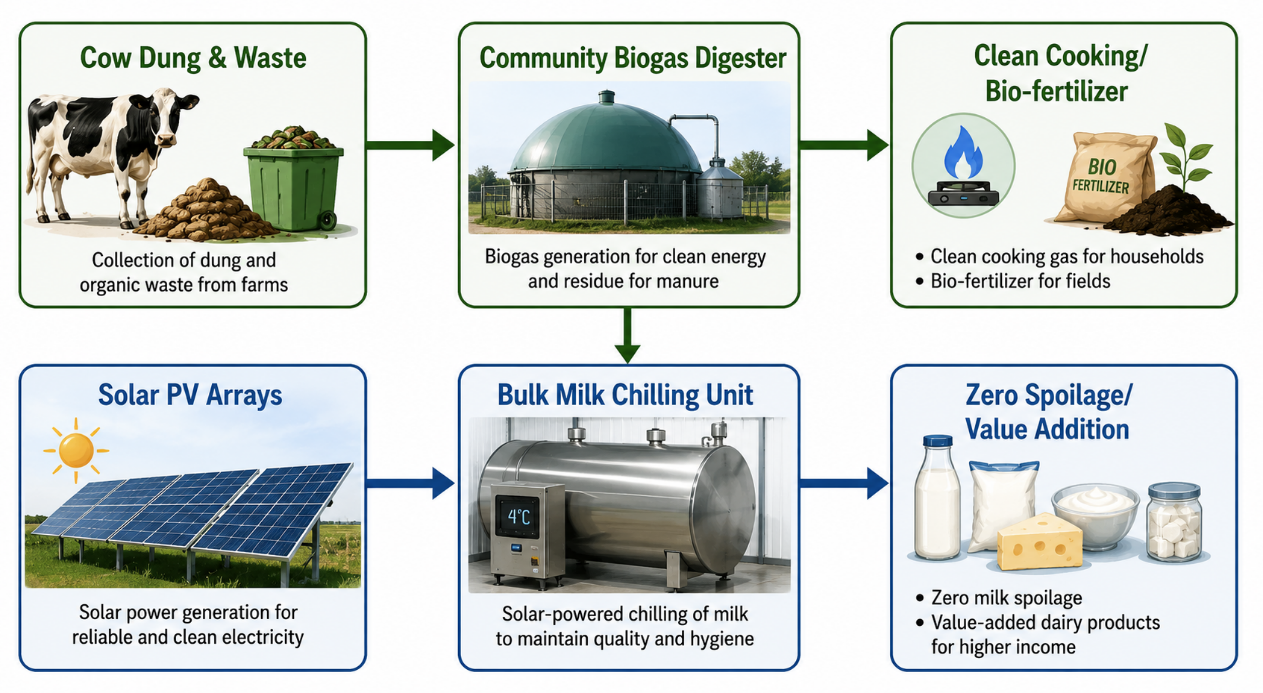
To address these infrastructure and resource gaps, women-led dairy enterprises can transition toward an integrated, climate-smart, circular economy blueprint. This model combines Decentralized Renewable Energy (DRE) with bio-resource recycling to maximize efficiency and create new revenue streams.
5.1. The Decentralized Solar Dairy Model
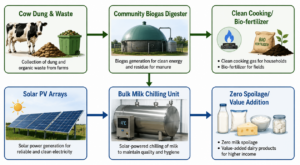
Integrating solar energy into the dairy-SHG value chain offers a practical solution to rural electricity deficits, helping to mitigate “time poverty” and reduce manual drudgery for women entrepreneurs (Kabiraj, 2023).
By establishing small-scale, solar-powered Bulk Milk Chilling units (BMCs) managed directly by village SHG federations, communities can maintain an uninterrupted cold chain independent of the central power grid. The deployment of DRE technologies ensures stable milk preservation, enhances bargaining power by preventing forced distressed sales, and opens paths for profitable value-added processing (e.g., producing ghee, paneer, and curd) at the local level (Kabiraj, 2023).
5.2. Biogas Integration and Bio-Fertilizer Value Chains
At the household level, dairy SHGs can link animal waste management to community-based anaerobic biogas digesters. This circular model converts livestock manure into clean cooking gas, reducing reliance on solid biomass fuel and improving respiratory health outcomes for rural women.
Additionally, the nutrient-rich byproduct slurry can be processed, packaged, and commercialized by the SHG as organic bio-fertilizer. This creates a secondary income stream while reducing household expenditure on chemical fertilizers, directly supporting long-term soil health.
5.3. Smart Ledger Technology and Capacity Building
To address literacy and record-keeping barriers, state rural livelihood missions should equip SHG leaders with icon-based, mobile-first ledger applications. Simplifying financial tracking and using automated digital accounting reduces administration friction, ensures internal transparency, and builds the verifiable financial history required to unlock commercial bank credit (Darlong, 2026; Yadav & Sagar, 2016).
- Conclusion and Policy Recommendations
The convergence of women-led Self-Help Groups and sustainable dairy enterprises represents a highly effective framework for rural economic development in India. By formalizing women’s roles in animal husbandry, these models convert informal household labor into structured economic power, generating measurable increases in household income, improving family nutritional status, and breaking down deep-seated social hierarchies.
However, safeguarding these gains against accelerating climate risks and operational vulnerabilities requires target policy adjustments:
- Decentralized Energy Subsidies:The Ministry of New and Renewable Energy (MNRE) and National Banks for Rural Development (NABARD) must expand targeted financial frameworks that subsidize DRE applications, such as solar milk chillers and solar forage cutters, specifically for women-led cooperatives (Kabiraj, 2023).
- Fodder Security Networks:Livelihood missions must integrate community fodder banks and promote drought-resilient, high-yielding forage varieties (such as specialized sorghum or hybrid napier cultivars) within SHG cluster designs to ensure year-round feed security (Farnworth et al., 2023; Yadav & Sagar, 2016).
- Institutional Governance Training:Expanding continuous, gender-sensitive financial literacy and democratic leadership training is critical to preventing external elite capture, securing long-term group survival, and building internal institutional resilience (Darlong, 2026).
Prioritizing these structural supports will allow India to transition from simple aggregate milk production to an equitable, climate-resilient dairy ecosystem rooted in female leadership.
References
- Darlong, J. (2026). Sustaining community self-help groups beyond donor support: Lessons from a qualitative study of self-help groups, including persons affected by leprosy and disability in rural India. BMC Public Health, 26(1), 112–125.
- Farnworth, C. R., Ravichandran, T., & Galiè, A. (2023). Empowering women across gender and caste in a women’s dairy cooperative in India. Frontiers in Sustainable Food Systems, 7(1123802), 1–14. https://doi.org/10.3389/fsufs.2023.1123802
- Geetha, R. S., & Srikantha Murthy, P. S. (2022). Assessment of women empowerment through women dairy cooperatives in Eastern Dry Zone of Karnataka. The Mysore Journal of Agricultural Sciences, 56(1), 122–129.
- Haritha, I. R., Krishna, G. S. R., & Devi, P. U. M. (2025). A study on financial performance of Self-Help Groups (SHGs) in Andhra Pradesh State with reference to Krishna District. Journal of Marketing & Social Research, 2(6), 7–13.
- Kabiraj, M. (2023). Renewable energy transforming rural women. Kurukshetra: A Journal on Rural Development, 71(4), 38–43.
- Mondal, S., Bisht, I., Akhauri, S., Chaudhuri, I., Pradhan, N., Kumari, S., Akhouri, S. S., Jha, R. K., Singh, M. K., Das, S., Purty, A., Mukherjee, A., & Mahapatra, T. (2025). Effectiveness of a technical support program with women’s self-help groups in catalyzing health and nutrition behaviors in Bihar—A multicomponent analysis. Frontiers in Public Health, 12(1389706), 1–16. https://doi.org/10.3389/fpubh.2024.1389706
- Rathinam, U. (2014). Dairy dependent Self-Help Group: A tool for economic empowerment of poor women. CABI Digital Library, 44(2), 189–196.
- Survase, M. (2026). Financial inclusion and rural economic empowerment: Evidence from Self-Help Groups in Maharashtra, India. MDPI Journal of Financial Risk and Management, 19(2), 142–155. https://doi.org/10.3390/jrfm19020142
- Yadav, R., & Sagar, M. P. (2016). Perceived constraints and associated factors of dairy based women self-help groups (SHGs) in Rewari district of Haryana. International Journal of Sociology and Anthropology, 8(3), 23–26. https://doi.org/10.5897/ijsa2015.0638