


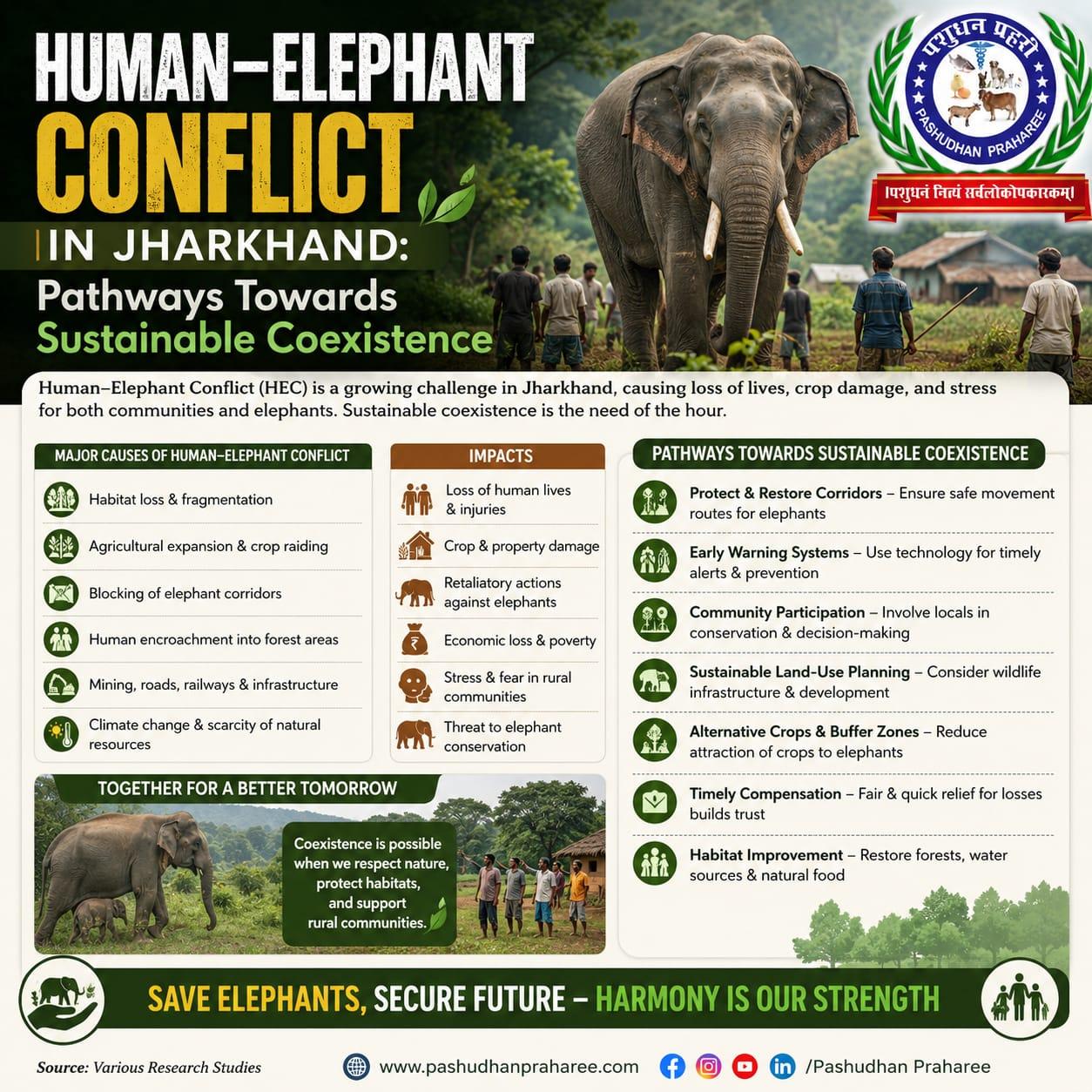
Human–Elephant Conflict in Jharkhand: Pathways Towards Sustainable Coexistence
By Dr. Rajesh Kumar Singh
Editor-in-Chief, Pashudhan Praharee | National Convener, Veterinary Association of India (VAI)
Abstract
Human–Elephant Conflict (HEC) has emerged as one of the most critical conservation and rural livelihood challenges in Jharkhand. Increasing interactions between elephants and human populations have resulted in significant loss of life, crop damage, and socio-economic distress. This article examines the underlying causes of HEC in Jharkhand and proposes a comprehensive, field-oriented framework integrating ecological restoration, modern technology, community participation, and policy interventions to achieve sustainable coexistence.
- Introduction
Jharkhand, known for its rich forest cover and significant elephant population, has become a major hotspot for human–elephant conflict in India. Between 2000 and 2023, the state has recorded more than 1,700 conflict incidents, including over 1,300 human fatalities, particularly in districts such as East Singhbhum, West Singhbhum, Ranchi, and Khunti.
The increasing frequency of such incidents reflects a growing imbalance between ecological sustainability and developmental pressures. Addressing this issue requires a multi-disciplinary, region-specific, and scientifically driven approach.
- Ground Reality of Jharkhand
– Estimated elephant population: 1,500–1,700 (≈10% of India’s total)
– Conflict incidents (2000–2023): ~1,740
– Human deaths: 1,340+
– Major hotspots:
– Dalma landscape (East Singhbhum)
– Chaibasa belt (West Singhbhum)
– Ranchi–Khunti region
– Palamu landscape
– Continued fatalities reported in 2026 highlight the urgency of intervention
- Drivers of Human–Elephant Conflict
3.1 Habitat Loss and Fragmentation
Deforestation due to mining, infrastructure expansion, and agriculture has fragmented elephant habitats and disrupted traditional migratory corridors.
3.2 Expansion of Agriculture and Settlements
Villages located near forest edges act as high-risk zones. Crops such as paddy, maize, and sugarcane attract elephants due to their high nutritional value.
3.3 Seasonal Patterns
Conflict peaks during the monsoon season, when visibility is low and crops are abundant, increasing accidental encounters.
3.4 Depletion of Natural Food Resources
Forest degradation reduces fodder availability, forcing elephants to depend on cultivated crops.
- Impact of Human–Elephant Conflict
– Loss of human lives and injuries
– Crop damage and economic loss
– Psychological stress in rural communities
– Retaliatory killing of elephants
– Ecological imbalance and biodiversity loss
- District-Wise Risk Profile
Region | Risk Level| Key Issues
Dalma (Jamshedpur, Chakulia)| 🔴 Very High| Corridor blockage, crop raiding
Chaibasa (West Singhbhum)| 🔴 Very High| Aggressive tuskers
Ranchi–Khunti belt| 🟠 High| Settlement expansion
Palamu region| 🟡 Medium–High| Corridor fragmentation
Santhal Pargana| 🟡 Emerging| Migratory elephant movement
- Mitigation Strategies: Jharkhand-Specific Framework
6.1 Habitat Restoration and Corridor Conservation
– Restoration of degraded forests using elephant-preferred species (bamboo, Napier grass)
– Identification and legal protection of elephant corridors
– Landscape-level ecological planning
6.2 Physical Barriers and Deterrents
– Solar-powered fencing
– Elephant-proof trenches
– Bio-fencing (chili rope, beehive fencing, thorny hedges)
6.3 Technology-Based Solutions
– Drone-based surveillance
– GPS collaring and tracking
– AI-based early warning systems
– Mobile applications for real-time alerts
6.4 Community Participation
– Formation of “Gaj Mitra” village teams
– Training of local youth for rapid response
– Awareness programs for safe practices
6.5 Crop Planning and Land Use
High-Risk Crops ❌| Recommended Crops ✅
Paddy| Chili
Maize| Ginger
Sugarcane| Turmeric
Banana| Citrus
6.6 Compensation and Livelihood Support
– Timely compensation mechanisms
– Crop insurance schemes
– Alternative livelihoods (beekeeping, agroforestry)
6.7 Scientific Research and Monitoring
– Establishment of dedicated research centres
– GIS mapping and satellite telemetry
– Identification of conflict hotspots
6.8 Emerging Innovations
– Seismic sensors for elephant detection
– Acoustic and light-based deterrents
– Machine learning-based prediction models
- Field-Level Implementation Model
Village-Level Early Warning System
– WhatsApp/SMS alert groups
– Siren-based alert towers
– Drone surveillance
Elephant-Proof Village Design
– Solar fencing
– Community trenching
– Chili rope fencing
Community-Based Gaj Mitra System
– 10–15 trained youth per village
– Night patrolling and coordination with forest department
Habitat Improvement Strategy
– Fodder plantation within forests
– Restoration of degraded corridors
- Policy Recommendations
Immediate (0–1 Year)
– Identify top 100 conflict villages
– Install solar fencing and early warning systems
– Ensure compensation within 15 days
Medium-Term (1–3 Years)
– Corridor restoration (Dalma–Odisha–Bengal link)
– Launch “Jharkhand Gaj Mitra Mission”
– Promote crop diversification
Long-Term (3–10 Years)
– Landscape-level forest restoration
– AI-based conflict prediction network
– Establish Human–Elephant Conflict Research Centre
- Role of Veterinary and AgroVet Professionals
Veterinary professionals can play a vital role by:
– Supporting wildlife health monitoring
– Assisting in tranquilization and rescue operations
– Participating in awareness programs
– Promoting livestock-based alternative livelihoods
- Integrated Action Plan
A sustainable solution requires convergence of:
– Ecological restoration
– Technological innovation
– Community participation
– Policy support
Pilot projects (5 villages) can include:
– Solar fencing
– Gaj Mitra teams
– Crop diversification
– Drone monitoring
Human–Elephant Conflict in Jharkhand is not merely a wildlife issue—it is a complex socio-ecological challenge. While short-term interventions provide immediate relief, long-term coexistence depends on restoring ecological balance, strengthening community engagement, and leveraging scientific innovations.
By integrating traditional knowledge with modern technology and policy support, Jharkhand has the potential to emerge as a national model for sustainable human–wildlife coexistence.
Keywords: Human–Elephant Conflict, Jharkhand, Wildlife Management, Sustainable Coexistence, Elephant Corridors, AgroVet Intervention.