


1,653 Elephants Lost to Human Activities Since 2009: A Wake-Up Call for India’s Conservation Future
Human–Elephant Conflict in India: Time for Science, Compassion and Coexistence
By Pashudhan Praharee
Editor-in-Chief, Pashudhan Praharee
India, home to nearly 60% of the world’s Asian elephant population, stands at a critical crossroads in wildlife conservation. A recent study highlighted in The Sunday Times of India (June 7, 2026) has revealed a deeply disturbing reality: 1,653 wild elephants have died due to human-induced causes between 2009 and 2025, exposing the growing crisis of human–elephant conflict (HEC) across the country.
The findings, published under the title “Reframing Human-Elephant Conflict in India Through Context-Dependent Coexistence Strategies”, were jointly conducted by the Ministry of Environment, Forest and Climate Change and the Wildlife Institute of India (WII), Dehradun. The study provides one of the most comprehensive analyses of elephant mortality and human casualties associated with conflict over the last 16 years.
The Alarming Numbers
According to the study:
ParameterData (2009–2025) Elephant deaths due to human activities1,653Human deaths due to elephant conflict7,868States covered16 Elephant Range States India’s share of global Asian elephant population~60%
The statistics reveal that the conflict is not only taking a devastating toll on elephants but also on human communities living alongside them.
Major Causes of Elephant Deaths
The study identifies the following leading causes of elephant mortality:
- Electrocution – The Biggest Killer
Electrocution accounted for 1,105 elephant deaths, representing nearly two-thirds of all anthropogenic elephant deaths during the study period.
The majority of cases were reported from:
Odisha
Karnataka
Assam
Tamil Nadu
West Bengal
Many incidents involved illegal electric fencing, exposed power lines, and unauthorized electrification of agricultural fields aimed at preventing crop damage.
- Train Collisions
Railway accidents claimed 225 elephants.
State-wise figures included:
State Elephant Deaths by Train Collisions
Assam 82
West Bengal 62
Others 81
Rapid railway expansion through elephant corridors continues to pose a serious threat despite mitigation measures such as speed restrictions and warning systems.
- Poaching
Poaching resulted in 214 elephant deaths.
States reporting the highest poaching-related mortality included:
State Deaths
Odisha 66
Assam 27
Kerala 24
Meghalaya 23
Karnataka 22
Tamil Nadu 22
Poaching remains a concern due to illegal ivory trade and retaliatory killings following crop damage incidents.
Human Casualties: A Parallel Crisis
While elephant deaths have received considerable attention, the study emphasizes that human casualties are even more alarming.
Between 2009 and 2025:
Human Deaths Due to Elephant Conflict
State Human Deaths
Odisha 1,495
West Bengal 1,306
Jharkhand 1,205
Assam 1,161
Together, these four states accounted for nearly 70% of all human fatalities recorded during the study period.
This highlights the enormous socio-economic burden faced by rural communities living near elephant habitats.
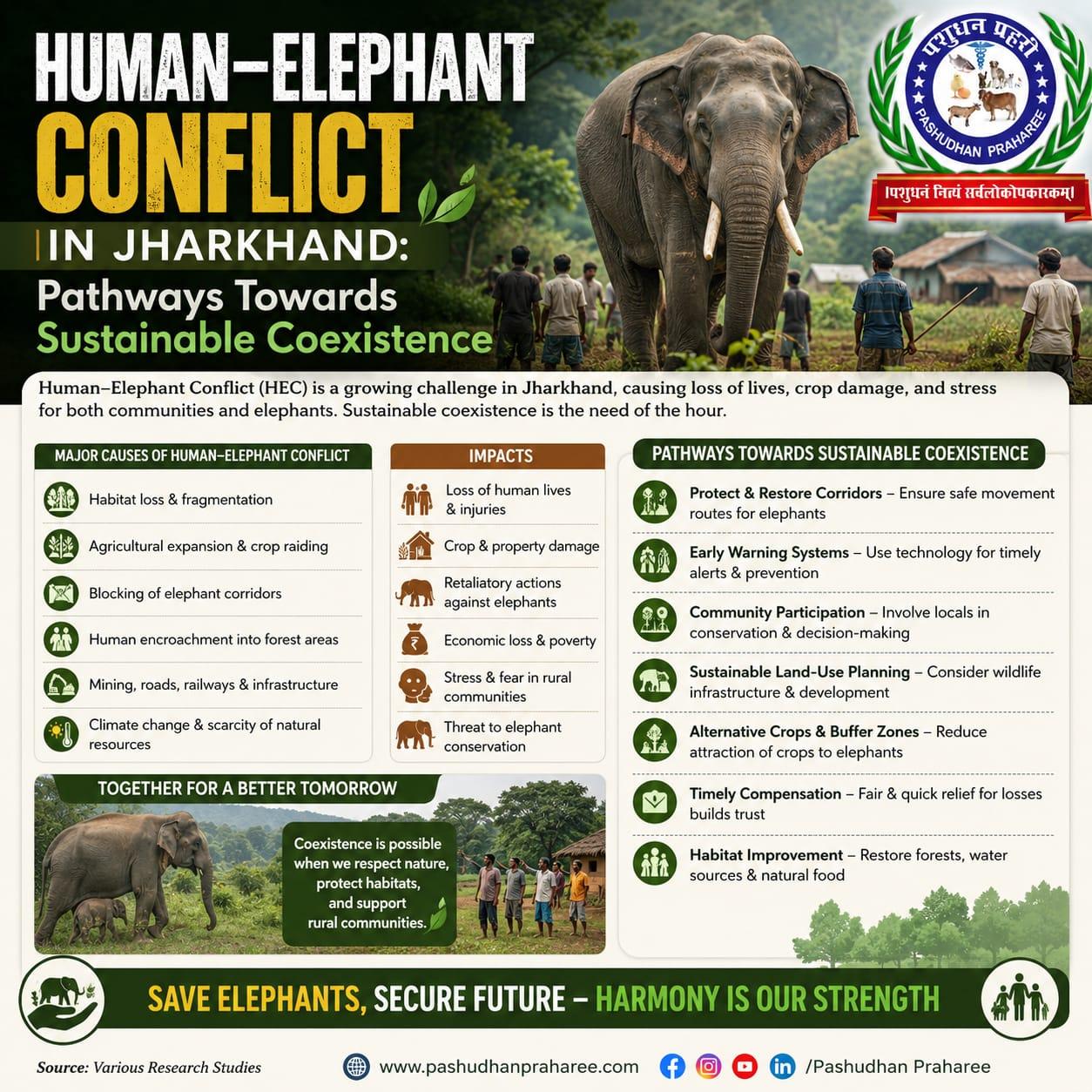
Why Is Human–Elephant Conflict Increasing?
The study identifies several underlying drivers:
Habitat Fragmentation
Natural elephant habitats are being fragmented by:
Expanding agriculture
Highways
Railways
Mining activities
Urbanization
As traditional migratory routes disappear, elephants increasingly enter villages and farmlands.
Shrinking Elephant Corridors
India has over 100 identified elephant corridors, many of which face encroachment and developmental pressures.
Food and Water Scarcity
Changing climate patterns and habitat degradation are reducing food and water availability inside forests, forcing elephants to venture into human settlements.
Infrastructure Expansion
Power transmission lines, railway tracks, canals and roads often intersect elephant movement routes without adequate wildlife-friendly designs.
A Surprising Finding
One of the most significant observations of the study is that human fatalities are not directly proportional to elephant population size.
For example:
States such as Odisha, Jharkhand and Chhattisgarh, despite having relatively smaller elephant populations, recorded disproportionately high conflict-related deaths compared with southern states such as Karnataka, Tamil Nadu and Kerala, which together host around 15,000 elephants but experience comparatively lower human casualty rates.
This suggests that conflict intensity depends more on:
Landscape characteristics
Habitat connectivity
Human population density
Agricultural practices
Effectiveness of mitigation measures than simply elephant numbers.
The Ecological Importance of Elephants
Elephants are often called “ecosystem engineers.“
Their role includes:
Seed dispersal across vast landscapes
Creation of forest clearings
Maintenance of biodiversity
Supporting regeneration of forests
Enhancing carbon sequestration
The loss of elephants can trigger cascading ecological impacts that affect entire ecosystems.
The Way Forward: Coexistence, Not Conflict
The study advocates a shift from traditional conflict-management approaches to context-dependent coexistence strategies.
Key Recommendations
✔ Strengthening elephant corridors
✔ Wildlife-friendly power infrastructure
✔ Underground or insulated electric lines in sensitive zones
✔ Smart railway mitigation systems
✔ Early warning and monitoring technologies
✔ Community-based conservation programs
✔ Timely compensation for crop and property losses
✔ Decentralized conflict management
✔ Greater local participation in decision-making
✔ Landscape-level planning integrating conservation and development
Dalma Wildlife Sanctuary: A Crucial Elephant Landscape Under Pressure
Among India’s important elephant habitats, the Dalma Wildlife Sanctuary in Jharkhand stands out as a significant landscape for understanding the complexities of human–elephant coexistence. Spread across the undulating Dalma Hills near Jamshedpur, the sanctuary serves as a vital refuge and migratory corridor for elephant herds moving between Jharkhand, Odisha and West Bengal.
The sanctuary’s rugged hills, sal forests, seasonal streams and traditional elephant routes make it an ecologically important landscape. However, increasing human settlements, mining activities, agricultural expansion and infrastructure development around the sanctuary have intensified interactions between elephants and local communities. As a result, villages surrounding the Dalma landscape frequently experience crop depredation, property damage and occasional human casualties, while elephants themselves face risks from electrocution, retaliatory attacks and habitat fragmentation.
The Dalma landscape exemplifies the broader challenge highlighted by the recent study: conservation success cannot be measured solely by elephant numbers. Long-term survival of elephants depends on maintaining connected landscapes, securing migratory corridors and ensuring that local communities become active partners in conservation efforts. Strengthening protection and habitat connectivity in landscapes such as Dalma could serve as a model for reducing conflict and promoting coexistence across India’s elephant range states.
The forested hills and elephant corridors of Dalma Wildlife Sanctuary remind us that conservation is not only about protecting wildlife within protected areas—it is about safeguarding entire landscapes where people and elephants must learn to coexist in harmony.
Commendable Efforts of the Forest Department
While the challenges of human–elephant conflict remain significant, it is equally important to acknowledge the dedicated efforts being undertaken by the Jharkhand Forest Department, particularly in the Dalma Elephant Landscape. Over the years, the department has implemented a range of proactive measures aimed at reducing conflict and promoting peaceful coexistence between local communities and elephants.
These initiatives include the development and maintenance of water sources within forest areas, restoration of elephant habitats, strengthening of anti-poaching surveillance, installation of solar fencing in vulnerable locations, community awareness campaigns, rapid response teams for conflict mitigation, and continuous monitoring of elephant movements through field staff and modern technologies. The department has also worked closely with local communities to encourage participatory conservation and timely dissemination of information whenever elephant herds approach human settlements.
Particularly noteworthy is the commitment of frontline forest personnel who work tirelessly, often under difficult conditions, to ensure the safety of both elephants and people. Their efforts in managing elephant corridors, preventing retaliatory killings, and facilitating safe passage for migratory herds have contributed significantly to reducing potential conflicts in many areas.
The Dalma Wildlife Sanctuary today stands not only as a refuge for elephants but also as an example of how dedicated forest management, scientific intervention and community participation can together create a framework for sustainable coexistence. The initiatives undertaken by the Forest Department deserve appreciation and continued support from all stakeholders, including policymakers, conservation organizations, researchers and local communities.
As India searches for long-term solutions to human–elephant conflict, the conservation efforts being carried out in landscapes such as Dalma offer valuable lessons and hope for the future.
Lessons for India
The deaths of 1,653 elephants and 7,868 people over sixteen years should not be viewed merely as statistics. They represent a deeper challenge of balancing development with conservation.
India’s elephants are not only a symbol of cultural heritage and ecological resilience but also a test of our ability to coexist with wildlife in an increasingly crowded landscape.
As the nation moves toward rapid infrastructure expansion and economic growth, conservation planning must become an integral part of development policies. Protecting elephant corridors, ensuring safe movement pathways, and empowering local communities are no longer optional—they are essential.
The future of India’s elephants will depend not on how effectively we separate humans from wildlife, but on how wisely we learn to live together.
“Every elephant lost to electrocution, train collision, or poaching is not merely the death of an animal—it is the loss of a vital architect of India’s forests and a reminder that sustainable coexistence remains our greatest conservation challenge.”
Pashudhan Praharee sincerely appreciates the relentless efforts of the Forest Departments across India, particularly the Jharkhand Forest Department and the dedicated field staff of Dalma Wildlife Sanctuary, whose commitment to wildlife conservation and human safety continues to strengthen the vision of harmonious coexistence between people and elephants. Their service to nature and society deserves the highest recognition and support.