
SUTRA-PIC, COWPATHY & SCIENTIFIC VALIDATION OF INDIGENOUS COW PRODUCTS: Bridging Traditional Knowledge with Modern Science
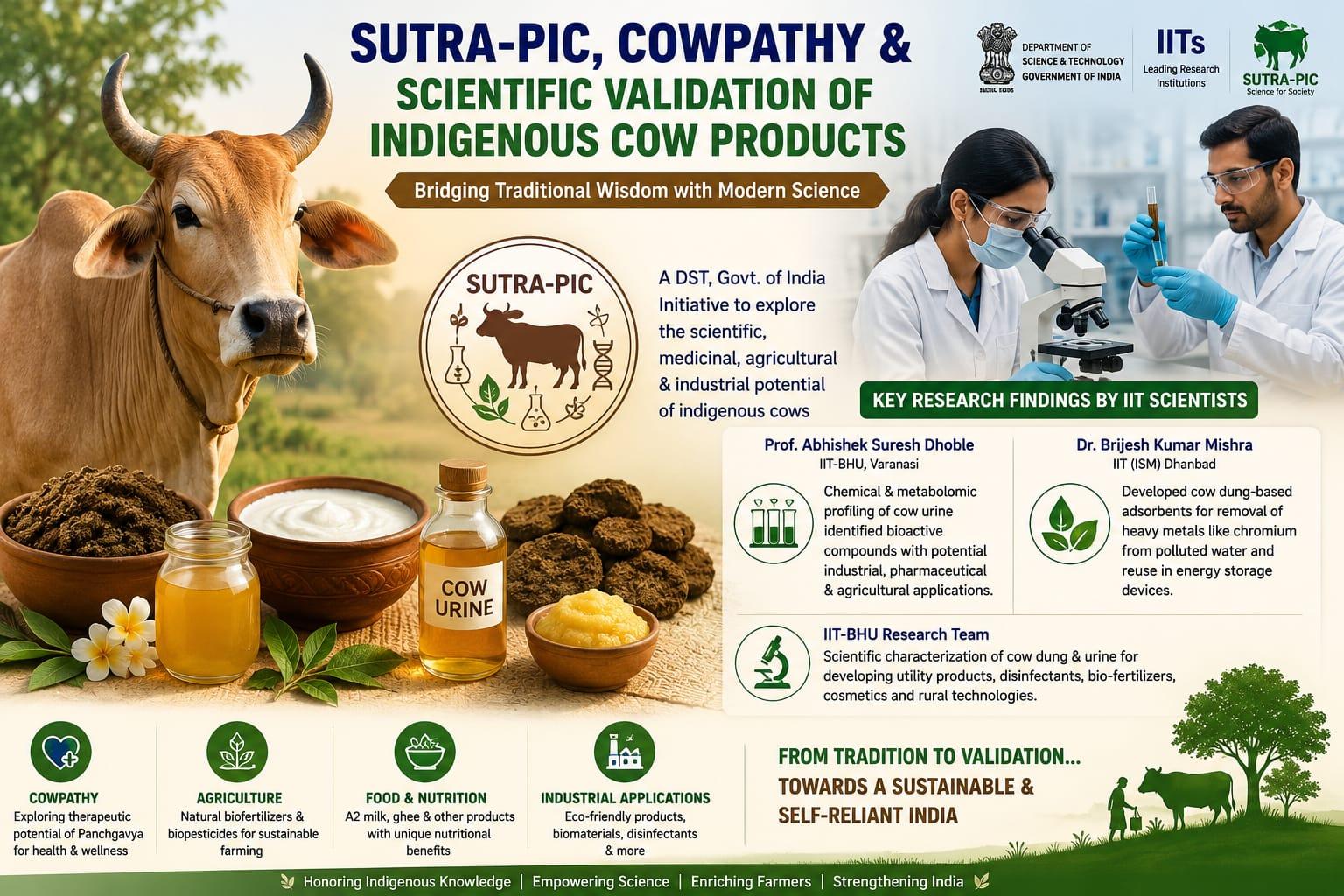
India’s traditional knowledge related to indigenous cows is now undergoing structured scientific validation through the flagship national program SUTRA-PIC (Scientific Utilization through Research Augmentation – Prime Products from Indigenous Cows).
🔬 SUTRA-PIC: A National Scientific Initiative
Launched in 2020 by the Department of Science and Technology (DST), Government of India, SUTRA-PIC is a multi-disciplinary program aimed at exploring the scientific, medicinal, agricultural, and industrial potential of indigenous cow products.
This program involves premier institutions such as IITs, ICAR institutes, and other national research bodies, making it a significant step toward bridging traditional knowledge and modern science.
🧪 Key IIT Researchers & Their Contributions
A major strength of SUTRA-PIC lies in the involvement of leading IIT scientists. Some of the notable researchers and their findings include:
🔹 Prof. Abhishek Suresh Dhoble (IIT-BHU, Varanasi)
– Led research on chemical and metabolomic profiling of cow urine and dung.
– His study titled “Metabolomic Profiling of Cow Urine of Various Breeds…” identified bioactive compounds such as phenols, esters, and other metabolites with potential industrial and pharmaceutical applications.
– His research emphasizes that cow-derived by-products can be utilized for disinfectants, cosmetics, agrochemicals, and nutraceuticals.
🔹 Dr. Brijesh Kumar Mishra (IIT (ISM) Dhanbad, Jharkhand)
– Led a project on cow dung-based hybrid adsorbents.
– Demonstrated that processed cow dung can be used for removal of heavy metals (like chromium) from polluted water.
– The same material can further be used as low-cost electrodes for energy storage devices, contributing to circular economy and sustainability.
🔹 IIT-BHU Research Team (Biochemical Engineering Department)
– Conducted systematic studies on scientific characterization of cow dung and urine.
– Focused on developing utility products and economic models for farmers using cow-based resources.
🔹 Insights from IIT Madras Leadership
– According to IIT Madras Director Prof. V. Kamakoti, research studies indicate that cow urine may exhibit anti-fungal, anti-bacterial, and anti-inflammatory properties, although further scientific validation is required.
🧬 Understanding “Cowpathy”
“Cowpathy” refers to therapeutic applications of cow-derived products, particularly Panchgavya (milk, curd, ghee, urine, dung), rooted in Ayurveda.
SUTRA-PIC attempts to:
– Identify bioactive molecules
– Validate pharmacological properties
– Standardize formulations for scientific acceptance
🌱 Major Scientific Findings So Far
– Cow dung-based materials can purify polluted water and be reused in energy storage systems
– Cow urine profiling reveals multiple bioactive compounds with industrial applications
– Potential applications in:
– Agriculture (biofertilizers, biopesticides)
– Healthcare (under validation stage)
– Environment (waste-to-wealth technologies)
These findings suggest that indigenous cow resources can contribute significantly to sustainable agriculture, green technology, and rural economy.
⚖️ Scientific Perspective & Need for Validation
While promising, researchers emphasize:
– Need for rigorous clinical trials
– Standardization of formulations
– Evidence-based validation before therapeutic claims
This balanced approach ensures that traditional knowledge is validated scientifically rather than blindly accepted.
🌍 Implications for Veterinary & Livestock Sector
– Strengthening indigenous breed conservation
– Promoting organic and natural farming systems
– Creating new livelihood opportunities
– Supporting ethnoveterinary and integrative medicine research
✍️ Conclusion
SUTRA-PIC represents a transformational initiative where ancient wisdom meets modern science.
The involvement of IIT scientists such as Prof. Abhishek S. Dhoble and Dr. Brijesh Kumar Mishra provides scientific credibility to this emerging field. If pursued with scientific rigor, this initiative can redefine livestock-based bio-economy in India and position the country as a global leader in sustainable and integrative veterinary sciences.
-(Dr. Rajesh Kumar Singh)
Editor-in-Chief, Pashudhan Praharee