

From Seva to Sustainability: Reimagining the Future of Gaushalas and Indigenous Cattle Economy in India
By Dr. Rajesh Kumar Singh
Editor-in-Chief, Pashudhan Praharee
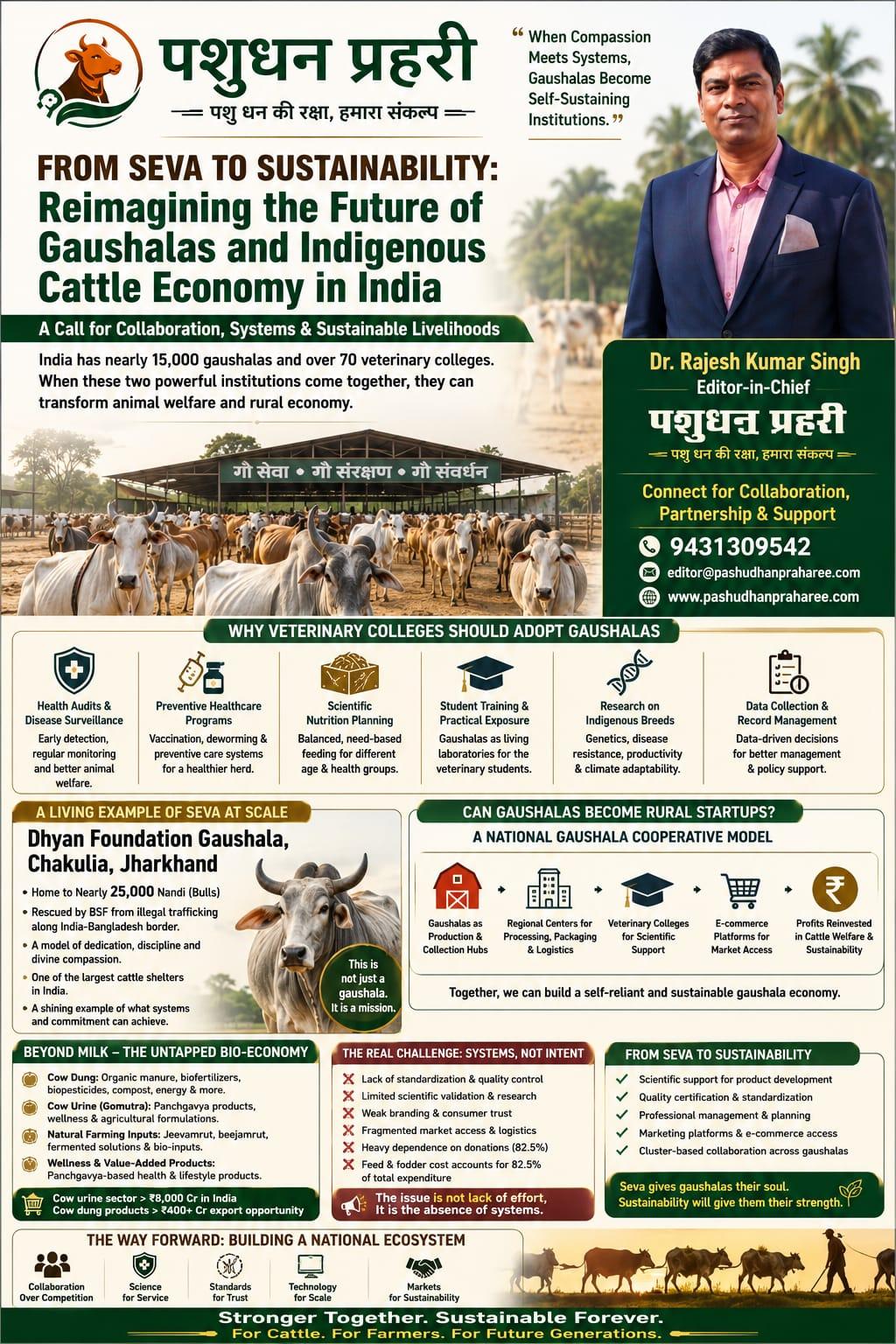
India stands at a unique crossroads where tradition and science have the potential to converge and create one of the most powerful rural transformation models in the world. On one side, the country has more than 70 veterinary colleges equipped with scientific expertise, research infrastructure, and trained professionals. On the other, India hosts nearly 15,000 gaushalas—living repositories of indigenous cattle, compassion, and cultural heritage.
Yet, despite this natural synergy, these two systems rarely collaborate.
This disconnect is not just a missed opportunity—it is a structural gap that limits both animal welfare and rural economic potential.
The Foundation: Healthy Cattle, Sustainable Gaushalas
The sustainability of any gaushala begins with the health of its cattle. Without healthy animals, discussions around dairy production, Panchgavya products, organic farming inputs, or rural livelihoods become meaningless.
Most gaushalas today care for abandoned, aged, injured, or non-productive cattle. These animals require continuous veterinary care, nutritional support, and disease monitoring. However, due to limited access to professional veterinary services, many health issues remain undiagnosed.
This raises a critical question:
What if every veterinary college adopted a cluster of nearby gaushalas?
A Living Example of Seva at Scale: Chakulia Dhyan Foundation Gaushala
If one wishes to truly understand the scale, complexity, and spirit of gaushala management in India, one must look at the Dhyan Foundation Gaushala at Chakulia, Jharkhand.
This gaushala stands as a remarkable example of compassion translated into action.
Today, it houses nearly 25,000 Nandi (bulls)—rescued by the Border Security Force (BSF) from illegal trafficking along the India-Bangladesh border. Each animal represents not just a life saved, but a commitment upheld.
Managing such an enormous cattle population is not an ordinary task. It requires:
– Continuous veterinary care
– Large-scale feeding and nutrition management
– Disease surveillance systems
– Infrastructure, manpower, and unwavering dedication
At the heart of this extraordinary effort is Dr. Shalini Mishra, whose leadership, vision, and tireless commitment deserve the highest appreciation.
Her work goes far beyond routine management. It reflects:
– Exceptional administrative capability in handling one of the largest gaushalas in India
– Deep compassion and ethical commitment toward animal welfare
– Scientific orientation in managing large herds under challenging conditions
– Resilience and dedication in sustaining such a massive operation
Dr. Shalini Mishra’s contribution is not just managerial—it is inspirational. She represents a new generation of leaders who are redefining gaushalas not merely as shelters, but as organized, scalable, and impactful institutions.
The Chakulia gaushala is not just a facility—it is a living institution of service, discipline, and commitment. It clearly demonstrates that when compassion is supported by leadership and systems, even the most challenging tasks become achievable.
Such models deserve national recognition and institutional support, particularly from veterinary colleges and research organizations.
Veterinary Colleges as Catalysts of Change
If veterinary colleges partner with gaushalas like Chakulia, the transformation could be immense:
– Regular health audits and disease surveillance
– Structured vaccination and preventive healthcare
– Scientific feeding and ration balancing
– Hands-on student training and internships
– Research on indigenous cattle under real field conditions
– Data-driven livestock management
This is not just collaboration—it is a necessity.
Can Gaushalas Become Rural Startups?
India’s dairy revolution through the Amul model proved that rural systems can transform the national economy.
Now, a similar opportunity exists—this time with gaushalas as the unit.
A National Gaushala Cooperative Model can:
– Transform gaushalas into production hubs
– Enable aggregation, processing, and branding
– Integrate veterinary science and quality systems
– Connect products to national and global markets
Beyond Milk: The Untapped Bio-Economy
The future of indigenous cattle economy lies beyond milk.
Cow dung and gomutra—available in abundance—can drive:
– Organic agriculture
– Biofertilizers and biopesticides
– Panchgavya-based wellness products
– Sustainable rural industries
This represents a circular bio-economy, where nothing is wasted and everything creates value.
The Real Challenge: Systems, Not Intent
Despite dedication, gaushalas face:
– Lack of standardization
– Limited scientific validation
– Weak market access
– Heavy dependence on donations
The problem is not lack of effort—it is lack of structured systems.
From Seva to Sustainability
Seva gives gaushalas their soul.
But sustainability gives them their future.
To move forward, gaushalas need:
– Scientific support
– Professional management
– Quality certification
– Market linkage
– Institutional collaboration
The Role of Digital Platforms
India’s growing digital economy provides an opportunity to connect gaushalas with conscious consumers.
An e-commerce ecosystem can:
– Expand market reach
– Enable branding and value addition
– Reduce dependency on donations
– Create sustainable income
The Way Forward: Building a National Ecosystem
The future does not lie in isolated gaushalas struggling alone.
It lies in building a connected ecosystem where:
– Veterinary colleges provide technical support
– Gaushalas collaborate and share knowledge
– Standards ensure trust
– Technology enables scale
Conclusion
India’s indigenous cattle are not just a legacy—they are an opportunity.Institutions like the Dhyan Foundation Gaushala, Chakulia, and leaders like Dr. Shalini Mishra show what is possible when dedication meets discipline and vision.Now, the responsibility lies with us—policymakers, veterinary institutions, researchers, and society—to build systems that support such efforts.
Because the future of gaushalas is not just about protection.
It is about transformation.
And that transformation has already begun.