

Eggs in Mid-Day Meals: A Scientific Necessity, Not a Philosophical Debate
By Dr. Rajesh Kumar Singh
Editor-in-Chief, Pashudhan Praharee
The recent discourse surrounding the exclusion of eggs from mid-day meals in West Bengal has once again brought to the forefront a critical issue—the conflict between nutrition and ideology. Any move to replace eggs with purely vegetarian alternatives in government nutrition programs must be examined not through the lens of belief systems, but through science, economics, and public health priorities.
At a time when India continues to battle protein-energy malnutrition, especially among children from economically weaker sections, removing eggs from mid-day meals is not just a policy shift—it is a step backward in nutritional security.
Egg: A Complete and Affordable Nutritional Package
Eggs are widely recognized as one of the most nutrient-dense and cost-effective animal protein sources available.
Nutritional Highlights of Eggs
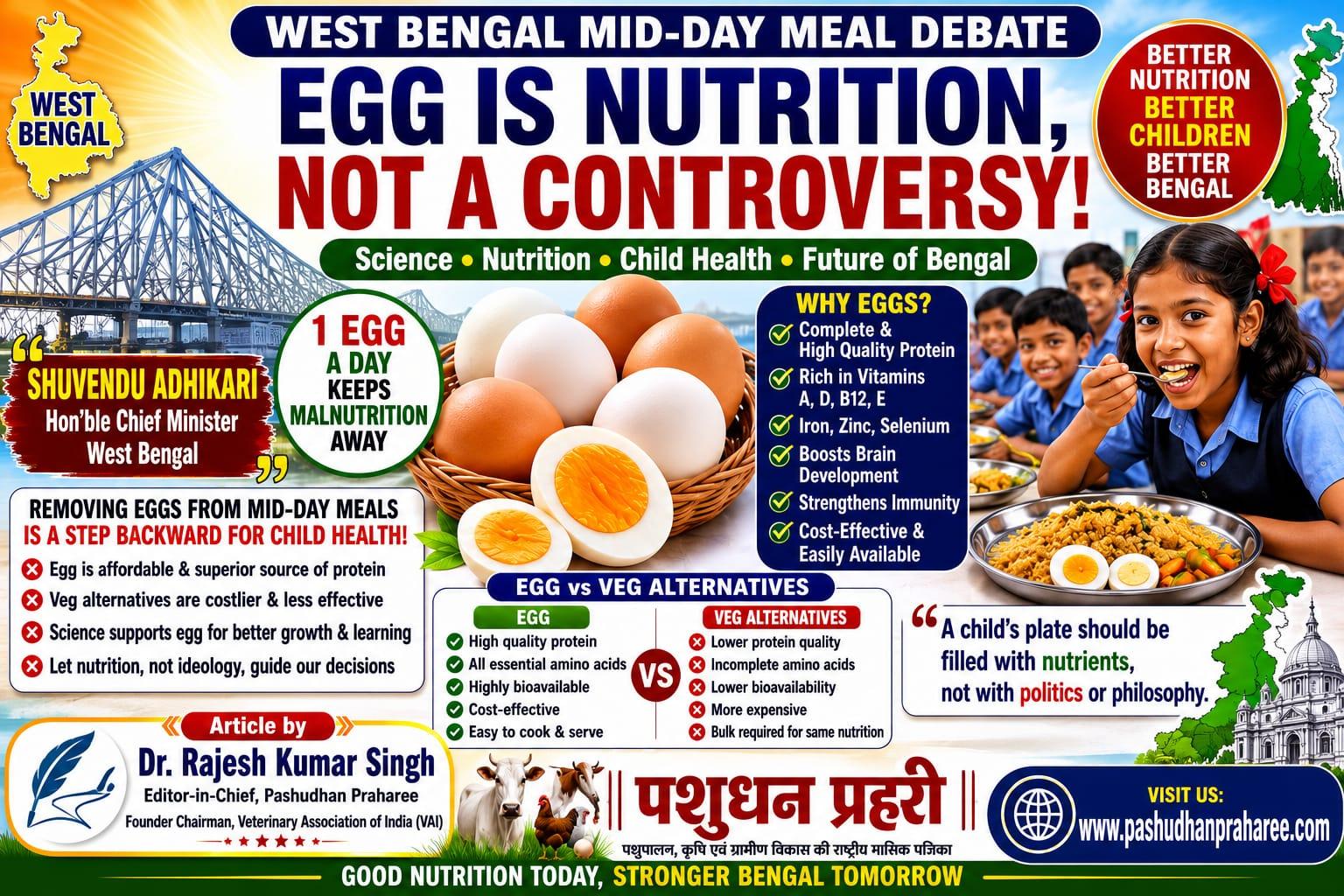
– High-quality complete protein containing all essential amino acids
– Rich in Vitamin A, D, E, B12
– Excellent source of choline (important for brain development)
– Contains iron, selenium, and zinc
– Highly digestible with superior biological value
For growing children, especially in rural and underprivileged communities, one egg a day can significantly improve nutritional outcomes, including physical growth, cognitive development, and immunity.
Egg and Malnutrition: A Proven Solution
India faces a significant burden of stunting, wasting, and undernutrition. Eggs have been scientifically proven to:
– Reduce stunting in children
– Improve muscle development and cognitive function
– Provide essential nutrients often lacking in cereal-based diets
In states where eggs have been included in mid-day meals, improvements in attendance, retention, and child health indicators have been observed.
Economic Reality: Eggs vs Vegetarian Alternatives
One of the most overlooked aspects of this debate is cost-effectiveness.
– Eggs are cheaper per gram of protein compared to most vegetarian sources
– Alternatives like paneer, milk, pulses, or soy products:
– Are often more expensive
– Require larger quantities to match protein levels
– Have lower bioavailability in many cases
Replacing eggs with vegetarian options not only increases the financial burden on the state, but also risks delivering inferior nutritional value.
Egg as “Vegetarian” in Indian Context
Interestingly, in many parts of India, eggs are considered “vegetarian” or “eggetarian”, especially since:
– They are unfertilized and do not involve animal life
– Widely accepted even among semi-vegetarian populations
– Already part of diets in states like Tamil Nadu, Odisha, Jharkhand, and West Bengal itself
Thus, opposing eggs on purely ideological grounds often ignores practical dietary realities.
West Bengal Context: A Missed Opportunity
West Bengal has historically been a fish and egg-consuming state, with eggs forming an integral part of local diets. Removing eggs from mid-day meals:
– Contradicts local food culture
– Undermines nutritional needs of children
– Sends a confusing public health message
Instead of exclusion, the focus should be on choice-based inclusion, allowing children who consume eggs to benefit from their nutritional value.
Science Must Prevail Over Sentiment
Public nutrition programs must be guided by:
– Scientific evidence
– Nutritional requirements
– Affordability and accessibility
Not by ideological or religious considerations that may not reflect the needs of the majority.
Conclusion
Eggs are not merely a food item—they are a powerful tool in the fight against malnutrition. Any attempt to remove them from mid-day meal programs risks compromising the health and future of millions of children.
India, and particularly states like West Bengal, must prioritize nutrition over narrative, ensuring that policy decisions are rooted in science, inclusivity, and practicality.
Disclaimer
The views expressed in this article are personal and based on scientific evidence, field experience, and public health perspectives. They do not intend to hurt any religious or cultural sentiments but aim to promote informed decision-making in the interest of child nutrition and national development.