

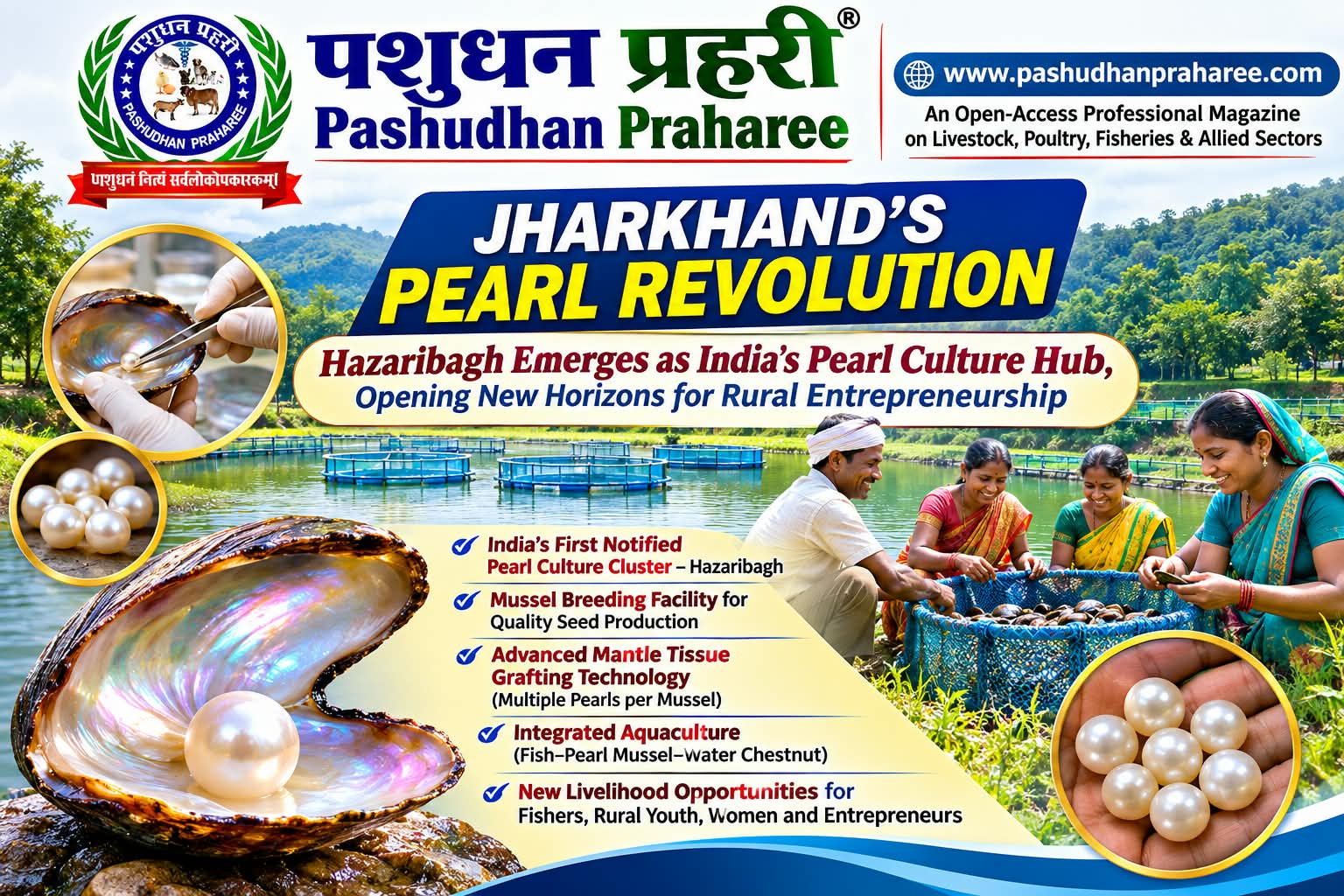
JHARKHAND’S PEARL REVOLUTION : Hazaribagh Emerges as India’s Pearl Culture Hub, Opening New Horizons for Rural Entrepreneurship
From Mussel Breeding to Advanced Mantle Grafting Technology, Government of Jharkhand’s Vision is Transforming Aquaculture into an Opportunity for Livelihood Generation
By Dr Rajesh Kumar Singh
Editor-in-Chief, Pashudhan Praharee
Jharkhand is steadily carving out a new identity in India’s aquaculture landscape. Known for its rich natural resources, reservoirs and growing fisheries sector, the state is now attracting attention for an emerging and promising activity: freshwater pearl culture.
What makes this development particularly remarkable is the concerted effort by the Government of Jharkhand to transform pearl farming into an organised economic activity through scientific interventions, institutional support, infrastructure development and farmer-oriented programmes.
The Hazaribagh Pearl Culture Cluster, successful establishment of a mussel breeding facility, adaptation of advanced mantle grafting technology and participation in the prestigious India International Trade Fair (IITF), New Delhi, represent important milestones in this journey.
These developments deserve appreciation not only as achievements in fisheries technology but also as an example of progressive governance aimed at creating new livelihood opportunities for fishers, rural youth, women and aspiring entrepreneurs.
Hazaribagh: India’s First Notified Pearl Culture Cluster
One of the most significant developments is the identification and notification of Hazaribagh district as India’s first dedicated Pearl Culture Cluster by the Department of Fisheries, Ministry of Fisheries, Animal Husbandry and Dairying, Government of India.
The cluster was notified on 30 August 2024, with the objective of developing an organised production and processing ecosystem for freshwater pearl culture.
The initiative is being supported under the Pradhan Mantri Matsya Sampada Yojana (PMMSY), with a reported investment plan of approximately ₹22 crore for cluster development.
The importance of this initiative is evident from the National Fisheries Development Board’s reported data, which recorded the production of approximately 1.02 lakh pearls from Hazaribagh district.
This provides an encouraging foundation for expanding pearl farming through organised production, scientific management, value addition and improved market connectivity.
A Major Breakthrough: Establishment of a Mussel Breeding Facility
The availability of quality mussel seed is one of the most important requirements for the expansion of freshwater pearl culture.
Recognising this requirement, efforts have been made to establish a mussel breeding facility in Jharkhand. Its successful establishment represents an important step towards developing local breeding and seed production capabilities.
This is particularly important because pearl farming cannot expand sustainably without a dependable supply of healthy, quality mussels.
Local breeding infrastructure can help strengthen the production chain, reduce dependence on external seed sources and provide greater confidence to farmers interested in adopting this enterprise.
The development also creates opportunities for specialised training, technical employment and the emergence of entrepreneurs in mussel seed production and pearl farming.
Technological Innovation: Moving Beyond Conventional Pearl Production
Another exciting development is the adaptation of mantle graft tissue technology for pearl formation.
Conventionally, freshwater pearl culture involves different techniques, including the implantation of artificial nuclei and tissue grafting. The newer approach being showcased in Jharkhand involves mantle tissue grafting without the implantation of an external hard nucleus.
In this technique, suitable mantle tissue is introduced into the mussel to initiate pearl formation through its natural nacre-secreting process.
According to the technical information presented by pearl culture expert Shri Budhan Singh Purti at the India International Trade Fair, the technique has the potential to produce multiple pearls from a single mussel. He reported that approximately seven to eight pearls can be developed in an individual mussel through this approach.
The adaptation of such techniques reflects the growing technical capabilities of pearl farming in Jharkhand.
However, successful commercial adoption will require scientific validation, standardised protocols, monitoring of mussel survival, pearl quality assessment and appropriate post-operative management.
The involvement of trained technicians, research institutions and experienced pearl farmers will be essential in taking this technology to the next level.
Jharkhand Showcases Its Pearl Culture Potential at India International Trade Fair
The participation of Jharkhand at the India International Trade Fair, New Delhi, has provided an important national platform for showcasing the state’s emerging pearl culture capabilities.
The Jharkhand Pavilion highlighted pearl farming and the technological developments taking place in the state.
Shri Budhan Singh Purti, a recognised pearl culture practitioner and technical resource person, explained the advances in pearl farming, including the development of the Hazaribagh cluster and the application of innovative grafting techniques.
The exhibition was significant because it brought an emerging rural enterprise to the attention of national-level visitors, potential entrepreneurs and other stakeholders.
Such participation can help attract investment, establish institutional collaborations, encourage market partnerships and create awareness about the commercial possibilities of freshwater pearl farming.
Adding to this recognition, the recent coverage of Jharkhand’s pearl culture initiative in the Telugu daily newspaper Eenadu is encouraging.
Recognition in a prominent regional-language newspaper demonstrates that an innovative initiative originating in Jharkhand is attracting attention beyond the state.
This is a welcome development for the fisheries sector and the state’s efforts to promote alternative rural enterprises.
Government Leadership Deserves Special Appreciation
Behind every successful developmental initiative is a combination of administrative vision, institutional coordination, technical expertise and sustained commitment.
The progress of pearl culture in Jharkhand deserves special appreciation for the leadership of Shri Aboobacker Siddiqui P., IAS, Secretary, Department of Agriculture, Animal Husbandry and Co-operation, Government of Jharkhand, under whose administrative jurisdiction the Directorate of Fisheries functions.
The proactive approach towards promoting innovative aquaculture activities, strengthening fisheries infrastructure and encouraging livelihood-oriented interventions deserves recognition.
The Secretary’s leadership, together with the efforts of the Directorate of Fisheries, district-level officials, technical experts and progressive pearl farmers, has helped bring this emerging sector into greater prominence.
Special appreciation is also due to the Director of Fisheries, Shri Amarendra Kumar, and the entire fisheries department team for their role in advancing fisheries development and promoting new opportunities for farmers.
The contribution of technical resource persons and progressive entrepreneurs, particularly those involved in farmer training, breeding initiatives and technology adaptation, is equally important.
This initiative demonstrates how administrative encouragement and scientific innovation can work together to create new economic opportunities.
Pearl Culture: An Opportunity for Women, Youth and Rural Entrepreneurs
Pearl culture has considerable potential as a supplementary livelihood activity, particularly in rural areas with suitable water resources.
Unlike conventional aquaculture, pearl farming offers opportunities for value addition beyond the production of fish.
- Additional income for fishers: Pearl farming can diversify income sources and reduce dependence on conventional fish production alone.
- Women’s entrepreneurship: Self-help groups and women-led enterprises can participate in mussel rearing, pearl production, processing and associated activities.
- Rural youth employment: Specialised skills in mussel breeding, grafting, pearl farming and marketing can create new avenues for self-employment.
- Development of local enterprises: Opportunities exist in mussel seed production, culture infrastructure, surgical instruments, pearl processing and jewellery making.
- Value-chain development: Connecting farmers with jewellery manufacturers, traders, e-commerce platforms and other markets can improve the economic returns from pearl production.
For Jharkhand, where rural livelihood diversification remains an important development priority, pearl culture could become a valuable supplementary enterprise.
ICAR’s Scientific Approach: Integrating Fish, Mussels and Water Chestnut
An important scientific dimension of Jharkhand’s aquaculture development is the integrated multi-trophic aquaculture model demonstrated by ICAR-Central Institute of Fisheries Education (CIFE), Mumbai, in collaboration with the Directorate of Fisheries, Government of Jharkhand.
The demonstration was undertaken at Dorwa-Kundwa village in Hazaribagh district under the Dharti Aaba Janjatiya Gram Utkarsh Abhiyan.
The model combined three components:
- Indian major carps as the principal fish crop.
- Freshwater pearl mussels (Lamellidens marginalis) as an organic extractive component.
- Water chestnut (Trapa natans) as an inorganic extractive component.
The demonstration began in January 2025. After nine months of culture, tribal farmers undertook partial harvesting of fish and water chestnut, with the results reported as economically promising.
This model is particularly important because it demonstrates how different aquatic resources can be integrated within a single water body to generate multiple outputs.
Such approaches can be explored further to improve resource utilisation and diversify farmers’ incomes.
What Should Be the Next Priority?
The achievements so far provide a strong foundation, but the real success of the initiative will depend on its ability to reach farmers and create a commercially sustainable pearl culture ecosystem.
- Strengthening the mussel breeding facility and developing a dependable supply of quality seed.
- Establishing farmer training and demonstration centres in different districts.
- Promoting women-led pearl farming enterprises and fisheries self-help groups.
- Developing scientific protocols for different pearl production techniques.
- Encouraging collaboration with ICAR institutes, universities and specialised research organisations.
- Establishing quality testing, grading, processing and jewellery-making facilities.
- Developing direct market linkages and branding Jharkhand-produced pearls.
- Encouraging fisheries entrepreneurs and startups to invest in pearl culture technology and allied industries.
The proposed development of Hazaribagh as a model pearl culture destination should also include a strong extension and market-support mechanism so that farmers are not limited to production but can participate in the entire value chain.
Jharkhand’s Emerging Pearl Story: A Model of Innovation and Inclusive Development
The development of pearl culture in Jharkhand is a promising example of how an innovative aquaculture activity can contribute to rural economic transformation.
From the notification of India’s first dedicated Pearl Culture Cluster in Hazaribagh to the development of mussel breeding infrastructure, the adaptation of mantle grafting technology and national-level showcasing at the India International Trade Fair, the state has made encouraging progress.
The recognition received through media coverage, including the recent mention in Eenadu, further strengthens the visibility of this initiative.
The Government of Jharkhand, particularly Secretary Shri Aboobacker Siddiqui P., IAS, deserves sincere appreciation for the administrative leadership and encouragement behind this emerging development initiative. The Directorate of Fisheries, technical experts, progressive farmers and all associated stakeholders deserve equal recognition.
Pashudhan Praharee believes that Jharkhand has the potential to emerge as a leading centre for freshwater pearl culture in India. With continued government support, scientific guidance, entrepreneurship development and strong market linkages, pearl farming can become an important instrument of rural prosperity.
This initiative sends a positive message: the future of fisheries is not limited to fish production alone. It also lies in innovation, diversification, value addition and the creation of sustainable livelihood opportunities.
Jharkhand is not merely cultivating pearls; it is nurturing new possibilities for rural prosperity.
PASHUDHAN PRAHAREE
Advancing Livestock, Fisheries and Rural Entrepreneurship
References
The following sources were consulted while preparing this feature. These references are provided for editorial verification and are not part of the main article text.
- Press Information Bureau – Enhancing Natural Pearl Production (5 December 2024)
https://pib.gov.in/ - Press Information Bureau – Workshop on Value Addition in Pearl Cluster, Hazaribagh (18 February 2025)
https://pib.gov.in/ - ICAR – Integrated Multi-Trophic Aquaculture: A Viable Model for Scheduled Tribe Farmers Empowerment
https://icar.gov.in/ - ThePrint / PTI – Pearl farming: How Jharkhand is training farmers (13 July 2025)
https://theprint.in/ - Jharkhand24 – IITF highlights Jharkhand’s pearl farming technology (November 2026)
https://jharkhand24.com/ - Official Jharkhand Fisheries Department – Departmental leadership and officers
https://jharkhandfisheries.org/