



FISH CULTURE POND CONSTRUCTION IN INDIA
Requirements for Fish Culture Pond Construction in India
Fish culture pond construction in India requires careful planning and scientific approach to ensure high productivity, sustainability, and economic viability. The following are the key requirements:
- Site Selection:
- Choose a low-lying area with a gentle slope to facilitate water retention and drainage.
- Proximity to water sources like rivers, lakes, or groundwater for sustainable water supply.
- Avoid flood-prone areas to prevent fish loss and infrastructure damage.
- Soil Quality:
- Clayey or loamy soil with good water retention capacity (minimum 20-30% clay content).
- Avoid sandy or rocky soil as it leads to water seepage and instability.
- Soil pH should be between 6.5 to 8.5 for optimal fish growth.
- Pond Design & Construction:
- Pond size depends on purpose and fish species; commonly 0.1 to 2 hectares.
- Pond depth should be 1.5 to 2.5 meters to maintain oxygen levels and temperature balance.
- Construct strong embankments with grass or vegetation to prevent soil erosion.
- Proper inlet and outlet systems for controlled water flow and drainage.
- Water Quality Management:
- Maintain dissolved oxygen levels above 4-5 ppm for healthy fish growth.
- Regularly monitor pH, alkalinity, and ammonia levels.
- Use liming, fertilization, and aeration techniques to improve water quality.
- Stocking Density & Species Selection:
- Choose high-yielding fish species like Rohu, Catla, Mrigal, Pangasius, and Tilapia.
- Stocking density depends on the culture type (extensive, semi-intensive, or intensive).
- Infrastructure & Equipment:
- Installation of sluice gates, aerators, feeding platforms, and fencing.
- Provision for electricity and water pumps for proper water management.
- Biosecurity & Disease Prevention:
- Implement quarantine measures for new fish stocks.
- Regular use of probiotics and organic supplements to reduce disease risks.
- Maintain hygiene and periodic health monitoring of fish.
A scientifically designed and well-maintained fish culture pond ensures higher productivity, better fish health, and sustainable income for farmers. Government schemes like PM Matsya Sampada Yojana support pond construction and fish farming, making it a profitable venture in India.
Construction of Fish Culture Pond

A) Criteria of Site Selection
- Land should have more water holding capacity.
- Land Should not be more alkaline or acidic.
- Low lying area are more suitable.
- Site must have assured water supply.
- Outlets and Inlets of ponds should be well built.
- Site should be approachable with road or path.
- Site must be away from floods affected areas.
B) Permissible parameter of soil & water
Soil :-
- Sand (%) – 40
- Silt (%) – 20
- Clay (%) – 40
- Organic carbon (%) – 0.5-2.0
- Available Nitrogen (mg/100gm) – 20-75
- Available Phosphorous (mg/100gm) – 2 10
Water :-
- Colour – Light Green
- Temperature (Degree Centigrade)- 25 – 35
- Transparency(cm) – 30 – 40
- pH – 7.0 – 8.6
- Dissolve Oxygen (mg/lt) – 4 -10
- Carbon Dioxide (mg/lt) – 3 – 7
- Total Alkalinity (mg/lt) – 60 – 230
- Total Nitrogen (mg/lt) – 0.05 -1.5
- Phosphorous (mg/lt) – 0.05 -7.0
- Salinity (ppt) – <5
- Ammonia (ppm) – 0 – 0.1
- Calcium (ppm) – 75 – 150
- Chlorine (ppm) – <0.003
- Total Dissolve solids (ppm) – <80
- Potassium (ppm) – 0.5 – 10
- Iron (ppm) – 0.3 – 10
Time Scheduling for Fish Culture in Pond (PERT/CPM)
| Event | Activity | Net Duration Time (Days) |
| A | Identification of site | 10 |
| B | Formulation of Project (preparation of plan & estimates, Bank loans etc.) | 30 |
| C | Training in Fish Farming | 15 |
| D | Construction/Renovation of Pond | 45 |
| E | Stocking Management (Liming, Manuring, Filling of water, Growth of plankton and stocking of seed) | 18 |
| F | Soil and Water Analysis | Quarterly, After 60 days of seed in the pond. |
| G | Sale of Fingerlings | 30 days after stocking of seed |
| H | Trial Netting | Every Month |
| I | Partial Harvesting | After 150-180 days of Stocking. (10 Jan) |
| J | Final Harvesting & Marketing | After 250- 260 days of stocking. |


Construction of Prawn Culture Pond
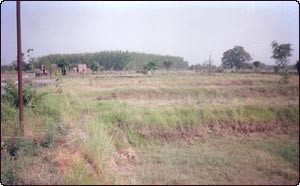
A – Criteria of Selection of Site
- Site must be easily approachable with road or path.
- Site should be free from floods and seepage.
- Assured water supply system.
- Arrangement of outlet of water be made.
B – Permissible Parameters for Soil & Water
I) Soil :-
- Texture
- Sand (%) – 40
- Silt (%) -20
- Clay (%) – 40
- Colour – Blackish brown
- Moisture (%) – 35-40
- Water Retention Capacity (%) – 40
- Total Alkalinity (mg/100gm) – 0-150
- Total Hardness (mg/100gm) – 50-180
- Phosphate (mg/100gm) – 0.5-2.0
- Salinity (ppt) – <5
II) Water :-
- Temperature (Celsius) – 28-30
- Dissolved oxygen (mg/lt) – 5-10
- Visibility (cm) – 35-40
- pH -7.0-8.5
- Carbonate (mg/lt) – 30-50
- Total Alkalinity (mg/lt) – 50-180
- Total Hardness (mg/lt) – 50-150
- Conductivity (mohs/cm) – 20-1500
- Salinity (ppt) – <5
- BOD (mg/lt) – <30
- COD (mg/lt) – <40
- Phytoplankton (nos/lt) – >500
- Zooplankton (nos/lt) – >500
Time Scheduling for Prawn Culture in Pond
| Event | Activity | Net Time Duration (Days) |
| A | Selection of site & beneficiary | 30 |
| B | Training & Study Tour | 15 |
| C | Formulation of Project & Sanction of loan from bank | 30 |
| D | Construction of Pond & Infrastructure | 45 |
| E | Nursery pond preparation & Stocking | 15 |
| F | Stocking of Seed in Grow out of Pond | 45 |
| G | Trial Netting | After 60 days of Stocking of seed |
| H | Soil & water analysis | quarterly |
| I | Water exchange | Every month after 60 Days of stocking. |
| J | Partial Harvesting | After 150 days of Stocking. |
| K | Total Harvesting | After 220-245 days of Stocking |

Please follow and like us: