

DONKEY MILK AS A NUTRACEUTICAL: POTENTIAL APPLICATIONS IN HUMAN HEALTH AND ALLERGY MANAGEMENT
*Dr. Bhargav J. Solanki and Dr. Ashif A. Mathakiya
Assistant Professor, Vrundavan Polytechnic in Animal Husbandry, Jasdan-360050, Rajkot, Gujarat,
*Corresponding author email: solankibhargavj@gmail.com
ABSTRACT
Donkey milk has garnered increasing attention as a nutraceutical due to its unique composition and therapeutic potential. Historically revered for its medicinal and cosmetic applications, it closely resembles human breast milk in nutritional profile, making it suitable for infant nutrition and individuals with cow’s milk protein allergy. Rich in bioactive compounds such as lysozyme, lactoferrin, and α-lactalbumin, donkey milk exhibits potent antimicrobial, antiviral, and immunomodulatory properties. Its low-fat and cholesterol content, high vitamin D levels and balanced protein ratio further enhance its appeal for cardiovascular and bone health. Despite these benefits, challenges such as low milk yield, high production costs, limited consumer acceptance and risks associated with raw consumption hinder its widespread adoption. In India, underdeveloped donkey farming and a lack of regulatory frameworks pose additional constraints. Nonetheless, with proper processing and awareness, donkey milk holds promise as a functional food in allergy management and human health support.
INTRODUCTION
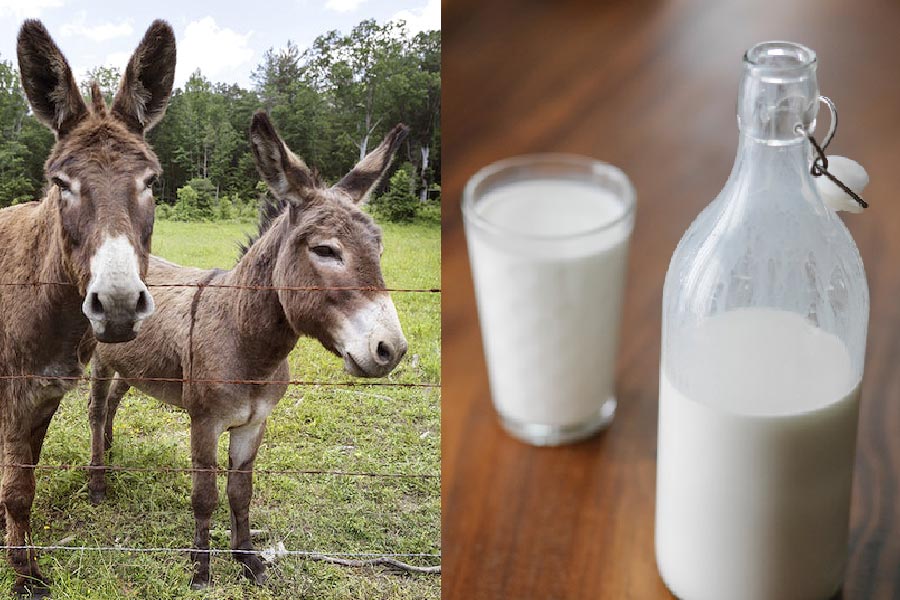
Numerous breeds of domesticated donkeys inhabit various regions around the globe and similar to many other mammals, female donkeys, referred to as jennies, have been cultivated for thousands of years for their milk. Donkeys are members of the Equidae family, which also encompasses horses and zebras. The use of donkey milk for medicinal and cosmetic purposes from ancient history. It is reported that Hippocrates utilized it as a remedy for arthritis, coughs and wounds. Donkey milk possesses antimicrobial properties and is employed as a traditional medicine for treating infections, including whooping cough, as well as certain viruses in regions of Africa and India. When compared to milk from other dairy animals such as cows, goats, sheep, buffalo and camels, donkey milk bears the closest resemblance to human breast milk. In fact, it was first utilized in the 19th century to nourish orphaned infants.
NUTRITIONAL FEATURES OF DONKEY MILK
Donkey milk has nutritional properties similar to human breast and cow milk. It provides vitamins, minerals and protein. It is lower in fat and thus calories and contains more vitamin D than other milks. The majority of the calories in donkey milk come from carbohydrates, specifically lactose. This figure shows the nutritional values for 3 ounces (100 mL) of donkey, human breast and whole, vitamin-D-fortified cow’s milk.
| Donkey milk | Whole, vitamin-D-fortified cow’s milk | Human breast milk | |
| Calories | 49 | 61 | 70 |
| Protein | 2 grams | 3 grams | 1 gram |
| Carbohydrate | 6 grams | 5 grams | 7 grams |
| Fat | 2 grams | 3 grams | 4 grams |
| Cholesterol | 3% of the Daily Value (DV) | 3% of the DV | 5% of the DV |
| Vitamin D | 23% of the DV | 9% of the DV | 1% of the DV |
| Calcium | 7% of the DV | 11% of the DV | 3% of the DV |
| Riboflavin | 2% of the DV | 13% of the DV | 2% of the DV |
Table 1: Comparison of the composition of donkey milk with different species
The majority of dairy milk’s protein is casein and whey. Donkey milk is comparable to human breast milk in that it contains less casein and more whey proteins. The whey protein in donkey milk has antibacterial properties, inhibiting the growth of viruses and bacteria. In laboratory experiments, it inhibits the spread of microorganisms such as Listeria monocytogenes, Escherichia coli and Staphylococcus aureus.
OVERALL BENEFITS OF DONKEY MILK
- Donkey milk having vast nutritional value as well as enhance immune system and also useful for allergic person.
- Donkey milk has lower fat and cholesterol levels compared to bovine milk, which can be beneficial for weight management and cardiovascular health.
- It contains essential amino acids, polyunsaturated fatty acids, vitamins and minerals like calcium, contributing to overall health and bone health.
- The milk contains protective proteins like lysozyme and lactoferrin, which give it antibacterial, antiviral and antioxidant properties
- It can improve skin elasticity and has been linked to delaying signs of aging.
- Protein in donkey milk consists of roughly equal proportions of casein and whey. Whereas in cow milk contains approximately five times more casein than whey.
- Due to its markedly lower casein levels, many individuals with a cow’s milk protein allergy can tolerate donkey milk.
- Another significant element of donkey milk is lactose, which aids in the absorption of calcium, essential for maintaining strong bones.
THERAPEUTIC BENEFITS OF DONKEY MILK
The primary antimicrobial proteins found in milk include immunoglobulins, lactoferrin, lactoperoxidase and lysozyme. α-lactalbumin possesses antitumor, antiviral and anti-stress properties (Bielecka et al. 2022). While cow’s milk is the most prevalent choice for infant feeding and is commonly used as a substitute for human milk, it is also one of the leading causes of food allergies in infants and children, potentially resulting in an abnormal immunological response. Donkey milk serves as a valuable source of the natural antimicrobial compound known as lysozyme (LZ). LZ directly inhibits pathogenic bacteria by targeting their cell walls. Recent in-vitro studies have indicated that donkey milk has poor digestibility. Consequently, it appears that LZ reaches the gastrointestinal tract and helps reduce the occurrence of gastrointestinal infections in infants (Caroli et al. 2015). Reports in the literature have demonstrated that LZ positively impacts the storage of raw milk by decreasing bacterial load. The concentration of LZ varies among different species. Donkey milk contains a significantly higher amount of lysozyme compared to human and cow’s milk (1.5, 0.420 and 0.0013 g/L, respectively). The level of LZ in donkey milk fluctuates with the lactation period, averaging between 4,000 to 5,000 U/mL, with the highest concentration observed during early lactation, which may account for the low microbial load of donkey milk. Cows and buffalo are the primary animal species that meet the global demand for milk and dairy products due to their abundant lacteal secretions.
DISADVANTAGES OF DONKEY MILK
- The primary disadvantage of donkey milk lies in its cost and availability. Due to the limited number and size of donkey dairy farms, production and sales are costly, making it difficult to obtain.
- Donkeys produce significantly less milk compared to cows, with a donkey yielding about one liter of milk per day compared to a cow’s potential of 12 gallons.
- The high price of donkey milk, coupled with its low casein content, renders it both costly and challenging for cheesemaking purposes.
- Donkey milk is more sensitive to heat treatment, causing protein sedimentation due to poor colloidal stability and a high-calcium environment.
- Low total solids and low casein content, along with high levels of antibacterial substances, make it challenging to prepare fermented products like yogurt from donkey milk.
- Another possible drawback is that most small farms provide only raw donkey milk and consuming unpasteurized milk poses a risk of foodborne illnesses.
- While donkey milk possesses antimicrobial properties and tests typically indicate it is free from harmful pathogens, there remains a risk that raw milk may harbor bacteria or other dangerous toxins.
- Individuals with lactase deficiency may have difficulty digesting the lactose in donkey milk, experiencing symptoms like bloating and diarrhea.
- This can be particularly hazardous when given to infants, elderly individuals, or anyone with a weakened immune system.
Therefore, individuals with lactose intolerance should either avoid or limit their intake of donkey milk. As an alternative, a lactase enzyme can be utilized to break down the lactose before consumption.
CONSTRAINTS
- In India, donkey farms are very small or not yet well organized.
- Donkey milk is not gaining huge consumer acceptance because of a lack of related food product legislation.
- Social Prohibition.
- Lower milk yield
CONCLUSION
Donkey milk, long valued for its medicinal and nutritional properties, is emerging as a promising alternative to conventional dairy. Its close resemblance to human breast milk, low casein content and rich supply of immune-boosting compounds make it especially suitable for individuals with cow’s milk protein allergies and those seeking functional foods. Nutritionally, it offers a balanced profile with fewer calories and more vitamin D than cow’s milk, while its antimicrobial and immunomodulatory effects add therapeutic potential.
However, its limited availability, high cost and risks associated with raw consumption pose significant challenges. Additionally, its lactose content may not be suitable for those with lactose intolerance. While donkey milk holds great promise in both nutrition and health, careful sourcing and medical guidance are essential to ensure safe and effective use.
REFERENCE
Bielecka M, Cichosz G, Czeczot H. Antioxidant, antimicrobial and anticarcinogenic activities of bovine milk proteins and their hydrolysates-A review. International Dairy Journal. 2022;127:105208.
Caroli AM, Bulgari O, Gigliotti C, Altomonte I, Salari F, Martini M. Profilo lattoproteico e attività proteasica totale del latte di asina. Scienza e Tecnica Lattiero Casearia. 2015;66(1-2):11-16.