



Women empowerment through floriculture
Harshita Bora1, Anju Pal1 and Anamika Sajwan2
1Department of Horticulture, Govind Ballabh Pant University of Agriculture and Technology, Pantnagar, Uttarakhand (263145), India
2Department of Agriculture, Dolphin (PG)Institute of Bio-Medical & Natural Sciences, Manduwala, Dehradun, Uttarakhand (248007), India
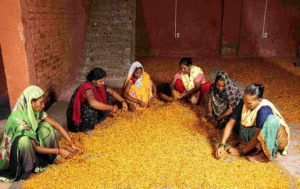
Flowers have been an essential part of the social fabric since antiquity, with their essence and aroma playing important roles in many social, cultural, and religious events around the world (Chaubey, 2020). Floriculture is a branch of horticulture that focuses on the profitable production of flowers and beautiful plants for both outdoor gardens and flower shops (Basnayake, 2022). Women play an important part in the agricultural system, contributing significantly to the physical aspects of farming, livestock management, post-harvest operations, and related areas. Approximately 43% of the agricultural labour force in developing countries consists of women, yet they are frequently left out of decision-making processes due to financial barriers. India has achieved self-sufficiency in horticultural production, but a considerable amount of food products gets spoiled every year due to improper post-harvest facilities. Value addition of floricultural crops has the potential to significantly improve the livelihood and financial conditions of rural women (Chatterjee and Das, 2017).
 |
|
|
|
|
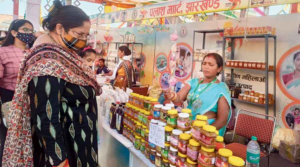
Women’s empowerment through value-added flower goods includes converting waste flowers into higher-value things such as dried arrangements, essential oils, potpourri, crafts, and incense, thereby increasing income and skills for rural women, particularly in India. Self-help organizations are crucial because they facilitate group production and marketing, which promotes social recognition and financial independence. Women make floral candles, resin jewelry, pressed flower bookmarks, rose water, potpourri, dry flowers and food products such as hibiscus jam and rose gulkand. Temple flower waste is recycled into incense sticks, handmade paper, and biodegradable packaging, lowering pollution while generating employment. These products have longer shelf lives, decrease perishability concerns and appeal to environmentally concerned customers through online and local sales.
Government initiatives for the promotion of floriculture
 |
|
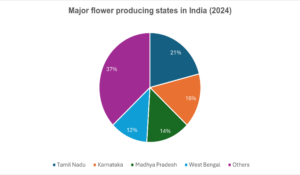
Government initiatives in India strongly promote floriculture through subsidies, training, and export support under schemes such as MIDH (Mission for Integrated Development of Horticulture) and APEDA (Agricultural and Processed Food Products Exports Development Authority), with the goal of increasing farmer incomes and exports. These projects include area extension, protected cultivation, and value addition, with new expansions in places such as Odisha and Arunachal Pradesh. The MIDH provides 60% of the funds for floriculture area extension, sheltered cultivation (greenhouses, polyhouses), and post-harvest infrastructure such as cold storage. The National Horticulture Board (NHB) provides 35-50% project subsidies for greenhouses, cold chains, and high-quality planting materials. APEDA helps exporters increase their global competitiveness by providing transport subsidies, refrigerated storage, and infrastructure. The CSIR Floriculture Mission, which is being implemented in 22 states, promotes high-value varieties, agro-technologies, and entrepreneurship based on CSIR innovations, which are merged with apiculture to generate additional income. It focuses on import substitution and increasing farmer income through nursery commerce and value addition.
(Source: APEDA)
Role of government and other organizations in empowering women
Government and organizations in India actively empower women in floriculture through targeted training, financial aid, and SHG integration under schemes like MIDH and CSIR Floriculture Mission. These efforts focus on skill-building for value addition, protected cultivation, and market linkages, benefiting thousands of rural women.
Central Government Schemes
MIDH and NHB provide up to 50% subsidies for women-led floriculture projects, such as greenhouses and cold storage, as well as training through Krishi Vigyan Kendras. The CSIR Floriculture Mission has trained 1,615 women among 5,728 beneficiaries in 26 states, incorporating apiculture and value-added goods such as incense made from floral waste. Stand-Up India and Mahila Udyam Nidhi provide loans of up to ₹2 crore for women entrepreneurs in floral enterprises.
NGO and Collaborative Roles
Organizations such as Phool.co and KVIC (Khadi and Village Industries Commission) work together on waste-to-wealth programs, training women for eco-products and supplying bee boxes for integrated farming. These collaborations increase socioeconomic status, with 65% of Odisha SHG women reporting improved household authority.
Rashtriya Mahila Kosh (RMK) and Mahila e-Haat have helped women gain work in floriculture by offering microcredit and digital marketing platforms, allowing SHGs to convert flowers into value-added items such as incense and potpourri. RMK provided collateral-free loans to NGOs and SHGs for various livelihood activities, including floriculture operations such as nursery establishment, protected cultivation and value addition. Mahila e-Haat is a virtual marketplace operated by the Ministry of Women and Child Development that connects women artisans and SHGs with national purchasers of flower items such as dried bouquets, essential oils and eco-friendly crafts made from temple waste. It was launched to promote economic empowerment by facilitating direct sales, eliminating middlemen and increasing incomes for women entrepreneurs trained under CSIR missions.
Success Stories
|
|
|
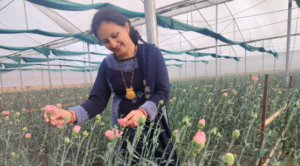
- In 2015, Meena Chandel of Bilaspur, Himachal Pradesh, quit her teaching job to work in her husband’s floriculture business. They currently grow roses, carnations, and gerberas on 22 bighas, including an 11,000-square-meter greenhouse, and generate an outstanding annual revenue of Rs 70 lakhs from their growing flower business. Meena and her husband formed the Vatika Floriculture Society as a cooperative society to support the growing community. This group plays an important role in educating and directing farmers on the complexities of floriculture, from crop care to market access. Their innovative efforts were not ignored. They have received the ICAR Innovative Farmer Award, as well as four other renowned national awards, in acknowledgment of their accomplishments.
|
|
|

|
|
|


- Maya Vivek and Minal Dalmia, two social entrepreneurs from Telangana, are using their unique firm, Oorvi Sustainable Concepts, to tackle India’s floral waste pollution. By recycling flower waste into eco-friendly products, they not only contribute to sustainability but also provide employment for marginalized women.
Conclusion
The value addition of flowers presents a significant business opportunity for women entrepreneurs. Women may create successful companies that produce income and promote economic empowerment by utilizing their creativity, developing sustainable methods, and capitalizing on online platforms and particular markets. With the expanding global demand for eco-friendly, natural, and artisanal floral goods, women entrepreneurs are well-positioned to lead the way in this thriving industry, contributing significantly to floriculture’s growth and sustainability.
References
Basnayake. 2022. Women Entrepreneurs and Poverty Alleviation in Floriculture of Colombo District in Sri Lanka. Colombo Journal of Multi-Disciplinary Research, 7(01&02): 84-110.
Chatterjee, R. and Das, K. 2017. Generation of employment for women through value addition in horticultural crops. Journal of Rural and Community Affairs, 2 (1): 118-130.
Chaubey, S. 2020. Women Empowerment through Floriculture in Dinapur Village, Varanasi, Uttar-Pradesh. Thesis, M. Sc., Department of Extension Education, Institute of Agricultural Sciences, BHU, Varanasi.















