
Delhi High Court Draws Clear Line: FSSAI Cannot Regulate Cattle Feed
In a landmark judgment with far‑reaching implications for the livestock and feed industry, the Delhi High Court has categorically held that the Food Safety and Standards Authority of India (FSSAI) has no jurisdiction to regulate animal or cattle feed under the Food Safety and Standards Act, 2006 (FSS Act).
A Division Bench of Chief Justice Devendra Kumar Upadhyaya and Justice Tejas Karia, in Godrej Agrovet Ltd v. Union of India & Ors (judgment dated 07.04.2026), allowed a writ petition challenging the validity of Note (c) to Regulation 2.5.2 of the Food Safety and Standards (Food Products Standards and Food Additives) Regulations, 2011, as amended in 2021.
- Prohibited the use of certain meat and bone meals in feed meant for milk and meat‑producing animals (except poultry, pigs and fish).
- Made it compulsory for commercial cattle feed to conform to Bureau of Indian Standards (BIS) specifications and bear the BIS certification mark.
Why the Court Struck Down FSSAI’s Move
The Court went back to first principles and the scheme of the FSS Act, 2006.
- The statute is designed exclusively to ensure safe and wholesome food for human consumption.
- Section 3(1)(j) defines “food” in a wide but human‑centric manner and does not include animal feed or cattle feed.
- Therefore, all powers and functions of FSSAI – including its regulation‑making authority – are confined to food meant for humans and cannot be extended to feed for animals.
On this basis, the Bench held that attempts to bring animal feed within the fold of the FSS Act amounted to enlarging the statute beyond its intended scope, making Note (c) and related directions ultra vires (beyond the powers) of the parent Act.
BIS Standards: Voluntary Unless Centre Makes Them Mandatory
An important part of the decision concerns BIS standards.
- Under the Bureau of Indian Standards Act, 2016, BIS standards are generally voluntary, unless the Central Government issues a specific notification making them compulsory for a particular product.
- The Court held that FSSAI cannot indirectly convert voluntary BIS norms into mandatory requirements for animal feed by using its delegated powers under the FSS Act.
Consequently, the Court quashed not only Note (c) to Regulation 2.5.2 but also the FSSAI directives dated 10.12.2019, 27.01.2020 and 01.01.2021, which had insisted on mandatory BIS certification for commercial animal feed.
Federal Dimension: Animal Husbandry Is Primarily a State Subject
The judgment also highlights the constitutional allocation of powers.
- Matters relating to “preservation, protection and improvement of stock and prevention of animal diseases” fall under Entry 15 of List II (State List) in the Seventh Schedule.
- The Bench observed that this reinforces the conclusion that FSSAI – a central food safety authority meant for human food – is not the appropriate body to take over regulatory control of the animal feed sector.
What Changes on the Ground?
This ruling does not mean that cattle feed is now unregulated; rather, it clarifies who can regulate it and how.
- FSSAI’s role is confined to human food and cannot be stretched to animal feed via subordinate legislation.
- BIS continues to frame feed standards, but these remain voluntary unless made mandatory by the Central Government under the BIS Act, 2016.
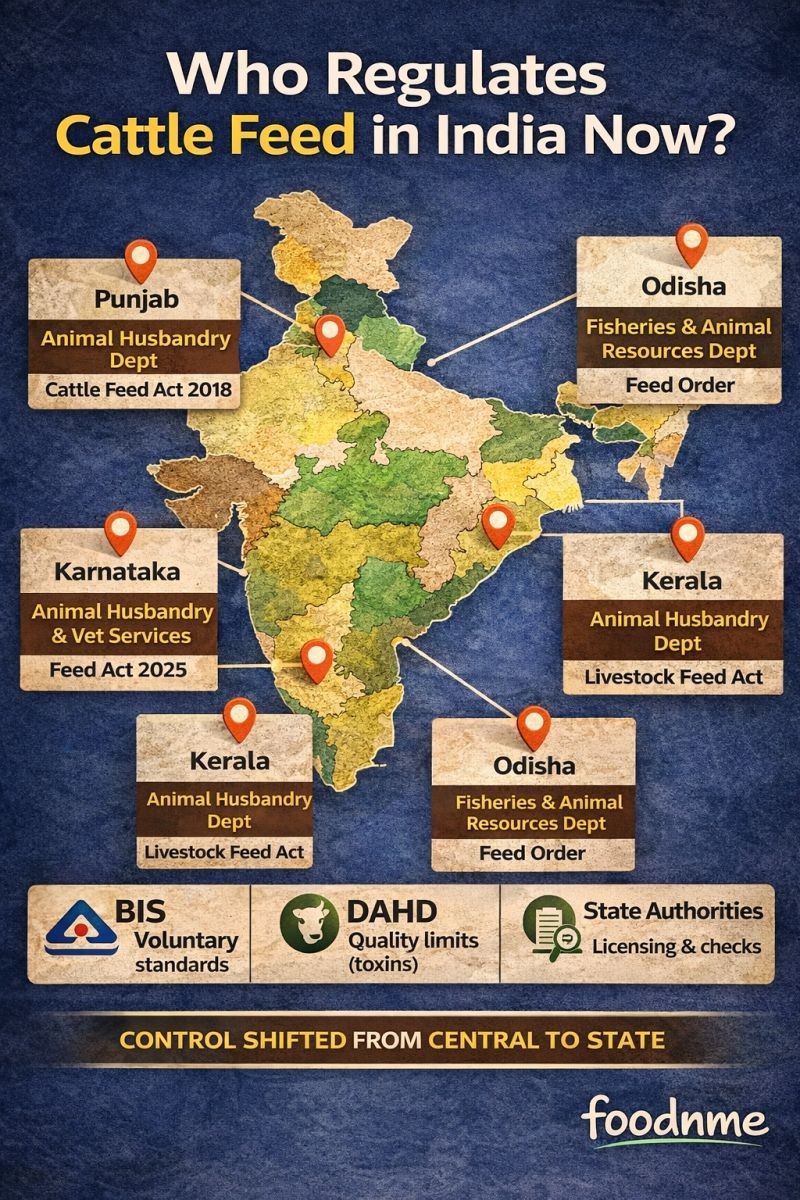
- Quality control, licensing, inspection and enforcement in the feed sector will now fall more squarely on line departments such as the Department of Animal Husbandry and Dairying (DAHD) and State Governments under their existing laws and schemes.
For the feed industry, the decision removes the earlier requirement of dual compliance with both FSSAI regulations and mandatory BIS certification, potentially reducing compliance costs and offering greater flexibility in formulations, while still leaving room for sector‑specific regulations by the appropriate authorities.
Why Feed Quality Still Matters
Even though BIS standards may technically be “voluntary” in the absence of a specific Central notification, good‑quality feed norms remain crucial. Key parameters such as:
- Crude protein levels (typically in the range of 16–22% for many compound feeds),
- Crude fibre and moisture within recommended limits,
- Tight control on contaminants like aflatoxin (often kept below 20 ppb in good practice),
are vital for animal productivity, farmer economics and, ultimately, the safety and quality of milk and meat reaching human consumers.
In other words, the Court has only clarified who can set and enforce standards – it has not diluted the importance of maintaining high‑quality feed. The onus is now on DAHD, State Governments, BIS, cooperatives, industry associations, veterinarians and nutritionists to work together for a robust, science‑based framework that protects both livestock and public health.
Click here to download judgment
Title: Godrej Agrovet Ltd v. Union of India & Ors. Bench: Chief Justice Devendra Kumar Upadhyaya and Justice Tejas Karia, Date of Judgment: 07.04.2026

godrej-agrovet-ltd-v-union-of-india-ors-2152615.pdf
Compiled and analysed for Pashudhan Praharee by Dr. Rajesh Kumar Singh, Editor‑in‑Chief, to inform veterinarians, feed manufacturers and livestock farmers about this important legal and regulatory development.