


AI on the Tracks: How Intrusion Detection Systems Are Revolutionizing Elephant Safety in India
By- Dr. Rajesh Kumar Singh, Jamshedpur
India stands at a critical intersection where infrastructure growth meets ecological responsibility. Among the most urgent challenges is the increasing number of elephant–train collisions, particularly across forest corridors in eastern and northeastern India.
In a major step towards mitigating human–wildlife conflict and enhancing rail safety, Indian Railways has introduced an AI-enabled Intrusion Detection System (IDS) designed to detect the presence of elephants near railway tracks and generate real-time alerts for Loco Pilots, Station Masters, and Control Rooms. The system uses Distributed Acoustic Sensors (DAS) to enable timely preventive action and reduce incidents of elephant fatalities caused by train hits.
The initiative is being implemented by the Ministry of Railways in close coordination with the Ministry of Environment, Forest & Climate Change, as part of a broader strategy to protect wildlife in elephant corridors across the country.
In a historic and forward-thinking move, is deploying Intrusion Detection Systems (IDS)—a cutting-edge, AI-powered solution designed to detect elephant movement near railway tracks and prevent fatal collisions.
The Crisis: When Development Intersects Wildlife
Railway tracks passing through dense forests in:
have become high-risk zones for elephants, especially along traditional migratory routes.
Ground Reality & Data
Over 180+ elephants have died due to train collisions in the past decade
Assam and West Bengal account for the highest fatalities
North Bengal’s region is one of the most vulnerable zones
Frequent incidents near and corridors
A major accident in Assam killed multiple elephants including calves, raising national concern
These tragic events underline a harsh truth:
Railway tracks have unintentionally become ecological barriers and death corridors.
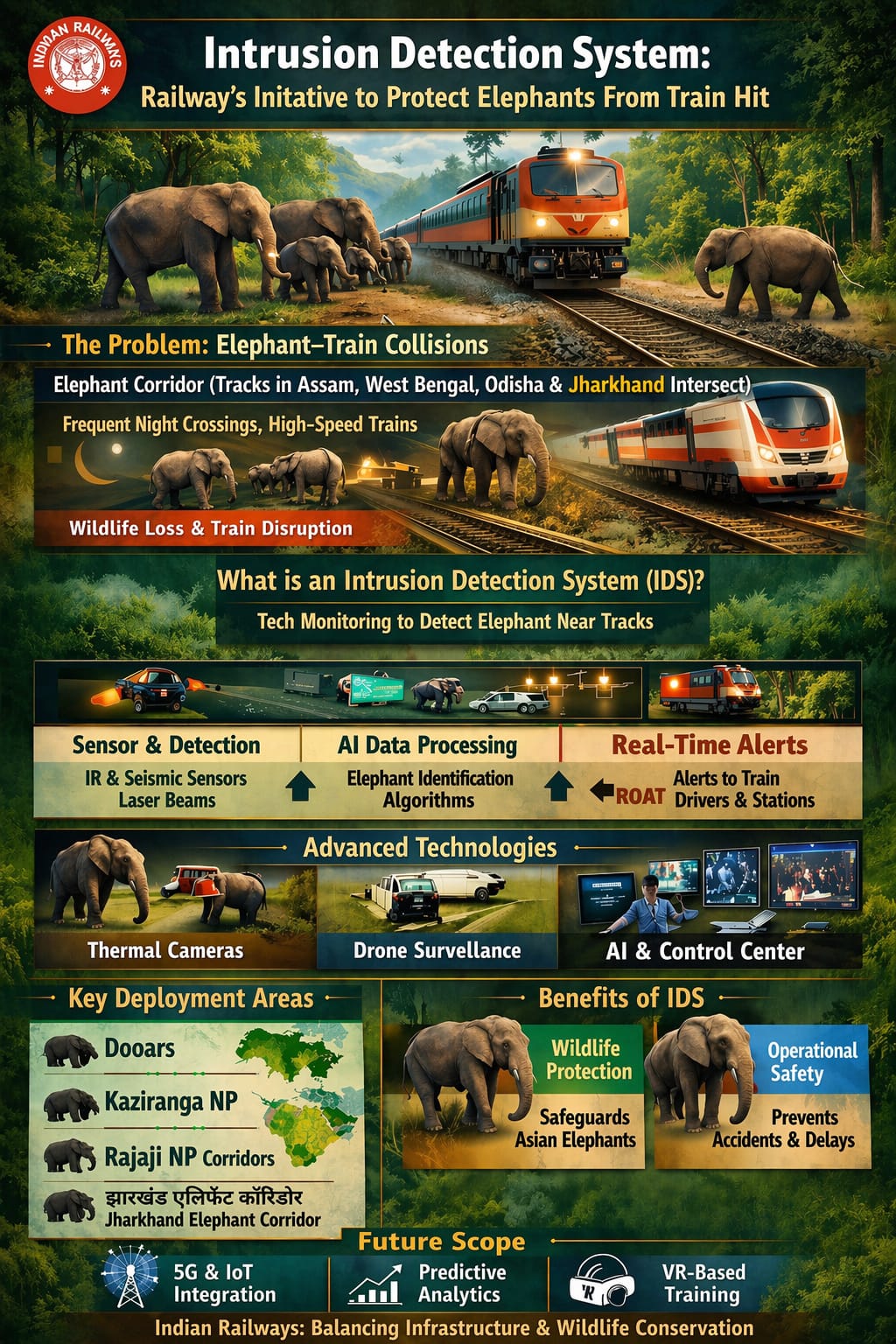
How the AI-Enabled IDS Works
The Intrusion Detection System leverages optical fibre-based Distributed Acoustic Sensing technology, integrated with AI algorithms trained on pre-installed signatures of elephant locomotion. The system continuously monitors ground vibrations along railway tracks and can accurately identify elephant movement in proximity to rail lines.
Once detected, automated alerts are instantly transmitted to train crews, station masters, and control rooms, enabling speed regulation, train stoppage, or other precautionary measures well in advance.
At present, the IDS is operational over 141 route kilometres (Rkms) at critical and vulnerable locations identified by Forest Departments under the Northeast Frontier Railway (NFR).
Understanding IDS: The Technology Behind Prevention
The Intrusion Detection System (IDS) is not just a monitoring tool—it is a real-time intelligent surveillance ecosystem designed specifically for wildlife protection.
🔍 Step-by-Step Working Mechanism of IDS
- Detection Layer (Field Sensors)
Installed along railway tracks in forest corridors:
Infrared (IR) Sensors detect body heat of large animals
Seismic Sensors capture ground vibrations caused by elephant movement
Laser Beams / Optical Sensors identify physical obstruction on tracks
👉 These sensors continuously scan the environment 24×7, even in fog, darkness, or dense vegetation.
- Data Processing Layer (AI Engine)
Sensor data is transmitted to an AI-based processing unit
Advanced algorithms analyze:
Size and shape of the object
Movement pattern
Heat signature
👉 The system distinguishes elephants from humans, vehicles, or smaller animals, reducing false alarms.
- Communication Layer (Real-Time Alerts)
Once an elephant is detected:
Instant alerts are sent to:
Train loco pilots
Station masters
Central control rooms
Alerts include:
Exact location (GPS-based)
Movement direction
Risk level
👉 This entire process takes just a few seconds, enabling rapid response.
- Response Layer (Action Mechanism)
Train drivers reduce speed or apply emergency brakes
Nearby stations may hold or regulate train movement
Control centers monitor and coordinate response
👉 This transforms railway safety from reactive to proactive.
- Advanced Integration (Future-Ready Features)
As highlighted in your shared creative, IDS is evolving with:
Thermal Cameras for night surveillance
Drone Monitoring in high-risk corridors
5G & IoT Integration for faster communication
Predictive Analytics to forecast elephant movement
AI-Control Centers for centralized monitoring
Why IDS is a Game-Changer
- Wildlife Protection
Prevents unnecessary deaths of endangered Asian elephants.
- Operational Safety
Reduces derailment risks and train damage.
- Ecological Balance
Ensures safe passage for elephants across fragmented habitats.
- Smart Infrastructure
Positions India as a global leader in AI-driven conservation.
Field Perspective: A Reality from Eastern India
Working in Jharkhand and adjoining tribal regions, I have personally observed that:
Elephants follow traditional routes older than railway lines
Night crossings are common, increasing vulnerability
Communities often witness helplessly as accidents occur
The deployment of IDS in these areas is not just innovation—it is a moral and ecological necessity.
Expansion Across Indian Railways
To scale up this safety intervention, IDS works have been sanctioned across multiple railway zones covering the following route lengths:
Northeast Frontier Railway (NFR): 403.42 Rkms
East Coast Railway (ECOR): 368.70 Rkms
Southern Railway (SR): 55.85 Rkms
Northern Railway (NR): 52 Rkms
South Eastern Railway (SER): 55 Rkms
North Eastern Railway (NER): 99.18 Rkms
Western Railway (WR): 115 Rkms
East Central Railway (ECR): 20.3 Rkms
These corridors have been identified as high-risk elephant movement zones, based on inputs from Forest Departments and historical data.
Additional Measures to Prevent Elephant Hits
Apart from the AI-based IDS, Indian Railways has adopted a multi-pronged approach to reduce elephant-train collisions:
Joint investigations by Zonal Railways and Forest Departments following any incident, with immediate corrective actions such as speed restrictions and crew advisories
Regular coordination meetings with forest officials to sensitise train crews
Construction of underpasses and ramps to facilitate safe elephant movement
Installation of fencing along vulnerable track sections
Placement of signage boards at all identified elephant corridors to warn loco pilots
Clearance of vegetation and edible items within railway land near tracks
Provision of solar-powered LED lighting in forest areas for improved visibility
Deployment of elephant trackers by Forest Departments to alert railway staff in advance
Installation of Honey Bee buzzer devices at level crossings, whose sound acts as a natural deterrent for elephants
Pilot use of thermal vision cameras to detect wild animals during night or poor visibility conditions
Despite these efforts, Indian Railways has reported an average of around 16 elephant-hit incidents annually over the past five years, underlining the importance of technology-driven solutions like IDS.
The Way Forward
To maximize impact, IDS must be combined with:
Identification of critical elephant corridors
Speed restrictions in sensitive zones
Strong coordination between Railways & Forest Departments
Community participation and awareness
Conclusion: Technology Enabling Coexistence
The adoption of Intrusion Detection Systems by Indian Railways is a defining moment in India’s journey towards sustainable development.
It reflects a powerful philosophy:
👉 Development should not displace nature—it should adapt to it.
This initiative is not just about preventing accidents.
It is about redefining progress with compassion, intelligence, and responsibility.
🐘🚆 A safer railway. A safer wildlife. A smarter India.