

Strategic Roadmap for Next-Generation Dairy Ecosystems in India: Techno Centric Paradigms,Structural Bottlenecks and Socio-Economic Sustainability
Author: GONNABATTULA LIKITHA
Name of the University: Sri Venkateswara Veterinary University
1.Abstract
The structural landscape of the Indian dairy industry is undergoing a paradigm shift, transitioning from volume-centric expansion models to decentralized, technology-driven value networks. Currently serving as a cornerstone of the agrarian economy by contributing approximately 5% to the national gross domestic product (GDP), the sector provides immediate livelihood security to over 80 million rural households. This treatise presents an analytical evaluation of the primary macro-economic and micro-technological forces driving this evolution. By scrutinizing the transition toward “Dairy 4.0”-characterized by Internet of Things (IoT) monitoring, genetic interventions in native cattle, and circular bio-economy implementations-this study maps the trajectory through which India can defend its position as the global milk leader while addressing climate vulnerability, fragmented logistical networks, and fluctuating nutritional demands.
2.Introduction
Over the past five decades, India has successfully transformed its domestic milk landscape, mutating from a nation plagued by severe dairy deficits into the absolute global titan of milk production. At present, India controls roughly 24.6% of global dairy output, generating an estimated 247.87 million tonnes annually. This monumental trajectory represents a 69.4% surge in gross output over the preceding eleven-year window alone, demonstrating an unmatched growth vector anchored by the cooperative frameworks popularized during Operation Flood under Dr. Verghese Kurien.
Macro Evolution Pathway:

Contemporary economic models project that the domestic dairy market will achieve an aggregate financial valuation of ₹57,001.8 billion by the year 2033. However, the current operational imperative is shifting. The sector must pivot from the historical focus on absolute herd expansion toward a dual framework prioritizing per-capita animal efficiency, rigorous quality standardization, and localized value-addition networks.
3.Human Nutrition and the Evolving Biochemistry of Dairy Consumption
3.1 Mitigating Malnutrition in Vegetarian Demographics
Within the Indian subcontinent, where a vast percentage of the populace adheres to strict vegetarian dietary regimens, bovine milk functions as an indispensable biological vector for delivering complete animal proteins. It supplies crucial essential amino acids, calcium, phosphorus, and essential micronutrients such as Vitamin B12 and Vitamin D. Consequently, decentralized dairy supply chains act as a frontline defense against childhood stunting, wasting, and maternal micro-nutrient deficiencies, a reality leveraged by state-sponsored nutritional initiatives like the Mid-Day Meal program.
3.2. Consumer Premiumization and Functional Biomolecules
Rapid urbanization and rising disposable incomes have reshaped consumer spending, driving demand toward premium, functional dairy alternatives. Modern consumers look beyond basic liquid milk toward health-focused derivatives:
- Micronutrient Enrichment:Milk variants fortified with bio-available Vitamins A and D to counteract widespread dietary deficits.
- Macronutrient Optimization:High-protein formulations, including concentrated Greek yogurts and ultra-filtered paneer, designed for urban wellness demographics.
- The A2 Beta-Casein Shift: An expanding commercial segment favoring indigenous cattle breeds (e.g., Sahiwal, Gir, and Tharparkar) that produce the A2 beta-casein variant, which exhibits superior gastrointestinal tolerance compared to the A1 variant common in exotic cattle.
3.3. Therapeutic Food Engineering
Concurrently, diagnostic advancements for digestive conditions have carved out specialized consumer segments. The market for lactose-free formulations, skimmed high-calcium milk powders, and low-glycemic index dairy products reflects a growing focus on preventative health and therapeutic food engineering in metro areas.
- Agrarian Micro-Economics and Regional Structural Matrices
4.1. The Decentralized Livelihood Anchor
Unlike the highly consolidated, capital-intensive corporate mega-farms seen across North America and Europe, India’s dairy economy operates as a deeply decentralized micro-enterprise model. Over 80% of producers are classified as marginal or smallholder farmers managing small herds of two to five animals. This unique structure turns dairy into a vital financial safety net; while traditional crop yields remain hostage to erratic monsoonal cycles, daily milk sales generate consistent cash flow, stabilizing rural household incomes during agricultural crises.
4.2. Gender Equity and Financial Inclusivity
The operational backbone of the Indian dairy industry is primarily female, with women constituting more than 70% of the active workforce.
Socio-Economic Empowerment Cycle:

By organizing into village-level cooperative collection nodes, rural women bypass predatory informal cash lenders. Direct digital payouts into their bank accounts build personal financial autonomy, directly improving family health, financing child education, and shifting rural leadership roles toward women.
4.3. Regional Production Profiles and Local Realities
The Indian dairy sector cannot be viewed as a monolith; productivity, operational systems, and challenges vary drastically by state geography:
- The Northern Belt (Uttar Pradesh, Rajasthan, Punjab, Haryana):Characterized by high-yielding crossbred cattle and Murrah buffaloes. Punjab leads the country in per-capita milk availability (over 1,200 grams/day), driven by advanced farm mechanization, commercial silage operations, and a strong culture of dedicated dairy cropping.
- The Western Model (Gujarat, Maharashtra):The birthplace of the three-tier cooperative structure (AMUL). Gujarat’s landscape is highly institutionalized, where milk unions manage advanced satellite automated processing plants, and livestock insurance penetration is the highest in the country.
- The Southern Cooperative Shift (Andhra Pradesh, Tamil Nadu, Karnataka):Rapidly rising in volume production, driven by state-backed initiatives like Andhra Pradesh’s tie-ups with Amul to revitalize local milk unions. However, this region faces acute monsoonal vulnerabilities and groundwater scarcity, forcing a shift toward hydroponic fodder setups.
- The Eastern & North-Eastern Frontier (Bihar, West Bengal, Assam):Traditionally low-yield zones dominated by non-descript indigenous cattle. The focus here is on primary structural organization-transitioning farmers from unorganized local middlemen to organized state cooperative brands like Sudha (Bihar) and Purabi (Assam).
- Deployment of “Dairy 4.0” and Digital Supply Networks
The integration of automated systems, the Internet of Things (IoT), and machine learning diagnostics is actively modernizing traditional Indian dairy supply chains.
Next-Gen Supply Chain Architecture:

5.1. Decentralized Thermal Energy Chilling
The primary obstacle within tropical dairy supply chains is rapid microbial spoilage during the critical window immediately following extraction. To counter this, innovators have deployed advanced farm-gate solutions like the MilkoChill system. Using innovative thermal-storage mechanisms, these systems chill milk to 4°C within an hour of milking, locking in low bacterial counts and preventing early souring without relying on an unstable electrical grid.
5.2. Automated Analytical Standardization
The introduction of Automated Milk Collection Units (AMCUs) equipped with high-precision Fourier Transform Infrared (FTIR) technology has revolutionized the daily milk collection process. These systems instantly analyze Fat and Solids-Not-Fat (SNF) profiles, eliminating arbitrary
5.3. End-to-End Cold Chain Visibility
Modern logistics use smart loT tracking configurations on long-haul transport tankers. Real-time sensors continuously log internal tank temperatures, agitation levels, and transport speeds. Combined with blockchain ledger structures, this enables processing plants to guarantee complete “farm-to-table” transparency, a requirement for breaking into strict international export markets.
- Advancements in Veterinary Medicine and Breeding Technologies
6.1 Molecular Genetics and Assisted Breeding Technologies
To overcome the traditionally low milk yields of indigenous herds without losing their innate climate resilience, veterinary scientists are scaling advanced assisted reproduction technologies:
- Sex-Sorted Insemination:Wide-scale rollouts of sex-sorted semen ensure a 90% female calf delivery rate, drastically reducing the financial drain of maintaining non-productive male calves.
- In-Vitro Fertilization (IVF) and Ovum Pick-Up (OPU):Accelerating generational intervals by harvesting oocytes from genetically superior donor cows, fertilizing them in vitro, and implanting them into low-yielding surrogate livestock.
6.2 Tele-Veterinary Monitoring and Biosensor Analytics
Continuous health tracking utilizes ruminal boluses and neck-mounted loT collars to capture precise motion and biophysical data. These biosensors identify changes in rumination patterns and core body temperature days before physical symptoms manifest. This early warning window allows targeted treatment for conditions like sub-clinical mastitis, minimizing down-time and preventing antibiotic residue from contaminating public milk supplies.
6.3 Advanced Rumen Nutrition
Veterinary nutrition strategies focus on balancing metabolic inputs through Total Mixed Rations (TMR). By using local agricultural by-products treated with bypass proteins, rumen-protected lipids, and area-specific mineral blocks, nutritionists can optimize microbial fermentation in the rumen. This keeps milk production steady and predictable, even during seasonal green fodder shortages.
6.4 Future Technologies in Dairy
The future of the Indian dairy industry will be strongly driven by technological innovation. Modern technologies are transforming traditional dairy farming into a smart, efficient, and sustainable system. These advancements not only improve milk production but also ensure better animal health, higher profitability, and improved quality of dairy products.
6.5 Artificial Intelligence and Smart Dairy Farming
Artificial Intelligence (AI) is becoming an important part of modern dairy farming. Smart sensors and wearable devices attached to dairy animals can monitor body temperature, feeding habits, movement, and milk yield in real time. These systems help farmers identify diseases at an early stage and take timely preventive measures. AI-based applications can also predict breeding cycles, improve reproductive management, and reduce economic losses.
6.6 Internet of Things (IoT) in Dairy Management
The Internet of Things (IoT) is helping farmers manage dairy farms more efficiently. Automated machines connected through digital networks can monitor milking operations, water intake, and animal behavior. Farmers can access farm data through mobile phones and make quick decisions. IoT technology reduces labor dependency and increases farm productivity.
6.7 Robotic Milking Systems
Robotic milking machines are another major innovation in the dairy sector. These machines can automatically milk cows with minimal human intervention while maintaining hygiene and efficiency. Robotic systems reduce stress in animals and improve milk quality. In the future, large commercial dairy farms in India may increasingly adopt robotic milking technology.
6.8 Genetic Engineering and Advanced Breeding
Advanced breeding technologies such as artificial insemination, embryo transfer, and genomic selection are improving the genetic quality of dairy animals. Scientists are developing high-yielding and disease-resistant breeds that can adapt to changing climatic conditions. These technologies can significantly increase milk productivity and strengthen India’s dairy economy.
6.9 Blockchain Technology in Milk Supply Chains
Blockchain technology can improve transparency and traceability in the dairy industry. Consumers will be able to track milk quality, source, and processing details digitally. This technology can reduce milk adulteration and increase consumer trust in dairy products.
6.10 Renewable Energy and Sustainable Dairy Farming
Future dairy farms will increasingly use renewable energy sources such as biogas and solar power. Cow dung can be converted into biogas for cooking and electricity generation, reducing environmental pollution. Sustainable technologies will help create eco-friendly dairy farming systems and support climate-smart agriculture.
6.11 Digital Veterinary Services
Telemedicine and mobile veterinary services are emerging rapidly in rural India. Farmers can consult veterinarians online and receive expert advice regarding animal health, vaccination, and nutrition. Digital healthcare services can improve disease management and reduce mortality in dairy animals.
In the coming years, the Indian dairy industry is expected to become more technology-driven and globally competitive. Increased investment in research, automation, and digital infrastructure will improve productivity and product quality. With support from government policies and scientific innovations, dairy farming can become more profitable, sustainable, and attractive for future generations of farmers and entrepreneurs.
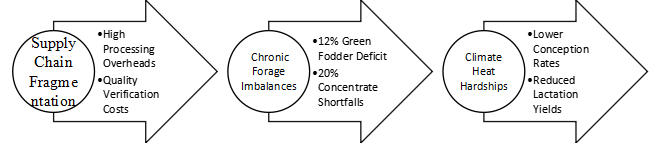
- Strategic Threats and Vulnerability Matrices
Despite volume leadership, the Indian dairy sector faces severe systemic risks that demand targeted structural interventions:
Vulnerability Interconnection Matrix:
8.Ecological Circularity and Environmental Sustainability
8.1. The GOBARDHAN Model for Bio-Energy Recovery
To reduce the carbon and methane footprints of large-scale animal agriculture, the industry is adopting circular bio-economy practices. The Galvanizing Organic Bio-Agri Resources Dhan (GOBARDHAN) framework converts livestock waste into clean energy. Village anaerobic digesters process raw manure into compressed biogas (CBG) for cooking and fuel, while yielding high-grade bio-slurry that restores organic matter to depleted agricultural soils.
8.2. Solarization of Processing Infrastructures
To minimize fossil fuel dependency, rural collection networks are integrating solar photovoltaic arrays paired with advanced thermal energy storage. These systems run refrigeration infrastructure using clean energy captured during the day, maintaining deep-chill states through evening milk drop-offs without relying on polluting diesel generators.
- State-Level Production Share and Availability Matrix
| Top Milk Producing States | % Share of National Output | Dominant Breed / Livestock Type | Key Regional Challenge |
| Uttar Pradesh | 15.7% | Murrah Buffaloes, Hariana Cattle | Fragmented land holdings & informal middleman channels |
| Rajasthan | 13.9% | Rathi, Tharparkar, Gir Cattle | Acute green fodder scarcity & arid climate heat stress |
| Madhya Pradesh | 9.5% | Malvi, Nimari Cattle, Local Buffaloes | Lower institutional cooperative procurement coverage |
| Gujarat | 7.6% | Kankrej Cows, Jafrabadi Buffaloes | Rising cost of balanced cattle feed concentrates |
| Andhra Pradesh | 6.9% | Ongole Cattle, Murrah Grading | Groundwater stress impacting perennial fodder crops |
9.1 Comprehensive Policy Analysis of Government Strategies
| Strategic Framework | Operational Scale & Allocation | Centralized Macro-Objective |
| White Revolution 2.0
|
National Cooperative Network
|
Launching 75,000 new village-level dairy cooperative societies to eliminate unorganized middleman networks. |
| National Programme for Dairy Development (NPDD)
|
₹2,790 Crore Fiscal Outlay
|
Installing smart testing laboratories and scaling decentralized bulk milk cooling infrastructure. |
| Animal Husbandry Infrastructure Development Fund (AHIDF) | ₹15,000 Crore Credit Pool
|
Providing 3% interest subsidies to encourage private investment in high-margin dairy processing plants. |
| Rashtriya Gokul Mission | ₹1,000+ Crore Conservation Budget
|
Improving genetic traits and funding extensive distribution networks for native cattle breeds. |
10.Emerging Commercial Frontiers and Future Trends
10.1. The High-Margin Value-Added Shift
The traditional liquid milk sector typically operates on thin margins of 3% to 5%. Consequently, processing plants are scaling up production of Value-Added Dairy Products (VADPs)-such as mozzarella cheese, paneer, ultra-pasteurized flavored milks, and specialized infant formulas-which deliver annual growth rates over 11% and significantly higher profitability.
10.2. Delivery Channels and Quick-Commerce Networks
The rapid expansion of urban quick-commerce applications (e.g., Zepto, Blinkit, Instamart) has transformed the final stages of the supply chain. Processing hubs now plug directly into regional dark-store fulfillment networks, cutting delivery windows down to minutes, ensuring cold-chain integrity, and driving higher consumer purchase volumes.
- Localized Innovations (Micro-Case Studies)
11.1. Case Study 1: Hydroponic Fodder Greenhouses in Arid Rajasthan
In districts like Jodhpur and Jaisalmer, where traditional grazing lands have dried up, progressive dairy farmers have introduced automated low-cost hydroponic fodder units. Using multi-tier vertical racks inside a temperature-controlled greenhouse, farmers sprout maize and barley seeds into nutrient-rich green carpets within 7 to 8 days. This setup uses 90% less water than traditional field cultivation and provides a steady supply of green fodder through peak summer heatwaves.
11.2. Case Study 2: Solarized Chilling Centers in Andhra Pradesh
To combat frequent rural power cuts that spoil evening milk collections, cooperatives in Andhra Pradesh have deployed Thermal Energy Storage (TES) systems attached to solar panels. The solar setup creates a “blue ice” battery during peak daylight hours. This thermal battery can chill up to 2,000 liters of milk instantly during evening collections without using a single drop of grid electricity or diesel generator fuel.
11.3. Case Study 3: The INAPH Digital Identification Program
The National Dairy Development Board (NDDB) introduced the Information Network for Animal Productivity and Health (INAPH), an impactful digital identity program. Utilizing unique polyurethane RFID ear tags, the system tracks livestock across India, mapping breeding histories, vaccination milestones, and individual milk yields to optimize state-level veterinary planning.
- Conclusion
The future of the Indian dairy industry depends on its ability to combine technology with cooperative principles. By leveraging digital automation, precision breeding, and circular economy practices, the sector can address climate risks while protecting smallholder profits. Building on the foundational legacy of Dr. Verghese Kurien, India’s dairy network is poised to secure national nutritional needs and pioneer low-carbon, highly efficient dairy models for the developing world.
References
- Department of Animal Husbandry and Dairying (DAHD), Government of India. Basic Animal Husbandry Statistics Matrix Profile. Retrieved from: https://dahd.gov.in
- National Dairy Development Board (NDDB). Statistical Report on the Performance of Dairy Cooperative Networks. Retrieved from: nddb.coop
- Press Information Bureau (PIB). Infrastructure Development Allocations and Policy Focus. Ministry of Fisheries, Animal Husbandry & Dairying. Retrieved from: pib.gov.in
- Mordor Intelligence Report. India Dairy Market Dynamics: Size, Processing Volume, and Forecast Horizons. Retrieved from: mordorintelligence.com
- Kurien, V. (2005). I Too Had a Dream. Roli Books Private Limited. (Historical framework on cooperative organization).