

One Health and emerging zoonotic diseases: Infections affecting Humans and animals
Dr. Mohini Tripathi
M.V. Sc Scholar, Department of Livestock Products Technology, College of Veterinary Science and Animal Husbandry, DUVASU, Mathura-281001
Email: mohinitripathi2307@gmail.com
Abstract
One health is a strategy to ensure the well‐being of human, animals and their environment by collaborative problem solving locally, nation-ally and internationally. zoonoses are infectious diseases that are naturally transmitted from wild or free‐living animals to humans by direct contact, inhalation, ingestion, or inoculation of infectious material. The zoonotic aetiology consists of infectious agents such as prions, parasites, viruses, bacteria, fungi. One Health concept is the cooperation between various sectors including animal, human, and environmental health. Vaccination to improve animal and human health is the core element/main target of One Health. Several zoonotic agents need a one health strategy for their successful surveillance, detection, and control in addition to the burden on the health of humans and animals, the global economic impacts of pandemic and emerging infectious agents could be catastrophic with the decrease in international trade, travel, and tourism.
Key words: zoonoses, one health, remerging, pathogens, viral, bacterial
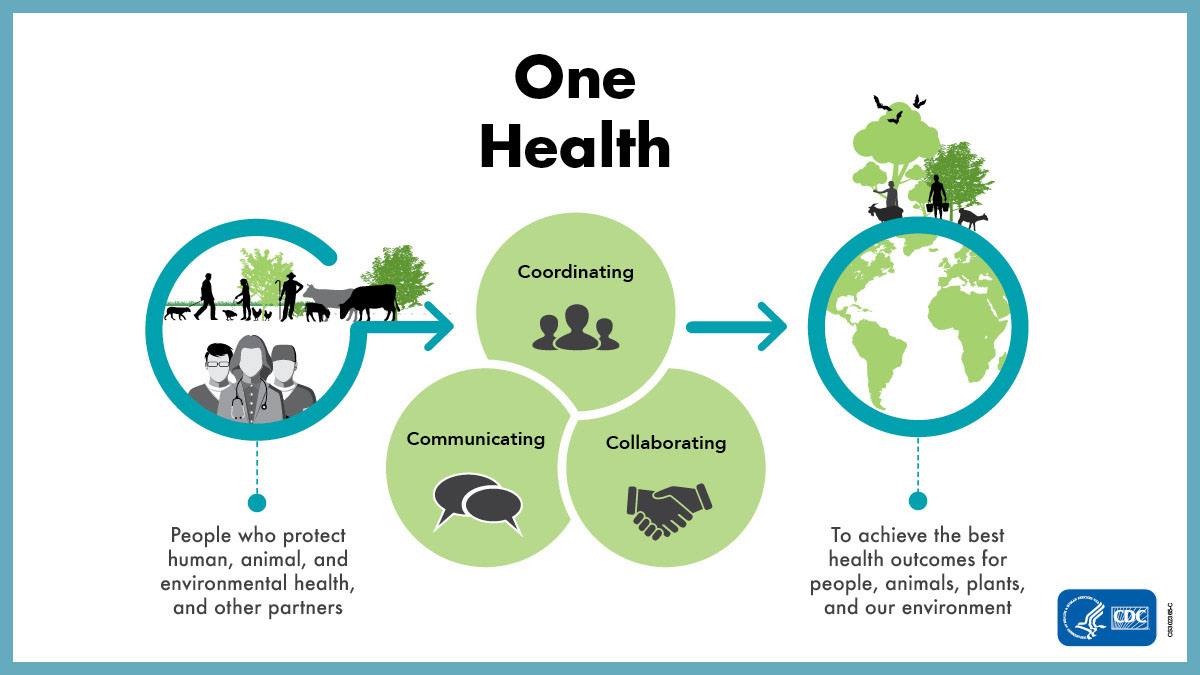
Introduction: Zoonosis comes from the Greek zoon “animal” and nosos “disease” and is defined as diseases that are transmitted from domestic and/or wild animals to humans and vice versa, through various different ways The One Health strategy presents significant opportunities to decrease the effect of emergence events and also to control or prevent future emergence through better knowledge and better coordination. Investing in One Health by reducing pandemic risks versus business as usual might save over $300 billion worldwide over the next century. An analysis study by World Bank suggested that investments of $3.4 billion annually in One Health capacity worldwide via enhanced animal and human health services could save over $30 billion annually in zoonotic disease globally collaborative efforts by multisector, including human and veterinary medicine sectors as well as environmental and wildlife health sectors, at both national and international levels can lead to the success of the One Health concept. The most widely definition used for one health concept shared by the US CDC where One Health is recognized as a collaborative, transdisciplinary, and multi-sectoral approach working at the local, national, regional, and global levels with the objective of reaching best health outcomes recognizing of the interconnection between human, plants, animals and EN their shared environment. The phrase ‘One Health’ was also used in 2003–2004, with the outbreak of severe acute respiratory disease (SARS) in beginning of 2003 followed by the spread of H5N1 highly pathogenic avian influenza (HPAIV), and by the series of strategic objectives identified as the “Manhattan Principles” derived in 2004 at a Wildlife Conservation Society meeting, that clearly recognized the connection be-tween the health of human and animal.
Various zoonotic diseases: Leptospirosis caused by Leptospira spp. is another bacterial zoonosis, especially common in tropical and subtropical climates, and is transmitted to humans through contact with water contaminated with animal urine, such as rats and other rodents.
Another important zoonotic disease is brucellosis, caused by the Brucella species. This bacterium enters the human body through unpasteurized milk and dairy products, contact with infected animal tissues, or inhalation of bacterial aerosols.
Anthrax is also a zoonotic bacterial disease that is caused by Bacillus anthracis. Normally, it is transmitted to humans through contact with infected animals or by inhaling pores of the bacteria. The three forms of this disease are cutaneous, gastrointestinal, and pulmonary, each with severe implications.
Another important bacterial zoonosis is campylobacteriosis caused by Campylobacter spp., especially Campylobacter jejuni and is mostly transmitted by contaminated chicken meat or unpasteurized water and food. Campylobacteriosis is usually associated with diarrhea, fever, and abdominal pain, and in some cases can lead to serious complications, such as Guillain-Barré syndrome.
Viral diseases include diseases such as bird flu, Crimean- Congo fever, Nipah virus, rabies virus, and viruses of the coronavirus family.
Crimean Congo fever virus is another important zoonotic viral disease that poses a serious threat to human and animal health. It is a member of the Bunyavirus family and is transmitted to humans via ticks. It may also be transmitted from human to human through direct contact with blood or body fluids of an infected person.
The other zoonotic viruses transmitted by mosquitoes are Zika and Chikungunya, which have become widespread in tropical and subtropical regions. The Zika virus gained huge importance in 2015, being responsible for severe effects among pregnant women and causing defects to the fetus.
Another globally important zoonotic viral disease is rabies. Rabies virus belongs to the family Rhabdo viridae, which is usually transmitted to humans by bites from infected animals, especially dogs. This virus is highly virulent, and if symptoms develop, it almost invariably causes the infected individual’s death. Rabies is a zoonotic disease that is generally more common in rural areas and countries where access to broad vaccination and stray animal control is limited.
Yellow fever is another zoonotic viral disease that is spread. Flaviviridae, a family of viruses, cause yellow fever, which is transmitted to humans by infected mosquitoes. A high number of people are infected with yellow fever every year in tropical Africa and South America.
Value of the one health approach: The one health strategy builds on the connection between various sectors (e.g., public health, environment, agriculture and animal health) to offer broader health benefits. Increasing the coordination between these sectors can help the decision making to address accurately the factors affecting disease burden based on scientific data with reducing the unnecessary duplication found among health sectors related to humans, animals, and the environment. Most of the newly identified human viral infections in the last decade had a zoonotic background, indicating increase the animal influence in human diseases. Zoonotic viral diseases like Middle East respiratory syndrome (MERS‐CoV), Ebola, SARS‐Corona, West Nile, Hendra, Nipah, swine influenza, and avian influenza are the examples of infectious diseases, which have economies and threatened health thought the world.
The One Health approach promotes collaboration, coordination and communication across all sectors among animal, human, environmental and other relevant disciplines. Consequently, anyone can contribute to the actual implementation of One Health strategies through participating in human, animal/wildlife and environmental health. Professionals (human and veterinary medicine and environmental health cares) can greatly contribute by applying this approach to regular practice.
A collaboration of FAO, WOAH, WHO, United Nations International Children Emergency Fund (UNICEF) World Bank and UNESCO:
In 2007, these major international organizations meet in India and developed a joint strategic framework to respond to emerging and reemerging infectious diseases, particularly avian influenza. This Joint Strategic Framework was entitled “Contributing to One World, One Health” and built on the lessons of the One Health concept.
Tripartite agreement among three international organizations:
The World Organization for Animal Health (WOAH), FAO of The United Nations and WHO have agreed to a tripartite agreement in April 2010 for working together on antimicrobial resistance, tuberculosis, rabies, and Middle East respiratory syndrome-coronavirus. This agreement proposes and advances a long-term strategic direction for international collaboration, with the aim of sharing responsibilities and coordinating global health activities at the interface of humans, animals and ecosystems.
The first one health congress
In 2011, an international One Health Congress was held in Melbourne, Australia, by representatives from 60 nations. The conference discussed the importance of working together to promote a One Health approach; awareness of the interdependence of animal, human and environmental health; and the necessity of involving other disciplines, such as economics, social behaviour, food security and safety.
The world medical and veterinary association one health collaboration
In 2012, these two organizations signed a memorandum of understanding to integrate a unified approach for addressing common health threats and working effectively to improve global health. Their agreement focuses on zoonoses such as rabies control, antimicrobial resistance and education.
The one health global conference
The World Medical and Veterinary Associations held a conference in May 2015 (Spain) and strongly agreed on the need for increasing multidisciplinary collaboration among human and veterinary professionals to improve common wellbeing.
Quadripartite memorandum of understanding for the One Health collaboration
On March 17, 2022, the FAO, WOAH and WHO updated their former tripartite agreement to a new quadripartite agreement by incorporating the United Nations Environmental Programme as an equal partner working on One Health in collaboration. Accordingly, the Directors General of the four organizations signed a memorandum of understanding agreeing to increase collaboration to maximize and optimize the health of animals, humans, the environment and plants. The agreement not only provides a legal framework for those organizations to combat challenges at the ecosystem–animal–human interface, but also enhances the reinforcement of international, regional, national and local health services.
Challenges to control zoonotic diseases: Various approaches are being developed and implemented to combat zoonotic diseases. Some of the most important methods in use include advanced warning and monitoring systems. These systems predict and identify zoonotic disease incidence by collecting and analysing biological and epidemiological data. Emerging technologies, like artificial intelligence in data processing, may enhance the speed and precision of diagnosis. Furthermore, it is essential to establish educational programs for at risk populations, including farmers, ranchers, and those in contact with wildlife, to mitigate the spread of zoonotic diseases. The advancement of vaccinations and other pharmaceuticals is regarded as a crucial technique for therapy. Effective vaccinations are available for some zoonoses, including rabies and yellow fever, to prevent their transmission within the human population.
Conclusion and future prospects: Human and animal health can be enhanced within “One Health” approach using innovative collaborations, partnerships and/surveillance/research/control. Resistance of the zoonotic pathogens to antimicrobials driven by overuse in agriculture and health is a serious threat, while the pathogens like Salmonella and E. coli have already developed increased resistance Building national effective monitoring and surveillance network including professionals in animal health (para-professionals, veterinarians and agricultural workers), human health (public health practitioners, doctors, nurses and epidemiologists), environment (wildlife and ecologists experts), and other areas of expertise (law enforcement, agriculture, food safety and Security, communities, policymakers and pet owners) need to communicate, collaborate on and coordinate activities. This national network will result in communication improvement, surveillance improvement, development of a novel generation of systems‐thinkers, reduced lag time of response, and improvement of health and economic savings.
References
- Amin, S., H. Mahmood, and H. Zorab. 2023. “Campylobacteriosis.” One Health Triad 2: 87–93.
- Berthe FCJ, Bouley T, Karesh WB, et al. One Health: Operational Framework for Strengthening Human, Animal, and Environmental Public Health Systems at Their Interface 2018 (No. 122980). The World Bank, pp. 1‐152.
- Carlson, C. J., M. J. Farrell, Z. Grange, et al. 2021. “The Future of Zoonotic Risk Prediction.” Philosophical Transactions of the Royal Society B 376, no. 1837: 20200358.
- Kalal, M. N. 2019. “Crimean- Congo Haemorrhagic Fever: A Global Perspective.” International Journal of Research in Medical Sciences 7, no.12: 4812.
- Kelly TR, Machalaba C, Karesh WB, et al. Implementing one health approaches to confront emerging and re‐emerging zoonotic dis-ease threats: lessons from PREDICT. One Health Outlook.2020;2(1):1‐7.
- Lopez-Robles, G., F. N. Córdova-Robles, E. Sandoval-Petris, et al. 2021. “Leptospirosis at Human-Animal-Environment Interfaces in Latin-America: Drivers, Prevention, and Control Measures.” Biotecnia 23, no.3: 89–100. https://doi.org/10.18633/biotecnia.v23i3.1442.
- Pike J, Bogich T, Elwood S, et al. Economic optimization of a global strategy to address the pandemic threat. Proceedings of the National Academy of Science. 2014;111(52):18519‐18523
- World Bank. People, Pathogens and Our Planet: The Economics of One Health; 2012. Accessed April 18, 2016.