

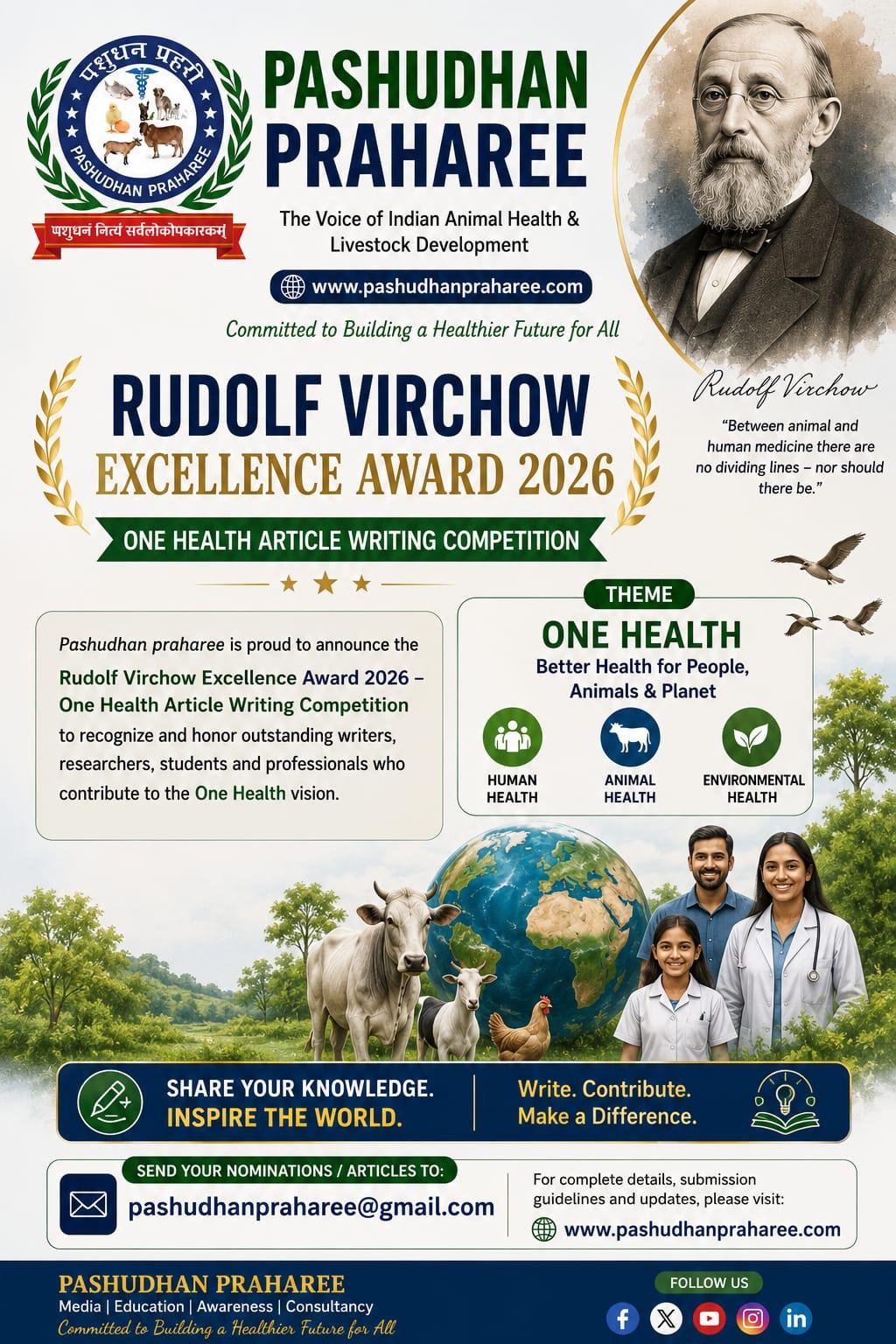
Rudolf Virchow Excellence Award 2026 & One Health Article Writing Competition
Call for Nominations | All India & Global Participation | World Zoonoses Day Special
NATIONAL CALL FOR NOMINATIONS & ALL INDIA ARTICLE WRITING COMPETITION – 2026
Rudolf Virchow Excellence Award for “One World – One Health”
On the Occasion of World Zoonoses Day – 6 July 2026
About the Initiative
To commemorate World Zoonoses Day (6 July 2026) and to advance the global vision of “One World – One Health”, the AgroVet Research & Development Foundation (ARDF), in collaboration with CM Singh Trust, Livestock Institute of Training & Development (LITD), Veterinary Association of India (VAI), Goel Vet Pharma and Pashudhan Praharee, proudly announces:
✅ Call for Nominations – Rudolf Virchow Excellence Award 2026
✍️ All India Article Writing Competition 2026
This national initiative aims to bring together veterinary, medical, environmental, and public health professionals on a common platform to promote knowledge exchange, innovation, and global health security, aligned with the United Nations Sustainable Development Goals (SDGs) 2030 Agenda.
Why World Zoonoses Day Matters
World Zoonoses Day highlights the growing importance of zoonotic diseases in global health:
Over 60% of known infectious diseases are zoonotic
Nearly 75% of emerging infectious diseases originate in animals
This reinforces the urgent need for a strong, integrated One Health approach.
About the Award
The Rudolf Virchow Excellence Award for “One World – One Health” recognizes individuals and organizations for exceptional contributions toward:
Zoonotic disease prevention and control
Strengthening One Health collaboration
Advancing human and animal health systems
Promoting sustainable livestock and environmental health
Supporting global health innovation and policy
Important Dates
Opening of Nominations & Article Submission: 11 June 2026
Last Date for Nominations: 26 June 2026
Last Date for Article Submission: 3 July 2026
Result Announcement: 3 July 2026
Award Ceremony: 6 July 2026
Award Categories
- Rudolf Virchow Excellence Award (Nomination-Based)
For distinguished professionals and organizations with outstanding contributions to One Health.
- Rudolf Virchow Excellence Award (Through Article Competition)
For top participants selected from the All India Article Writing Competition.
All India Article Writing Competition 2026
Theme:
“One World, One Health: Building Resilient Systems to Prevent Zoonotic Threats and Future Pandemics”
Suggested Topics
- Zoonotic Disease Preparedness in India and Global Context
- Role of Veterinarians in Pandemic Prevention
- Antimicrobial Resistance and One Health
- Climate Change and Emerging Diseases
- AI and Digital Disease Surveillance
- Food Safety and Public Health
- Livelihoods and Zoonotic Risks in Rural Areas
- Sustainable Farming and Ecosystem Health
- Wildlife-Human Disease Interface
- Policy and Community Engagement in One Health
Language & Participation Scope
Articles can be submitted in English or Hindi
Hindi articles must be typed using Unicode Mangal font only
Open to participants from India and international contributors
Eligibility
Veterinarians and veterinary students
Medical professionals and medical students
Scientists, academicians, and researchers
Public health professionals
Registration Fee
INR 500 per participant (Non-Refundable)
Payment Details:
Account Name: Pashudhan Praharee
Bank: IDBI Bank
Account Number: 1131102000001779
IFSC Code: IBKL0001311
UPI / Digital Payment: 8092877290
(Payment confirmation must be shared via email)
Submission Guidelines
Format: MS Word document
Font:
Times New Roman (for English articles)
Unicode Mangal font (for Hindi articles – mandatory)
Maximum 5 entries per participant
Articles must be original, unpublished, and plagiarism-free
Relevant images may be included in JPG format
Submit entries at: pashudhanpraharee@gmail.com
Evaluation Criteria
Relevance to theme – 30%
Originality and research depth – 25%
Clarity and structure – 20%
Practical applicability – 15%
Language and presentation – 10%
Publication & Recognition
Selected articles will be published on the Pashudhan Praharee platform
Top entries will be compiled into an ISBN-based publication (proposed)
All participants will receive certificates of participation
Winners will receive national recognition and awards
Why Participate
Contribute to the global One Health mission
Showcase your work on a national platform
Gain publication and professional recognition
Engage with experts across multiple disciplines
Declaration
Participants must declare that the submitted work is original and agree to all competition rules.
📞 Contact Information
Email: pashudhanpraharee@gmail.com
Contact: 9431309542
About the Organizers
This initiative is led by the AgroVet Research & Development Foundation (ARDF) and its partner organizations, committed to advancing animal health, public health, and sustainable agriculture.
“Protecting Animal Health is Protecting Human Health”
Join the One Health Movement
World Zoonoses Day is observed annually every July 6. This day aims to shed light on diseases that originate in animals that can be transmitted to humans. In a study by the C.D.C., 60% of all existing infectious diseases are zoonotic and at least 70% of emerging infectious diseases originate in animals.
HISTORY OF WORLD ZOONOSES DAY
On July 6, 1885, French biologist Louis Pasteur successfully administered the first rabies vaccine to a little boy bitten by a rabid dog. The vaccine not only prevented the child from getting rabies; it saved his life.
Rabies is just one example of many zoonotic diseases. Avian influenza, Ebola, and the West Nile Virus are some other examples that have been discovered over the years. Zoonotic pathogens can be viral, bacterial, or parasitic and can spread to humans through direct contact or indirectly through food, water, or the environment. It may even spread through an intermediary species. It does not just originate from wild animals like bats or monkeys. It can also come from pets and farm animals. The use of antibiotics in animals raised for food increases the potential for drug-resistant strains of zoonotic pathogens. That’s why animals have an important role in zoonotic infections.
As there are many types of Zoonotic diseases, there are also many types of treatments such as antibiotics. Some practices can help prevent the spread of foodborne zoonotic diseases like safe guidelines for animal care in the agriculture industry. Having access to clean drinking water and proper waste removal are effective ways to reduce the spread of diseases. Vaccinating household pets and maintaining proper hygiene like washing your hands after close contact with animals can also help.
Protecting and managing the health of animals that live alongside humans is vital. When we prevent diseases in animals, we safeguard the health of people.
About the Rudolf Virchow
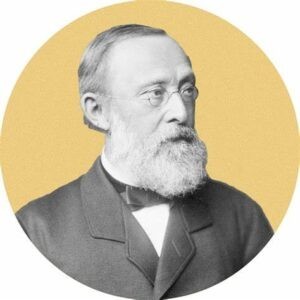
Lived 1821 – 1902.
Rudolf Virchow was an eminent pathologist and politician, widely regarded as one of the greatest and most influential physicians in history. A founding father of both pathology and social medicine, Virchow analyzed the effects of disease in various organs and tissues of the human body. He identified that diseases are caused by malfunctioning cells.
A man of boundless energy, he simultaneously had four careers: medical scientist, editor of several medical journals, politician, and anthropologist. Although he played a tremendous part in ridding medicine of unscientific practices, he also made some rather large scientific errors.
Beginnings
Rudolf Ludwig Carl Virchow was born on October 13, 1821 in the town of Schivelbein, in the German kingdom of Prussia. Today the town is called Świdwin and lies in Poland.
His father was Carl Christian Siegfried Virchow, a farmer, and town treasurer of Schivelbein; his mother was Johanna Maria Hesse. The couple were not especially well-off financially and Rudolf was their only child. His parents loved the natural world and passed this love on to their son, taking him on bird watching trips.
Rudolf attended elementary school in Schivelbein. From his earliest days at school, he seems to have been exceptionally gifted intellectually, so much so that his parents paid for extra lessons to push him forward. From elementary school he progressed to the Gymnasium (a high school for academically strong students) in Köslin, about 40 miles from his hometown.
Rudolf’s high school curriculum was classical, with heavy emphasis on Greek and Latin. This was not a problem for Rudolf, who had a passion and remarkable ability for learning languages. In addition to Greek and Latin, he also learned Dutch, English, French and Hebrew. In his spare time between high school and medical school he taught himself Italian.
He graduated from high school in 1839, aged 17.
Abandoning his original idea of becoming a pastor – he didn’t think his voice was strong enough to be an effective preacher – he won a scholarship to study medicine at the Friedrich-Wilhelms University in Berlin, Prussia’s capital city. Completing his course in 1843, he spent short spells in a number of different medical jobs.
His passion was pathology – the study of diseases.
Politics in Brief
A man with incredible energy levels, Virchow enjoyed an important political career in addition to his scientific career. Here we’ll be concerned mainly with the science. Suffice to say that Virchow’s politics were liberal. He promoted better education, better living conditions, and better health for the poor. These political beliefs coincided with his ideas for social medicine.
Virchow was elected to the German Parliament in 1880 to represent the party he helped found, the German Progress Party. He had a sharp tongue, and his political opponents became wary of his sarcasm. Virchow was ardently anti-Catholic, believing the Catholic Church’s influence led to bad outcomes for society and the poor.
Rudolf Virchow’s Contributions to Science and Pathology
Autopsies and Leukemia
Virchow carried out the first systematic autopsies involving microscopic examination of tissue. One such autopsy in 1845 led to his first published contribution to science.
Virchow identified and named the disease leukemia and offered the best description of it available. He named the disease by combining the Greek words leukos (white) and aima (blood). Even in his earliest work he focused heavily on cells.
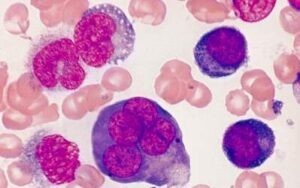
A microscope view of a bone marrow smear in a leukemia case. Virchow recommended systematic microscopic examinations of tissues from autopsies to diagnose causes of death.
Outflanking the journals that blocked publication of his work
In 1847 Virchow started a new job, teaching pathological anatomy at the University of Berlin. Although he had once believed his voice too weak to preach, he became a supremely self-assured teacher and researcher.
He was also ambitious, and had grown increasingly frustrated by the editors of German medical journals. They refused to publish some of his research papers: in Virchow’s opinion they were hamstrung by out-of-date ideas about medicine.
In his new teaching job he met Benno Reinhardt, another young physician who shared his dim view of the medical journals. Virchow and Reinhardt decided to bypass the journals’ stuffy editors entirely.
They launched their own journal, Archive for Pathological Anatomy and Physiology and Clinical Medicine. This new journal insisted all medical contributions should be based on robust, well-researched science. Virchow utterly rejected medical practices that had persisted for millennia which he believed had no scientific basis, such as Galen’s use of the ‘humours.’
Virchow and Reinhardt’s journal has been remarkably resilient. Today it is still one of the leading medical journals, now called Virchows Archiv. Sadly its founding co-editor Benno Reinhardt died young in 1852. Virchow, who had a prodigious appetite for hard work, became the journal’s sole editor until his own death in 1902.
Epidemics and Public Health
Early in 1848 the Prussian Government sent Virchow to Upper Silesia to investigate a typhus epidemic that had begun the previous year and was claiming thousands of lives.
After studying the situation, Virchow characterized the peasants of Upper Silesia as lazy and unhygienic. He was shocked at the extreme poverty they lived in and their extremely poor diets. He blamed their plight on the combined effects of the Catholic Church sapping their ambition and local landowners removing any wealth generated in Upper Silesia to be spent elsewhere.
“Wealth, education and liberty depend on one another and thus, conversely, do hunger, ignorance and servitude.”
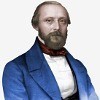
Rudolf Virchow
Report on the Typhus Epidemic in Upper Silesia, 1848
The medical consensus at the time, accepted by Virchow, was that diseases like typhus were caused by ‘miasma’ – bad air caused by rotting matter. Virchow believed malaria was caused by rotting vegetable miasma, while typhus was caused by rotting animal miasma. So, although he rejected some doctrines of medicine taught in ancient times by Galen, he did not question the truth of miasmas.
Virchow did not recognize that epidemics are spread by microorganisms.
He formed the view that the main cause of the epidemic in Upper Silesia was the terrible conditions most of the people were living in. He decided that if living conditions could be improved, there would be no more epidemics.
Epidemics, he said, were best treated politically rather than medically. This is not entirely correct. However, he was correct to say that improving people’s living conditions, hygiene, and diets would be highly beneficial to their general health and well-being. And, although he did not know it, better hygiene slows the spread of the microorganisms that cause epidemics such as typhus, and more recently Ebola, bird flu, and SARS.
The Beginning of Social Medicine
Never slow to act on his beliefs, in July 1848 Virchow founded the weekly magazine Medical Reform to promote his new concept of social medicine and his idea that:
“physicians are the natural advocates of the poor”.
The magazine ran for about a year before folding, but in that time it was highly influential in promoting improved public health for everyone in Germany, including the poorest.
How do Cells Form?
In 1849 Virchow moved to University of Würzburg and began a program of serious research into the roles cells play in the body and in disease.
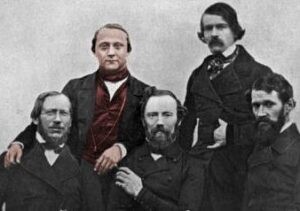
Rudolf Virchow, clean shaven, poses with other professors at the University of Würzburg in 1850.
The great Theodor Schwann had pushed biological science forward dramatically in 1837, when he established that all animal tissues are made of cells. However, he made a major error when he said new cells are created from a fluid called blastema. Although incorrect, this was the accepted explanation for cell reproduction in the early 1850s.
Scientists believed imbalances in the body created blastema in which disease cells start to grow. This belief began changing in 1855 when Virchow, aged 34, published an essay in which famously he declared:
“Every cell arises from another cell.”
Although he was not the first person to suggest this, people only began to take serious notice after Virchow said it. It was a turning point in biology.
Cellular Pathology
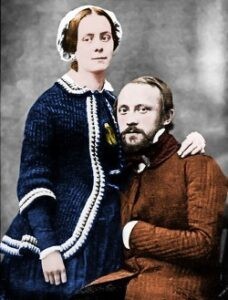
Rudolf Virchow and his wife Rosa in the late 1850s. They were married in 1850.
In 1856 Virchow returned to Berlin to the Chair of Pathological Anatomy at the Friedrich-Wilhelms University.
In 1858 he published Cellular Pathology, a groundbreaking book of 20 lectures he had given at the university, which laid the foundations of modern pathology and indeed of modern medical theory.
Simply put, Virchow established that all diseases can be traced to cells. Diseases attack normal cells and cause them to malfunction. A whole organism does not get sick; each disease affects a particular set or sets of an organism’s cells, not all of its cells. Different diseases affect different types of cell.
Virchow told doctors and pathologists seeking to diagnose diseases or to understand their effects that they could do this best by studying the affected cells.
“Virchow, the chief founder of modern scientific medicine … will rank for all mankind and for all time to come as one of the greatest figures in science … the establishment by Virchow of the principles of cellular pathology marked the greatest advance which scientific medicine had made since its beginning.”