

ONE HEALTH: HEALTHY ANIMALS, HEALTHY PEOPLE, HEALTHY PLANET
Dr. Sneh Lata Chauhan, Scientist, Department of Veterinary Clinical Complex, LUVAS, Hisar
In today’s interconnected world, the health of humans, animals, and the environment cannot be viewed separately. The air we breathe, the water we drink, the food we consume, and the animals we interact with all influence our health in one way or another. This understanding forms the basis of the One Health concept, an approach that recognizes that the well-being of people, animals, and the environment is closely linked. As global challenges such as emerging diseases, climate change, environmental degradation, and food safety concerns continue to grow, the importance of One Health has become more evident than ever before.
The roots of the One Health concept can be traced back to the pioneering work of Rudolf Virchow (1821–1902), the renowned German physician and pathologist often regarded as the “Father of Modern Pathology.” Virchow was among the first scientists to recognize the close relationship between human and animal health. He coined the term “zoonosis” to describe diseases that can be transmitted between animals and humans and famously stated, “Between animal and human medicine there are no dividing lines—nor should there be.” His visionary perspective emphasized that the health of humans and animals is inseparable and should be addressed through collaborative efforts. More than a century later, his ideas continue to form the scientific foundation of the modern One Health approach, guiding veterinarians, physicians, environmental scientists, and public health professionals worldwide.
For centuries, humans and animals have shared the same environment. While this relationship provides numerous benefits, it also creates opportunities for diseases to spread between animals and people. In fact, many of the infectious diseases affecting humans today originated in animals. Rapid urbanization, deforestation, wildlife habitat destruction, and increasing human-animal interactions have further increased the risk of disease transmission. Therefore, protecting human health is no longer possible without considering the health of animals and the environment around us.
Veterinarians play a vital role in maintaining this delicate balance. Their contribution extends far beyond treating sick animals. Veterinarians are involved in disease surveillance, food safety, animal welfare, and public health protection. They monitor livestock and wildlife for emerging diseases, conduct vaccination programs, and help prevent the spread of infections that could affect humans. Every time a veterinarian helps control a disease outbreak in animals, they are also helping to protect communities and safeguard public health. Their work is a perfect example of how animal health directly influences human well-being.
Similarly, doctors, epidemiologists, and public health professionals work tirelessly to protect human populations from infectious diseases and other health threats. Their efforts become even more effective when they collaborate with veterinarians and environmental experts. The early detection and control of many diseases depend on information shared between these different sectors. When experts work together, outbreaks can be identified more quickly, risks can be assessed more accurately, and preventive measures can be implemented more efficiently.
The environment forms the third pillar of One Health and is equally important. Healthy ecosystems provide clean air, clean water, fertile soil, and biodiversity, all of which are essential for life. However, environmental degradation caused by pollution, climate change, and habitat destruction can upset the natural balance and create conditions that favor the emergence of new diseases. As humans continue to alter natural ecosystems, wildlife species are increasingly forced into closer contact with livestock and people, increasing the chances of disease transmission. Protecting the environment, therefore, is not only a conservation issue but also a public health necessity.
The importance of One Health becomes particularly evident when examining major disease outbreaks that have occurred across the globe. Many of these outbreaks have originated at the interface of humans, animals, and the environment, clearly demonstrating how interconnected these sectors are. Diseases such as COVID-19, Avian Influenza, Nipah, Rabies, Ebola, Brucellosis, and Mpox have emerged or spread due to interactions among people, domestic animals, wildlife, and changing ecosystems. These outbreaks have not only caused illness and loss of life but have also disrupted economies, food systems, and livelihoods. Their occurrence highlights the need for integrated disease surveillance, environmental monitoring, wildlife conservation, and close collaboration among veterinarians, physicians, epidemiologists, and environmental scientists. The lessons learned from these events reinforce the fact that effective prevention, preparedness, and response to health threats require a coordinated One Health approach.
The COVID-19 pandemic changed the lives of billions of people around the world and highlighted how a disease emerging at the human-animal-environment interface can rapidly become a global crisis. Although the exact origin of the virus continues to be studied, the pandemic emphasized the need for stronger surveillance systems, better wildlife monitoring, and greater collaboration among health professionals from different disciplines. It reminded the world that health threats do not respect geographical boundaries and that preparedness requires a coordinated effort.
Another well-known example is Avian Influenza, or bird flu. This disease primarily affects birds but can occasionally infect humans. Outbreaks have resulted in significant economic losses to the poultry industry and have raised concerns about public health. Controlling avian influenza requires veterinarians, public health officials, wildlife experts, and environmental agencies to work together. Surveillance of migratory birds, monitoring of poultry farms, and strict biosecurity measures all play important roles in preventing the spread of the disease.
Rabies is perhaps one of the most striking examples of a successful One Health intervention. Although rabies is almost always fatal once symptoms appear, it is entirely preventable through vaccination. Mass vaccination of dogs, community awareness programs, and timely medical treatment for exposed individuals have helped reduce rabies cases in many regions. These achievements have only been possible through close cooperation between veterinary and public health sectors.
The Nipah virus outbreaks in India, particularly in Kerala, further illustrate the value of One Health. Fruit bats are recognized as the natural reservoirs of the virus, and changes in the environment can increase contact between bats, domestic animals, and humans. During these outbreaks, veterinarians, doctors, epidemiologists, and environmental experts worked together to identify the source of infection, monitor disease spread, and protect affected communities. Their collaborative efforts played a crucial role in controlling the outbreaks and preventing wider transmission.
Similarly, Ebola virus outbreaks in Africa have emphasized the importance of wildlife surveillance and ecosystem health. Human infections have often been associated with contact with infected wildlife. Environmental disturbances and encroachment into wildlife habitats can increase the likelihood of such spillover events. Consequently, wildlife conservation, habitat protection, and community education are now recognized as important components of disease prevention strategies.
One Health is also highly relevant in addressing the growing problem of antimicrobial resistance. Antibiotics have transformed modern medicine and animal healthcare, but their excessive and inappropriate use has led to the emergence of resistant bacteria. These resistant organisms can move between humans, animals, and the environment, making infections more difficult to treat. Combating antimicrobial resistance requires responsible use of medicines, improved hygiene, disease prevention strategies, and coordinated monitoring across all sectors. The One Health approach provides the ideal framework for tackling this global challenge.
Food safety is another area where One Health principles are highly relevant. Every stage of food production, from the farm to the dining table, involves interactions between animals, humans, and the environment. Veterinarians help ensure that milk, meat, eggs, and other animal products are safe for consumption by preventing diseases and monitoring food quality. Safe food production not only protects consumers but also contributes to economic stability and public confidence in food systems.
Climate change has added a new dimension to One Health challenges. Rising temperatures, changing rainfall patterns, and extreme weather events are influencing the spread of disease vectors such as mosquitoes and ticks. Diseases that were once confined to certain regions are now appearing in new areas. Climate change also affects livestock production, wildlife populations, and natural ecosystems, creating additional health risks for both humans and animals. Addressing these challenges requires integrated solutions that consider environmental sustainability alongside human and animal health.
The future of global health depends on our ability to work together across disciplines and sectors. Governments, researchers, healthcare professionals, veterinarians, environmental scientists, and local communities all have a role to play in advancing One Health. Strengthening surveillance systems, investing in research, promoting environmental conservation, improving disease prevention strategies, and raising public awareness are essential steps toward building a healthier and more resilient world.
In conclusion, One Health reminds us that the health of people, animals, and the environment is deeply interconnected. The lessons learned from outbreaks such as COVID-19, Avian Influenza, Rabies, Nipah, and Ebola have shown that no sector can address complex health challenges alone. By fostering collaboration and recognizing these connections, the One Health approach offers a pathway toward a safer, healthier, and more sustainable future. Protecting animals helps protect people, preserving the environment safeguards public health, and working together strengthens our ability to face the challenges of tomorrow. More than a century after Rudolf Virchow emphasized the inseparable connection between human and animal health, the One Health approach continues to serve as a guiding framework for addressing global health challenges and building a healthier, safer, and more sustainable future for all.
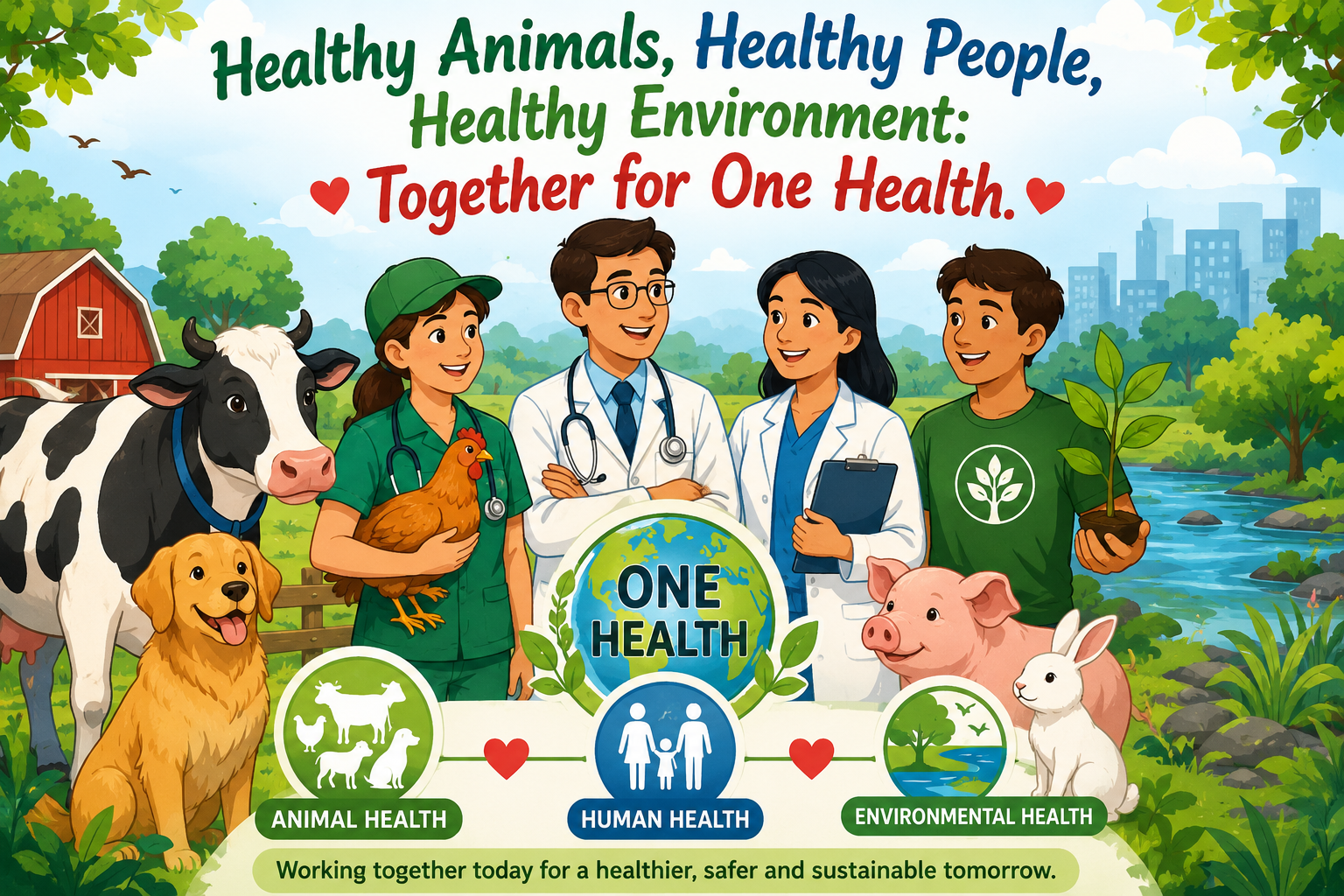
“Healthy Animals, Healthy People, Healthy Environment: Together for One Health.”