

Solid-State Fermentation: An Eco-Friendly Innovation in Animal Feeding
Neha Sahu
Animal Nutrition Division, ICAR-NDRI, Karnal, Haryana
Abstract
Feed is the foundation of animal health and productivity, and improving its quality is essential for sustainable livestock farming. Solid-state fermentation harnesses the power of beneficial microorganisms to transform conventional feed ingredients into more nutritious, digestible, and functional feeds. By enhancing nutrient availability, reducing anti-nutritional factors, supporting gut health, and converting agricultural by-products into valuable feed resources, this technology offers a natural and eco-friendly solution to modern livestock challenges. This article explores how solid-state fermentation is shaping the future of animal nutrition and contributing to healthier animals and more sustainable farming systems.
Keywords
Solid state fermentation, Gut health, Fermented feed, Agricultural byproduct, Animal health
Introduction
“The health of livestock begins not in the barn, but in the feed trough.” This simple idea has never been more relevant than it is today.
Animal feed accounts for nearly 60–70% of the total cost of livestock production. At the same time, livestock producers face rising feed prices, increasing competition for conventional feed ingredients, climate-related uncertainties, and growing pressure to reduce the environmental footprint of animal agriculture. These challenges have intensified the search for sustainable technologies that can improve feed quality without significantly increasing production costs.
One such technology attracting worldwide attention is solid-state fermentation (SSF). Although fermentation has been used by humans for centuries to prepare foods such as curd, cheese, bread, and pickles, its application in animal nutrition represents one of the most exciting developments in modern livestock science. By harnessing the natural ability of beneficial microorganisms, SSF transforms ordinary feed ingredients into nutritionally enriched, highly digestible, and biologically active feeds that support better animal health and productivity.
What is Solid-State Fermentation?
Solid-state fermentation is a biological process in which selected microorganisms grow on moist solid feed materials with little or no free water. During fermentation, microbes such as Lactobacillus, Bacillus, Saccharomyces, Aspergillus, and Pediococcus produce enzymes and beneficial metabolites that modify the nutritional composition of feed ingredients.
Did You Know
Tiny microbes can make a big difference—transforming ordinary feed into healthier nutrition for animals while supporting sustainable agriculture.
| Category | Common Feed Substrates Used in Solid-State Fermentation |
| Oilseed meals | Soybean meal, Rapeseed meal, Mustard oil cake |
| Cereal by-products | Wheat bran, Rice bran, Maize by-products |
| Crop residues | Cassava residues, Various crop residues |
| Agro-industrial by-products | Distillers dried grains and other agro-industrial by-products |
How Microorganisms Transform Feed and Promote Animal Health
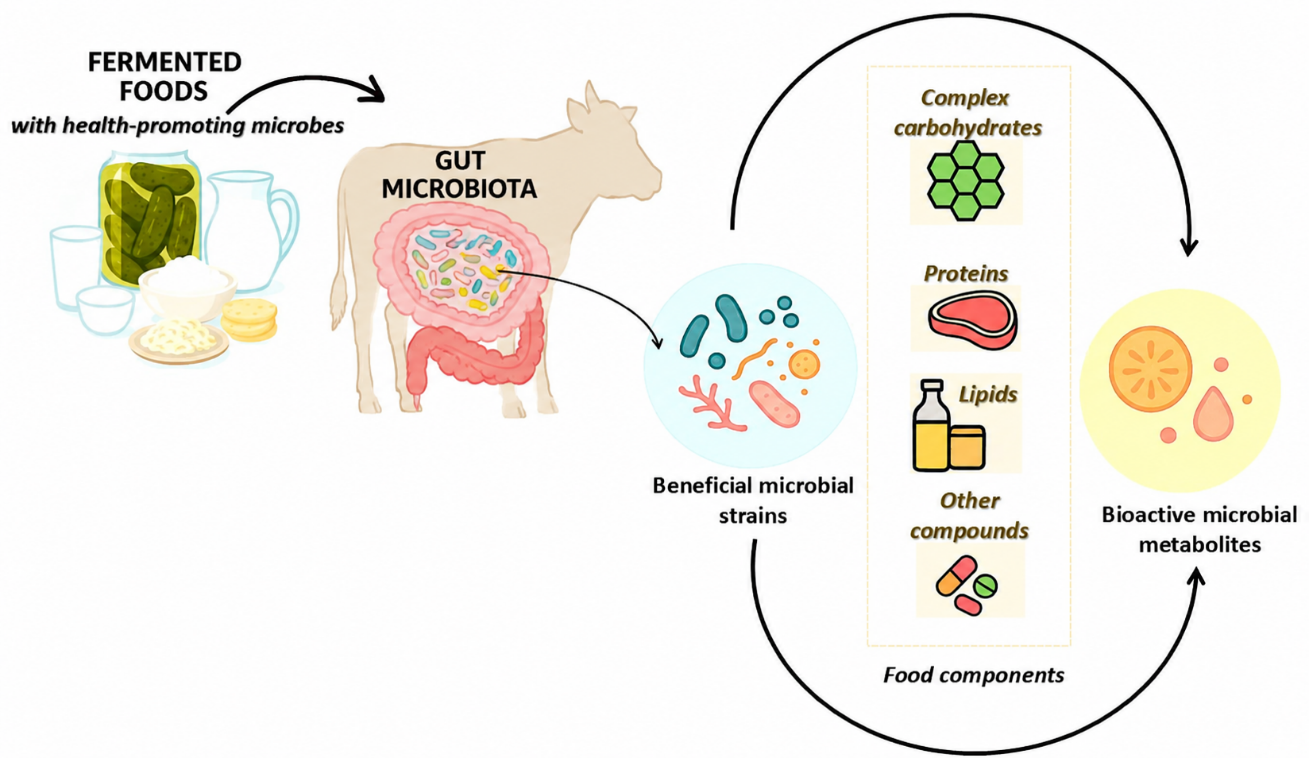
The benefits of solid-state fermentation (SSF) stem from the metabolic activities of beneficial microorganisms, which produce enzymes such as cellulases, xylanases, proteases, phytases, amylases, and lipases that break down complex carbohydrates, proteins, and fibre into more digestible forms. Fermentation also reduces anti-nutritional factors, including phytate, tannins, glucosinolates, trypsin inhibitors, and allergenic proteins, while generating valuable metabolites such as organic acids, vitamins, antioxidants, antimicrobial peptides, and other bioactive compounds. These changes improve feed safety, digestibility, palatability, and nutrient availability. Beyond enhancing nutrition, fermented feeds promote a healthy gut microbiome by encouraging beneficial bacteria, suppressing pathogens, strengthening intestinal barrier function, and improving nutrient absorption and immune responses. Consequently, SSF supports better animal health and productivity and has emerged as a promising natural alternative to antibiotic growth promoters in sustainable livestock production.
Benefits Across Animal Species
Poultry
In poultry production, fermented feeds have been associated with improved feed conversion efficiency, enhanced nutrient digestibility, healthier intestinal microbiota, stronger immunity, and reduced pathogen load. Better gut health often translates into improved growth and lower dependence on antibiotic growth promoters.
Swine
Young piglets particularly benefit from fermented feeds because their digestive systems are still developing. Fermented soybean meal has been shown to reduce anti-nutritional factors responsible for digestive disturbances, improve intestinal integrity, and enhance nutrient utilization, resulting in improved growth performance and reduced incidence of post-weaning diarrhoea.
Ruminants
For cattle, buffaloes, sheep, and goats, SSF can improve the feeding value of crop residues and agro-industrial by-products. Fermentation increases digestibility of fibrous feeds, enhances rumen fermentation, and may contribute to improved feed efficiency while utilizing locally available feed resources more effectively.
Aquaculture
Research is also expanding into fish and shrimp nutrition, where fermented plant-based ingredients show promise in improving digestibility and reducing reliance on costly fishmeal.
Converting Agricultural Waste into Valuable Feed “Waste to Wealth”
Challenges That Need Attention
Despite its considerable promise, successful implementation of SSF requires careful scientific management.The quality of fermented feed depends on several interconnected factors, including the choice of microbial strain, substrate composition, moisture content, temperature, fermentation duration, oxygen availability, and storage conditions. Poorly controlled fermentation can result in contamination, nutrient losses, or inconsistent product quality.
Large-scale commercialization therefore demands standardized production protocols, strict quality control, and reliable microbial starter cultures. Continued research is also needed to identify strain combinations capable of producing consistent results under diverse farming conditions.
Advances in microbial biotechnology are making solid-state fermentation increasingly precise and efficient. Scientists are now developing tailored microbial combinations capable of targeting specific feed ingredients and animal species. Future innovations may enable production of customized fermented feeds designed to improve gut health, nutrient utilization, disease resistance, and environmental sustainability.
Integration of SSF with probiotics, enzymes, precision nutrition, and digital process monitoring is expected to further enhance its commercial value.
Conclusion
Solid-state fermentation represents a powerful example of how nature and science can work together to improve animal nutrition. By enhancing feed quality, reducing anti-nutritional factors, promoting gut health, utilizing agricultural by-products, and supporting sustainable livestock production, SSF is emerging as a valuable tool for modern animal agriculture.
While further research and standardization are needed to optimize its application across different species and production systems, the growing body of scientific evidence indicates that fermented feed is far more than a passing trend—it is an important step toward producing healthier animals with better-quality feed while making livestock farming more sustainable for the future.
References
Yang, L., Zeng, X., & Qiao, S. (2021). Advances in research on solid-state fermented feed and its utilization: The pioneer of private customization for intestinal microorganisms. Animal Nutrition, 7(4), 905-916.
Álvarez, A., Rodríguez, A., Chaparro, S., Borrás, L. M., Rache, L. Y., Brijaldo, M. H., & Martínez, J. J. (2025). Solid-state fermentation as a biotechnological tool to reduce antinutrients and increase nutritional content in legumes and cereals for animal feed. Fermentation, 11(7), 359.
Parmar, A. B., Patel, V. R., Usadadia, S. V., Rathwa, S. D., & Prajapati, D. R. (2019). A solid state fermentation, its role in animal nutrition: A review. Int. J. Chem. Stud, 7(3), 4626-4633.
Ikusika, O. O., Akinmoladun, O. F., & Mpendulo, C. T. (2024). Enhancement of the nutritional composition and antioxidant activities of fruit pomaces and agro-industrial byproducts through solid-state fermentation for livestock nutrition: a review. Fermentation, 10(5), 227.
Betchem, G., Monto, A. R., Lu, F., Billong, L. F., & Ma, H. (2024). Prospects and application of solid-state fermentation in animal feed production: A review. AFMA Matrix, 33(3), 28-33.