

Vasudhaiva Kutumbakam and One Health: Yogic Principles for Human and Animal Welfare
International Webinar
International Yoga Day
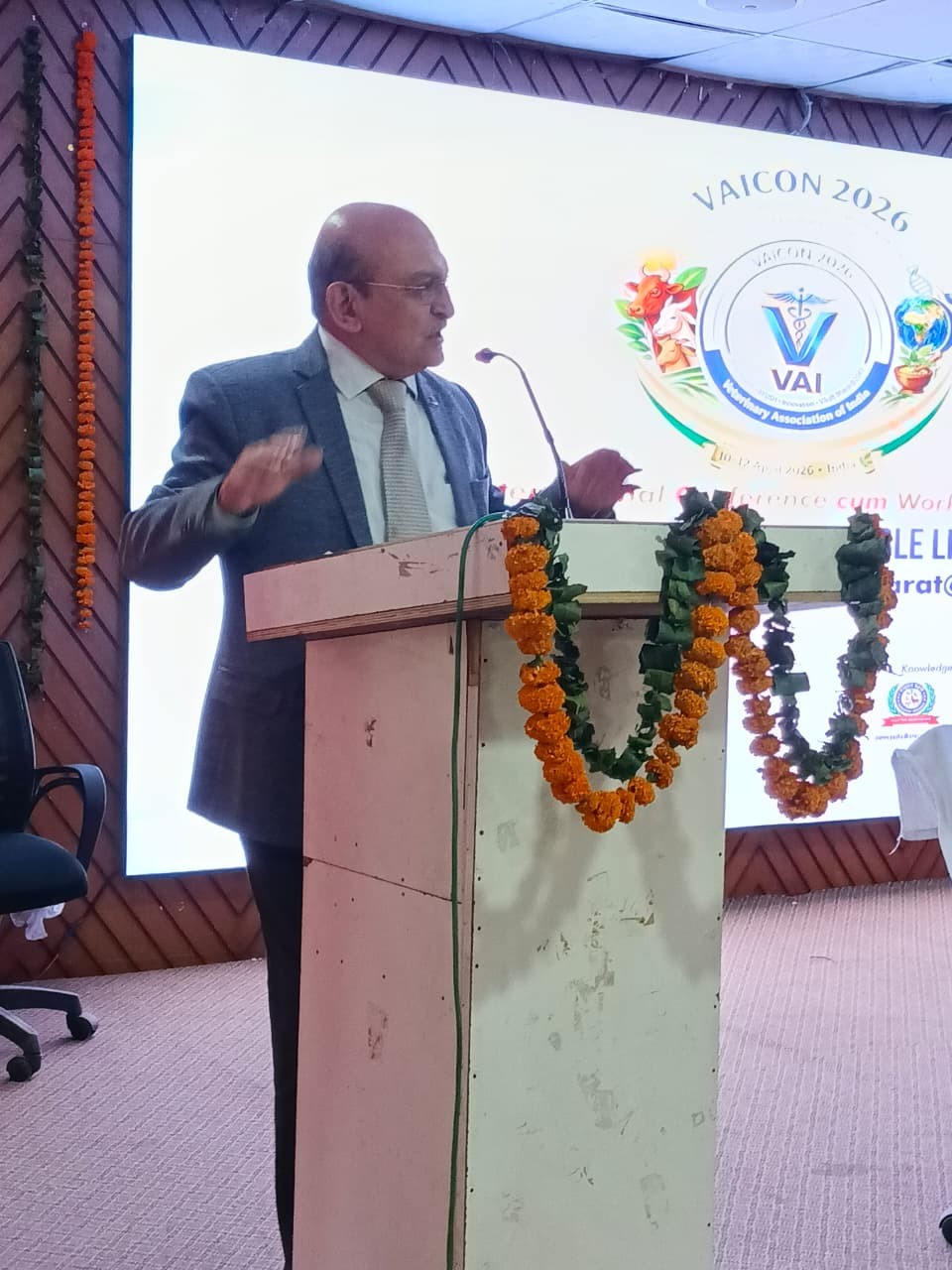
Keynote Address
Dr. Tarun Shridhar
Director General, Indian Chamber of Food and Agriculture (ICFA) and Former Secretary, Ministry of Fisheries, Animal Husbandry and Dairying, Government of India
Distinguished delegates.
It is a privilege to be amongst such eminent professionals today to speak on a subject that is at once ancient and contemporary, philosophical and practical, deeply Indian and profoundly global.
The theme before us is “Vasudhaiva Kutumbakam and One Health: Yogic Principles for Human and Animal Welfare.”
At first glance, these may appear to be separate concepts. One belongs to the realm of philosophy and spirituality; the other comes from the world of science, public health and policy. Yet, when we look closely, we discover that they are in fact two expressions of the same truth.
The principle of the Scale of Absolute Parity would further expand this philosophy, best illustrated by the legend of King Shibi and the Dove; a cornerstone narrative illustrating the equal value of all life forms. The story is preserved in both the Mahabharata and the Buddhist Jataka tales. King Shibi, a monarch committed to absolute justice and compassion, was holding court when a terrified dove landed in his lap, fleeing a predatory hawk. The hawk pursued the dove to the throne, demanding its prey. The king faced a profound ethical dilemma: as a protector, he could not betray the dove that had sought his shelter; yet, as a righteous ruler, he could not deprive the hawk of its natural food, which would doom the predator to starvation. The hawk argued with human intelligence: “O King, your compassion is selective. By saving the dove, you sentence me and my offspring to death. Is your dharma limited only to those species that appear gentle?”.
Acknowledging the hawk’s right to survive, King Shibi offered to provide any other food as a substitute. The hawk demanded an equal weight of the king’s own flesh. The king agreed and ordered a set of weighing scales to be brought to the court. The dove was placed on one pan of the balance. The king carved a portion of flesh from his right thigh and placed it on the opposite pan. However, the scale remained tipped in favor of the tiny dove. The king cut more flesh from his body, yet the dove consistently outweighed the accumulating pieces. Eventually, realizing that no partial offering would suffice, the king stepped onto the scale himself, presenting his entire body as a sacrifice. At that moment, the hawk and the dove revealed their true identities as the gods Indra and Agni, who had descended to test the depth of the king’s compassion.
This narrative serves as an ideological anchor for animal welfare. It demonstrates that in the calculus of universal justice, the life of a small, vulnerable bird carries a weight equal to that of a powerful human emperor. It rejects the anthropocentric assumption that human utility takes precedence over the existential rights of other species, providing an uncompromising moral baseline for the One Health philosophy.
One Health tells us that the health of humans, animals and the environment is interconnected. Vasudhaiva Kutumbakam tells us that the entire world is one family. The first is the language of modern science. The second is the language of ancient wisdom. And both are saying exactly the same thing.
We often observe that a farmer’s concern about his cows’ health is a far more serious concern than many others. Illness of one animal affects an entire household. The family’s income depends on it. The nutrition of the children depends on it. The farmer’s emotional well-being depended on it.
We often think of health in individual terms. “How is your (or mine) health?” Rarely do we ask: “How is the health of the ecosystem of which I am a part?”
The villagers understand something instinctively that modern science is now rediscovering: our well-being is interconnected.
That is the essence of One Health.
The phrase Vasudhaiva Kutumbakam comes from the Maha Upanishad:
“Ayam Nijah Paro Veti Ganana Laghuchetasam; Udara Charitanam Tu Vasudhaiva Kutumbakam.”
“The narrow-minded distinguish between ‘mine’ and ‘yours’; for the broad-minded, the entire world is one family.”
Notice that the verse does not merely advocate kindness. It advocates a way of seeing, a universal perspective.
A family is not a collection of unrelated individuals. A family is a network of relationships.The happiness of one member affects everyone else. The suffering of one member affects everyone else. In a family, we cannot remain indifferent.
Today, One Health asks us to adopt the same perspective toward humans, animals and nature.
The COVID-19 pandemic offered perhaps the most powerful reminder of this interconnectedness.
A microscopic pathogen brought the entire world to a standstill.
It demonstrated how porous the boundaries between species can be.
It showed how ecological disruption, wildlife interactions, animal health and human health are linked in ways we often fail to appreciate.
The pandemic was not merely a public health crisis.
It was a One Health crisis.
And it reminded us that human beings cannot achieve health in isolation from animals and ecosystems.
India, in many ways, has always possessed a natural affinity with the One Health concept.
Our traditions are rich with examples.
We worship rivers.
We revere trees.
We celebrate animals in festivals.
The cow, the elephant, the snake, the monkey, the peacock, the fish—all find a place in our cultural consciousness.
This is not accidental.
It reflects a civilizational understanding that humans are part of nature, not masters of nature.
Yoga emerged from this same worldview.
Unfortunately, in modern times, yoga is often reduced to a set of physical exercises.
But yoga is much more than postures.
Yoga means union.
Yoga means connectedness.
Yoga means recognising the deeper relationships that bind life together.
In that sense, yoga is perhaps the oldest expression of One Health thinking.
Yoga is an ancient mind-body practice that originated in India. Derived from the Sanskrit root word yuj (meaning “to join” or “to yoke”), it refers to the union of the individual consciousness with universal consciousness, as well as the integration of body, mind, and spirit.
Beyond physical fitness, the ultimate objective of yoga is Self-realization and liberation. It provides a systematic framework to unfold your inner potential, free yourself from mundane suffering, and live in harmony with yourself and the world.
Let us consider some of the yogic principles that can guide us today.
The first is Ahimsa—non-violence.
Ahimsa is often interpreted as refraining from physical harm.
But its meaning is broader.
It requires us to avoid causing unnecessary suffering.
Applied to One Health, Ahimsa encourages humane treatment of animals, ethical livestock management, responsible use of natural resources and compassionate public policy.
When we improve animal welfare, we are not merely helping animals.
We are creating healthier food systems, reducing disease risks and strengthening rural livelihoods.
In other words, compassion and practicality are not opposites.
They are partners.
The second principle is Karuna—compassion.
Compassion is not sentimentality.
Compassion is intelligent concern.
A compassionate society pays attention to the vulnerable.
This includes vulnerable human communities, but also vulnerable animal populations and fragile ecosystems.
I have often observed that societies which treat animals with care tend also to be societies that value human dignity.
The two are not separate.
The habit of compassion does not stop at species boundaries.
It expands outward.
The third principle is Aparigraha—moderation and restraint.
Many of the environmental challenges we face today stem from excessive consumption.
Climate change, biodiversity loss, pollution and resource depletion are, in many ways, consequences of imbalance.
Yoga teaches balance.
Nature itself thrives on balance.
One Health ultimately depends on balance.
A balanced relationship between production and conservation.
A balanced relationship between economic growth and ecological sustainability.
A balanced relationship between human needs and planetary limits.
Hippocrates, the ancient philosopher regarded as the Father of medicine, in his 600 BC treatise “On Airs, Waters and Places” advises the physicians to consider all aspects of a patient’s life, further explaining that disease is nothing but an imbalance between man and his environment; so the concept of One Health, though articulated by science in recent times, is as old as the human civilisation.
As someone who has spent considerable time working in the fields of fisheries, animal husbandry and food systems, I have repeatedly seen how interconnected these sectors are.
Take nutrition, for example.
When we discuss human health, we often focus on hospitals and medicines.
Yet health begins long before a person enters a hospital.
It begins with nutrition.
It begins with safe food.
It begins with healthy animals.
It begins with healthy ecosystems.
The quality of milk, eggs, fish and meat is influenced by animal health.
Animal health is influenced by environmental conditions.
Environmental conditions are influenced by human behaviour.
The circle is complete.
One Health simply makes visible what has always been true.
Consider antimicrobial resistance.
This is one of the most serious health challenges confronting humanity.
Misuse of antibiotics in humans can create problems.
Misuse in animals can create problems.
Environmental contamination can create problems.
The solution therefore cannot come from one sector alone.
Doctors, veterinarians, farmers, environmental scientists and policymakers must work together.
This is precisely the collaborative spirit that One Health advocates.
And it is entirely consistent with the spirit of Vasudhaiva Kutumbakam.
After all, family members solve problems together.
Climate change provides another example.
When temperatures rise, animals experience heat stress.
Water availability changes.
Disease patterns shift.
Fish stocks migrate.
Vector-borne diseases spread into new areas.
Human livelihoods are affected.
Food security is affected.
Nutrition is affected.
Again, we see the same lesson.
There are no isolated problems.
There are only interconnected systems.
One of the most encouraging developments globally is the growing recognition that animal welfare is not merely an ethical issue but also a development issue.
Healthy and well-cared-for animals are more productive.
They are less susceptible to disease.
They require fewer medical interventions.
They contribute to sustainable livelihoods.
Animal welfare, therefore, is not a luxury.
It is a foundation for resilient agricultural systems.
The farmer, the veterinarian, the policymaker and the consumer all have a role to play.
I believe India has a unique opportunity to contribute to the global One Health movement.
Not because we have all the answers.
But because we possess a valuable synthesis of scientific capability and civilizational wisdom.
Modern science provides us with data, diagnostics and technology.
Ancient wisdom provides us with ethical direction.
The future requires both.
Technology without values can become destructive.
Values without action remain ineffective.
The challenge is to bring them together.
in 2023, when India held the G20 presidency, our theme of Vasudhaiva Kutumbakam was directly linked by the government — by the Prime Minister himself — to the One Earth, One Health vision. He said, at the One Earth One Health summit: “Our goal is not restricted to just humans. It extends to our whole ecosystem. From plants to animals, from soil to rivers, when everything around us is healthy, we can be healthy.”
When India proposed Vasudhaiva Kutumbakam as a guiding principle for global engagement, it resonated across the world because it speaks to a universal aspiration.
However, the declaration fell short and confined the entire narrative to AMR; and there was not a whisper on animal health.
People everywhere want security, health and dignity.
Animals too deserve freedom from unnecessary suffering.
Future generations deserve a livable planet.
The idea of one family reminds us that responsibility accompanies privilege.
It reminds us that leadership requires stewardship.
And it reminds us that prosperity cannot be sustained if it excludes compassion.
Let me conclude with a simple thought.
A yogi sitting in meditation, a veterinarian caring for an animal, a doctor in the operation theatre, a scientist studying zoonotic diseases, a farmer nurturing livestock, a conservationist protecting biodiversity and a policymaker designing public health systems may appear to be engaged in very different activities.
But in reality, they are all participating in the same endeavour.
They are all working to preserve the harmony of life.
That harmony is what yoga seeks.
That harmony is what One Health seeks.
And that harmony is what Vasudhaiva Kutumbakam celebrates.
If the world is indeed one family, then health cannot be fragmented.
Human welfare, animal welfare and environmental welfare must advance together.
The future belongs not to isolated solutions but to integrated thinking.
Not to narrow interests but to shared responsibility.
Not to domination but to harmony.
Let us therefore move forward with the wisdom of our ancestors, the tools of modern science and the compassion that binds all living beings together.
Let us embrace One Health not merely as a policy framework but as a way of life.
And let us strive to create a world in which the ancient ideal of Vasudhaiva Kutumbakam becomes a living reality.
Thank you for your patience.