

India’s First Indigenous H5N1 Vaccine: : A New Shield for Poultry, a Test of National Preparedness
What the ICAR-NIHSAD breakthrough could mean for farmers, animal-health security, research, trade and the ambition of Viksit Bharat
By Dr Rajesh Kumar Singh
Editor-in-Chief, Pashudhan Praharee
A vaccine announcement—and the larger question of preparedness
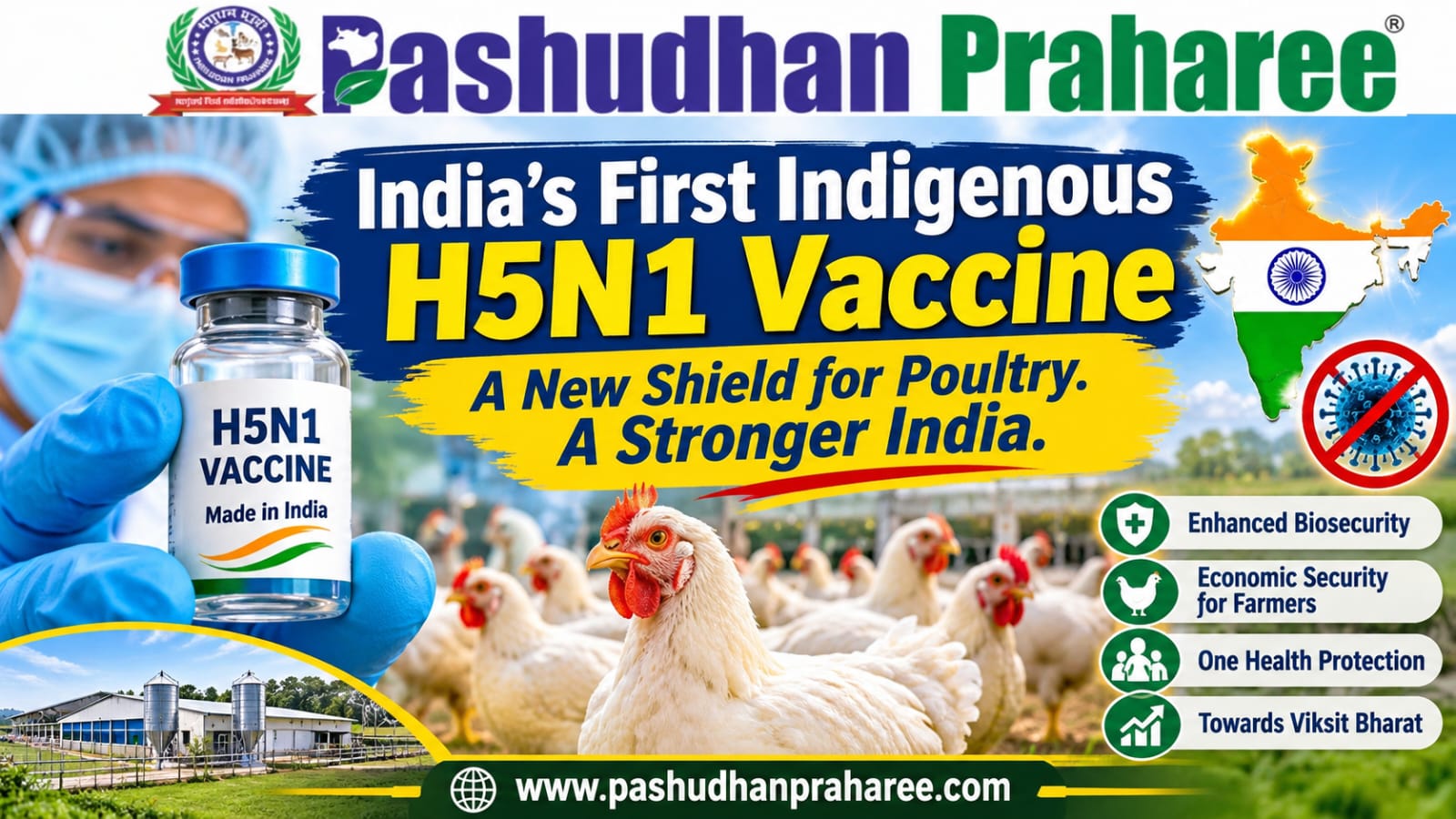
On 20 November 2026, Union Minister of Agriculture and Farmers’ Welfare Shivraj Singh Chouhan is scheduled to dedicate India’s first indigenous inactivated H5N1 vaccine for chickens to the nation at the ICAR–National Institute of High Security Animal Diseases (ICAR-NIHSAD), Bhopal. The vaccine has been developed by ICAR-NIHSAD and is directed against the highly pathogenic avian influenza (HPAI) virus H5N1, Clade 2.3.2.1a. The announcement was made by the Ministry of Agriculture and Farmers’ Welfare through the Press Information Bureau on 18 November 2026.
For India’s poultry industry, this is more than a laboratory milestone. It is an important step towards building domestic capacity to respond to a disease that can devastate flocks, disrupt markets, unsettle exports and threaten the livelihoods of farmers and workers across the poultry value chain. It also signals the growing importance of Indian veterinary science in anticipating animal-health emergencies rather than merely responding after an outbreak.
But scientific achievement and field-level protection are not the same thing. Dedication to the nation, regulatory authorisation, technology transfer, commercial-scale manufacture, market availability and a government-approved vaccination strategy are distinct steps. As of 19 November 2026, the official announcement identifies ICAR-NIHSAD as the developer; it does not name a commercial manufacturer or licensee, publish a price or dose schedule, or give a date when poultry farmers can purchase the product. Responsible reporting must keep that distinction clear.
Why H5N1 is an economic and animal-health emergency
Highly Pathogenic Avian Influenza is a contagious viral disease of birds. In susceptible poultry, outbreaks can cause extremely high mortality. The consequences extend well beyond the birds that die: authorities may impose movement restrictions, infected flocks may be culled, premises must be cleaned and disinfected, restocking may be delayed, and buyers can lose confidence in poultry products from affected areas. Farmers face direct losses; hatcheries, feed suppliers, transporters, processors, retailers and exporters face disruption.
The Government of India’s 18 November 2026 release says that more than 500 combined outbreaks involving H5N1 and H5N8 have been reported in India since the first detection in 2006. It cites estimated direct and indirect losses of ₹2,200–3,000 crore from the 2006 outbreak. The same release notes that a major uncontrolled outbreak could put more than 20 per cent of the country’s poultry population at risk and could reduce GDP growth by up to 1.5 per cent. These are government-cited risk estimates, not a forecast that a future outbreak will necessarily cause losses of that scale.
The public-health dimension also matters. The PIB release cites the WHO tally of 1,003 human H5N1 cases, including 479 deaths, across 25 countries since 2003. It also reports three human cases associated with the Clade 2.3.2.1a context in India. Human infections are uncommon and generally linked to exposure; this is not a reason to create panic about eating properly handled and cooked poultry. It is, however, a strong reason to prevent infection in birds, strengthen occupational protection and ensure prompt reporting.
Why Clade 2.3.2.1a—and why a strain-specific response matters
H5N1 is not a single unchanging virus. Influenza viruses evolve, and H5N1 viruses are grouped into genetic clades and subclades. The Indian government says Clade 2.3.2.1a has been responsible for most H5N1 outbreaks in chickens in the country and that related infections have also been detected in other animal species, including mammals. A vaccine designed around a relevant circulating clade is therefore a strategic response to the epidemiology observed in India.
The key scientific issue is antigenic match: how closely the vaccine antigen corresponds to the viruses circulating in the field. A vaccine developed against one clade should not be casually described as universal protection against every H5N1 lineage or every future variant. Continuous virus surveillance, sequencing and periodic assessment of vaccine match will be essential. India must treat the vaccine as part of an adaptive disease-control system, not as a one-time solution.
What does ‘inactivated vaccine’ mean?
The official description identifies the product as an inactivated vaccine. In general, an inactivated vaccine is made using virus material that has been rendered non-infectious while retaining antigenic components capable of stimulating an immune response. The development pathway for such a vaccine ordinarily involves work with an appropriately selected seed strain in high-containment facilities, controlled propagation, validated inactivation, formulation with suitable adjuvant, and testing for identity, purity, sterility, potency, safety, stability and batch consistency.
That is a description of the established scientific principles behind inactivated vaccines—not a disclosure of the proprietary manufacturing protocol used by ICAR-NIHSAD. The PIB announcement does not provide the seed-strain details, inactivation method, adjuvant, dose, route, booster interval, trial size, efficacy percentage or duration of immunity. These particulars should be taken only from the institute’s technical dossier, product label and competent regulatory authority.
The significance of indigenous development lies in the ability to align research with Indian field strains, strengthen domestic veterinary biologics capability and potentially reduce dependence on imported solutions. Yet ‘indigenous’ must never be treated as a substitute for rigorous quality assurance. Each production batch must meet prescribed standards, and field effectiveness must be monitored under real farm conditions.
Who will manufacture it—and when will farmers get it?
This is the question poultry farmers and the industry are most likely to ask. The official PIB announcement names ICAR-NIHSAD, Bhopal, as the developer. It does not identify a private company, public-sector manufacturer, technology-transfer partner, commercial brand, production capacity, price or retail launch date. No company should therefore be presented as the confirmed manufacturer on the basis of market speculation or unrelated vaccine partnerships.
Some market commentary has mentioned established poultry and animal-health businesses because they operate in relevant segments. That is not evidence that any of them has received the H5N1 technology or a manufacturing licence. A previous technology transfer for a different avian influenza subtype, for example, would not by itself establish a role in this H5N1 product. The manufacturer question remains officially unanswered as of the publication cut-off.
Before commercial use, the sector needs clarity on the technology-transfer arrangement, manufacturing site, applicable licence and regulatory pathway, GMP and batch-release standards, annual production capacity, cold-chain requirements, pack size, price, shelf life and distribution channels. It also needs a clear statement on whether initial deployment will be targeted to high-risk commercial farms or undertaken under a wider national or state-level programme.
Farmers should not buy or administer any product advertised as this new vaccine until an authorised product, approved label and official veterinary guidance are available. Unverified social-media claims, advance bookings or unofficial vials create avoidable risks.
What could change for poultry farmers?
If the vaccine secures the necessary authorisations and performs well in the field, its potential value could be substantial—particularly for longer-cycle layer and breeder operations, where birds remain on farms for extended periods and the economic exposure to an outbreak can be significant. The exact target categories and schedule, however, must be confirmed through official technical guidance.
- Lower risk of severe clinical disease and mortality in appropriately vaccinated flocks, if the vaccine is well matched to circulating viruses and administered correctly.
- Reduced probability of catastrophic flock losses, emergency depopulation and prolonged farm downtime.
- Greater continuity in egg and meat supply, with potential benefits for hatcheries, feed mills, processors, retailers and allied businesses.
- Improved confidence for investment in commercial poultry production, provided surveillance and outbreak response remain credible.
- New opportunities for Indian veterinary biologics manufacturing, quality-control laboratories, cold-chain logistics, diagnostics and trained veterinary personnel.
- Potential support for trade confidence, although vaccination alone cannot guarantee disease-free status, export access or acceptance by importing countries.
An important distinction must be maintained between protection against clinical disease and prevention of infection or virus shedding. A vaccine may reduce disease severity without completely preventing infection or transmission. The field data must establish what this product does. If vaccinated birds can still become infected, surveillance and diagnostic testing become even more important—not less.
India’s poultry economy: a strategic national asset
India is among the world’s leading poultry-producing countries. According to the Department of Animal Husbandry and Dairying’s Basic Animal Husbandry Statistics (BAHS) 2025, India produced 149.11 billion eggs in 2024–25, ranking second globally in egg production. Per-capita egg availability reached 106 eggs per year. Commercial poultry contributed 125.98 billion eggs, or 84.49 per cent of the national total, while backyard poultry contributed 23.13 billion eggs.
The same official publication records total meat production of 10.50 million tonnes in 2024–25, of which poultry meat accounted for 5.18 million tonnes—about half of total meat output. India ranked fourth globally in meat production. These figures show the scale of the sector and why animal-health shocks can have consequences for nutrition, employment, rural enterprise, food processing and trade.
Poultry is not merely an organised-company business. It supports small and medium farmers, contract growers, women-led backyard enterprises, feed and ingredient suppliers, hatcheries, veterinary practices, transporters, cold-chain operators and retail networks. A disease-control innovation that protects production continuity can therefore support livelihoods across a wide economic ecosystem.
The challenges that will decide whether the vaccine succeeds
- Viral evolution and antigenic drift: field viruses must be sequenced and compared with the vaccine strain; vaccine suitability may need periodic review.
- Scale and affordability: manufacturing must deliver consistent quality at a price that farmers can realistically afford, with reliable supplies during periods of heightened risk.
- Farm-level delivery: different production systems—broilers, layers, breeders and backyard flocks—have different management cycles, handling constraints and economic priorities.
- Surveillance after vaccination: clinical observation alone may miss infection in vaccinated flocks. Molecular testing, serology and transparent reporting must remain active.
- Regulatory and trade alignment: India must consider WOAH standards, domestic disease-control rules and the requirements of importing markets.
- Farmer trust and compensation: vaccination will be adopted more responsibly when farmers receive clear instructions, prompt outbreak confirmation and transparent compensation rules.
Will vaccination end culling and movement restrictions?
No such conclusion should be drawn. India’s Revised Action Plan for Prevention, Control and Containment of Avian Influenza (2021) sets out a response framework that includes outbreak notification, containment operations, demarcation of infected and surveillance zones, restrictions on poultry movement, culling/stamping-out where directed, safe disposal of carcasses and infected material, cleaning, disinfection, post-operation surveillance and regulated restocking. The plan describes a one-kilometre infected zone and a ten-kilometre surveillance zone as the standard framework, subject to provisions for adjustment.
The arrival of a vaccine does not automatically suspend these measures. Any change in national policy must be formally communicated by the competent authorities. Until then, farmers must continue to comply with official reporting, sampling, movement-control and outbreak-response directions—even if vaccination becomes available.
Practical precautions for poultry farmers
- Control farm entry. Maintain visitor registers, dedicated footwear and clothing, vehicle disinfection and restricted access to poultry sheds.
- Keep wild birds and their droppings away from poultry, feed and drinking water. Protect water sources and feed stores from contamination.
- Follow all-in/all-out management where feasible, maintain appropriate downtime between batches and clean and disinfect sheds, equipment and crates.
- Monitor daily mortality, feed and water intake, egg production and unusual respiratory, digestive or neurological signs.
- Report sudden or unusual mortality immediately to the local veterinarian and district animal husbandry authorities. Do not conceal suspected disease or move birds, eggs, litter or equipment from an affected premises.
- Do not open, sell, transport or casually dispose of suspect dead birds. Sampling and carcass handling should be carried out by trained authorised teams.
- Use personal protective equipment and hand hygiene when handling sick or dead birds. Workers who develop fever, red eyes or respiratory symptoms after exposure should seek medical advice and disclose the exposure.
- Use the new vaccine only after official authorisation, through an authorised supply chain and under the label and veterinary protocol. Do not guess dose, route, booster timing or withdrawal/monitoring instructions.
Ten questions India’s poultry veterinary community must ask
- What seed strain and antigenic evidence guided the selection of the vaccine strain, and how closely does it match recent Indian field isolates?
- What were the study design, sample size, bird categories and endpoints used to establish safety and protection?
- Does the vaccine primarily reduce clinical disease and mortality, or has it also demonstrated a reduction in infection and virus shedding?
- What is the recommended age, dose, route and booster schedule, and will protocols differ for broilers, layers and breeders?
- What is the expected duration of immunity, and what evidence supports that estimate under field conditions?
- How will surveillance distinguish vaccinated birds from infected birds, and is a DIVA-compatible strategy available or planned?
- Who will receive the technology for commercial manufacture, and what regulatory approvals and batch-release tests will apply?
- What is the proposed price, production capacity, cold-chain requirement and distribution plan for small and large farms?
- Will vaccination be targeted initially to high-risk districts or production clusters, and what criteria will determine eligibility?
- If HPAI is confirmed in a vaccinated flock, what outbreak-control, movement restriction, culling and compensation rules will apply?
From a vaccine to a national poultry-health security framework
India should use this breakthrough to build a coordinated poultry-health security framework linking ICAR institutes, state veterinary universities, the Department of Animal Husbandry and Dairying, state animal husbandry departments, diagnostic laboratories, integrators, independent farmers and industry associations. The immediate priorities should be publication of a clear technical summary; transparent disclosure of the regulatory and manufacturing pathway; risk-based deployment guidance; continuous genomic surveillance; and practical training for veterinarians and farm personnel.
The framework should also strengthen wild-bird surveillance, farm biosecurity audits, rapid laboratory diagnosis, safe carcass disposal, traceability, outbreak communication and compensation. A farmer who reports suspicious mortality promptly should not be left to navigate uncertainty alone. Timely sampling, transparent communication and predictable compensation are essential to encourage early reporting—the foundation of effective disease control.
A vaccine programme must be evidence-led. Its performance should be evaluated through measurable indicators: outbreak frequency, mortality, virus detection, flock-level losses, vaccine coverage, adverse events, cost per protected bird and time taken to restore production after an outbreak. Public reporting of these indicators will build confidence and help researchers refine the strategy.
A meaningful contribution to Viksit Bharat
The contribution of this vaccine to Viksit Bharat cannot responsibly be expressed as a guaranteed percentage increase in GDP. Its value lies in reducing biological risk in a major food-producing sector, protecting farmer incomes, supporting affordable animal protein, strengthening domestic vaccine research and improving the resilience of supply chains. A modern poultry sector must be productive, but it must also be capable of detecting, containing and recovering from disease threats.
India’s global standing in egg and meat production has been built through farmers’ enterprise, private investment, veterinary services, research institutions and public infrastructure. The next stage of growth will depend increasingly on biosecurity, traceability, animal welfare, reliable diagnostics, quality assurance and science-based disease prevention. Indigenous veterinary vaccines can become a strategic pillar of that transition—provided research is translated into safe, affordable and verifiable field protection.
The ICAR-NIHSAD H5N1 vaccine is therefore a welcome national achievement. The scientific community deserves recognition, and the poultry sector deserves a clear roadmap for what follows. The true measure of success will not be the launch ceremony; it will be whether the vaccine, supported by surveillance and disciplined farm management, helps prevent devastating losses, protects livelihoods and strengthens public confidence in Indian poultry.
A vaccine can become a shield only when science, policy, industry and farmers work together. India has taken an important step. The task now is to make that step count on every farm.
At a glance: what is confirmed—and what remains to be announced
| Issue | Position as of 19 November 2026 |
| Developer | ICAR–NIHSAD, Bhopal |
| Vaccine type | Inactivated H5N1 vaccine for chickens |
| Target | H5N1 HPAI, Clade 2.3.2.1a |
| National dedication | Scheduled for 20 November 2026 at ICAR-NIHSAD, Bhopal |
| Commercial manufacturer/licensee | Not named in the official announcement |
| Brand, price and production capacity | Not stated in the official announcement |
| Dose, route and duration of immunity | Detailed product information not included in the PIB announcement |
| Commercial availability date | Not announced |
| National/state vaccination policy | Requires formal guidance from competent authorities |
References
1.Press Information Bureau, Ministry of Agriculture & Farmers Welfare, Government of India (18 November 2026). “Shri Shivraj Singh Chouhan to dedicate India’s First Indigenous H5N1 (Clade 2.3.2.1a) Chicken Vaccine to the Nation on 20 November.” Primary source for developer, target clade, event date and official background figures.
https://www.pib.gov.in/PressReleseDetailm.aspx?PRID=2337716&lang=2®=48
2.Department of Animal Husbandry and Dairying, Government of India. Action Plan for Prevention, Control & Containment of Avian Influenza (Revised, 2021). Outbreak notification, infected/surveillance zones, movement restrictions, culling, disinfection, compensation and restocking.
https://dahd.gov.in/sites/default/files/2025-03/Revised_AI_Action_Plan_2021.pdf
3.Department of Animal Husbandry and Dairying, Government of India. Basic Animal Husbandry Statistics 2025. Official estimates for egg and meat production in 2024–25 and global rankings.
https://www.dahd.gov.in/sites/default/files/2026-02/BAHS2025.pdf
4.Press Information Bureau, Government of India (26 November 2025). Release of Basic Animal Husbandry Statistics 2025; summary of 2024–25 milk, egg and meat production.
https://www.pib.gov.in/PressReleasePage.aspx?PRID=2195049&lang=2®=3
5.Rural Voice (18 November 2026). “India to Get Its First Indigenous H5N1 Bird Flu Vaccine for Chickens on November 20.” Secondary report summarising the announcement and industry context.
https://eng.ruralvoice.in/agritech/india-to-get-its-first-indigenous-h5n1-bird-flu-vaccine-for-chickens-on-november-20.html
6.Deccan Herald. “India unveils 1st indigenous H5N1 vaccine to combat bird flu amid rising outbreaks.” Background report supplied for this editorial.
https://www.deccanherald.com/health/healthcare/india-unveils-1st-indigenous-h5n1-vaccine-to-combat-bird-flu-amid-rising-outbreaks-4222616-4222616