



Piglet mortality and its management
Kiran S V1, M.V.Sc Scholar, Livestock Production Management, NDRI, Karnal, 132001
Amulya G V2, M.V.Sc Scholar, Animal Nutrition, NDRI, Karnal, 132001
Mohan Kumar A S3, M.V.Sc Scholar, Animal Reproduction and Gynaecology Obstetrics, NDRI, Karnal, 132001
Abstract
Piglet mortality is a significant constraint in profitable swine production, particularly in developing countries like India. It refers to the death of piglets from birth to weaning, with the highest losses occurring during the first week of life. This issue arises due to a combination of prenatal, perinatal, and postnatal factors involving the sow, piglet, management practices, environment, and diseases. Key causes include poor nutrition and health of the sow during gestation, farrowing complications such as dystocia and asphyxia, and postnatal challenges like low birth weight, inadequate colostrum intake, hypothermia, crushing, and infectious diseases. Environmental stress, poor housing, and lack of proper hygiene further aggravate the problem.
Effective management strategies play a crucial role in reducing piglet mortality. These include proper care and nutrition of pregnant sows, close supervision during farrowing, ensuring timely colostrum intake, maintaining optimal temperature, and adopting good hygiene and disease prevention practices. Management of suckling piglets through practices like iron supplementation, creep feeding, and proper identification also enhances survival rates.
Overall, reducing piglet mortality requires a comprehensive approach that includes improved husbandry practices, timely interventions, and greater awareness among farmers. Implementing these measures can significantly improve piglet survival, productivity, and the economic returns of pig farming.
Key words: piglet, mortality, weaning, farrowing, parturition, sow,
Introduction
Pig farming plays an important role in the livelihood of small and marginal farmers in India, contributing to income generation, nutritional security, and employment. Despite its potential, the productivity of the Indian swine sector remains low compared to developed countries, and piglet mortality is one of the key limiting factors.
Piglet mortality refers to the death of piglets from birth to weaning, with the highest losses occurring during the first week of life. Under Indian conditions, mortality rates are relatively high due to a combination of environmental stress, poor management, and disease challenges. Newborn piglets are highly vulnerable because they are born with low energy reserves, limited immunity, and poor thermoregulatory ability. Failure to consume adequate colostrum soon after birth further increases their susceptibility to diseases such as Clostridial enteritis and diarrhoea-causing infections.
Piglet mortality is a big deal in pig farming, causing significant losses. Factors like pregnant sow management, handling during farrowing, birth weight, litter size, sow behaviour, nutrition, and environment all play a role. To boost survival rates and profitability, farmers need to understand these factors and take steps to address them, like improving sow care and farrowing conditions.
Causes of mortality and morbidity may be multifactorial, including lack of awareness among the farmers and pig breeders regarding management practices, disease prevention and control measures. The predisposing factor of piglet mortality is inextricably linked with other causes, either because they directly lead one to another or have common predisposing factors, for example, prolonged farrowing duration is influenced by increased litter size, and sow stress associated with fatigue, restrictive farrowing environments, and high ambient temperatures. As previously suggested, the cause of death can be influenced by many factors
Here is the broad classification of piglet mortality:-
- prenatal causes of mortality (before farrowing).
- perinatal cause of mortality (during farrowing).
- postnatal mortality (after birth).
(A. sow factors, B. piglet factors, C. managemental factors, D. environmental factors, F. infectious factors
Piglet Mortality During Pre-Parturition Period (Before Farrowing)
This period includes late gestation (especially the last 2–3 weeks).
Poor Nutrition of Sow/Inadequate energy, protein, vitamins, and minerals
Leads to: Weak fetuses, Low birth weight piglets, and increased stillbirths.
- Disease Conditions in Sow Reproductive infections may cause abortion, stillbirth, or weak piglets. Important diseases: Porcine reproductive and respiratory syndrome, Brucellosis, Leptospirosis.
- Stress in Pregnant Sow: Overcrowding, heat stress, transport, rough handling
Causes hormonal imbalance → fetal death or premature birth.
- Placental Insufficiency (Poor blood supply to fetuses) leads to intrauterine death or weak piglets.
- Large Litter Size Competition for nutrients in the uterus Results in uneven growth and weak piglets.
Piglet Mortality During Parturition (Farrowing).
This is a critical stage, where many piglets die due to birth-related complications.
Dystocia (Difficult Farrowing)
Caused by: Large piglets, Narrow birth canal, Uterine inertia
Leads to delayed birth and death of piglets.
Asphyxia (Oxygen Deficiency)
The most common cause of stillbirth
Occurs due to: Prolonged farrowing, Umbilical cord rupture, Piglets suffocate before or during birth.
Prolonged Farrowing Duration
Normal: 2–4 hours
If prolonged, Later-born piglets become weak or dead, Increased stillbirth rate
Birth Trauma
Injury during passage through the birth canal, rough handling during assisted delivery
Premature Birth
Piglets born before full development, Weak, low viability, high mortality
Poor Supervision at Farrowing
No assistance during complications, Delay in helping piglets to breathe or suckle
postnatal factors
Refers to deaths occurring after birth
Sow factors:-
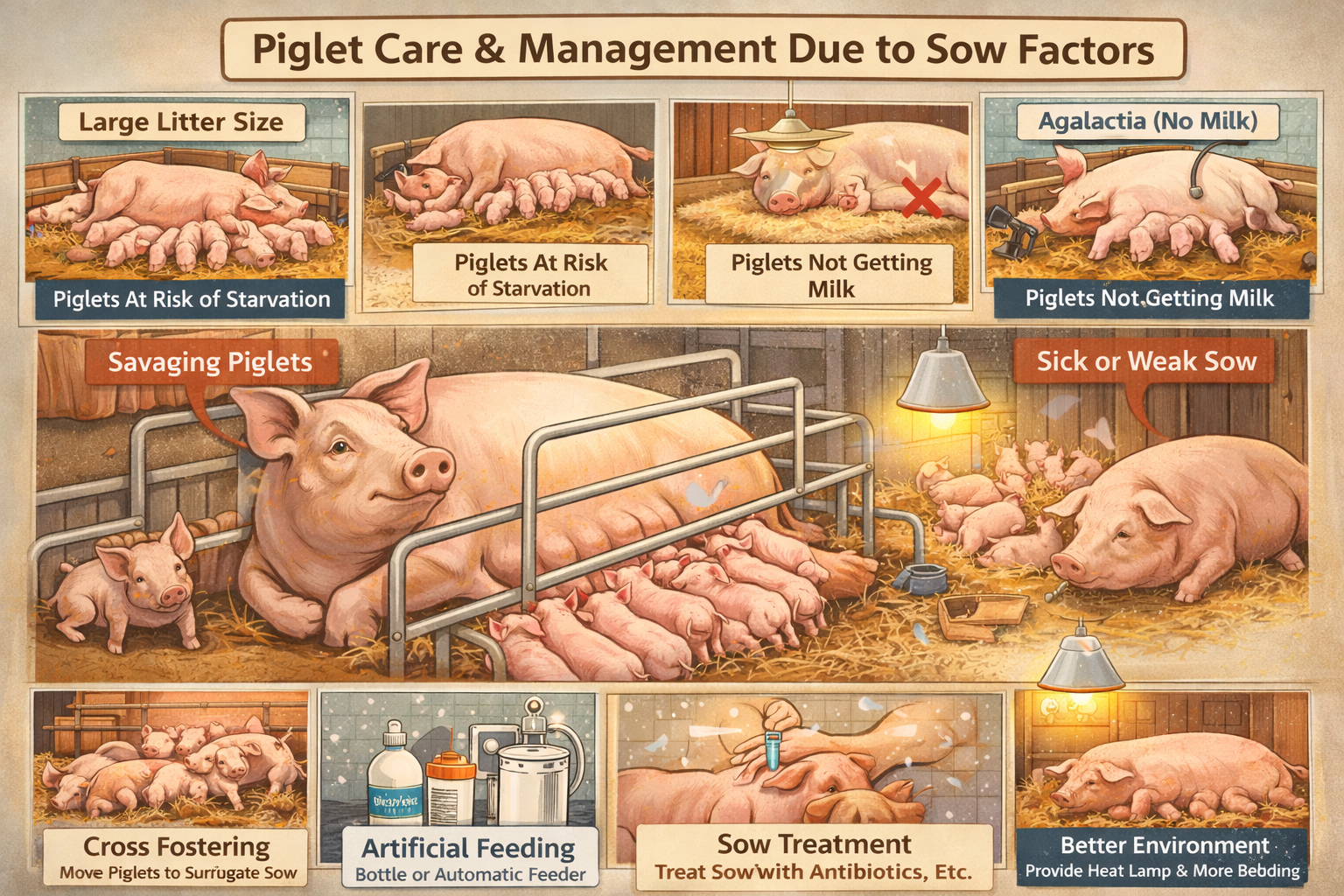
A piglet must have safe and easy access to the udder to consume colostrum early in life. Thus, the sow must be relatively passive, lying laterally, exposing her udder, and emitting rhythmic grunts as an auditory cue to her newborns to suckle. Restless maternal behaviour, particularly during farrowing, not only prevents early colostrum intake but also prolongs farrowing duration and increases the risk of crushing.
Crushing
Crushing is generally regarded as the ultimate cause of the vast majority of neonatal deaths, and as such, it is a well-studied aspect of the hypothermia-starvation-crushing complex. Lack of piglet-directed pre-lying behaviour, designed to remove piglets from the lying location, frequency and nature of posture changes, and failure to rise in response to a trapped piglet are all sow behaviours that influence the risk of crushing.
Maternal temperament AND savaging
Piglet mortality is also affected by the sow’s temperament. Individual differences in maternal ability exist, and sows classified as ‘crushers’ behave differently from ‘non-crushers.’ The consistency of behavioural patterns within individuals, as well as the high variation within populations, suggests that ‘non-crushers’ may be selected. Neophobia and nervousness toward humans were also linked to piglet crushing, most likely due to increased reactivity to disturbance. Mismothering in the form of maternal aggression or savaging can result in traumatic or fatal injuries and is not the only maternal behaviour that can directly cause piglet death. Savaging is more common in gilts, possibly due to a neophobic reaction to newborns. When sows are confined in crates and unable to escape the attention of the neonates, savaging is more common, whereas this behaviour is rare in other systems. During parturition, scavenging sows are more restless and overly responsive to their piglets.
Colostrum yield AND large litter size: Sow colostrum yield was reduced by a prolonged farrowing period and low haptoglobin levels in sow plasma. Sows’ inadequate nutrition can also influence colostrum yield and composition in late gestation. Sows need a lot of energy to grow their mammary glands, so nutrition may affect colostrum production through both mammary gland growth and the mechanisms that regulate colostrum secretion in late gestation. Sows’ energy intake during pregnancy is positively correlated with the birth weight of piglets.
Piglet factors
This section will detail the consequences of piglets being born with physical and behavioural detriments, with particular reference to their links with chilling, reduced colostrum intake and crushing.
Birth weight
Birth weight is widely regarded as the most important predictor of live-birth survival. Pre-weaning mortality was 40% in pigs with birth weights less than 1 kg, 15% in pigs with birth weights between 1 and 1.2 kg, and only 7% in pigs with birth weights greater than 1.6 kg. Piglets who reach the udder first, find a functional teat and suck colostrum are more likely to survive. As a result, piglets will fight to gain and keep possession of a preferred teat, and if they do not perform optimal massaging and suckling behaviours at this teat, colostrum and milk yield, as well as piglet survival, may suffer.
Poor Colostrum intake/failure to suckle
Colostrum is essential for a piglet’s development of passive immunity, intestinal maturation, and thermoregulation. The bioactive substances immunoglobulins (IgA, IgM, and particularly IgG), hydrolytic enzymes, hormones, and growth factors are all abundant in the colostrum. There is a limited time after birth when the gut is permeable to macromolecules such as immunoglobulins, which confer passive immunity before gut closure begins (at approximately 48 h). Because colostrum ingestion stimulates the oesophageal groove closure process, it is critical for the piglet to obtain and process as much colostrum as possible during this time.
Colostrum provides highly metabolizable energy as well as a high content of fatty acids and lactose, which the piglet efficiently utilises to cope with cold-induced stress by increasing its metabolic rate and maintaining homeothermic equilibrium on the first day of life
Low body temperature/Hypothermia
The neonatal piglet is born almost hairless, with no brown adipose tissue, and low glycogen reserves, which help in metabolic heat production. The hypothermia gets exaggerated when reduced insulation through heat loss by evaporation (moist skin with placental fluids), cold surface (> 40% on a concrete floor) and heat loss per unit of body weight is inversely related to body size; smaller piglets are more vulnerable to hypothermia.
Litter size
Piglet survival has been further hampered by genetic selection for larger litters in pigs, which has an effect on birth weight and inter-piglet weight variance. Nowadays, litter size has increased over the years due to lots of breeding techniques for sows. But sows have a limited biological capacity related to the number of functional teats and maternal investment; these larger litters demand more management input from the farmer to keep piglet mortality low.
- Environmental factors
- Temperature & Ventilation:Thermal stability is critical; cold stress is a primary cause of mortality. Improper ventilation reduces air quality, increasing susceptibility to infections and respiratory syndromes.
- Housing Systems:Studies on loose-housed systems indicate that while they can reduce sow stress, poor design can lead to increased crushing. The presence of farrowing rails in pens significantly reduces mortality.
- Seasonality:Mortality is often higher in hot seasons due to sow exhaustion and in cold seasons due to piglet hypothermia.
- Managemen tPractices:Lack of cleaning and litter in the farrowing area negatively affects survival rates.
- d. Alternative Environments:Research on outdoor organic systems found that genetic parameters for survival differ from indoor, crated conditions, requiring different management approaches to optimise survival.
Important Diseases Causing Piglet Mortality
- Neonatal Diarrhoea (Scours):-Most common cause of death in young piglets. Major pathogens: Colibacillosis, Clostridial enteritis, Coccidiosis. Symptoms:’ Watery diarrhoea, dehydration, weakness Leads to rapid death if untreated.
- Septicemia:- Bacterial infection spreads in the blood, causing sudden death without clear signs, often due to poor hygiene and weak immunity.
- Respiratory Infections:-Occur due to cold stress and poor ventilation. Common disease: Pneumonia. Symptoms: Coughing, breathing difficulty, poor growth.
- Piglet anaemia (Iron Deficiency Disease):-Not infectious but very common. Leads to: Pale skin, Weakness, increased susceptibility to infections. NEWLY BORN PIGLET HAS 12-13G/100ML OF Hb IN BLOOD, AND THIS RAPIDLY DECREASES TO 6-7G BY 10-14 DAYS OF AGE.
- Viral Diseases Affecting Survival: Some viral infections reduce survival or cause weak piglets: Porcine reproductive and respiratory syndrome, Swine influenza.
- Navel Ill (Omphalitis):-Infection through the umbilical cord.
- Joint Ill (Polyarthritis):-Bacterial infection of joints.
- Infectious disease: About 4% of piglet deaths are attributable to infectious illnesses, with gastroenteritis and pneumonia being the main causes. Different causes of mortality of pigs in the age group (0-42) days were enteritis (37.50%), pneumonia (36.11%), pneumonia with enteritis (6.94%), Classical swine fever (4.16%) and 1.38% of other causes i.e. diarrhoea, liver abscess, general poor health with debility, hypovolemic shock, spleen rupture, fibrinous polyserositis, trauma, liver rupture, and physical wound. 29.17% of deaths were due to gastroenteritis, 20.83% to pneumonia and gastroenteritis, 4.17% to mother-child abuse, 8.33% to iron poisoning, 29.17% to pneumonia, and 8.33% to other causes of pneumonia (15.82%), gastroenteritis (42.09%), weakness and debility (10.10%), and traumatic injury (4.04%) were identified to be the most prevalent conditions. Gastroenteritis-40.91%, Pneumonia-9.15%, Weakness, debility, and inanition-12.15%, Traumatic injury-6.32%, Foot and Mouth Disease-1.94%, Urinary Tract Infection-1.26% and others-28.28%.
- Managerial factors:-
There are several obvious areas within the farrowing house where a handler can influence piglet mortality. In one farm survey, it is concluded that the handler’s factors constitute 26-27% of the variance in pre-weaning mortality. Failure to assist weak piglets with colostrum intake or thermoregulation, as well as failure to intervene when a sow has more piglets than functional teats, will inevitably result in piglet losses. Furthermore, poor management practices in terms of hygiene and disease treatment increase the risk of neonatal diseases and infections becoming fatal.
Stressful experiences during pregnancy not only affect the sow’s behaviour, but they can also have long-term negative effects on the developing offspring, including transgenerational effects. Some researchers subjected primiparous sows to the stress of social mixing during mid-gestation in a study. Neurobiological research found that female offspring of stressed sows were more anxious, and those females who went on to become mothers displayed abnormal maternal behaviour. When compared to control sows, they were also more reactive to their piglets and spent more time visually attending to them; these differences had a negative impact on piglet survival.
- Environmental factors:–
- Season
Piglets’ mortality was significantly impacted by the farrowing season. In India, winter seasons had the greatest mortality rates, followed by rainy and spring seasons due to low ambient temperature and cold stress. Winter (47.36%) had the highest fatality rate, followed by summer (27.19%) and monsoon (25.43%).
Farrowing pens vs farrowing crates
The relative risk of pre-weaning mortality was 14% higher in farrowing pens when compared with crates. The number of piglets born dead was comparable between the crates and pens with enrichment, but the relative risk of stillbirth was increased by 22% in crates versus pens without enrichment. The floor characteristics of the farrowing pen or the creep area might influence piglet PWM. Floors with rigid physical features (i.e. slatted iron floor, partial concrete and partial round-weld mesh floor) increase the incidence of foreleg skin lesions in piglets with a negative effect on piglets’ pre-weaning growth.
Reduction of piglet mortality by applying different management aspects in different stages of life
Care and management of pregnant pigs: to reduce problems because of prepartum and during farrowing factors
- The most important principle of caring for pregnant pigs is to provide them with a ration, which will ensure the complete nourishment of the sow and her developing foetuses. In addition to proper nutrition, the pregnant animal should be provided with regular exercise. Feeding some distance away from the house or inducing the animal for a moderate walk may bring about forced exercise.
- Provide a well-balanced pregnancy ration for uniform litter and better birth weight. Leguminous greens like Berseem, Lucerne and cowpea should be liberally fed. As major growth of the developing foetuses takes place from 70-90 days of gestation, increase the amount of feed during this period.
- Avoid overheating and heat stress and provide plenty of fresh drinking water. Pregnant gilts/sows should not be mixed with other animals to avoid fighting, which may lead to skidding and abortions.
- Before moving into the farrowing pen, the sow should be thoroughly scrubbed with soap and warm water, especially in the region of the sides, udder, under surface of the body and inter-digital space. This removes dirt and adhering parasite eggs and bacteria that are potential diarrhoea-causing agents.
- Trim the overgrown long toe of the sow to minimise crushing injuries. Move the clean animal to the clean pen 10 days before farrowing.
Care of the sow at farrowing time: To prevent piglet mortality
- Good care and management of the sow during farrowing can make the difference of the survival of 8-10 piglets out of the 12 farrowed. The different challenges facing involve different aspects
- Approximately 30% of the pigs farrowed never reach the weaning age, and an additional loss of 5% occur after weaning. This means that only 65% of the pigs farrowed reach market age. This stresses the need for good care and management of the sow before, during and after parturition.
- Reduce the ration by 1/3rd till farrowing. Provide bulky rations.
- Withdraw feed 12 hours before farrowing.
- The farrowing pen should be dry, warm and clean and should offer protection from heat, cold and winds.
- Appearance of milk in teats when pressed indicates the approach of farrowing time.
Care of sow after farrowing: To prevent piglet mortality
- Clean the sow with lukewarm water and allow her to suckle her young ones. If there is no letting down of milk, give oxytocin injection.
- Provide sow her first meal 12 hours after farrowing. The sow may be fed the same bulky ration fed before farrowing. It is best to feed half of the ration on the first day and to increase the ration to 200 to 300 g daily until she is fully fed.
- Mastitis, Metritis, agalactia syndrome (MMA) is a complex condition in which there is inflammation of the udder, uterus and complete lactational failure.
- Since the main effect is loss of milk in the first three days post-farrowing, the condition contributes to piglet losses from starvation. The symptoms are anorexia, lethargy, disinterest towards piglets, high fever, swelling of the udder, which becomes hard to touch, agalactia, and mucopurulent vaginal discharge. In many cases, elevated body temperature is associated with this condition.
- The litter size should be equalised by moving piglets from large litters to small litters and fostering (Cross fostering:- Move extra or big piglets from large litters to sows with fewer piglets. Done within 12-24 hrs of birth to balance litter size and match teats. The most common typeof suckling is temporary fostering within the same litter. Lock strong piglets away for 1-2 hrs so weak ones get colostrum first. Then swap. Ensures all get colostrum in the first 6 hrs Split.to make the litter size equal. This should be done during the first three days of farrowing. Swab the sow’s udder with a saturated solution of ferrous sulphate, zinc sulphate and copper sulphate to prevent nutritional anaemia in piglets. Provide adequate, nutritious, balanced rations to the lactating sow for sufficient milk production.
Care of piglets at birth:
- Farrowing should be attended by an experienced person, irrespective of the time of day or night.
- Remove the piglets soon after they are farrowed. Ensure that the breathing passage of all baby pigs is clear.
- In case of difficulty, swing the piglets at arm’s length or give artificial respiration using a pig resuscitator. Clean all piglets free of mucous and dry their body dry.
- The navel cord should be cut at a distance of 2.5 cm from the body with a sterilised pair of scissors, apply a cord clamp and disinfect with tincture iodine
- If farrowing is abnormally prolonged, oxytocin may be used to speed the rate of delivery. Oxytocin should not be used if there is any suggestion that a pig is blocking the canal. Continuous strong abdominal contractions for an extended period of time without the birth of piglets indicate the need for manual assistance.
- A well-lubricated gloved hand should be inserted in the vagina; the piglet should be grasped gently and firmly pulled out. It is advisable to give an antibiotic injection after this procedure to avoid complications.
- Transfer the piglets to the creep area in which the temperature is 25 to 30°C to protect them from chilling.
- Assist the piglets to get the teat and suck colostrum from their mother’s udder. The sow should suckle the piglets 8 to 10 times initially in a 24-hour period.
- Following parturition, the sow will often call her litter to suck by emitting repeated short grunts and may emit loud barking grunts if an intruder disturbs the nest. The sow rarely licks or grooms her young, but sometimes appears to try to position the piglets near her udder or draw them towards her teats using her forelegs in scooping action.
- Check the udder of the sow for Agalactia, Mastitis and the number of functional teats to assess the nourishing capacity.
- Protect baby pigs from aggressive sows and from trampling. As soon as the afterbirth is expelled, it should be removed from the pen and burned or buried in lime. This prevents the sow from eating the afterbirth.
- Remove wet, stained or soiled bedding and provide clean, fresh material. Provide micro-environment of light and heat to keep piglets comfortable.
- The temperature regulatory mechanism is underdeveloped in newborn piglets. When they new born piglets are exposed to cold conditions, they have to mobilise limited glycogen reserves to maintain body temperature. Therefore, the baby piglet’s body temperature falls very rapidly when the environmental temperature falls. Normally, they have sub-normal temperatures during the first 30 minutes, and it returns to normal during the next 48 hours.
- The lower critical temperature is 34°C for piglets; therefore, for newborn piglets, the room temperature should be 32-35°C under the infrared lamp. Infrared bulbs should be placed 45 cm above the pigs. After four or five days, the temperature is lowered to 26-29°C by raising the height of the lamp. The most effective method of reviving a chilled pig is to immerse the body except for the head in warm water.
Care and management of suckling pigs:
Plays a very important role in the management of piglet mortality,
The baby pigs are on their feet within minutes after birth, and begin to explore their environment within a few minutes after birth and soon locate the nipple and begin to nurse. On average, they will have nursed successfully within 45 minutes following delivery. Because of this curiosity, the pen environment should be kept clean to reduce the risk of disease and parasites. The important management practices to be performed on piglets are:
- The umbilical cord should be tied off to prevent blood loss and cut with a sterilised pair of scissors at a distance of 2.5 m away from the body and dipped into a solution of tincture iodine. This will soon dry up and drop off, leaving a clean, non-infected navel. A common malady, “navel ill,” which causes lameness and death, may result from failure to disinfect the cord at birth.
- The “needle” teeth should be clipped. Newborn pigs have eight small(lastincisor and 1stthree canines), tusks like teeth called needle teeth or “wolf teeth”. They are of no practical value to the pigs themselves, and these sharp teeth often cause pain or injury to the sow, particularly if the udder is tender or cause injury to other pigs when they fight or play among themselves. Therefore, it is advisable to clip these teeth shortly after birth. A disinfected tooth cutting pliers for this purpose. It is important to avoid loosening the root of the tooth, leaving sharp edges or causing injury to the gums.
- The piglets should be identified immediately after birth by painting with silver nitrate solution and later by permanent identification methods like tattooing or ear notching. Ear notching is a simple and effective method of identifying individual pigs and litters and is essential for good record keeping. A disinfected commercially available ear notcher can be used, or it can be done using sharp scissors. Polyurethane ear tags are also used nowadays for identifying pigs.
- Management practices to prevent piglet anaemia should be adopted. Iron dextran injection should be given on the 4th and 14th day, which is an easy and practised procedure in this direction.
- In a totally confined commercial production system, docking of the tail is advisable to avoid the vice of tail biting. The tail should be cut as short as a stub as possible. Thermocautery scalpels can be effectively used for this procedure.
- Piglets start nibbling feed as early as one and a half weeks. Creep feed should be supplied during the second week to encourage dry feed consumption. By this time, baby pigs develop an appetite for dry feed as their feed requirement begins to exceed the nutrition supplied by the sow’s milk.
- Watch the piglets closely for scours. Drugs given orally often work better than injections in preventing scours.
- Excess male piglets not required for breeding are generally castrated at 2-3 weeks of age. This allows the piglets to recover from the growth lag before it receives weaning growth check.’ At this age, the animal can be restrained easily, and the stress is minimal.
- The final task to be performed on a suckling pig is weaning. Depending on the management status of the herd, conventional weaning at 8 weeks or early weaning at 4 weeks or split weaning before 4 weeks can be adopted.
Conclusion
Piglet mortality is a major issue in swine production, affecting both profitability and animal welfare. It occurs due to prenatal, farrowing, and postnatal factors involving the sow, piglet, and environment.
Reducing mortality requires good sow management, careful supervision during farrowing, and proper postnatal care such as colostrum feeding, warmth, and disease prevention. Clean housing and good hygiene are also essential.
In conclusion, piglet mortality can be minimised through proper management, timely care, and improved husbandry practices, leading to better survival and productivity.
Reference:-
TANUVAS (LIVESTOCK; PIG: CARE AND MANAGEMENT)
LIVESTOCK PRODUCTION MANAGEMENT BY NSR SHASTRY and CK THOMAS















