

Tackling the Mycotoxin Threat: Safeguarding Poultry Flock Health and Productivity.
Dr Sagar Dukare., MVSc & PhD (Poultry Science), MBA, MA, PGDRDA Veterinary Officer (Grade 1)., V.D. Chauk, Tel Khalapur., District Raigad.
Department of Animal Hasbandary Maharashtra Government.
Corresponding Author: bhagatsahar249@gmail.com
Executive Summary
Mycotoxins present a continuous and costly threat to global poultry production, severely compromising flock health, welfare, and overall farm performance. To protect profit margins and maintain high biosecurity standards, poultry producers must understand the core fungal threats and deploy a multi-layered defence strategy. This comprehensive guide outlines proactive risk-monitoring protocols, rigorous feed quality checkpoints, and target-driven nutritional interventions designed to keep your flock safe.
Keywords: Mycotoxins, Mycotoxicosis, Poultry Flock Health, Aflatoxins, Ochratoxins, Trichothecenes, Immunosuppression, Toxin Binders, ELISA Testing, Mold Inhibitors.
Introduction: The Unseen Threat in Poultry Feed.
Over the past fifty years, the global meat sector has expanded rapidly, outstripping human population growth by a factor of three—with poultry leading this historic surge. However, this rapid scaling faces a subtle and dangerous biological challenge: mycotoxins. Produced by microscopic Molds, these toxic secondary metabolites frequently contaminate raw feed ingredients. When ingested by birds, they trigger a pathological state known as mycotoxicosis, which can lead to everything from minor growth delays to severe flock mortality. Furthermore, because these toxins can leave residues in meat and eggs, they represent a significant food safety concern for human consumers.
What makes mycotoxins particularly dangerous is their extreme chemical stability. Once a Mold generates these toxins in the field or during storage, they easily survive the heat and pressure of commercial feed manufacturing. Erratic weather patterns during crop cultivation, paired with inadequate storage infrastructure in developing regions, make prevention an uphill battle. Mitigating this threat requires a thorough understanding of how these toxins function and how to neutralize them effectively.
The Global and Regional Scale of Contamination
The Worldwide View
According to data from the Food and Agriculture Organization (FAO), roughly 25% of the world’s grain supply contains measurable mycotoxin contamination. On a global scale, the four most prevalent and damaging threats are:
- Deoxynivalenol (DON)
- Zearalenone (ZEN)
- Fumonisin (FUM)
- Aflatoxin (AFL)
Rising raw material costs, climate shifts, and logistical disruptions have recently driven these contamination rates even higher.
The Situation in India
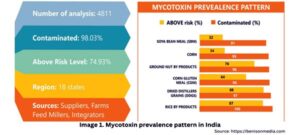
In India, tropical climates and high relative humidity create an ideal breeding ground for toxic Molds, a problem frequently compounded by suboptimal grain-storage practices. The most common threats found in Indian poultry operations include aflatoxins, fumonisins, T-2 toxin, and zearalenone. Diagnostic screening reveals that a remarkably high percentage of standard Indian poultry feed formulations contain at least one of these harmful compounds.
Core Biology: What Are Mycotoxins?
Molds produce mycotoxins as secondary defence metabolites when triggered by environmental stressors like drought, excessive moisture, or temperature extremes. Out of roughly 200 Mold species known to produce these toxins, the vast majority belong to just three main fungal genera:
- Aspergillus
- Penicillium
- Fusarium
While scientists have identified more than 500 distinct mycotoxins, only a select group poses a direct threat to poultry. Chronic exposure to low concentrations can be deceptively dangerous, gradually causing digestive upset, feed rejection, liver degradation, kidney damage (nephritis), severe immune suppression, and reproductive failure.
The Unique Challenges of Mycotoxins:
- Thermal and Chemical Resilience: They remain stable throughout harvesting, physical processing, and long-term storage.
- Pre- and Post-Harvest Vulnerability: Crops can become contaminated either while growing in the field or during subsequent storage.
- Synergistic Toxicity: Feeds often contain multiple toxins simultaneously, creating a combined effect that multiplies the damage to the bird’s immune system.
- Public Health Risks: Toxic residues can transfer directly to human consumers via meat and eggs.
Classification Systems
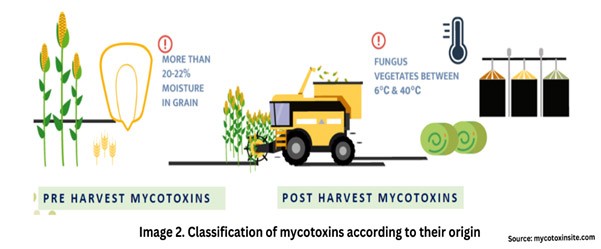
By Lifecycle Origin
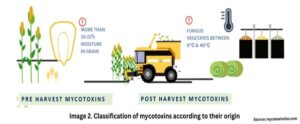
- Pre-Harvest Toxins: Generated by field fungi before the crop is harvested (e.g., DON, ZEN, fumonisin, and certain aflatoxins).
- Post-Harvest Toxins: Developed by storage fungi when grain moisture and temperature levels rise after harvest (e.g., ochratoxin and aflatoxin).
By Fungal Origin
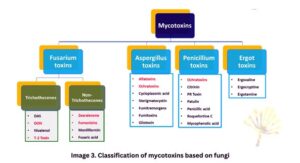
- Fusarium Toxins: Includes T-2 toxin, DON, fumonisin, and zearalenone.
- Aspergillus Toxins: Primarily aflatoxins and ochratoxins, which represent the most common threats in commercial poultry feeds.
- Penicillium Toxins: Primarily ochratoxins.
- Ergot Toxins: Alkaloids generated by the fungus Claviceps purpurea.
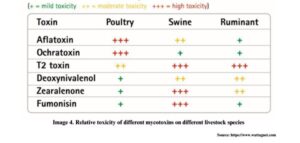
(Note: Although zearalenone is frequently detected in Indian raw materials, poultry naturally exhibit a higher biological tolerance to it compared to other livestock species.)
Clinical Impacts on Poultry Health
- Aflatoxins (Aflatoxicosis)
Aflatoxins are potent immune suppressors that primarily target the liver, thymus, and the bursa of Fabricius.
- Key Symptoms: Marked drops in daily feed consumption, poor weight gains, decreased egg production in layers, and falling hatchability rates in breeders.
- Pathology: Severe liver damage, increased susceptibility to secondary infections, leg weakness, and a stark reduction in vaccine-induced immunity.
- Ochratoxins
Ochratoxins are highly nephrotoxic, severely damaging the kidneys and disrupting glycogen storage in liver and muscle tissues.
- Key Symptoms: Pale, pathologically enlarged kidneys serve as a primary diagnostic indicator.
- Pathology: Stunted growth, poor eggshell quality, gizzard erosion, acute intestinal inflammation (catarrhal enteritis) in chicks, impaired nutrient absorption, and severe immunosuppression.
- Trichothecenes (T-2 Toxin, DON, DAS)
These compounds act as severe tissue irritants and disrupt cellular protein synthesis.
- Key Symptoms: Highly visible necrotic lesions inside the mouth and on the tongue.
- Pathology: Complete feed refusal, damaged intestinal villi leading to poor nutrient absorption, and rapid performance drops.
- Fumonisins
Fumonisins target cellular membranes and are typically linked to highly contaminated Fusarium corn batches.
- Key Symptoms: Severe diarrhoea and spikes in unexplained flock mortality.
- Pathology: Reduced body weight gains and structural enlargement of the gizzard.
- Modern Detection Methods
- Because mycotoxins are invisible and unevenly distributed in feed, farms and mills rely on two main diagnostic validation methods:
- Immunochemical Assays (ELISA)
- Overview: Enzyme-Linked Immunosorbent Assays are the most widely deployed, cost-effective screening tools available.
- Application: Commercial ELISA kits provide rapid, on-site testing for aflatoxins, DON, fumonisins, ochratoxins, and zearalenone.
- Chromatography and Mass Spectrometry
- Overview: High-Performance Liquid Chromatography (HPLC) and Gas Chromatography (GC) offer precise quantification but require specialized laboratory environments and high technical expertise.
- The Gold Standard: Liquid Chromatography-Mass Spectrometry (LC-MS) stands as the definitive industry benchmark for identifying complex, multi-toxin contamination profiles.
Proactive Control and Mitigation Strategies
Because completely eliminating mycotoxins from raw grains is virtually impossible, commercial feed operations must utilize a dual-action chemical and nutritional defense system.
- Fungal Inhibitors
Mold inhibitors are applied directly to feed ingredients to halt fungal growth and prevent new toxins from developing. However, they cannot neutralize or destroy mycotoxins that are already present in the grain.
- Organic Acids: These serve as the backbone of mold inhibition, with propionic, acetic, citric, sorbic, and benzoic acids being the most effective options.
- Supporting Agents: Compounds like ammonium hydroxide, copper oxine, gentian violet, and botanical essential oils are also widely used to suppress fungal activity.
- Advanced Toxin Binders (Adsorbents)
Incorporating broad-spectrum nutritional toxin binders directly into the mixer remains the most effective way to fight mycotoxicosis. These specialized agents act like a chemical sponge, binding tightly to mycotoxins within the bird’s digestive tract to prevent them from entering the bloodstream. They are an invaluable insurance policy when routine feed testing isn’t feasible.
- Mineral-Based Inorganics (Aluminosilicates): Highly researched mineral clays, including bentonite, montmorillonite, and zeolites, are exceptional at binding polar toxins like aflatoxins.
- Carbon Adsorbents: Activated charcoal provides a highly porous, non-specific binding surface.
- Organic Binders: Modified yeast cell wall extracts (rich in beta-glucans and glucomannans) and micronized plant fibers offer excellent protection against complex, non-polar toxins.
- Synthetic Polymers: Formulated macromolecules designed for targeted toxin capture.
5 Essential Criteria for Selecting a Toxin Binder
When choosing a commercial toxin binder, ensure it meets the following standards:
- Broad-Spectrum Efficiency: It must successfully adsorb both polar and non-polar mycotoxins across a wide range of molecular sizes.
- Nutritional Selectivity: The binder must target mycotoxins exclusively, without binding or depleting essential vitamins, trace minerals, or amino acids in the feed.
- pH Stability: The chemical bond must remain completely stable across the highly acidic environment of the gizzard and the alkaline environment of the lower intestines, ensuring the bound toxins are safely excreted.
- Absolute Safety: The compound must be completely non-toxic to the birds, leave no chemical residues in meat or eggs, and pose no hazards to the environment.
- Low-Level Efficacy: It must actively neutralize toxins even at low contamination levels, preventing the harmful compound effects that occur when multiple low-level toxins interact.
Conclusion
Mycotoxin contamination remains an inescapable reality for the global poultry supply chain. Because absolute prevention in raw ingredients is impossible under practical conditions, these hidden toxins present a constant threat to flock performance and farm profitability. Implementing a premium, broad-spectrum toxin binder into your standard feed formulation program remains the most effective, reliable defence strategy for safeguarding your birds and securing your bottom line.
Referances
- FAO. (2013). Poultry Development Review. Food and Agriculture Organization of the United Nations, Rome.
- FAO. (2020). Climate Change: Unpacking the Burden on Food Safety. Food and Agriculture Organization of the United Nations, Rome.
- BIOMIN. (2023). World Mycotoxin Survey Report. DSM-Biomin.
- Chalamacharla, R. B., Reddy, K. R. N., & Kumar, R. (2018). Prevalence of mycotoxins in poultry feed and feed ingredients in India: A review. Indian Journal of Poultry Science, 53(2), 121-132.
- Ramesh, J., & Balachandran, C. (2014). Survey of mycotoxins in poultry feed ingredients and finished feeds in Tamil Nadu, India. Journal of Veterinary Science & Technology, 5(4), 1-6.
- Bryden, W. L. (2012). Mycotoxins in the food chain: Human health implications. Asia Pacific Journal of Clinical Nutrition, 21(2), 277-283.
- Murugesan, G. R., Ledoux, D. R., Naehrer, K., Berthiller, F., Applegate, T. J., & Grenier, B. (2015). Prevalence and effects of mycotoxins on poultry health and performance, and bio-protection strategies. The Journal of Applied Poultry Research, 24(2), 236-249.
- Dhanasekaran, D., Shanmugapriya, S., Thajuddin, N., & Panneerselvam, A. (2011). Aflatoxins and ochratoxins in poultry disease. Aflatoxins-Biochemistry and Molecular Biology, 337-356.
- Anfossi, L., Giovannoli, C., & Baggiani, C. (2016). Mycotoxin detection by enzyme-linked immunosorbent assay: Updates and recent developments. Mycotoxin Research, 32(3), 115-126.
- Berthiller, F., Crews, C., Dall’Asta, C., Saeger, S. D., Haesaert, G., Karlovsky, P., … & Krska, R. (2013). Masked mycotoxins: A review. Molecular Nutrition & Food Research, 57(1), 165-186.
- Kihal, A., Rodriguez-Prado, M., & Calsamiglia, S. (2022). The efficacy of mycotoxin binders in reducing the toxicity of mycotoxins in livestock: An overview. Toxins, 14(7), 469.
- Vila-Donat, P., Marín, S., Ramos, A. J., & Sanchis, V. (2018). A review on mycotoxin adsorbents and treatments to reduce mycotoxin contamination in foods and feeds. Food Control, 90, 413-426.
| डॉ सागर डुकरे, पशुवैद्यकीय अधिकारी
पशुवैद्यकिय दवाखाना चौक, ता खालापूर जि रायगड MVSc & PhD (Poultry Science), MBA, MA, PGDRDA |