

THE SILENT HEALERS
Why India Must Recognise, Respect and Reward Its Veterinarians
A Landmark Judicial Recognition of a Profession That Serves Those Who Cannot Speak
There are some professions that can be understood only when we look beyond the walls of hospitals, clinics and cities.
Veterinary medicine is one such profession.
A veterinary doctor is not simply a doctor who treats animals. A veterinarian stands at the meeting point of animal health, human health, food security, rural livelihoods, agriculture, public health, disease control and national development.
Yet, despite this enormous responsibility, the contribution of veterinary doctors has often remained less visible than it deserves to be.
That is why the recent judgment of the Madhya Pradesh High Court deserves deep appreciation and careful reflection by governments, policymakers, civil society and the entire Indian society.
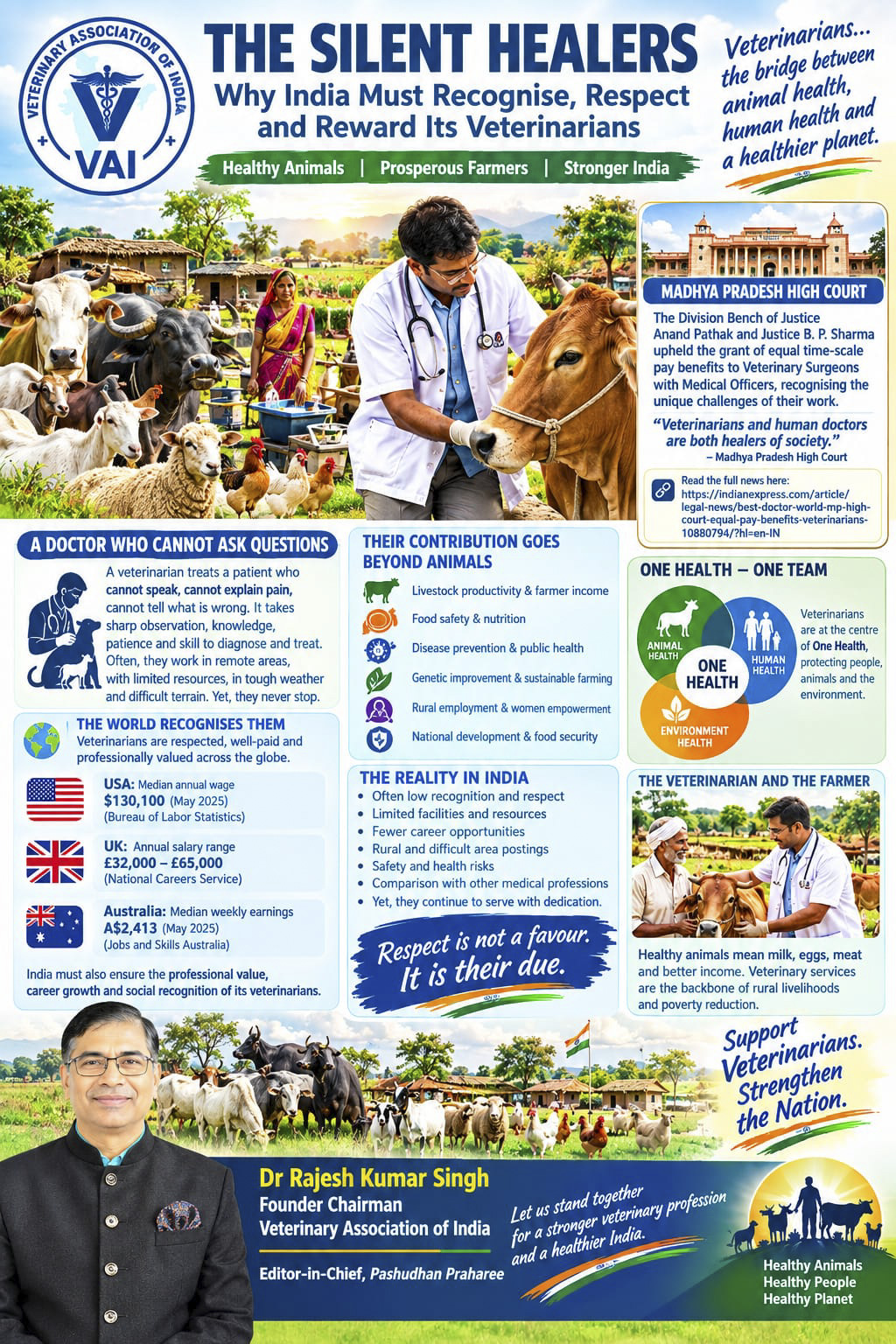
The Madhya Pradesh High Court, while dealing with the issue of time-scale pay benefits for veterinary surgeons, upheld the grant of equal time-scale pay benefits on par with medical officers. The Division Bench of Justice Anand Pathak and Justice B. P. Sharma also highlighted the difficult conditions in which veterinarians work, including remote areas, difficult terrain and adverse weather.
READ THE INDIAN EXPRESS REPORT ON THE JUDGMENT:
https://indianexpress.com/article/legal-news/best-doctor-world-mp-high-court-equal-pay-benefits-veterinarians-10880794/
More importantly, the Court recognised something that veterinary professionals have known for generations:
A veterinarian treats a patient who cannot tell the doctor where it hurts.
The Court referred to the famous words of American humourist Will Rogers, describing the veterinarian as the “best doctor in the world” because the veterinarian cannot ask the patient what is wrong and has to find out through observation, examination and professional judgement.
This observation by the Court is not merely a compliment. It is a powerful recognition of the special nature of veterinary medicine.
And it is time for India to listen.
A VETERINARIAN TREATS THE VOICELESS
Imagine a patient entering a hospital and saying:
“My chest hurts.”
“My stomach is painful.”
“I cannot breathe properly.”
A human doctor can ask questions. The patient can describe symptoms. The patient can point towards the place of pain.
But what happens when the patient is a cow, buffalo, goat, dog, horse, sheep or poultry bird?
The patient cannot speak.
The patient cannot explain.
The patient cannot answer a medical history questionnaire.
The veterinarian has to observe. The veterinarian has to listen. The veterinarian has to examine. The veterinarian has to understand behaviour.
The veterinarian has to study appetite, movement, breathing, temperature, pulse, rumination, dung, urine, milk production, posture and many other signs.
The veterinarian has to connect small clues to reach a diagnosis.
In many parts of India, there may be no laboratory nearby. Sometimes there is no X-ray, ultrasound, proper road, electricity or even a proper building.
Yet the veterinarian is expected to provide professional service.
This is the reality of veterinary medicine in large parts of India.
THE RURAL VETERINARIAN: A DOCTOR WITHOUT A HOSPITAL
Urban India often imagines healthcare through the picture of a modern hospital. But rural veterinary medicine is often very different.
A veterinary doctor may receive a call from a village late at night.
“Doctor Sahib, my buffalo is not eating.”
“My cow has stopped giving milk.”
“My goat is seriously ill.”
“My animal is having difficulty giving birth.”
“There is sudden death in my poultry flock.”
The veterinarian cannot simply say, “Bring the patient to the hospital.”
The patient may weigh hundreds of kilograms. The patient may be in a village several kilometres away. The road may be broken. The weather may be extreme.
The veterinarian has to travel.
Sometimes on a motorcycle. Sometimes in a government vehicle. Sometimes in an ordinary vehicle arranged locally. Sometimes the doctor has to walk.
The Madhya Pradesh High Court specifically recognised the fact that veterinarians may have to work in remote areas and difficult terrain and weather while treating animals that cannot communicate their problems.
That recognition should not end with a judgment. It should become a policy principle.
VETERINARY MEDICINE IS NOT A SECONDARY FORM OF MEDICINE
Human medicine is often seen as “medicine”. Veterinary medicine is sometimes treated as something secondary.
This thinking needs to change.
A veterinarian is a doctor. The patient is different. The responsibility is different. The working environment may be different.
But the professional responsibility to diagnose, treat, prevent disease and protect life is equally serious.
In fact, veterinary medicine carries responsibilities that extend beyond the individual animal.
When a veterinarian treats an animal, the benefits may reach an entire family.
A healthy buffalo may provide milk. A healthy cow may support a household. A healthy goat flock may provide income. Healthy poultry may support a farmer’s livelihood.
Disease control in animals can also protect human beings from diseases that can pass from animals to people.
Therefore, veterinary medicine is not only about animals.
Veterinary medicine is about people, families, communities, food and the future of the country.
THE VETERINARIAN AND THE POOR FARMER
For a wealthy family, an animal may be a companion. For a poor livestock-owning family, an animal can be an economic asset.
A cow can be a source of milk. A buffalo can be a source of regular income. A goat can be household savings. A group of sheep can represent years of hard work. A poultry flock can be a small business.
A healthy animal can mean food on the table. A sick animal can mean debt.
This is why veterinary services are closely connected with poverty reduction.
When a veterinarian prevents disease, improves reproduction, treats an animal, advises on nutrition or controls an outbreak, the doctor is not simply saving an animal.
The veterinarian may be protecting the income of a family.
This is national development at the grassroots level.
VETERINARY MEDICINE AND RURAL EMPLOYMENT
India’s livestock sector is one of the major pillars of the rural economy.
The Department of Animal Husbandry & Dairying reports that livestock accounted for 30.87% of agricultural GVA and 5.5% of India’s total GVA at current prices in 2023–24.
When livestock grows, rural India grows. When livestock productivity improves, farmers can earn more. When animal disease falls, losses fall.
The veterinary profession is directly connected with India’s economic development.
The veterinarian is one of the people standing between livestock disease and rural prosperity.
THE VETERINARIAN AND INDIA’S FOOD SECURITY
India’s food system depends heavily on agriculture and livestock.
Milk. Eggs. Meat. Other animal products.
The safety and quality of these products cannot be separated from animal health.
India is the world’s largest milk producer and ranks second in egg production and fourth in meat production, according to the Department of Animal Husbandry & Dairying.
Behind these achievements is an enormous network of farmers, livestock keepers, workers, scientists, entrepreneurs, technicians and veterinary professionals.
The veterinarian plays a critical role in this system through disease prevention, vaccination, diagnosis, treatment, breeding advice, herd health, farm biosecurity, food safety and disease surveillance.
ONE HEALTH: THE VETERINARIAN IS AT THE CENTRE
The modern world has moved towards an idea known as One Health.
The basic idea is simple: human health, animal health and environmental health are connected.
The World Health Organization describes One Health as an integrated approach connecting the health of people, animals and the environment. It is especially important for zoonotic diseases, food safety and antimicrobial resistance.
There can be no complete One Health system without strong veterinary services.
PROTECTING PEOPLE FROM DISEASES THAT COME FROM ANIMALS
Many diseases can pass between animals and humans. These are known as zoonotic diseases.
Rabies is a well-known example. Avian influenza is another. Food-borne infections provide another example.
Veterinarians work with animal owners, government departments, public health professionals and laboratories. They support disease surveillance, help identify outbreaks and advise on vaccination and control measures.
Thus, a veterinary doctor working in a village is also contributing to public health.
FOOD SAFETY BEGINS BEFORE FOOD REACHES THE KITCHEN
People often think that food safety starts in a kitchen. In reality, it begins much earlier.
It begins on the farm.
Healthy animals. Safe medicines. Responsible use of antibiotics. Disease control. Clean production systems. Safe milk. Safe meat. Safe eggs.
Veterinarians are involved at many points in that chain.
Therefore, when we respect veterinarians, we are also respecting the people who help protect the safety of the food we eat.
GENETICS, BREEDING AND THE FUTURE OF LIVESTOCK
Veterinary science is deeply connected with animal breeding and genetic improvement.
Healthy breeding programmes can improve productivity. Good genetic selection can improve disease resistance, production and efficiency.
Veterinary professionals contribute to reproductive health, breeding management, disease control and herd improvement.
The goal is not simply to produce more animals. The goal is to build healthier, more productive and sustainable livestock populations.
A DIFFICULT EDUCATION FOR A DIFFICULT PROFESSION
Becoming a veterinary doctor is not easy.
A veterinary student studies anatomy, physiology, biochemistry, pathology, pharmacology, microbiology, parasitology, medicine, surgery, reproduction, epidemiology, public health, nutrition, livestock production, poultry science, diagnostics and many other subjects.
But the difficulty does not end after graduation.
New diseases appear. New medicines become available. New diagnostic tools emerge. Climate change creates new risks. Antimicrobial resistance creates new challenges.
The veterinary doctor therefore remains a lifelong learner.
THE DIFFERENCE BETWEEN READING A CASE AND LIVING THE CASE
A textbook can teach a disease. A classroom can explain symptoms. A laboratory can demonstrate an organism.
But the village teaches another kind of medicine.
A veterinarian may have to look at an animal and decide what is wrong without a full medical history.
The animal cannot say:
“I ate something unusual yesterday.”
“I was bitten.”
“My stomach has been hurting.”
“I have difficulty breathing.”
The doctor must find the answer.
This requires observation, experience, patience, knowledge, clinical judgement and compassion.
THE WORLD RECOGNISES VETERINARY PROFESSIONALS
It is useful to look beyond India.
In the United States, the Bureau of Labor Statistics reported a median annual wage of $130,100 for veterinarians in May 2025.
In the United Kingdom, the National Careers Service lists an annual salary range of approximately £32,000 for starters to £65,000 for experienced vets.
In Australia, Jobs and Skills Australia reports median full-time earnings of A$2,413 per week for veterinarians in the cited 2025 data.
These figures cannot be directly treated as an India-versus-foreign-country salary comparison because living costs, taxes, currency, public and private employment systems and career structures differ.
But they demonstrate an important point: veterinary medicine is treated as a serious, skilled profession in major economies.
India should also ensure that the professional value, working conditions, career growth and social recognition of its veterinarians receive appropriate attention.
RESPECT MUST NOT BE MEASURED ONLY BY SALARY
Salary is important. Career progression is important. Promotion is important. Facilities are important. Safety is important. Training is important.
But respect is larger than salary.
A veterinarian wants society to understand the value of the work.
A veterinarian wants the government to recognise the responsibility attached to the job.
A veterinarian wants adequate tools to work effectively.
A veterinarian wants the same dignity that is associated with other highly trained medical professionals.
The demand is not for one profession to be placed above another. It is for veterinary medicine to be recognised according to its own professional responsibility and social value.
THE QUESTION INDIA MUST ASK
The recent Madhya Pradesh High Court judgment should make policymakers ask a larger question:
Are we giving veterinary professionals the professional recognition, career opportunities, working conditions and institutional support that their responsibilities require?
This is not a demand against human doctors.
Human doctors and veterinarians serve different patients. Both are healers. Both protect life. Both serve society.
The Court itself recognised both as “healers of society.”
GOVERNMENT MUST LOOK AT VETERINARY SERVICES AS AN INVESTMENT
Veterinary services should not be viewed merely as an administrative cost.
They are an investment in farmers, rural employment, food security, public health, disease prevention, women-led rural livelihoods, livestock productivity, national economic growth and resilient communities.
If livestock is an important economic sector, veterinary services supporting that sector must also receive appropriate institutional strength.
THE REMOTE VETERINARIAN DESERVES SPECIAL RECOGNITION
A government veterinary doctor posted in a remote area may face poor roads, long distances, limited medicines, limited diagnostic facilities, shortage of staff, limited equipment, emergency calls, difficult weather and animal-handling risks.
Yet these professionals continue.
They serve. They travel. They treat. They vaccinate. They educate. They investigate. They prevent outbreaks. They save animals.
And through those animals, they protect livelihoods.
Such service deserves recognition.
WHEN ONE ANIMAL MEANS ONE FAMILY’S FUTURE
For a large farmer, losing one animal may be manageable. For a small farmer, losing one productive animal can be a serious financial blow.
Imagine a poor family owning only two dairy animals.
One becomes seriously ill.
Milk production falls.
The family’s daily income falls.
The family may have to borrow money.
If the animal dies, the loss can be much greater.
A veterinary doctor who saves that animal may therefore be protecting the economic stability of the family.
This is why veterinary care should be understood as part of rural economic security.
WOMEN AND LIVESTOCK: AN OFTEN INVISIBLE CONNECTION
In many rural households, women are deeply involved in livestock care—feeding, milking, cleaning, calf care, poultry management and goat rearing.
Livestock income can contribute to household resilience and women’s economic participation.
Strengthening veterinary services can therefore have a wider social effect.
VETERINARY DOCTORS AND NATIONAL BUILDING
National building is not limited to roads, bridges, factories and technology.
National building also means healthy people, healthy animals, healthy food systems, strong rural economies, disease-free livestock, productive farmers, safe food, disease prevention and resilient communities.
Veterinarians contribute to every one of these areas.
The work may happen in a village far away from a major city.
But its value reaches every Indian household.
THE VETERINARIAN IS ALSO A TEACHER
A good veterinarian does more than prescribe medicine.
The veterinarian teaches the farmer how to feed an animal, maintain hygiene, vaccinate, recognise early signs of disease, maintain biosecurity, care for newborn animals and reduce losses.
The veterinarian transfers knowledge from science to the village.
THE VETERINARIAN IS ALSO A FIRST RESPONDER
During disease outbreaks, veterinarians often become the first line of defence.
They investigate, collect samples, advise farmers, support surveillance, recommend control measures, implement vaccination programmes and coordinate with authorities.
In some situations, their work can also protect human communities.
This is One Health in practice.
THE FUTURE NEEDS A STRONGER VETERINARY PROFESSION
India’s livestock sector is changing.
Dairy is becoming more organised. Poultry is becoming more scientific. Pet ownership is increasing. Animal-based food production is becoming more technology-driven. Veterinary diagnostics are improving. Genetics is developing. Digital veterinary care is emerging.
New diseases and climate-related risks are appearing.
All of this means that the role of veterinarians will become even more important.
The future needs better-supported veterinarians, better trained veterinarians, better equipped veterinarians and more respected veterinarians.
TO EVERY VETERINARIAN: YOU ARE NOT ALONE
To every veterinarian working in a metropolitan hospital: Your work matters.
To every veterinarian working in a district veterinary hospital: Your work matters.
To every veterinarian travelling from village to village: Your work matters.
To every veterinarian standing beside a sick cow at midnight: Your work matters.
To every veterinarian handling an emergency in a poultry farm: Your work matters.
To every veterinarian protecting a goat farmer’s livelihood: Your work matters.
To every veterinarian working with wildlife, research, public health, academia, laboratories, companion animals or livestock: Your work matters.
To every young veterinary student dreaming of serving animals: Your profession matters.
And to every retired veterinarian who spent decades serving society: Your contribution matters.
A MESSAGE FROM THE VETERINARY ASSOCIATION OF INDIA
As Founder Chairman of the Veterinary Association of India, I express my deepest appreciation to every veterinarian in India and across the world.
We may work in different countries. We may work in different institutions. We may treat different species. We may have different areas of specialisation.
But we share one professional identity.
We are veterinarians.
We are healers.
We are protectors of animal health.
We are partners in public health.
We are guardians of food safety.
We are supporters of farmers.
We are contributors to rural development.
We are important partners in One Health.
And we are contributors to nation building.
The time has come for us to recognise our collective strength.
UNITY DOES NOT MEAN UNIFORMITY
Veterinary professionals do not have to think alike on every issue.
But we must stand together on the fundamental dignity of our profession.
We must support professional excellence, promote ethical practice, encourage young veterinarians, support research, promote continuing education, strengthen veterinary public health and cooperate with policymakers and farmers.
And above all, we must maintain the highest standards of professional integrity.
LET THIS JUDGMENT BECOME A TURNING POINT
The Madhya Pradesh High Court has provided a powerful reminder of the special responsibilities carried by veterinarians.
It is now for society and governments to take that message forward.
A judgment can recognise a principle. Policy can implement it. Institutions can strengthen it. Society can give it dignity. Veterinarians themselves can turn it into a movement for professional excellence.
India needs to see the veterinarian differently.
The veterinarian standing in a remote village is serving India.
The veterinarian vaccinating animals is serving India.
The veterinarian preventing a disease outbreak is serving India.
The veterinarian protecting a dairy farmer’s animal is serving India.
The veterinarian protecting food safety is serving India.
The veterinarian controlling zoonotic disease is serving India.
The veterinarian improving livestock productivity is serving India.
The veterinarian training the next generation is serving India.
The veterinarian conducting research is serving India.
The veterinarian working with wildlife is serving India.
The veterinarian caring for a companion animal is serving society.
This contribution deserves visibility. It deserves institutional support. It deserves professional dignity. And it deserves respect.
A CALL FOR A CHANGE IN MINDSET
The time has come for the Government of India, State Governments, Animal Husbandry Departments, policymakers, civil society, media and the public to look at veterinary professionals with a new understanding.
Let us change the mindset.
Let us recognise that the health of animals is connected with the health of people.
Let us recognise that livestock is connected with rural income.
Let us recognise that food safety begins with animal health.
Let us recognise that disease prevention is better than disease control after an outbreak.
Let us recognise that veterinary doctors work under unique professional challenges.
Let us recognise that a doctor treating a patient who cannot speak needs exceptional clinical skill.
Let us recognise that remote service deserves special support.
Let us recognise that professional responsibility deserves professional dignity.
And let us recognise that respect for veterinarians is not a favour.
It is recognition of reality.
SALUTING THE VETERINARIANS OF INDIA AND THE WORLD
Today, I salute every veterinarian who has chosen this noble profession.
I salute the young veterinary student, the newly graduated veterinarian, the rural veterinary doctor, the government veterinary officer, the private practitioner, the academician, the researcher, the veterinary surgeon, the public health veterinarian, the poultry veterinarian, the dairy veterinarian, the equine veterinarian, the small animal practitioner, the wildlife veterinarian, the laboratory veterinarian and every veterinary professional who works quietly without seeking applause.
You may not always receive the recognition you deserve.
You may not always have the facilities you need.
You may not always receive the respect that should naturally accompany your responsibility.
But your contribution is real.
Your contribution is measurable.
Your contribution is essential.
And your profession matters.
THE WAY FORWARD
Let the recent judgment become more than a legal development.
Let it become a national conversation.
Let it encourage governments to strengthen veterinary services.
Let it encourage society to respect veterinary doctors.
Let it encourage farmers to value scientific veterinary care.
Let it encourage young people to take pride in veterinary medicine.
Let it encourage veterinarians to stand together.
Let it encourage all health professionals to work together under the One Health approach.
And let it remind India of one simple truth:
A healthy nation needs healthy animals, healthy food systems and healthy communities.
And behind all three stands the veterinarian.
THE SILENT HEALERS MUST NO LONGER REMAIN INVISIBLE
The Madhya Pradesh High Court has reminded us of something that should never have been forgotten.
A veterinarian treats a patient who cannot speak.
A veterinarian often works where facilities are limited.
A veterinarian may travel where roads are difficult.
A veterinarian may work in heat, rain, cold and difficult terrain.
A veterinarian protects animals.
A veterinarian protects farmers.
A veterinarian contributes to food security.
A veterinarian supports rural income.
A veterinarian helps control diseases.
A veterinarian contributes to One Health.
A veterinarian contributes to national building.
The veterinarian is therefore not merely an “animal doctor”.
The veterinarian is a doctor of animal health, a partner in public health, a protector of livelihoods and an important guardian of national health and food security.
The recent judgment deserves our deepest respect because it has brought this truth into the public conversation.
But the real work begins now.
Government must recognise it.
Society must understand it.
Civil society must support it.
The media must communicate it.
And veterinarians themselves must unite to strengthen it.
Let us build a future in which no veterinary doctor feels that his or her profession is treated as less important.
Let us build a future in which a veterinarian serving in a remote village receives the professional dignity that the responsibility deserves.
Let us build a future in which veterinary hospitals have the staff, equipment, medicines and technology required for modern care.
Let us build a future in which veterinary professionals have fair career opportunities.
Let us build a future in which the contribution of veterinarians is understood by every farmer and every policymaker.
And let us build a future in which the words “Veterinary Doctor” are spoken with the respect, pride and dignity that they deserve.
Because behind every healthy animal there may be a healthy family.
Behind every healthy livestock farm there may be a farmer’s livelihood.
Behind every safe animal product there may be a veterinary professional.
Behind every successful disease-control programme there may be a veterinarian.
And behind a strong One Health system there must be a strong veterinary profession.
TO ALL VETERINARIANS OF INDIA AND THE WORLD
Stand together. Serve with pride. Learn continuously. Protect animal health. Support farmers. Protect public health. Strengthen One Health. And continue to build the nation through your profession.
The silent healers have always been serving society.
It is now time for society to hear their voice.
A FINAL TRIBUTE
With deep respect and gratitude to every veterinarian who has dedicated his or her life to serving animals, farmers, communities and humanity.
Your patients may not be able to speak.
But your work speaks for you.
Your patients may not be able to thank you.
But society benefits from your service.
Your work may sometimes remain invisible.
But its impact is everywhere.
Long live the spirit of veterinary service.
Long live the dignity of the veterinary profession.
And long live the commitment of veterinarians to One Health and nation building.
Dr Rajesh Kumar Singh
Founder Chairman, Veterinary Association of India
Editor-in-Chief, Pashudhan Praharee
KEY SOURCES
- Indian Express report on the Madhya Pradesh High Court judgment:
https://indianexpress.com/article/legal-news/best-doctor-world-mp-high-court-equal-pay-benefits-veterinarians-10880794/
- High Court of Madhya Pradesh – official Judgements portal:
https://www.mphc.gov.in/judgements
- Department of Animal Husbandry & Dairying, Government of India:
https://www.dahd.gov.in/
- World Health Organization – One Health:
https://www.who.int/news-room/questions-and-answers/item/one-health
- U.S. Bureau of Labor Statistics – Veterinarians:
https://www.bls.gov/ooh/healthcare/veterinarians.htm
- UK National Careers Service – Vet:
https://nationalcareers.service.gov.uk/job-profiles/vet
- Jobs and Skills Australia – Veterinarians:
https://www.jobsandskills.gov.au/data/occupation-and-industry-profiles/occupations-anzsco/2347-veterinarians