

Infertility in Bovine : Causes, management and treatment
DR NEETA SONI, VETERINARY ASSISTANT SURGEON
GOVT OF CHHATTISGARH
Infertility in bovines is a major challenge in livestock production, often caused by nutritional deficiencies, infections, poor management, or congenital abnormalities. Infertility in bovines is a significant challenge in livestock production, leading to economic losses due to reduced milk yield, longer calving intervals, and poor herd productivity Effective control requires a combination of understanding the causes,proper diagnosis, timely implementing treatment, and improved & sound herd management practices.
🔍 Causes of Infertility in Bovines
Disturbances of the bovine estrous cycle: Anestrus
- Cattle are deemed infertile when they are neither normally fertile nor completely sterile.
- Anestrus is considered a problem when cows are not seen in heat.
- Failure to observe heat and heat detection must always be ruled out as the primary problem.
- Pregnancy can be a prominent cause of anestrus and must always be a always be a prime rule out before anything else.
- Rule out true anestrus by palpating the ovaries.
- Anoestrous cows have small, flaccid uteri and small, inactive ovaries with no palpable corpus luteum or follicle.
- Cycling cows are identified by the size and tone of the uterus and the presence of the corpus luteum or follicle or both on either of the ovaries.
- Graafian follicle development and maturation,
- oestrus onset,
- successful coitus,
- ovulation,
- fertilization,
- implantation, and
The development and delivery of the foetus and its membranes
Anything interfering with these routines, such as
- diseases,
- poor nutrition,
- inadequate herd management,
- hereditary and congenital factors,
- hormonal disturbances or environmental changes,
- makes the animal infertile, only temporarily
Nutritional Factors
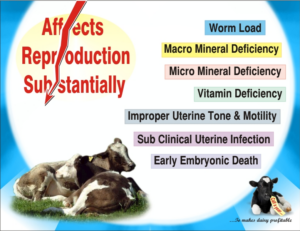
- Deficiency of energy, protein, minerals (phosphorus, copper, zinc), and vitamins
(A, D, E)
| q Vitamins and minerals are often suspected in infertility and anestrus,
q Carotene is needed by the CL. If it is low the cow may have low progesterone and irregular cycles. q Copper requirements are 10 ppm. Less than that may cause anestrus. q A cobalt deficiency may cause a delayed first estrus and irregular heats. q Mn requirements are 40 ppm. Less than this may cause anestrus or irregular heats. q Phosphorus Experimentally low levels also delayed puberty in heifers. |
|
| q Nutritional anestrus in the most common problem in cows.
q In the postpartum cow, lactation causes a negative energy balance. q More common in first calf heifers
|
|
- Infectious Causes
- Brucellosis, leptospirosis, campylobacteriosis, trichomoniasis.
- Endometritis and metritis due to bacterial contamination post-calving.
- Congenital/Genetic Abnormalities
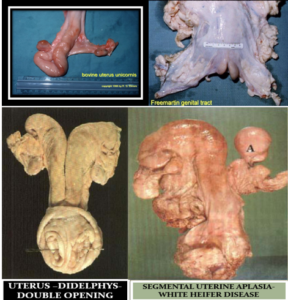
- Developmental abnormalities of the ovaries, oviducts, uterus, cervix, vagina and vulva.
- Ovarian (gonadal) hypoplasia and Aplasia,
| OVARIAN HYPOPLASIA
q It is not easy to diagnose. q In bilateral ovarian hypoplasia heifers do not develop secondary sexual characteristics. q They are anoestrus and infertile. q In unilateral, normal sexual organs and oestrous activity may be observed. q Such animals are fertile, although less so than normal. OVARIAN APLASIA & HYPERPLASIA — This is a rare condition when one or both ovaries are absent. — It is caused when the gonadal ridge does not form correctly. — Palpation is the best diagnostic method. — There may be partial aplasia, when only one ovary does not form. — In ovarian hypoplasia, one or both ovaries are smaller than normal. — You must ruleout true anestrus. — Again, there may be partial hypoplasia with this condition. |
- Anomalies of the tubular genitalia,
- Hermaphrodites,
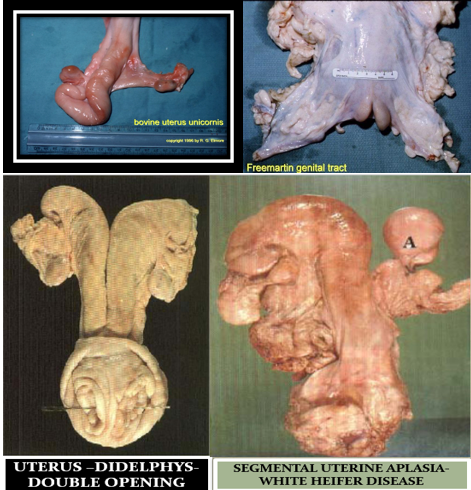
- Arrested development of the Mullerian ducts (White heifer disease)
- Double cervix
- Freemartin—failure of reproductive tract to develop.
| — A freemartin is a heifer born twin to bull. 90% are sterile
— Freemartins occurs when a female twin shares the uterus with a male. — The placental membranes connect the fetus to the dam are shared, and the placental fluids are exchanged between the two fetuses. — The exchange of fluid and blood between the two calves mixes the antigens responsible for carrying the unique sex characteristics of each calf. — The twins develop with sex characteristics of both the male and female. — MIF (Müllerian inhibition factor) from the male cells prevents Müllerian duct formation, so no uterus forms. Clinical Signs — Female always sterile — These animals often have a masculine steer-like appearance. — They may have a small vulva and long vulvar hairs. — No uterus — These animals have no ovaries, uterus, or vagina. — External signs are a bunch of hair at vulva, Diagnosis — The ‘test tube test’ checks the vaginal depth by using a test tube. — In normal animals you can insert a test tube 12-18 cm. — In abnormal heifers the tube will only go about 7.5 cm into the vagina. This test is only for young heifers, and age can play a big role in how deep the vagina is. |
- Closed cervix or blocked oviduct.
- Infantile reproductive tracts.
Hormonal/Functional Disorders
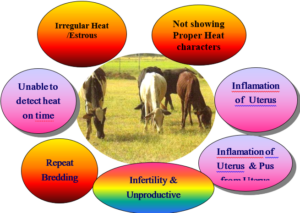
- Anestrus (failure to show heat).
- Repeat breeding syndrome.
- Ovarian cysts and adhesions.
- Management Issues
- Improper heat detection.
- Poor artificial insemination (AI) techniques.
- Stress due to overcrowding, poor housing, or climate extremes.
| SEASONAL ANESTRUS
• Daylight length (photoperiod) influences fertility in Brahman breeds, but there is no seasonal anestrus in cattle. • Summer heat stress, when the THI (Temperature Humidity Index) combined effects of heat and humidity produce a high “apparent temperature. • Estrous cycle is longer and the estrus duration is shorter and estrus intensity is less. • Anestrus may not really occur here, but since estrus is harder to detect, it may appear so. |
💊 Treatment Approaches
- Hormonal Therapy
Gonadotropin-Releasing Hormone (GnRH): This hormone stimulates the release of LH and FSH, inducing ovulation of mature follicles. It is a preferred treatment for follicular cysts and is often administered at the time of artificial insemination (AI) to improve conception rates, especially in repeat breeder cows.
Prostaglandin (PGF2): These are potent luteolytic agents that cause the regression of a functional corpus luteum (CL). They are essential for bringing “silent heaters” into observable estrus and for treating luteal cysts or chronic uterine infections like pyometra.
Progesterone (P4): Administered via intravaginal devices like CIDRs or PRIDs, progesterone provides “priming” that mimics the natural luteal phase. This helps initiate cycling in anestrous cows and supports early pregnancy by reducing embryonic mortality.
Key Treatment Protocols
Hormones are most effective when used in structured sequences:
- Ovsynch:This standard protocol involves an initial GnRH injection (Day 0) to synchronize follicular growth, followed by PGF2 (Day 7) to regress the CL, and a final GnRH dose (Day 9) to trigger timed ovulation. This allows for Timed Artificial Insemination (TAI) without the need for heat detection.
The Standard Ovsynch Timeline
The basic protocol involves three hormonal injections scheduled over a specific period, utilizing Gonadotropin-releasing hormone (GnRH) and Prostaglandin F2The Standard Ovsynch Timeline
The basic protocol involves three hormonal injections scheduled over a specific period, utilizing Gonadotropin-releasing hormone (GnRH) and Prostaglandin F2 alpha (PGF2α)
| Day | Hormone | Dose | Action |
| 0 | First GnRH Injection | 2.5 ml IM | This induces ovulation of any existing mature follicle and starts a new follicular wave |
| 7 | PGF2α Injection | 2 ml IM | This causes regression of the corpus luteum (CL), allowing a new dominant follicle to mature. |
| 9 | Second GnRH Injection | 2.5 ml IM | This triggers a synchronized surge of LH to induce ovulation of the new follicle. |
| 10 | Insemination | Perform Artificial Insemination (AI) approximately 16 hours after the second GnRH injection | |
Modified “Ovsynch-56” for Better Results
Research suggests that a 56-hour window between the PGF2α and the second GnRH shot often yields higher conception rates.
| Day | Hormone | Dose | Action |
| 0 | First GnRH Injection | 2.5 ml IM | This induces ovulation of any existing mature follicle and starts a new follicular wave |
| 7 | PGF2α Injection | 2 ml IM | This causes regression of the corpus luteum (CL), allowing a new dominant follicle to mature. |
| 9.5 | Second GnRH Injection | 2.5 ml IM | Administered 56 hours after PGF2α |
| 10 | Insemination | Perform Artificial Insemination (AI) approximately 16 hours after the second GnRH injection | |
Note: For some high-producing dairy cows, a second PGF2α shot, such as 24 hours after the first, may improve CL regression and pregnancy rates.
- Cystic Ovary Management:Treatment typically begins with GnRH or Human Chorionic Gonadotropin (hCG) to luteinize the cyst, followed by a PGF2 injection 7–10 days later to induce estrus. Adding a progesterone device to this regimen can increase pregnancy rates to approximately 57%.
- Acyclicity (Anestrus):For cows not showing signs of heat, combined treatments of progesterone (CIDR) and GnRH are used to “jump-start” the ovarian activity, often followed by PGF2at device removal.While hormonal treatments are highly effective, their success depends heavily on the animal’s Body Condition Score (BCS) and overall nutritional health.
Antibiotic Therapy
- Intrauterine or systemic antibiotics for uterine infections.
- Nutritional Correction
- Balanced ration with adequate minerals and vitamins.
- Supplementation of trace elements like selenium and zinc.
- Surgical/Manual Intervention
- Correction of adhesions or physical abnormalities.
- Immunotherapy
- Emerging approaches to treat immunoinfertility by modulating immune responses in the reproductive tract.
🐄 Management & Control Strategies
Heat Detection
- Regular observation (3–4 times daily).
- Use of aids like pedometers, tail paint, or activity monitors.
- Artificial Insemination
- Proper timing (mid-estrus).
- Skilled technicians and quality semen.
Postpartum Care
- Timely treatment of retained placenta and uterine infections.
- Adequate rest period before breeding.
- Biosecurity
- Vaccination against reproductive diseases (brucellosis, leptospirosis).
- Isolation of infected animals.
- Record Keeping
- Maintaining breeding, calving, and treatment records for herd monitoring.
- Stress Reduction
- Proper housing, ventilation, and minimizing handling stress.
📊 Comparison Table
| Cause | Treatment | Management |
| Nutritional deficiency | Mineral/vitamin supplementation | Balanced ration, regular monitoring |
| Infectious diseases | Antibiotics, vaccination | Biosecurity, isolation, herd vaccination |
| Hormonal disorders | Hormonal therapy (GnRH, PGF2α) | Estrus synchronization programs |
| Congenital anomalies | Limited (often culling) | Genetic selection, avoid twin breeding |
| Poor management | Training, improved AI techniques | Record keeping, heat detection aids |
⚠️ Risks & Challenges
- Overuse of hormones may cause resistance or reduced fertility.
- Mismanagement of antibiotics can lead to antimicrobial resistance.
- Ignoring subclinical infections often results in repeat breeding.
- Economic losses due to reduced milk yield and calving intervals.
In summary (Key Takeaway) :
Infertility in bovines is multifactorial, requiring early diagnosis, targeted treatment, and strong herd management practices. Farmers in India, including Chhattisgarh, should focus on nutrition, disease control, and proper AI techniques to reduce infertility rates and improve productivity. By combining scientific interventions with practical management, sustainable livestock production can be achieved.