

Homeopathic management of Canine Oral Papillomas: A Successful Clinical Case study
Dr Boda Swathi1and Dr. Bala Krishna Chavan2
Dr Boda Swathi1
Assistant Professor
Department of Veterinary Clinical Complex
College of Veterinary Science, Rajendranagar,PVNRTVU.,Hyderabad
Corresponding author
Dr. Bala Krishna Chavan2, Veterinary Assistant Surgeon, Govt. of Telangana
Chavanbalu.leo@gmail.com
Abstract
Canine Oral Papilloma(COP) in dogs characterised by progressively rapid growing masses especially mucocutaneous areas, a cosmetic and debilitating warts condition. This case study presents a 2year-6months old male dog, weighing 13kg suffering from numerous warts like growths around mouth including commissures and tongue, difficulty in mastication, anorexia and rapidly spreading warts towards tongue and oral cavity over a period of 2 months. Instituting combination of homeopathic medicines include Thuja occidentalis 200c drops applied twice daily on the lesions, Antimonium crudum 200c given 5drops directly on tongue once a day and Nitricum acidum 200c given 5 drops twice a day directly on the tongue for a period of 30days resulted in clinical recovery of the dog from COP. Though there was no marked response in the first week of treatment, the appetite restored and no new growths were observed. Complete disappearance of growths noticed by 30th day of treatment. There was no side effects and no reccurence noticed over a review period of one year. Hence, this report emphasising on use of homeopathic medicines as a promising option for managing canine oral papilloma where allopathic vaccume exists and current therapeutic options remain limited.
Keywords
canine oral papilloma, warts, homeopathic, Thuja occidentalis , Antimonium crudum and Nitricum acidum
Introduction
Papillomas or warts in dogs are the benign growths caused by the canine papillomavirus (CPV). They appear as growths, masses on the lips and muzzle, typically with a cauliflower-like appearance (Reiter, 2019). The Papillomavirus is a double stranded DNA virus that has special affinity towards the cutaneous squamous or mucosal epi thelium [Gross et al 2008]. There are a group of eight viruses, which are representing as canine papilloma virus (CPV) CPV-1 to CPV-8. Among these viruses, CPV-1 is responsible for causing canine oral papillomato sis in young dogs [Lange and Favrot 2011]. Papillomas on the oral mucosa inferring with swallowing is of major concern and signs are seen when the growths interfere with prehension, mastication, or swallowing (Reiter, 2019).
The present study was planned to evaluate the therapeutic use of homeopathic combinations – topical Thuja occidentalis and oral antimonium crudum and Nitricum acidum for resolution of warts. Papillomas have a pathognomonic presentation in their exophytic and cauliflower like morphology, and as a result, can be diagnosed clinically [Sancak et al 2015]. Since the papilloma is so obvious in its appearance, diagnosis is accomplished without laboratory testing in young dogs [Lange and Favrot 2011]. Homeopathy as an alternative therapy at affordable prices is becoming increasingly popular in human as well as veterinary medicine in developing countries, during the fight against anti microbial resistance (AMR).
CASE HISTORY &CLINICAL EXAMINATION
This case study presents a 2year-6months old male dog, weighing 13kg suffering from numerous growths around mouth including commissures and tongue, difficulty in mastication, anorexia with rapidly spreading growths over a period of 2 months.
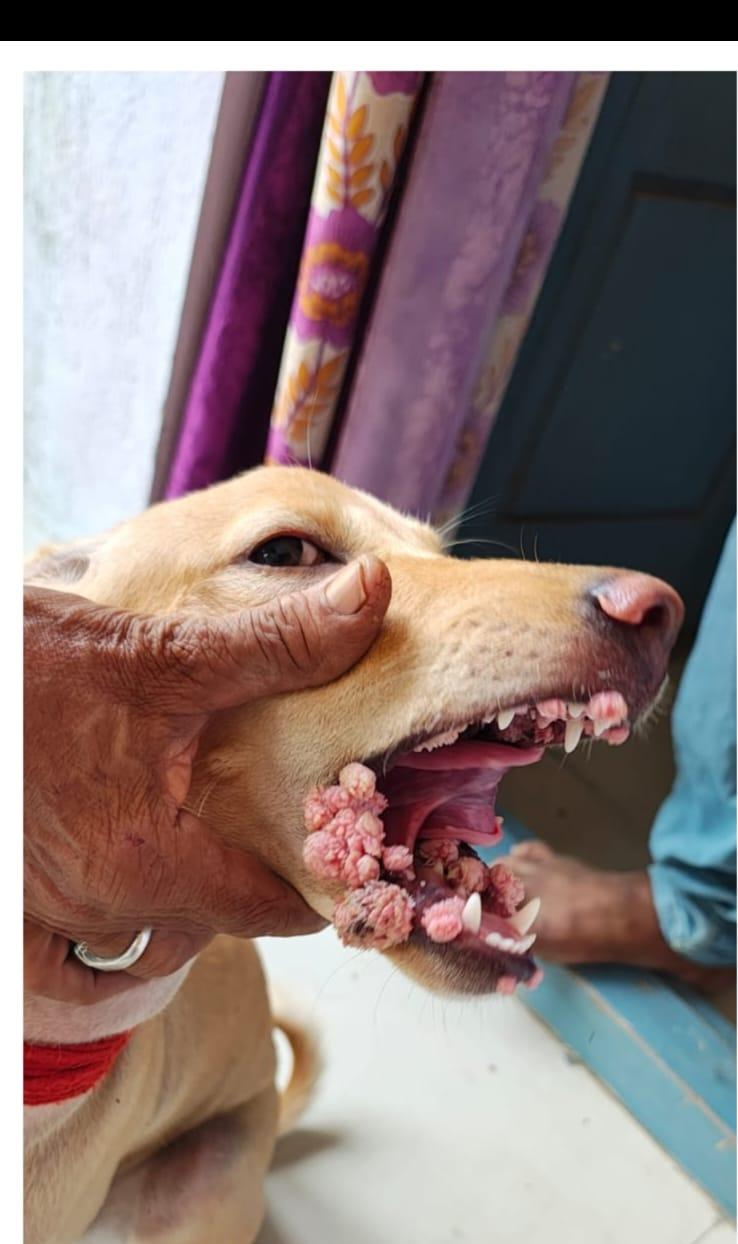
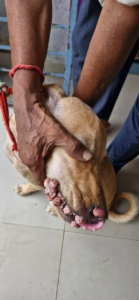
Clinical examination of dog revealed almost normal physiological activity, body temperature, heart rate and respiration rate. Oral examination revealed numerous papillomatous growths protruding from the surface of oral mucous membranes. Papilloma noticed as hard, cauliflower-like growth/warts of varied sizes (Fig. 1 and 2). Warts were grossly grayish-white and pink in color (Hemanth et al 2023) having rounded rough surface.
 |
 |
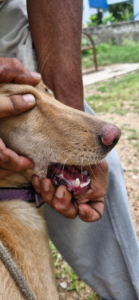 |
| Proliferating masses noticed on the day of presentation | Warts spreading on to the tongue | Regression of warts by day 30th |
TREATMENT &DISCUSSION
The client was clearly educated about the exact strength of homeopathic medicines and proper administration like strict placement of drops on tongue of the dog for better therapeuatic outcome. Treatment was started with Thuja occidentalis 200c drops to be applied twice daily on the lesions, Antimonium crudum 200c given 5drops directly on tongue once a day and Nitricum acidum 200c given 5 drops twice a day directly on the tongue for a period of 30days.
Though the response was not so marked on first week of therapy, there was no new growths noticed with restoration of better appetite for the dog. Further, macroscopically, the regressing papillomatous lesions darkens in colour and becomes dryer, fingers of papilloma open and lesions shrink, over the course of treatment with complete resolution by 30th day of therapy (Fig.3). As of one year post-treatment, the warts remain completely resolved and no new lesions have formed. No adverse effects during after treatment were noted.
Many authors (Hemanth et al 2023; Kumar and Debroy 2022; Raj et al 2020) supports the evidence of the antiviral activity and therapeutic value of Thuja occidentalis and Nitricum acidumin treating COP. It has been proved that Thuja occidentalis) has immunomodulatory and antiviral properties which cause B and T lymphocyte proliferation and differentiation into CD4+ cells and induces production of interleukin (IL)-2, IL-1, IL-6, tumor necrosis factor-α, and interferon-γ production in vitro and in vivo (Raj et al., 2020).
Our findings are compatible with some authors in the use of Thuja occidentalis to the papillomatosis treatment (Raj et al 2020 ; Kumar And Debroy 2022). Likewise, Jibachha et al 2025 have stated the use of different combinations of homeopathy drugs against canine oral papilloma. As Agnihotri et al. (2005) reported that treating canine oral papilloma with Thuja alone for 2 months was not effective, a combination was followed in our case study. In animals, diluted nitric acid (33.4%) produced erythematous reaction in 15 to 45 min. Nitric acid is a caustic and causes the destruction of tissue by tissue denaturation; therefore, they are used in treatment of hyperkeratosis or hyperplastic tissue (Parasuraman, 2016). Nitricum acidum could be used on large warts with jagged border which bleeds on washing (Boericke, 2011).
Conclusion
The result of this investigation proves that the combination of homeopathic drugs Thuja occidentalis , antimonium crudum and Nitricum acidum offers an attractive, non-invasive and most economical way of treating canine oral papillomas. Further, there is a need for comprehensive studies to evaluate mechanism of actions of homeopathic drugs in the field of veterinary medicine and to standardise protocols in the era of fighting against antimicrobial resistance.
Conflict of Interest
The authors declare that they do not have any conflict of interest.
References
- Lange CE, Favrot C. Canine papillomaviruses. Vet Clin North Am Small Anim Pract.2011;41(6):1183–1195.
- Gross TL, Ihrke PJ, Walder EJ, Affolter VK. Skin Diseases of the Dog and Cat: Clinical and Histopathologic Diagnosis.2nd ed. Ames, Iowa: Wiley-Blackwell; 2008. p. 406–410.
- Sancak A, Favrot C, Geisseler MD, Müller M, Lange CE. Antibody titres against canine papillomavirus 1 peak around clinical regression in naturally occurring oral papillomatosis. Vet Dermatol.2015;26(1):57–59, e19–e20. doi:10.1111/vde.12189.
- Agnihotri D, Kushwah M, Kumar T, Kumar P, Kumar A, Srikant N, Sindhu N. Successful therapeutic management of a case of canine papillomatosis. Haryana Vet.2015;54(1):79–80.
- Parasuraman S. Effect of nitric acid on cutaneous and plantar warts: a case report. J Young Pharm.2016;8(2):159–160.
- Raj PAA, Pavulraj S, Kumar MA, Sangeetha S, Shamugapriya R, Sabithabanu S. Therapeutic evaluation of homeopathic treatment for canine oral papillomatosis. Vet World.2020;13(1):206–213.
- Kumar M, Debroy B. Therapeutic management of canine oral papilloma (COP) using Thuja occidentalis. Indian J Vet Med.2022;42(2):86–87.
- Hemanth Gowda K, Nagaraju N, Ashwini A. Therapeutic evaluation of homeopathic complex for canine oral papillomatosis. J Bio Innov.2023;12(2):255–259. doi:10.46344/JBINO.2023.v12i02.03.
- Jibachha S, Kumar SP, Kumari SJ. Successful management of canine oral papillomatosis using homeopathic combination therapy: a field case report. Int J Recent Adv Multidiscip Res.2025;12(12):11970–11972.
- Boericke W. Boericke’s New Manual of Homoeopathic Materia Medica with Repertory.New Delhi: B. Jain Publishers (P) Ltd.; 2011.
- Reiter AM. Oral cavity disorders in dogs. In: Merck Veterinary Manual.Kenilworth, NJ: Merck Sharp & Dohme Corp.; 2019.