


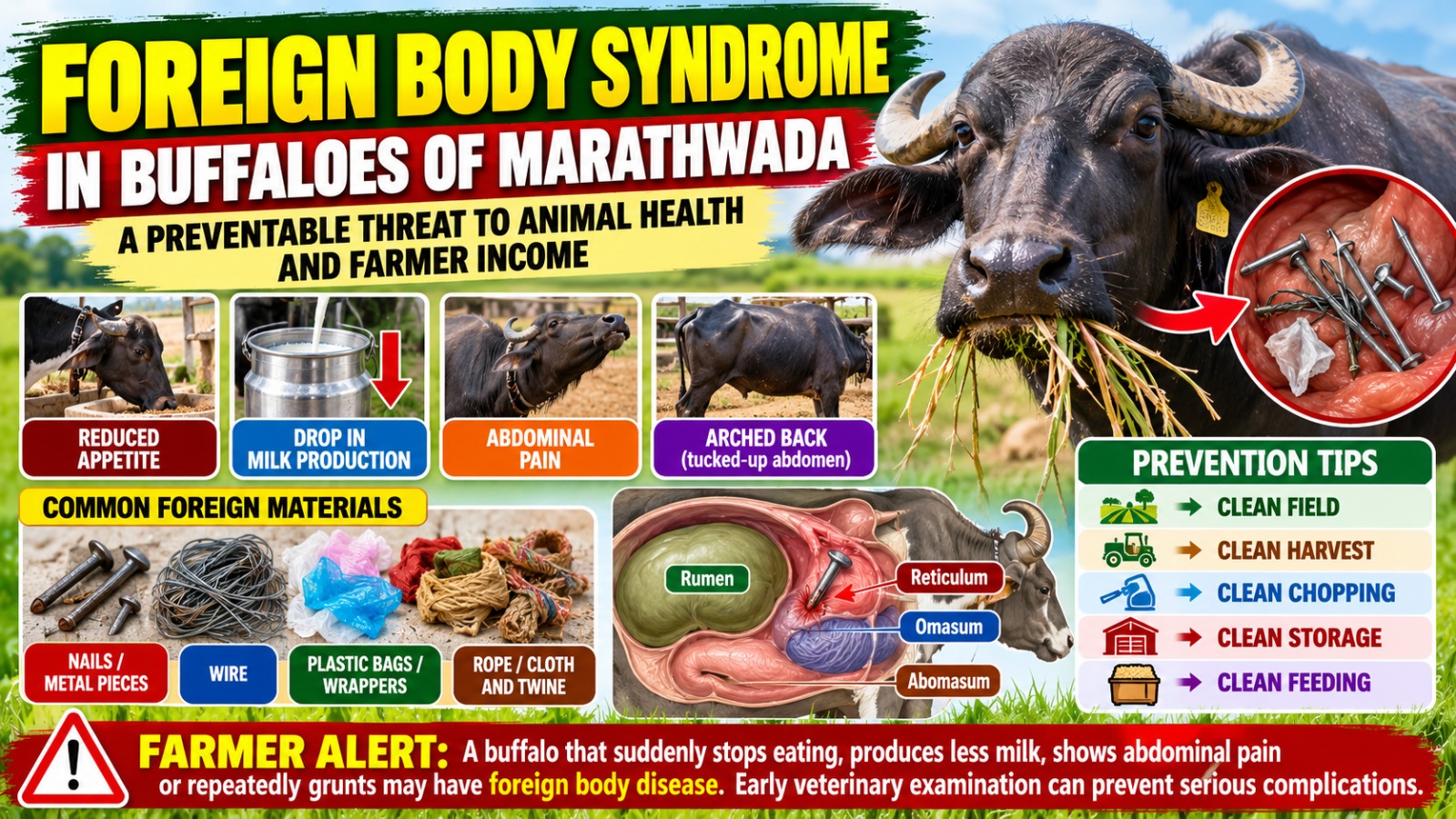
FOREIGN BODY SYNDROME IN BUFFALOES OF MARATHWADA: A PREVENTABLE THREAT TO ANIMAL HEALTH AND FARMER INCOME
Dr. Supreetkumar Sagar, M.V.Sc., NET, PGDAW1 and Dr. Sanjeev S. Pitlawar, M.V.Sc., PhD, PGDAW2
1: Veterinary Surgeon (Gold medalist), ALUMNUS, College of Veterinary and Animal Sciences, Udgir, Maharashtra Animal & Fishery Sciences University, Nagpur
2: Associate Professor and Sectional Head, Department of Veterinary Surgery and Radiology, College of Veterinary and Animal Sciences, Udgir, Maharashtra Animal & Fishery Sciences University, Nagpur
| FARMER ALERT: A buffalo that suddenly stops eating, produces less milk, shows abdominal pain or repeatedly grunts may have foreign body disease. Early veterinary examination can prevent serious complications and economic loss. |
Why Should Marathwada Farmers Be Concerned?
Foreign body syndrome is an important and largely preventable problem of adult buffaloes and cattle. Buffaloes may accidentally swallow metallic objects such as nails and pieces of wire along with feed, as well as non-metallic materials such as plastic, rope, cloth and other waste. Sharp metallic objects may penetrate the reticulum and cause traumatic reticuloperitonitis (TRP), commonly called hardware disease. Non-penetrating materials can accumulate in the rumen and interfere with normal rumen function.
The Marathwadi buffalo is an important indigenous buffalo type of the Marathwada region, particularly associated with Parbhani, Nanded, Beed, Hingoli and Latur. The breed is commonly maintained under relatively low-input systems, with grazing and crop residues forming important components of feeding. These conditions make careful inspection of grazing areas, fodder and feed particularly important.
What Is Foreign Body Syndrome?
Foreign body syndrome is a general term for disease caused by ingestion and accumulation of unwanted materials in the digestive tract. The most important forms in buffaloes are:
| Type | Common examples | Possible problem |
| Sharp metallic | Nails, wire, metal pieces | Reticular penetration and traumatic reticuloperitonitis |
| Non-metallic | Plastic bags, wrappers, rope, cloth | Rumen impaction and poor rumen function |
| Mixed waste | Plastic + wire + other refuse | Impaction, inflammation or penetration |
Why Do Buffaloes Swallow Foreign Objects?
- Fodder contaminated with nails, wire or metal fragments
- Plastic bags, wrappers and polythene mixed with fodder
- Discarded ropes, cloth and twine
- Feed or crop residues placed on contaminated ground
- Roadside or garbage-area grazing
- Improper disposal of farm waste around cattle sheds
- Metal fragments introduced during fodder processing or repair work
- The soil of this region is phosphorus deficient.
Marathwada Extension Message: Know Your Feeding System
Regional studies describe grazing plus stall feeding as common buffalo-management practices, while sorghum and other crop residues are important feed resources. Research in Parbhani has also documented the use of green fodder, dry fodder and concentrates. Therefore, foreign-body prevention should begin when fodder is harvested, transported and stored—not only after the animal becomes sick.
| EXTENSION TIP: “Before the buffalo eats the fodder, the farmer should inspect the fodder.” This one-minute habit can prevent a costly disease. |
Clinical Signs Farmers Should Recognize
- Sudden or gradual reduction in feed intake
- Drop in milk production
- Reduced rumen movements
- Poor body condition or gradual weight loss
- Abdominal pain or reluctance to move
- Arched back or tucked-up abdomen
- Grunting with movement or abdominal pressure
- Fever in some cases
- Reduced rumen fill and poorly digested faeces
- Recurrent mild bloat or digestive disturbance
- Chronic cases with vague signs and progressive loss of production
A Simple Farmer Rule
“Milk down + appetite down + pain = think foreign body.” A sudden fall in milk yield accompanied by reduced appetite and abdominal pain should not be dismissed as ordinary indigestion. Foreign body disease is one of several possible causes and requires veterinary examination.
Diagnosis
Veterinarians combine history and clinical examination with appropriate diagnostic tests. Withers pinch, xiphoid pressure and abdominal percussion may provide supportive information, but a negative field test does not completely rule out traumatic reticuloperitonitis.
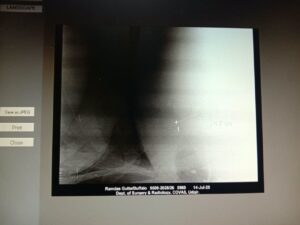
- Radiography: useful for detecting metallic foreign bodies.
- Ultrasonography: useful for assessing reticular movement, inflammation, fluid and adhesions.
- Blood and inflammatory tests: support assessment of inflammation but are not diagnostic by themselves.
- Rumen and abdominal assessment: helps evaluate impaction and digestive function.
- Feeding history: identifies exposure to plastic, wire, nails and other waste.
Treatment: What Can Be Done?
Treatment depends on the type and location of the foreign body, severity of inflammation, complications and available facilities. A veterinarian should decide whether conservative or surgical management is appropriate.
1. Conservative treatment for suitable metallic foreign bodies
In appropriate cases of suspected traumatic reticuloperitonitis caused by a ferromagnetic object, a veterinary magnet may be used to attract and immobilize the object. Appropriate antimicrobial, anti-inflammatory and supportive treatment may also be prescribed. Reassessment is important when the response is poor.
2. When is surgery required?
Surgery may be required when the foreign body remains penetrating, does not respond to conservative treatment, causes significant complications, or when a non-metallic foreign body produces severe ruminal impaction. Rumenotomy or laparorumenotomy may be performed by a veterinarian to remove accumulated foreign material.
3. Supportive care
- Fluid and electrolyte support when clinically indicated
- Appropriate pain and inflammation control
- Correction of dehydration and reduced feed intake
- Management of rumen dysfunction
- Treatment of secondary infection or complications when indicated
- Post-operative wound care and dietary management
Important: Antibiotics Do Not Remove the Foreign Body
Antimicrobial therapy may be required when traumatic penetration or secondary infection is present, but antibiotics cannot remove a nail, wire or plastic object. Treatment must address the underlying problem and should be guided by a veterinarian.
Plastic Foreign Bodies: A Different Problem
Plastic and other non-metallic materials cannot be attracted by a magnet. They may accumulate in the rumen and interfere with feed intake and rumen function. Studies in buffaloes have documented altered rumen function associated with plastic foreign-body impaction.
| REMEMBER: A magnet can help with suitable metallic foreign bodies. It cannot remove plastic, cloth or rope. |
Prevention Is Better Than Surgery
Foreign body syndrome is one of the diseases where farm-level prevention can make a major difference. Prevention mainly requires attention to fodder, waste disposal and the feeding environment.
| Risk point | What the farmer should do | Extension message |
| Before harvesting | Inspect fields and remove wire, plastic and metal waste. | Clean field = clean fodder. |
| During chopping | Keep machinery and surrounding area free from broken metal parts. | Check chaff cutter and tools. |
| During transport | Use clean carts, bags and containers. | Do not mix fodder with waste. |
| During storage | Store fodder away from scrap, nails, wire and plastic. | Keep feed on a clean surface. |
| Before feeding | Visually inspect fodder and remove foreign material. | One-minute fodder check. |
| Grazing | Avoid garbage dumps and contaminated roadside areas. | Safe grazing protects buffaloes. |
| Farm premises | Collect and dispose of plastic, wire and packaging safely. | No waste around feeding areas. |
| High-risk animals | Discuss preventive magnet use with a veterinarian where appropriate. | Use veterinary advice. |
Five Golden Rules for Marathwada Buffalo Farmers
- Never feed crop residues without checking for wire, plastic and other waste.
- Do not allow buffaloes to graze near garbage dumps or roadside waste.
- Keep fodder harvesting, chopping and storage areas free from metal and plastic debris.
- Call a veterinarian when appetite and milk production fall together with abdominal pain.
- Do not wait for severe disease—early diagnosis can reduce treatment cost and production loss.
Village-Level Foreign Body Prevention Programme
- Organize a short demonstration on identifying foreign materials in fodder.
- Display a simple poster: “Plastic and wire in fodder = danger to buffaloes.”
- Encourage separate collection and disposal of plastic and metal waste.
- Demonstrate safe fodder harvesting, chopping and storage.
- Include foreign-body prevention in village animal-health camps.
- Encourage farmers to report repeated cases so the feeding environment can be investigated.
Economic Importance
Foreign body disease can reduce feed intake, milk yield and body condition and may require prolonged treatment or surgery. Severe complications can result in death or premature disposal of the animal. Because Marathwadi buffaloes are an important livelihood resource for small and marginal farmers in their home tract, prevention protects both animal welfare and household income.
| THE ONE-MINUTE PREVENTION HABIT: Before putting fodder in the manger, spread it out briefly and remove visible plastic, wire, nails, rope and other waste. |
What Farmers Should NOT Do
- Do not ignore persistent reduction in milk yield and appetite.
- Do not repeatedly give home remedies for suspected foreign body disease.
- Do not assume a negative foreign-body test completely rules out disease.
- Do not try to pull a deep foreign body out without veterinary assistance.
- Do not use antibiotics repeatedly without veterinary diagnosis.
- Do not expect a magnet to remove plastic or cloth.
- Do not return recovering animals immediately to a contaminated feeding environment.
Flowchart: Contaminated fodder → ingestion → reticulum/rumen → penetration or impaction → reduced appetite/milk → diagnosis → treatment.
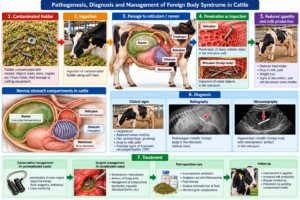
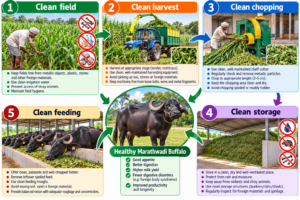
| Prevention cycle: Clean field → clean harvest → clean chopping → clean storage → clean feeding → healthy buffalo. |
Demonstrating Foreign body in Radiography
Conclusion
Foreign body syndrome in buffaloes is a serious but largely preventable condition. In Marathwada, where Marathwadi buffaloes are commonly maintained under grazing and stall-feeding systems and crop residues are important feed resources, prevention must begin with clean fodder and safe feeding environments.
Farmers should recognize the early combination of reduced appetite, reduced milk yield and abdominal pain. Appropriate veterinary examination, imaging and timely treatment can improve recovery. However, the most economical approach is prevention: remove plastic and metal waste from fields, fodder, feeding areas and grazing sites before buffaloes have the opportunity to swallow it.
“Clean fodder today can save a buffalo tomorrow.”
References
- Department of Animal Husbandry & Dairying, Government of India. Standard Veterinary Treatment Guidelines for Livestock and Poultry.
- Dhama, K. et al. (2021). Traumatic reticuloperitonitis in cattle and buffalo: Recent advances in understanding of etiopathogenesis, diagnosis and treatment. Indian Journal of Animal Sciences, 91(11).
- Bainwad, D.V., Deshmukh, B.R., Thombre, B.M. and Chauhan, D.S. Feeding and management practices adopted by buffalo farmers under watershed area. Indian Journal of Agricultural Research.
- Shitole, D.P., Deshmukh, B.R., Kashid, U.B. and Chavan, R.R. Studies on management practices of buffaloes in Parbhani district. Indian Journal of Animal Research.
- Central Institute for Research on Buffaloes. Marathawadi buffalo breed profile.
- Mahadappa, P. et al. (2020). Effect of plastic foreign body impaction on rumen function and heavy metal concentrations in various body fluids and tissues of buffaloes. Ecotoxicology and Environmental Safety.















