

MILK FEVER IN DAIRY CATTLE
Early Recognition, Emergency Management and Prevention for Farmers
Dr. Supreetkumar Sagar, M.V.Sc., NET, PGDAW1 and Dr. Sanjeev S. Pitlawar, M.V.Sc., PhD, PGDAW2
1: Veterinary Surgeon (Gold medalist), ALUMNUS,College of Veterinary and Animal Sciences, Udgir, Maharashtra Animal & Fishery Sciences University, Nagpur
2: Associate Professor and Sectional Head, Department of Veterinary Surgery and Radiology, College of Veterinary and Animal Sciences, Udgir, Maharashtra Animal & Fishery Sciences University, Nagpur
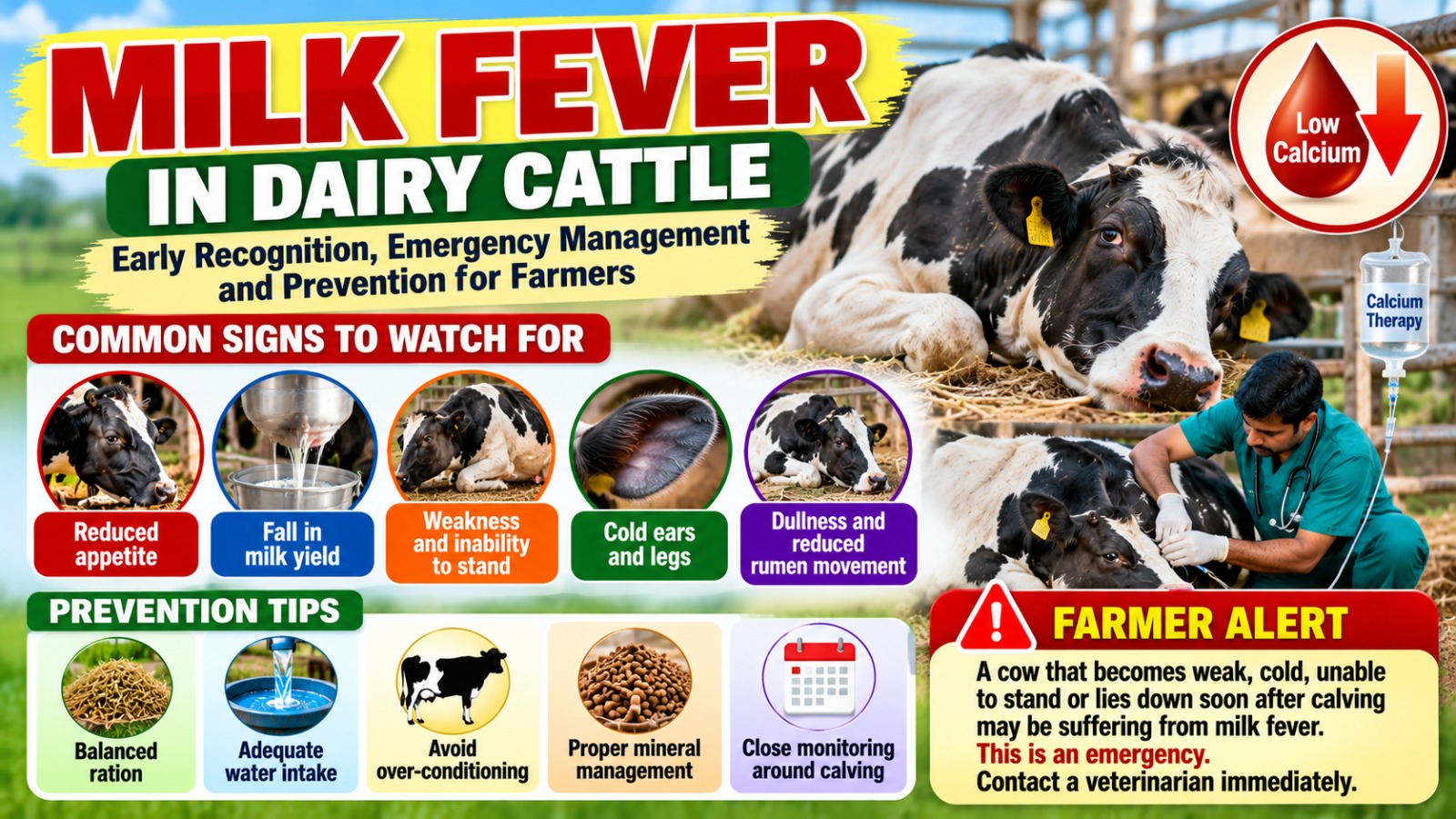
| FARMER ALERT A cow that becomes weak, cold, unable to stand or lies down soon after calving may be suffering from milk fever. This is an emergency. Do not wait for the cow to recover on her own. |
Why should every dairy farmer know about milk fever?
Milk fever, also called hypocalcaemia or parturient paresis, is an important metabolic disorder around calving. It develops when the cow cannot maintain enough calcium in the blood as the demand for calcium suddenly increases for colostrum and milk production. Severe cases can rapidly progress from weakness to recumbency and unconsciousness. Subclinical hypocalcaemia may occur without obvious collapse and can still affect health and production.
| SIMPLE FARMER MESSAGE Around calving, a cow that becomes weak, develops cold ears or legs, and has difficulty standing should be examined immediately for milk fever. |
What causes milk fever?
Before calving, calcium demand is relatively low. Immediately after calving, large amounts of calcium are required for colostrum and milk. The cow must rapidly increase calcium absorption from the intestine, mobilize calcium from bone and conserve calcium through the kidneys. If these adaptations are too slow, blood calcium falls and hypocalcaemia develops.
| IN SIMPLE WORDS Calcium demand suddenly increases after calving, but the cow’s body cannot supply calcium quickly enough. |
Which cows are at greater risk?
- Older cows, particularly cows in later lactations.
- High-producing dairy cows.
- Cows around calving and during the first few days after calving.
- Cows with a previous history of milk fever.
- Over-conditioned cows at calving.
- Cows receiving poorly balanced dry-period or transition rations.
- Cows with inadequate magnesium intake or other mineral imbalances.
- Animals with postpartum disease or poor feed intake.
The milk-fever watch period
Farmers should observe high-risk cows especially closely from the week before calving through the first few days after calving.
| HIGH-ALERT PERIOD 7 days before calving → Day of calving → First 24 hours → First 3 days after calving |
Recognizing the three stages of milk fever
| Stage | What the farmer may notice |
| Stage 1 | Restlessness, excitement, muscle tremors, hypersensitivity, reduced appetite, reluctance to move or early weakness. |
| Stage 2 | Cow becomes weak and recumbent, usually on the chest; head may turn toward the flank; ears and extremities become cold; rumen movement decreases. |
| Stage 3 | Severe weakness, lateral recumbency, poor response or unconsciousness; the cow cannot rise and requires urgent treatment. |
| IMPORTANT Do not wait until Stage 3. Early recognition and treatment improve the chance of a rapid recovery. |
|
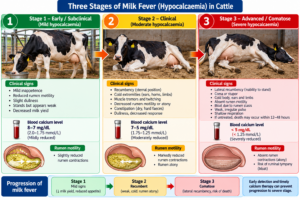
Three-stage illustration of milk fever
Early warning signs farmers should watch for
- Reduced appetite after calving.
- Weakness or unsteady walking.
- Difficulty getting up.
- Cold ears and extremities.
- Reduced cud chewing and rumen movement.
- Dullness and poor response to surroundings.
- Head turned toward the flank in a recumbent cow.
- Progression from sternal to lateral recumbency.
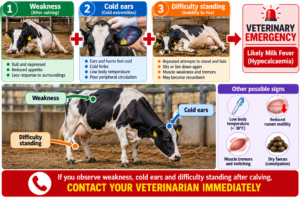
Weakness + cold ears + difficulty standing after calving = veterinary emergency
| FARMER RULE Recently calved + weak + cold ears/legs + difficulty standing = suspect milk fever and call the veterinarian. |
What should the farmer do immediately?
1. Call the veterinarian
Clinical milk fever is an emergency. Veterinary assistance should be obtained as soon as possible.
2. Keep the cow safely positioned
- Keep the cow on a soft, dry, non-slippery surface.
- Prefer sternal recumbency rather than prolonged lateral recumbency.
- Protect the cow from cold, rain and direct heat stress.
- Prevent slipping and traumatic injury during attempts to stand.
- If prolonged recumbency occurs, provide careful nursing and repositioning.
3. Do not force-feed or force-drink
A severely weak or recumbent cow may not swallow normally. Pouring water, calcium liquid or feed into the mouth can cause aspiration. Oral products should only be given when the cow is alert and swallowing safely.
Treatment of milk fever
| VETERINARY EMERGENCY Clinical milk fever is commonly treated with calcium preparations. Intravenous calcium must be administered slowly by a trained veterinary professional because rapid administration can cause dangerous cardiac disturbances. |
The Government of India’s Standard Veterinary Treatment Guidelines describe slow intravenous calcium borogluconate therapy for large animals, with the amount selected according to the preparation, animal and clinical severity. Heart rate and rhythm should be monitored during intravenous administration. Calcium-magnesium-containing preparations may be appropriate in selected cases.
A cow that responds typically becomes brighter, regains muscle strength and may attempt to rise. However, not every down cow has milk fever. Trauma, calving injury, hypomagnesaemia, hypophosphataemia, severe mastitis, toxic disease and other disorders must be considered when response is poor.
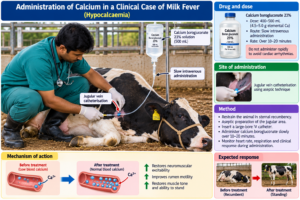
Veterinarian administering calcium to a clinical case
What about oral calcium?
Oral calcium supplements can be useful for selected high-risk cows around calving and as part of a planned prevention or follow-up programme. They should not replace emergency veterinary treatment in a severely affected recumbent cow.
| SAFETY WARNING Never give an oral calcium bolus or drench to a cow that cannot swallow properly. |
Prevention starts before calving
The most important extension message is that milk fever prevention begins during the dry and close-up periods, not after the cow becomes recumbent.
- Provide a balanced dry-period and transition ration.
- Avoid excessive body condition at calving.
- Maintain adequate magnesium intake because magnesium is important for normal calcium regulation.
- Avoid indiscriminate mineral supplementation without considering the complete ration.
- Maintain good-quality roughage, palatable feed and unrestricted clean water.
- Reduce overcrowding and stress around calving.
- Identify cows with previous milk fever and monitor them more closely.
- Use planned calcium supplementation or other preventive strategies under veterinary/nutritional guidance when indicated.
Role of DCAD in prevention
On organized dairy farms, a properly formulated negative dietary cation-anion difference (DCAD) ration during the close-up dry period can improve the cow’s calcium response around calving. Anionic programmes require ration formulation and monitoring; they should not be implemented by randomly adding anionic salts.
| FARMER MESSAGE Do not start anionic salts simply because a product is available. Ask a veterinarian or dairy nutritionist to formulate and monitor the ration. |
Milk fever versus normal post-calving recovery
| Farmer observation | Normal recovery | Possible milk fever |
| Standing | Stands normally | Weak, unsteady or cannot stand |
| Appetite | Begins eating | Reduced or absent |
| Ears/legs | Normally warm | Often cool or cold |
| Behaviour | Alert | Dull or weak |
| Cud/rumen | Active | Reduced |
| Head position | Normal | May turn toward flank when recumbent |
| Progress | Gradual improvement | Progressive weakness |
Why milk fever affects farm profitability
Hypocalcaemia affects muscle and physiological function and is associated with greater risk of other postpartum disorders. Clinical or subclinical hypocalcaemia can therefore increase treatment costs, reduce productivity and interfere with smooth transition into lactation.
- Retained fetal membranes and uterine problems.
- Displaced abomasum and reduced feed intake.
- Ketosis and other transition disorders.
- Mastitis risk and reduced productivity.
- Poorer reproductive and economic performance.
Farmer’s 24-hour milk fever watch
| Daily check | Record |
| Is the cow standing normally? | Yes / No |
| Is she eating? | Normal / Reduced |
| Is she drinking? | Yes / No |
| Is she chewing cud? | Yes / No |
| Are ears and legs reasonably warm? | Yes / No |
| Is rumen activity present? | Yes / No |
| Is she passing dung? | Yes / No |
| Is she alert and responsive? | Yes / No |
| Previous history of milk fever? | Yes / No |
What farmers should NOT do
- Do not wait for a severely weak or down cow to recover naturally.
- Do not inject calcium rapidly into a vein.
- Do not attempt intravenous calcium without veterinary training.
- Do not pour oral calcium or water into an unconscious or poorly swallowing cow.
- Do not force-feed a severely recumbent animal.
- Do not assume every down cow has milk fever.
- Do not ignore trauma, calving injury, hypomagnesaemia, hypophosphataemia or severe infectious disease as alternative causes.
5 Golden Rules for Preventing Milk Fever
| PASHUDHAN PRAHAREE FARMER MESSAGE 1. Manage the cow before calving—not after she falls down. 2. Avoid excessively fat cows at calving. 3. Provide a properly balanced transition ration. 4. Observe every cow closely during the first few days after calving. 5. Weak or recumbent cows need veterinary attention immediately. |
Village-level extension strategy
- Teach farmers to identify the early signs of hypocalcaemia using pictures or live demonstrations.
- Mark cows with a previous history of milk fever as high-risk animals.
- Promote a fresh-cow register recording calving date, appetite, standing ability and postpartum disease.
- Demonstrate correct sternal positioning and nursing of a recumbent cow.
- Discuss transition-ration management during farmer meetings rather than focusing only on emergency calcium treatment.
- Encourage herd-level investigation when repeated milk fever occurs.
Conclusion
Milk fever is an emergency but largely preventable metabolic disorder of dairy cattle. Early recognition of weakness, cold extremities, reduced appetite and difficulty standing can save the animal. Prevention depends on balanced transition nutrition, appropriate body condition, sound mineral and magnesium management, good cow comfort and close observation around calving. The most useful farmer message is simple: do not wait for the cow to fall down—prevent before calving and act immediately when early signs appear.
References
- Department of Animal Husbandry and Dairying. (2024). Standard veterinary treatment guidelines for livestock and poultry. Ministry of Fisheries, Animal Husbandry and Dairying, Government of India.
- DeGaris, P. J., & Lean, I. J. (2008). Milk fever in dairy cows: A review of pathophysiology and control principles. The Veterinary Journal, 176(1), 58–69.
- Goff, J. P. (2008). The monitoring, prevention, and treatment of milk fever and subclinical hypocalcemia in dairy cows. The Veterinary Journal, 176(1), 50–57. https://doi.org/10.1016/j.tvjl.2007.12.020
- Goff, J. P. (2014). Calcium and magnesium disorders. Veterinary Clinics of North America: Food Animal Practice, 30(2), 359–381.
- National Academies of Sciences, Engineering, and Medicine. (2021). Nutrient requirements of dairy cattle (8th rev. ed.). The National Academies Press. https://doi.org/10.17226/25806
- Reinhardt, T. A., Lippolis, J. D., McCluskey, B. J., Goff, J. P., & Horst, R. L. (2011). Prevalence of subclinical hypocalcemia in dairy herds. The Veterinary Journal, 188(1), 122–124.
- Wilkens, M. R., Nelson, C. D., Hernandez, L. L., & McArt, J. A. A. (2020). Symposium review: Transition cow calcium homeostasis—Health effects of hypocalcemia and strategies for prevention. Journal of Dairy Science, 103(3), 2909–2927.