

BUILDING HEALTHIER FUTURES: HOW BETTER ANIMAL WELFARE PREVENTS ZOONOTIC DISEASES
Sanjiv Kumar*, Ankita Srivastwa, Neha Kumari, Kushagara Anand, Saurabh Kr. Patel
Department of Veterinary Pathology, Bihar Veterinary College, BASU, Patna-14.
More than 200 known diseases can jump from animals to people, and they account for a large share of new and existing human infections from long familiar rabies to novel threats like SARS CoV 2 and avian influenza. Because every spill over begins with an animal, the first line of defence is the way we house, handle and trade those animals. “Animal welfare” is often framed as an ethical obligation, but mounting evidence shows it is also a pragmatic public health strategy: stressed, overcrowded, immuno suppressed or poorly managed animals are ideal incubators for pathogens that can spill into human populations.
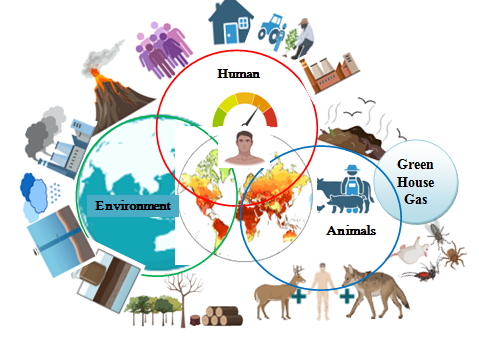
International agencies now embrace One Health, the recognition that human, animal and environmental health form a single web as the organising principle for pandemic prevention. The new WHO Pandemic Agreement adopted in May 2025 explicitly embeds One Health and, for the first time, makes animal welfare improvements a legally binding obligation for signatories. Good welfare is no longer a boutique concern; it is public health infrastructure.
Decades of intensive farming have led to the mass production of low-cost animal protein, alongside the concentration of large populations of genetically uniform animals. . High stocking densities accelerate pathogen replication, while breeding for rapid growth can weaken immune responses. Add the routine use of sub therapeutic antibiotics to compensate for these stresses and you manufacture both novel pathogens and drug resistant strains. Pathogens that move easily among animals do not respect the boundary of the farm fence; workers, ventilation systems, feed trucks and migratory wildlife completes the bridge to humans.
The 2022 23 H5N1 season in Europe drove home the cost of poor welfare and lax bio security. In England, a temporary national poultry housing order, essentially enforced indoor confinement plus heightened hygiene, reduced new farm infections within three weeks, with the greatest effect in the regions that had the highest bird density. The lesson is straightforward: lower densities, better shed design and rigorous sanitation reduce viral load in birds and therefore exposure risk for workers and surrounding communities.
SUGGESTIONS FOR WELFARE IMPROVEMENTS OF:
Poultry farms:
-
- Stocking density limits and enriched environments.Studies show that layer hens given more space, perches and foraging substrate have stronger plumage, less feather pecking and lower stress hormone levels, all factors that impede Salmonella and other enteric infections.
- Dry, vermin proof ranges for free range flocks.Simple landscaping, short grass, drainage, perimeter fencing, cuts the presence of wild birds and rodents that can carry influenza or Salmonella into shed.
- Humane on farm slaughter protocols.In smallholder settings, a low cost “contained slaughter” system has been shown to slash airborne H5N1 particles during home processing, protecting both women (who do most household slaughter) and their children.
Pigs Farms:
Globally, 70 % of all antibiotics is fed to livestock; pigs receive a disproportionate share. Better ventilation, enrichment (e.g., straw) and lower stocking densities on breeder–finisher farms in England were associated with dramatic drops in antibiotic use, without harming profitability. Welfare improvements thus serve as an upstream intervention against antimicrobial resistance, itself a zoonotic threat.
Companion Animals:
Rabies kills an estimated 59,000 people every year, yet it is 100 % preventable. In India, Tamil Nadu’s health ministry credits a massive expansion of post bite prophylaxis and dog vaccination for keeping cases “largely under control,” even as dog bites remain common. Maharashtra is rolling out a coordinated sterilisation and vaccination drive across city corporations to curb both stray dog populations and bite incidents. Humane dog population management—sterilisation, vaccination, sheltering rather than culling—improves animal welfare and eliminates the virus reservoir in a single stroke.
Wildlife:
The SARS CoV 2 origin debate and recurrent Ebola outbreaks underscore the danger of poorly regulated wildlife trade. A 2024 Memorandum of Understanding between CITES and the World Organisation for Animal Health aims to make wild animal trade “safe, traceable and legal” and to embed pathogen risk screening into every permit process. Illicit online markets remain a problem: a 2024 investigation found hundreds of protected species advertised on social media in just three months, bypassing any health or welfare oversight. Reducing stress, injury and crowding in supply chains or better, curtailing the trade outright lowers both animal suffering and the probability of viral adaptation to humans.
BARRIERS AND WAYS TO OVERCOME THEM:
Cross sector data sharing remains patchy and animal health budgets lag far behind human health spending. Farmers worry about increased expenses, while wildlife traders take advantage of gaps in regulations. Yet success stories offer blueprints: England’s housing order impact shows fast returns; Tamil Nadu’s rabies control demonstrates that proactive vaccination beats reactive culling; and CITES–WOAH co operation proves that trade rules can be rewritten around health criteria. Aligning subsidies, insurance and certification schemes with welfare standards would further tip the economic balance toward prevention. Here are few recommendations:
- Adopt science based stocking density and enrichment standardsfor all intensive farms; link compliance to market access.
- Phase out routine, prophylactic antibioticsand tie veterinary prescriptions to improved housing, ventilation and welfare audits.
- Invest in humane stray dog management—mass vaccination, sterilisation, community education—before outbreaks occur.
- Embed pathogen risk screening and welfare criteriainto every wildlife trade licence and strengthen cyber patrols of online markets.
- Protect and restore habitatsthat buffer wildlife from human settlements; use land use planning as a disease prevention tool.
- One Health surveillance networksthat integrate veterinary, environmental and clinical data, enabling early warning and rapid response.
Corporations can source higher welfare ingredients, reducing supplier densities and antibiotic use. Investors can adopt “pandemic safe” environmental, social and governance (ESG) metrics that penalise poor welfare. NGOs can watchdog online wildlife markets and campaign for stronger enforcement.
CONCLUSION:
The core insight of One Health is disarmingly simple: if animals stay healthy and unstressed, humans stay safer. From factory barns to city streets to remote forests, welfare interventions ample space, clean water, pain free handling, habitat integrity—block pathogen pathways long before viruses and bacteria reach hospital doors. As the world tries to avoid the next COVID scale catastrophe, elevating animal welfare from ethical afterthought to cornerstone of public health policy is not just compassionate; it is indispensable.
REFERENCES:
- World Health Organization (WHO). (2022). Taking a multisectoral, One Health approach: A tripartite guide to addressing zoonotic diseases in countries.
- Jones, K. E., et al. (2008). Global trends in emerging infectious diseases. Nature, 451(7181), 990–993.
- Fraser, D. (2008). Understanding animal welfare: The science in its cultural context. Wiley-Blackwell.
- Greger, M. (2007). The human/animal interface: Emergence and resurgence of zoonotic infectious diseases. Critical Reviews in Microbiology, 33(4), 243–299.
- Compston, P. C., et al. (2021). The association between farm management practices and antimicrobial usage in pig farms. Veterinary Record, 189(9), e646.
- Mulchandani, R., et al. (2023). Impact of antimicrobial stewardship interventions on antibiotic use in pigs. Journal of Antimicrobial Chemotherapy, 78(2), 367–375.
- Taylor, L. H., et al. (2017). Eliminating canine rabies: The role of public–private partnerships. Antiviral Research, 138, 67–73.
- Karesh, W. B., et al. (2005). Wildlife trade and global disease emergence. Emerging Infectious Diseases, 11(7), 1000–1002.
*Professor & Head, Department of Veterinary Pathology,
Bihar Veterinary College, BASU, Patna-800014.
Mob.: 9939016422.
email: mrsanvet@rediffmail.com