

Common Hill Myna: India’s Talking Forest Bird and Its Veterinary Importance
Dr. Sakshi Patel
Assistant Professor, Department of Veterinary Pathology, Shourabh College of Veterinary Science, Kheda, RAJUVAS, Rajasthan
Introduction
The Common Hill Myna (Gracula religiosa), is one of India and Southeast Asia’s most fascinating birds, admired by birdwatchers, scientists, and bird lovers for its high intelligence and exceptional talent for imitating human speech. It is the state bird of both Chhattisgarh and Meghalaya, and in Chhattisgarh it is specifically represented by the Bastar subspecies, Gracula religiosa peninsularis.
Taxonomy
Order: Passeriformes; Family: Sturnidae; Subfamily: Sturninae; Genus: Gracula; Species: Gracula religiosa.
Distribution and habitat
They are found across India and Southeast Asia, including the Western Ghats, central India, and northeastern states, as well as parts of Nepal, Bhutan, Bangladesh, Myanmar, Thailand, and Indonesia. In Chhattisgarh, it mainly occurs in Bastar district and surrounding southern areas, while in Meghalaya it is found in districts such as East Khasi Hills and West Garo Hills.
These birds mainly inhabit tropical moist deciduous and semi-evergreen forests, where they remain high in the tree canopy. They are commonly observed in small, vocal groups feeding on fruits, berries, and nectar. Nesting takes place in natural tree cavities; often old woodpecker holes located about 20-25 meters above the ground. The breeding season usually extends from January to April. However, habitat destruction and illegal trapping have led to population declines in certain areas.
Physical Features and Anatomy
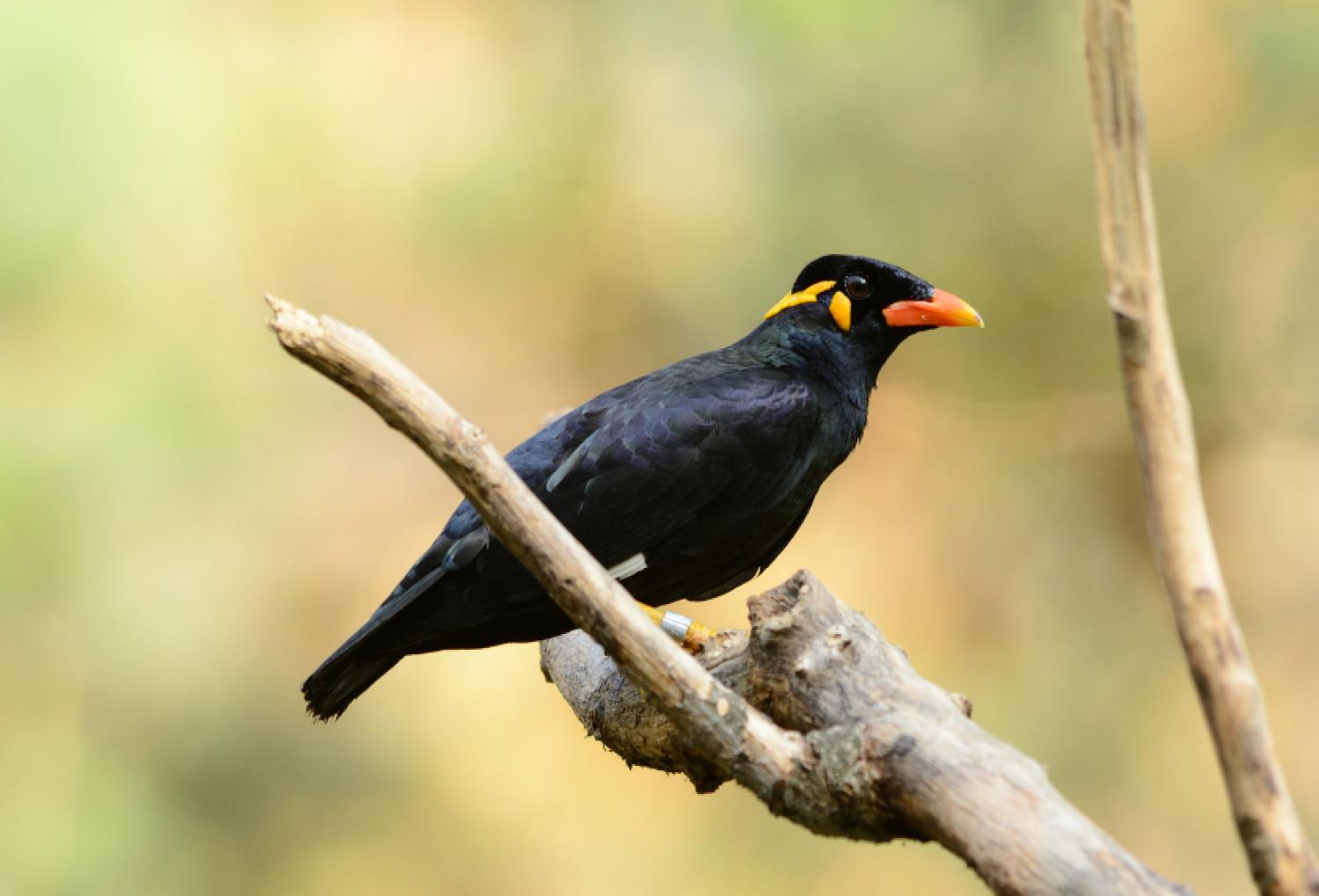
They are medium-sized birds measuring about 28-30 cm in length and weighing roughly 200-250 g. They have shiny greenish-black plumage, a bright orange-yellow beak, and striking yellow-orange fleshy wattles on the sides and back of the head, with a distinct white wing patch visible during flight.
They are well known for their intelligence and strong, clear voice, and is especially admired for its impressive ability to mimic human speech and other environmental sounds, which makes it easy to identify in forest habitats. Research indicates that this bird can adjust its vocalizations in response to particular sounds and visual signals. Young individuals show greater neural adaptability for learning new sounds, whereas older birds tend to retain and stabilize the calls they have already mastered. They are also capable of forming visual associations and linking them with learned vocalizations, demonstrating advanced cognitive abilities comparable in some ways to humans.
An interesting anatomical feature of them is that, like many members of the starling family, they lack a gallbladder, and bile flows directly from the liver into the intestine.
They are also well recognized in veterinary science for their susceptibility to iron storage disease (hemochromatosis), a condition in which excess iron accumulates in the liver and causes progressive damage. Because of this tendency, birds kept in captivity require a carefully planned low-iron (softbill) diet to maintain proper liver health.
Conservation Status
Even though they are listed globally as “Least Concern” by the International Union for Conservation of Nature, its numbers are decreasing in certain areas due to deforestation and illegal capture for the pet trade. In India, the species receives the highest level of legal protection under Schedule I (Part B) of the Wildlife Protection Act, 1972, which safeguards it against hunting and trade.
Diseases and Pathological Significance
From a veterinary perspective, they are susceptible to a wide range of diseases affecting multiple organs:
- Iron Storage Disease (Haemochromatosis)– Excessive absorption of dietary iron leads to excessive iron accumulation in liver causing liver damage, chronic inflammation, fibrosis, and in some cases neoplastic growths like multiple hepatic lipomas.
- Bacterial Infections– Systemic nocardiosis causes small nodular lesions in lungs, kidneys, and the digestive tract.
- Parasitic Diseases – Atoxoplasmosis (Isospora infection) mainly affects young birds, spreading to the liver and spleen. Sarcocystis kirmseican infect the brain, causing neurological signs.
- Viral Diseases– Avian pox produces wart-like skin growths.
- Cardiac Disorders– In captive birds, mitral regurgitation and congestive heart failure have been reported.
These findings indicate that they are vulnerable to a wide spectrum of systemic diseases, making them important subjects for veterinary study.
Poultry Health and Biosecurity
It is reported that wild hill mynas can carry important poultry pathogens, including the virus responsible for velogenic viscerotropic Newcastle disease. If these wild birds come into contact with domestic poultry, there is a risk of disease transmission to farm flocks, which can lead to serious health issues and economic losses. To reduce this risk, poultry farmers should prevent wild birds from entering poultry sheds, keep feed and water covered, and follow strict biosecurity practices.
Conclusion
The common hill myna is not only a striking and intelligent forest bird but also an important species for both wildlife conservation and veterinary science. Its remarkable ability to mimic human speech and form visual-vocal associations makes it unique among birds. Understanding its biology, habitat, and susceptibility to diseases helps veterinarians manage captive populations, informs farmers about potential poultry health risks, and highlights the need for biosecurity. Protecting them ensures the preservation of forest ecosystems, supports biodiversity, and strengthens the connection between wild and domestic animals, benefiting nature, science, and society alike.