


Effect of Climate Change in Livestock Farming
Deepandita Barman*1and Arunoday Das2,
*1Assistant Professor, Department of Livestock Production and Management, LCVSc, Assam Agricultural University, Joyhing, N Lakhimpur-787051, *Corresponding Author
2Assistant Professor, Department of ARGO, LCVSc, AAU, Joyhing, N Lakhimpur-787051
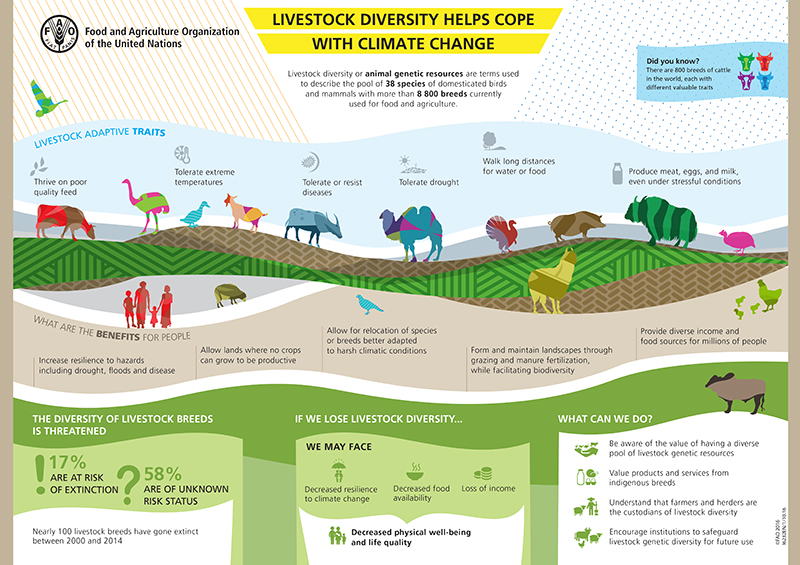
Climate change is a threat to livestock production because of the impact on quantity of feed crop and forage, water availability, livestock production efficiency, animal -reproduction, livestock diseases and biodiversity. Livestock production will be limited by climate variability as animal water consumption is expected to increase, demand for agricultural lands increase due to need for 70% growth in production.
The livestock sector contributes 14.5% of green house gas (GHG) emissions, driving further climate change. Hence, the livestock sector will be a key player in the mitigation of GHG emissions and improving global food security. Therefore, there is a need for
- Adaptation and mitigation measures to the location and livestock production system
- Policies that support and facilitate the implementation of climate change adaptation and mitigation measures.
Increase in ambient temperature alter heat exchange between animal and environment and feed intake, growth, milk production, egg, wool production, reproduction and health are all affected potentially.
Animals in production are more vulnerable to heat stress and further rise in temperature due to climate change will have additive impact. If the physiological and behavioural responses are insufficient to maintain thermal balance the animal try to restrict the feed intake to reduce the internal heat load.
- Increase in enteric methane production under increase in air temperature will enhance the gross energy loss and will adversely affect the productivity
- The work done under NICRA at NDRI revealed that increase of more than 4ᵒC above normal in maximum temperature during summer and decrease of more than 3ᵒC below normal in minimum temperature during winter had adverse effect on milk production in crossbred cattle and buffaloes. The decline in milk yield varied from 10 to 30 % in first lactation and 5 to 20 % in second and third lactation.
- Expected increase in daily stress hours will also adversely affect livestock production. The average stress hours, i.e. hours above THI 72, during hot months of the year are likely to increase in frequency and has been adversely affecting the livestock production.
- Goat and sheep are more vulnerable to climatic extremes like heat waves as they are mostly reared under extensive and pastoralist system in India. Majority of cows and buffaloes in small holding livestock system are under semi-extensive system and thus will also be vulnerable.
The fertility in female and male animals is affected by climatic heat directly as well as indirectly through feed and fodder and proneness to diseases.
- The release of ACTH from anterior pituitary which stimulate the release of cortisol and glucocorticoids from adrenal cortex occurs during stress condition. The release of luteinizing hormone is also inhibited by glucocorticoids. The hyperprolactinemia as a result of thermal stress inhibits secretions of both FSH and LH at hypophyseal level.
- Conception rates in animals seem delicately balanced between both heat and cold. Abrupt environmental temperature changes above critical level reduce the conception rates.
- Stressful environmental temperature reduces the flow of blood to the uterine tract, damaging, or killing the developing embryos. Uterine blood flow is source of oxygen, water, nutrients and hormones for embryos.
- Zygotes are most vulnerable to heat stress in initial stages of cleavage.
- Silent heat and low conception rates during summer in buffaloes is a serious problem in northern India.
- In males also the semen quality and libido get affected by heat stress. The problem of low libido and poor quality of semen is one of the major constraints even under existing climatic conditions.
The increase in climate variability and extreme climatic events like drought, heat waves, and cyclones are likely to put additional stress on fragile zone in arid and semi-arid regions in India. The beneficial effects of higher levels of carbon dioxide on yields of C3 crops, like wheat, rice, oat, barley, may be offset with rise in temperature and changes in rainfall in arid and semi-arid regions.
- A decline in fodder quality may cause decrease in forage intake and elevated methane emissions by livestock and the need to replace forage with concentrate.
- The proportion of browse in rangelands may increase in future as a result of increased growth and competition of browse species due to increased carbon dioxide levels
- Higher temperatures increase lignin formation in plant tissues and thereby reduce the digestibility and rates of degradation of fodder and crop residues in the rumen of animals. This will lead to reduced nutrient availability for animals and ultimately to a reduction in livestock production.
- Shortage of feed and fodder to the tune of 40 % dry fodder, 36 % green fodder and 52 % concentrate on dry matter basis (DAHDF, 2014-15) and poor quality roughage, primarily crop residues, is already one of the major constraints in expression of full genetic potential in livestock production in India.
- Extreme climate episodes like draught and floods may affect form and structure of roots, change leaf growth rate and decrease total yield as well as, impact forage quantity and quality.