

Emerging Role of Tulsi (Ocimum sanctum) in Animal Health, Immunity and Nutrition
Sourav Barman1, Vibhor Agrawal2*, Ayushi Sathe3
1PhD Scholar, (Livestock Production Management), ICAR-National Dairy Research Institute – ERS, Kalyani-74125, India
2PhD Scholar, (Animal Nutrition), ICAR-National Dairy Research Institute – ERS, Kalyani -74125, India
3MV. Sc. Scholars, (Livestock Production Management), ICAR – National Dairy Research Institute – ERS, Kalyani-74125, India
*Corresponding author: vibhor819182@gmail.com
Abstract
Tulsi or holy basil (Ocimum sanctum) is an important medicinal plant of the family Lamiaceae, widely recognized in Ayurveda for its adaptogenic and therapeutic properties. It contains bioactive compounds such as alkaloids, flavonoids, tannins, glycosides, saponins, phenolics and essential oils, particularly eugenol, which contribute to its antioxidant, antimicrobial, anti-inflammatory, immunomodulatory, hepatoprotective and stress-modulating activities. In animal nutrition, Tulsi is gaining attention as a phytogenic feed additive due to its potential to support gut health, immunity, growth, stress tolerance, udder health and disease resistance. Studies in broilers, goats and dairy cattle suggest beneficial effects of Tulsi powder or extract on body weight gain, gastrointestinal parasite control, somatic cell count and milk quality. However, evidence remains limited by variation in dose, plant form, duration and species response. Further controlled trials are needed to standardize dosage, characterize active compounds and validate long-term safety. Overall, Tulsi may serve as a natural and sustainable supportive alternative to synthetic growth promoters in livestock and poultry production.
Keywords: Tulsi, Ocimum sanctum, phytogenic feed additive, livestock, immunity, animal nutrition, sustainability
- Introduction
Tulsi (Ocimum sanctum), commonly known as holy basil, is a sacred medicinal plant native to the Indian subcontinent and widely cultivated in tropical climates. Belonging to the family Lamiaceae, it is valued in Ayurveda as an adaptogenic herb that helps maintain physiological balance during stress. Its leaves, seeds and roots have traditionally been used for medicinal purposes, earning Tulsi the name “Queen of herbs” (Kumari et al., 2017).
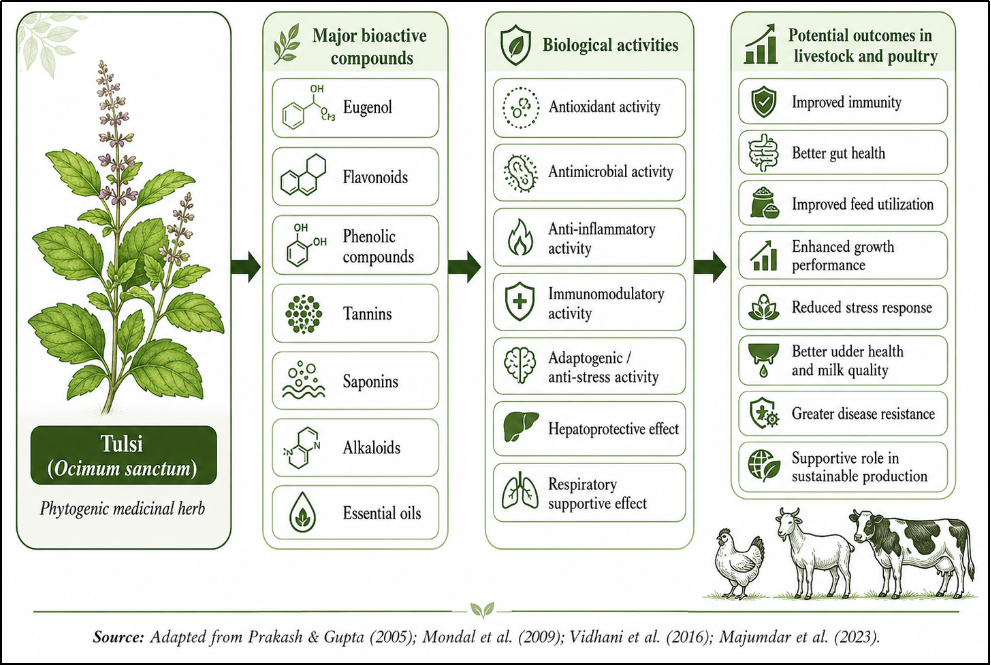
Tulsi also holds cultural and religious importance in India, where its sacred and medicinal role has been described in ancient literature and Ayurvedic texts such as the Charaka Samhita (Gupta et al., 2002; Shing et al., 2010; Kuhn et al., 2007). From a veterinary and animal nutrition perspective, however, its main relevance lies in its phytochemical profile and biological activities.Morphologically, Tulsi is a small aromatic shrub, generally 30–60 cm tall, with short branches, fragrant leaves, purple flowers and small yellowish seeds. Taxonomically, it belongs to Kingdom Plantae, Division Magnoliophyta, Class Magnoliopsida, Order Lamiales, Family Lamiaceae, Genus Ocimum and Species O. sanctum. The botanical and functional overview of Tulsi, including its major bioactive compounds and relevance to animal health, is presented in Figure 1.
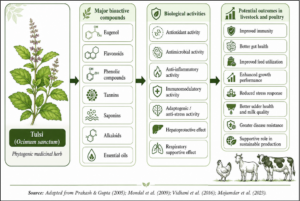
Figure 1. Bioactive compounds of Tulsi and their potential roles in animal health.
2. Phytochemical and Functional Composition
The biological activity of Tulsi is mainly attributed to its diverse phytochemical profile, including tannins, alkaloids, glycosides, saponins, flavonoids and volatile oils. Dried Tulsi leaves contain important constituents such as β-caryophyllene, β-elemene, caryophyllene oxide and eugenol. Eugenol, chemically known as 1-hydroxy-2-methoxy-4-allyl benzene, is one of the major active compounds and is associated with antibacterial, antifungal, antispasmodic, hepatoprotective, cardioprotective, antioxidant, antiemetic, analgesic and antistress properties (Prakash and Gupta, 2005). Tulsi has also been reported to possess anti-infertility, anticancer, antidiabetic, antimicrobial and anti-ulcerogenic activities (Mondal et al., 2009). Nutritionally, Tulsi provides several functional components. Vidhani et al. (2016) reported that Tulsi contains total protein 20.64 ± 1.47%, total fat 3.60 ± 0.08%, total carbohydrate 39.58 ± 2.09%, reducing sugar 3.58 ± 0.14%, total phenolics 1.88 ± 0.09 mg/g, ascorbic acid 65.41 ± 0.76 mg/100 g and total flavonoids 28.38 ± 0.58. These constituents may contribute to its antioxidant, immune-supportive and health-promoting effects.
- Traditional and Pharmacological Relevance
In traditional medicine, Tulsi has been used for cough, asthma, indigestion, flatulence, fever, skin problems and general wellness. It is also regarded as an appetite stimulant, digestant, respiratory support agent and stress-relieving herb. In modern biomedical research, Tulsi is being investigated for anti-stress, antioxidant, anti-inflammatory, immunomodulatory, gastroprotective, neuroprotective and cytoprotective effects. It has also been studied in relation to peptic ulcer, diabetes, hypercholesterolemia, obesity and immune support (Majumdar et al., 2023). Chandrasekaran et al. (2013) reported that Tulsi consumption did not produce genotoxic or organ-toxic effects, supporting its safety when used appropriately. A concise comparison of traditional and modern scientific relevance is presented in Table 2.
Table 2. Traditional and modern relevance of Tulsi.
| Aspect | Traditional use | Modern scientific relevance |
| Stress | Adaptogen and calming herb | Anti-stress and neuroprotective activity |
| Digestion | Appetite stimulant and digestant | Gastroprotective and anti-ulcer potential |
| Respiration | Used for cough, cold and asthma | Respiratory support through volatile oils |
| Immunity | General health tonic | Immunomodulatory and antimicrobial effects |
| Metabolism | Wellness-supporting herb | Studied for diabetes, obesity and hypercholesterolemia |
- Role in Animal Nutrition and Health
Interest in Tulsi as a natural feed additive has increased because of restrictions on antibiotic growth promoters and the growing demand for sustainable livestock production. Tulsi may act as a phytogenic additive due to its antimicrobial, antioxidant, immunomodulatory and adaptogenic properties. These effects may help improve feed intake, digestion, nutrient utilization, immune response and resistance against environmental and infectious stress. Tulsi is traditionally considered an immunity-supporting herb. Mondal et al. (2009) reported that O. sanctum enhanced anti-sheep red blood cell haemagglutination titre and IgE antibody titre in rats, indicating immunomodulatory activity. Such effects are relevant in livestock and poultry because immune suppression, pathogen exposure and stress can reduce productivity.
Tulsi may also have antipyretic, analgesic, respiratory-supportive and hepatoprotective effects. Bioactive compounds such as camphene, cineole and eugenol are associated with respiratory support and may help in conditions involving cough, cold, asthma-like symptoms and influenza-related respiratory stress (Majumdar et al., 2023). Ethanolic leaf extract has also been associated with liver-protective activity.
Evidence from Livestock and Poultry Studies
`Available studies indicate that Tulsi supplementation may improve growth, health and disease resistance in livestock and poultry. In broilers, Tulsi leaf powder at 2.5–7.5 g/kg diet for 42 days improved growth, with the highest response at 7.5 g/kg (Barman et al., 2025). Similarly, Tulsi leaf extract at 2 ml/L drinking water and Tulsi powder at 5 g/kg feed increased body weight gain in broilers (Alom et al., 2015; Bhoosale et al., 2015). In goats, neem (Azadirachta indica) and Tulsi extracts at 5–30 mg/ml showed anthelmintic potential against gastrointestinal parasites (Jaiswa et al., 2025). In dairy cattle, O. sanctum leaf powder at 600 mg/kg BW reduced somatic cell count and ceruloplasmin concentration, suggesting reduced udder inflammation and improved milk quality (Shafi et al., 2016). These findings support the potential use of Tulsi in growth promotion, parasite control, udder health and immune support, although further controlled studies are required.
Table 3. Evidence of Tulsi supplementation in livestock and poultry.
| Species | Tulsi form and dose | Major response | Reference |
| Broiler chicken | Leaf powder, 2.5–7.5 g/kg feed | Highest growth response at 7.5 g/kg | Barman et al., 2025 |
| Broiler chicken | Leaf extract, 2 ml/L drinking water | Increased body weight | Alom et al., 2015 |
| Broiler chicken | Tulsi powder, 5 g/kg feed | Higher body weight gain | Bhoosale et al., 2015 |
| Goat | Neem + Tulsi extract, 5–30 mg/ml | Anthelmintic potential | Jaiswa et al., 2025 |
| Dairy cattle | Leaf powder, 600 mg/kg BW | Reduced SCC and ceruloplasmin | Shafi et al., 2016 |
Conclusion
Tulsi (Ocimum sanctum) is a biologically active medicinal plant containing eugenol, flavonoids, phenolics, essential oils and other functional compounds. These constituents support its antioxidant, antimicrobial, anti-inflammatory, immunomodulatory, hepatoprotective and adaptogenic activities. In animal nutrition, Tulsi shows potential as a phytogenic feed additive for improving growth performance, immunity, stress tolerance, udder health and disease resistance. Evidence from broilers, goats and dairy cattle is promising, but wider application requires dose standardization, species-specific validation, active compound profiling and long-term safety assessment. With proper scientific validation, Tulsi may serve as a sustainable and eco-friendly supportive alternative to synthetic growth promoters and antibiotic-based interventions in livestock and poultry production.
Reference
Barman, S., Savino, N., Vidyarthi, V.K., Jha, K.K., Kumar, L., Porel, S. and Kanakaraja, M.G. (2025). Performance of broiler chickens fed a diet supplemented with Tulsi (Ocimum sanctum) powder at Nagaland, India. Journal of Scientific Research and Reports. 31 (12): 1169-1179.
Chandrasekaran, C.V., Srikanth, H.S., Anand, M.S., Allan, J.J., Viji, M.H. and Amit, A. (2013). Evaluation of the mutagenic potential and acute oral toxicity of standardized extract of Ocimum sanctum (OciBest™). Human & Experimental Toxicology. 32 (9): 992-1004.
Gupta, S.K., Prakash, J. and Srivastava, S. (2002). Validation of traditional claim of Tulsi, Ocimum sanctum Linn. as a medicinal plant. Indian Journal of Experimental Biology. 40 (7): 765-773.
Jaiswa, K. and Mishra, S. (2025). Comparative efficacy of ethanolic extracts of neem and tulsi leaves against gastrointestinal parasites of goat. Journal of Experimental Zoology India. 28 (1): details required.
Kuhn, A.B., Merrily, B. and Winston, D. (2007). Winston and Kuhn’s herbal therapy and supplements: A scientific and traditional approach. Lippincott Williams and Wilkins. p. 260.
Majumdar, A., Thakkar, B., Saxena, S., Dwivedi, and Tripathi, V. (2023). Tulsi (Ocimum sanctum): Health benefits and nutritional wonders. Acta Scientific Nutritional Health. 7 (9): 16-23.
Mathur, P., Rani, L., Ritu, J., Jain, Y. and Sharma, K. (2025). Botanical description and phytopharmacological profile. Innovation & Advances in Risk Assessment, Volume 1: Proceedings of HSFEAS 2023. 1: 35.
Mondal, S., Mirdha, B.R. and Mahapatra, S.C. (2009). The science behind sacredness of Tulsi (Ocimum sanctum Linn.). Indian Journal of Physiology and Pharmacology. 53 (4): 291-306.
Patel, K., Pandey, R., Aslam and Verma, D. (2021). Effect of different treatments of Tulsi leaves decoction as pre-milking udder wash of cows on bacteriological quality of raw milk. Journal details required. Volume details required: page details required.
Prakash, P. and Gupta, N. (2005). Therapeutic uses of Ocimum sanctum Linn. (Tulsi) with a note on eugenol and its pharmacological action: A short review. Indian Journal of Physiology and Pharmacology. 49 (2): 125-131.
Shafi, T.A., Bansal, B.K., Gupta, D.K. and Nayyar, S. (2016). Evaluation of immunotherapeutic potential of Ocimum sanctum in bovine subclinical mastitis. Turkish Journal of Veterinary and Animal Sciences. 40 (3): 352-358.
Singh, V., Amdekar, S. and Verma, O. (2010). Ocimum sanctum (Tulsi): Bio-pharmacological activities. Webmed Central Pharmacology. 1 (10): 1046.
Subramanian, M., Chintalwar, G.J. and Chattopadhyay, S. (2005). Antioxidant and radioprotective properties of an Ocimum sanctum polysaccharide. Redox Report. 10 (5): 257-264.
Vidhani, S.I., Vyas, V.G., Parmar, H.J., Bhalani, V.M., Hassan, M.M., Gaber, A. and Golakiya, B.A. (2016). Evaluation of some chemical composition, minerals fatty acid profiles, antioxidant and antimicrobial activities of Tulsi (Ocimum sanctum) from India. American Journal of Food Science and Technology. 4 (2): 52-57.